


CityTour AI

Hamburg self-guided walking tour

Hanseatic Grandeur and Warehouse Wonders

Explore the heart of Hamburg on a journey that bridges the gap between industrial history and modern elegance. You will wander through the red-brick canyons of the UNESCO-listed Speicherstadt before emerging into the grand squares and canals of the Hanseatic Altstadt. This casual stroll is perfect for anyone wanting to see the city’s most iconic landmarks and hidden architectural gems through the eyes of a local.

Audio tourSelf-guidediOS & Android
100minutes
3.8 kmdistance
11stops
Audio guideFormat
Hanseatic Grandeur and Warehouse Wonders
Original: Dietmar Rabich (Derivative work: Flominator) / CC BY-SA 4.0

Stops on this route

This tour works well for first-time visitors, weekend trips, and travelers who want to explore Hamburg without a fixed tour time.

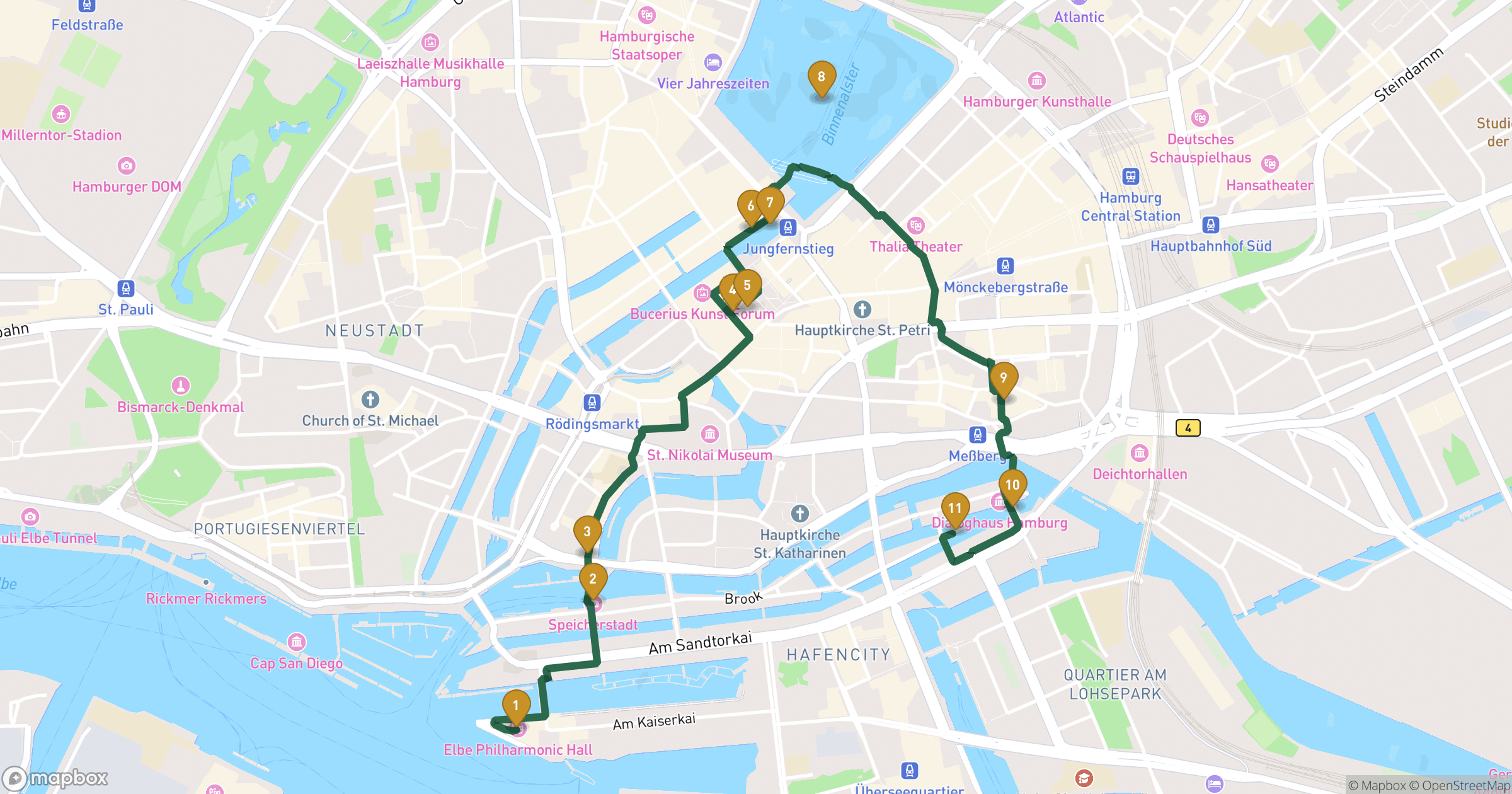
Route map for Hamburg walking tour

Map for Hamburg walking tour with 11 stops
The static map shows the tour route with Elbphilharmonie, Speicherstadt, Deichstraße, Hygieia-Brunnen, and 7 more stops.

Stops along the route

All stops on this self-guided tour at a glance.

  1. Elbphilharmonie in Hamburg
    Burkhard Mücke / CC BY-SA 4.0

    1ElbphilharmonieTheatre

    The Elbphilharmonie merges a 1960s cocoa and tobacco warehouse, Kaispeicher A, with a wave-like glass structure designed by Herzog & de Meuron. About 1,100 curved and chrome-dotted glass panels crown the brick base. An 82-meter curved escalator known as the Tube leads visitors directly up to the public Plaza viewing deck.

    Built: 1963 · Architect: Werner Kallmorgen, Herzog & de Meuron · Height: 110 m · Named after: Elbe · Wikidata

  2. Speicherstadt in Hamburg
    Thomas Wolf, www.foto-tw.de / CC BY-SA 3.0

    2SpeicherstadtAttraction

    Speicherstadt stands as an interconnected warehouse district planned by architect Franz Andreas Meyer between 1883 and 1927. The entire complex rests on thousands of oak piles driven into mud, requiring carefully managed canal water levels so the wood never dries out. Upper floors still feature exterior doors and pulleys once used to winch coffee sacks from barges.

    Built: 1927 · Architect: Carl Johann Christian Zimmermann · Wikidata

  3. Deichstraße in Hamburg
    Bernhard Diener / CC BY-SA 4.0

    3DeichstraßeSquare

    Deichstraße preserves narrow 17th- and 19th-century merchant homes that back directly onto the Nikolaifleet canal for boat deliveries. The Great Fire of Hamburg started here on May 5, 1842, inside Eduard Cohen's cigar factory at house number 42. A night watchman spotted the flames around 1:00 AM before the blaze spread to destroy a third of the city.

    Wikidata

  4. Hygieia-Brunnen in Hamburg
    Ichwarsnur / CC BY-SA 4.0

    4Hygieia-BrunnenMonument

    Set inside the City Hall courtyard, the Hygieia-Brunnen commemorates the 1892 cholera epidemic that killed over 8,000 residents. Sculptor Joseph von Kopf had originally designed a monument to Emperor William I for this space before the city pivoted to a public health tribute. The bronze statue depicts Hygieia stepping on a dragon that symbolizes the defeated disease.

    Built: 1896 · Wikidata

  5. Hamburg City Hall in Hamburg
    Dietmar Rabich / CC BY-SA 4.0

    5Hamburg City HallAttraction

    Hamburg City Hall displays neo-Renaissance sandstone facades completed in 1897 to showcase the city-state's independence. A team of nine architects led by Martin Haller placed 20 statues of German emperors between the windows alongside a phoenix representing rebirth after the 1842 fire. Supported by over 4,000 oak piles, the interior contains 647 rooms.

    Built: 1886 · Architect: Wilhelm Emil Meerwein, Bernhard Hanssen … · Style: Renaissance Revival architecture · Height: 112 m · Wikidata

  6. Alsterarkaden in Hamburg
    Frank Schulenburg / CC BY-SA 4.0

    6AlsterarkadenBuilding

    The Alsterarkaden showcase white Venetian-style arches along the Kleine Alster canal, planned after the 1842 fire to evoke a Mediterranean atmosphere. Architect Alexis de Chateauneuf introduced stone and brick construction with covered passages to help stop future fires from spreading easily. Today, swans glide past cafes set beneath the vaulted walkways.

    Wikidata

  7. Jungfernstieg in Hamburg
    Wolfgang Meinhart / CC BY-SA 3.0

    7JungfernstiegBuilding

    Jungfernstieg earned its name as a promenade where wealthy families once paraded their unmarried daughters on Sunday strolls. In 1838, it made engineering history by becoming the very first road in Germany paved with asphalt to protect long dresses from mud. The waterfront has hosted the Alsterpavillon coffeehouse on the exact same site since 1799.

    Wikidata

  8. Binnenalster in Hamburg
    Magnus Manske / CC BY-SA 3.0

    8Binnenalster

    Binnenalster forms an 18-hectare urban basin originally created in the 13th century by damming the river to power flour mills. Its central Alsterfontäne shoots water 60 meters high, pumping roughly 180,000 liters every hour to aerate the lake. In winter, an illuminated floating Christmas tree replaces the fountain in the center of the water.

    Wikidata

  9. Chilehaus in Hamburg
    Flocci Nivis / CC BY 4.0

    9ChilehausAttraction

    The Chilehaus rises as a Brick Expressionist landmark completed in 1924, shaped like a ship's prow cutting through city streets. Architect Fritz Höger layered roughly 4.8 million dark Oldenburg clinker bricks at angled orientations for client Henry B. Sloman, who earned his fortune importing Chilean saltpeter. Höger personally oversaw brick placement to ensure the sharpest possible eastern corner.

    Built: 1922 · Architect: Johann Friedrich Höger · Style: Brick Expressionism · Wikidata

  10. Poggenmühlenbrücke in Hamburg
    Ajepbah / CC BY-SA 3.0

    10PoggenmühlenbrückeBridge

    Poggenmühlenbrücke looks directly down the Wandrahmsfleet canal, surrounded by red-brick warehouses with copper roofs. The name translates to frog mill, recalling the marshy terrain that predated the late-1800s logistics hub. Visible watermarks on the dark foundations highlight the shifting daily tides connected to the nearby Elbe.

    Wikidata

  11. Wasserschloss in Hamburg
    Original: Dietmar Rabich (Derivative work: Flominator) / CC BY-SA 4.0

    11WasserschlossBuilding

    The turreted Wasserschloss was built between 1905 and 1907 on a canal peninsula as a functional depot rather than a royal residence. It housed the Windenwärter, the dedicated tradesmen who maintained the hydraulic winches used to hoist warehouse cargo. Today, the former winch-keepers' living quarters and workshops contain a traditional tea house and restaurant.

    Built: 1899 · Wikidata

Download the app

This public page shows a preview. The full route, all content, and navigation are available in CityTour AI.

Cities nearby

Discover self-guided tours in nearby cities.

Frequently asked questions

The key answers before you start.

Is this a self-guided audio tour?

Yes. In the CityTour AI app (iOS and Android), this is a self-guided audio tour for Hamburg — start anytime, at your own pace, with map, stops, and audio narration.

What will you see on this tour?

On this tour you'll see, among others, Elbphilharmonie, Speicherstadt, Deichstraße, Hygieia-Brunnen, Hamburg City Hall, Alsterarkaden and more sights.

Where does the tour start?

The route starts at Elbphilharmonie and ends at Wasserschloss. You can start anytime — the app guides you to the first stop.

How long does the tour take?

About 100 minutes for 11 stops — at your own pace, with breaks whenever you like.

How much does the tour cost?

This tour costs 15 credits. The exact price depends on the pack you buy and your country — roughly $5.

Is it an outdoor tour — are entry tickets included?

Yes, it's an outdoor tour: the sights are viewed from the outside. Entry tickets are not included, and step-free access cannot be guaranteed.

Is the audio guide available in my language?

The tour and audio guide are available in English, Deutsch, Français, Español, Italiano and 9 more languages. You pick your language in the app.

Can I use the tour offline?

Yes. Tours can be used offline.

Can I ask the AI questions along the way?

Yes. At every stop you can ask the AI directly if you want to know more or didn't understand something.