CityTour AI

Lisbon self-guided walking tour

Lisbon: Of Rubble, Stairs, and a Thousand Stones

Explore Lisbon on a route spanning from monumental squares by the Tagus to the charming ruins of Chiado. Discover architectural curiosities like the 'diamond facade,' visit the world’s oldest bookstore, and learn why a roofless church is the city’s most beautiful monument. A humorous journey through a city that has risen after every disaster—usually via a very steep staircase.


Audio tourSelf-guidediOS & Android
104minutes
3.7 kmdistance
11stops
Audio guideFormat
Lisbon: Of Rubble, Stairs, and a Thousand Stones
Osvaldo Gago / Osvaldo Gago / CC BY-SA 3.0

Stops on this route

This tour works well for first-time visitors, weekend trips, and travelers who want to explore Lisbon without a fixed tour time.
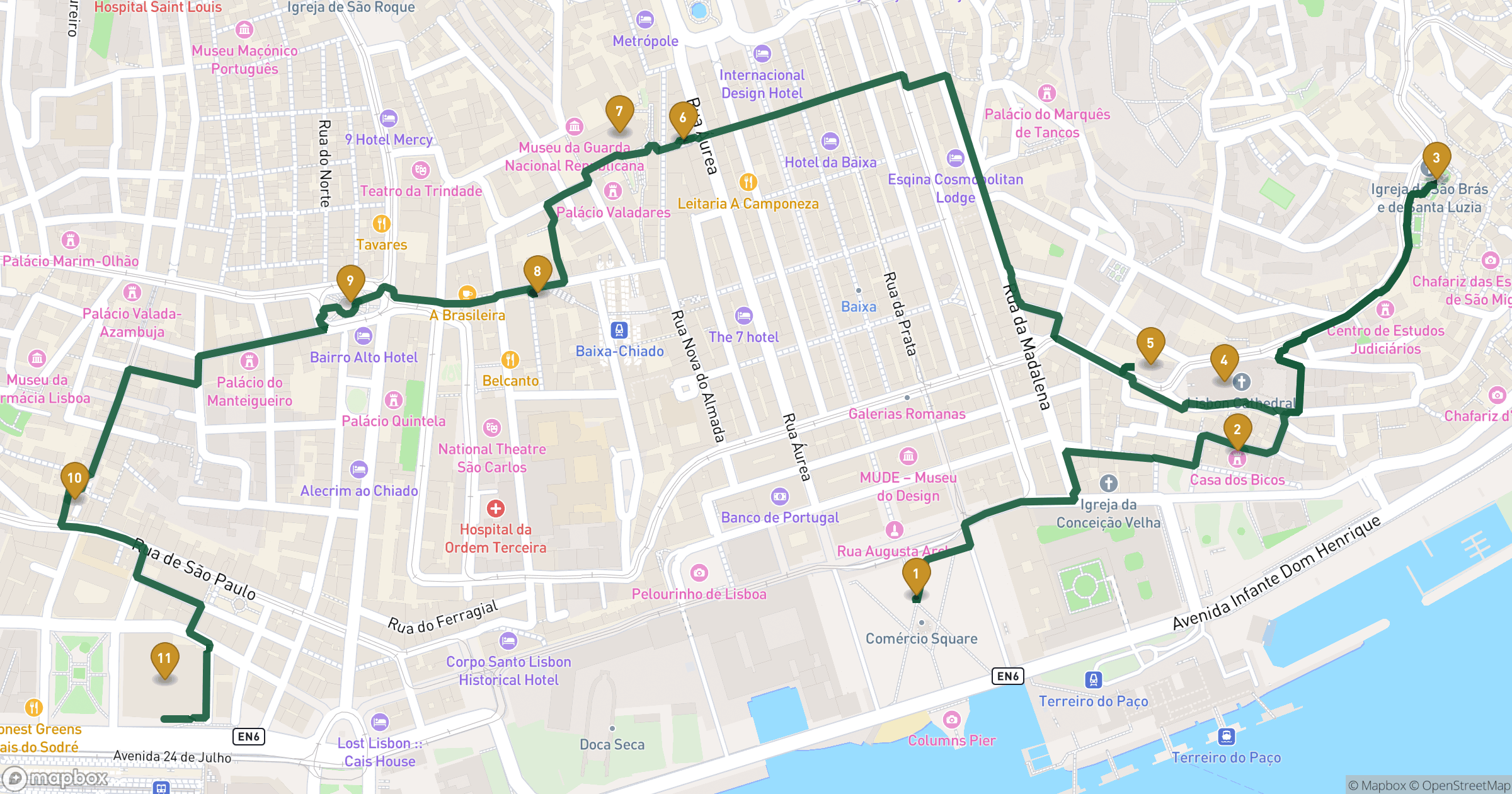
Route map for Lisbon walking tour

Map for Lisbon walking tour with 11 stops
The static map shows the tour route with Praça do Comércio, Casa dos Bicos, Miradouro de Santa Luzia, Sé de Lisboa, and 7 more stops.

Stops along the route

All stops on this self-guided tour at a glance.

  1. Praça do Comércio in Lisbon
    Jules Verne Times Two / CC BY-SA 4.0

    1Praça do ComércioSquare

    Praça do Comércio emerged as a strictly symmetrical, yellow U-shaped plaza facing the Tagus after the 1755 earthquake destroyed the royal palace. At its center, King José I sits atop his horse Gentil trampling snakes, though the traumatized ruler spent his remaining life in an Ajuda tent complex. The northern Arco da Rua Augusta was only finished in 1873.

    Wikidata

  2. Casa dos Bicos in Lisbon
    Alvesgaspar / CC BY-SA 3.0

    2Casa dos BicosCastle

    Casa dos Bicos stands out for its facade of over 1,100 diamond-pointed stones, commissioned in 1523 by Brás de Albuquerque after visiting Ferrara. The mansion lost its top two floors in the 1755 earthquake, which were only reconstructed in the 1980s from historical drawings. It now houses the José Saramago Foundation, with the writer's ashes buried beneath an olive tree out front.

    Architect: Manuel Vicente · Style: Renaissance · Wikidata

  3. Miradouro de Santa Luzia in Lisbon
    Public domain

    3Miradouro de Santa LuziaViewpoint

    Miradouro de Santa Luzia frames Alfama from behind a pergola entwined with bougainvillea, focusing on large blue-and-white azulejo murals on its walls. One tile panel illustrates the 1147 Christian assault on São Jorge Castle, where knight Martim Moniz sacrificed his life in a closing door. Another panel preserves the image of Praça do Comércio before the 1755 earthquake.

    Wikidata

  4. Sé de Lisboa in Lisbon
    Alvesgaspar / CC BY-SA 3.0

    4Sé de LisboaChurch

    Lisbon Cathedral resembles a fortress because Afonso Henriques raised it directly over the main mosque upon recapturing the city in 1147. Its inaugural bishop was Gilbert of Hastings, an English crusader bound for the Holy Land who chose to remain in Portugal. The baptistery is the traditional baptism site of Saint Anthony, while excavations in the cloister reveal Moorish and Roman ruins.

    Built: 1150 · Style: baroque architecture … · Named after: Mary · Wikidata

  5. Igreja de Santo António de Lisboa in Lisbon
    Hugo Ferreira / CC BY-SA 4.0

    5Igreja de Santo António de LisboaChurch

    The Church of Saint Anthony stands where local tradition marks the 1195 birthplace of Lisbon's beloved patron saint. Rebuilt in Baroque style after the 1755 earthquake, its crypt contains the site of his family home where Pope John Paul II prayed in 1982. Outside, young singles toss coins at the saint's statue, hoping to land on his book to ensure an impending wedding.

    Style: baroque architecture · Named after: Anthony of Padua · Wikidata

  6. Elevador de Santa Justa - Cabine 2 in Lisbon
    Diego Delso / CC BY-SA 4.0

    6Elevador de Santa Justa - Cabine 2

    The Santa Justa Lift is a 1902 neo-Gothic iron elevator built to save pedestrians the steep climb between the Baixa and Largo do Carmo. It was designed by Porto-born engineer Raoul Mesnier de Ponsard, who is often mistaken for a pupil of Gustave Eiffel. The polished wood and brass cabins ran on steam power until converting to electricity in 1907.

    Built: 1901 · Style: Art Nouveau architecture · Wikidata

  7. Igreja do Convento de Santa Maria do Carmo in Lisbon
    Pedro J Pacheco / CC BY-SA 4.0

    7Igreja do Convento de Santa Maria do CarmoChurch

    The Carmo Convent Church remains Lisbon's most striking ruin, intentionally left open to the sky as a monument after the 1755 earthquake. Founded in 1389 by general Nuno Álvares Pereira, the site became his home as an ascetic friar handing out soup to the poor at the gate. Today, the roofless Gothic nave and surviving arches host an eclectic archaeological museum.

    Style: Gothic architecture · Wikidata

  8. Livraria Bertrand in Lisbon
    bm.iphone; Lisbon Travel 2011 Uploaded by tm / CC BY 2.0

    8Livraria BertrandBuilding

    Livraria Bertrand traces its origins to 1732, making it the oldest continually operating bookstore in the world. Destroyed in the 1755 earthquake, the shop relocated to Rua Garrett in 1773 and became a legendary meeting hub for intellectuals like the satirist Bocage. Behind its blue azulejo facade lies a labyrinth of wood-paneled rooms named after renowned Portuguese authors.

    Built: 1732 · Wikidata

  9. Luís de Camões Square in Lisbon
    Luca Galuzzi; Luca Galuzzi (Lucag); Photo taken by (Luca Galuzzi) * http://www.galuzzi.it / CC BY-SA 2.5

    9Luís de Camões Square

    Praça Luís de Camões centers on the statue of Portugal's national epic poet, who gazes over the square missing an eye lost in Ceuta. Legend recounts that Camões saved his manuscript of The Lusiads during a shipwreck off Vietnam by swimming with one arm while his lover drowned. Below, the black-and-white Portuguese pavement depicts ships and waves celebrating his maritime verses.

    Wikidata

  10. Ascensor da Bica in Lisbon
    Vitor Oliveira from Torres Vedras, PORTUGAL / CC BY-SA 2.0

    10Ascensor da BicaBuilding

    The Bica Funicular has scaled the remarkably steep Rua da Bica de Duarte Belo since its opening in 1892. Designed by engineer Raoul Mesnier de Ponsard, its cars originally relied on water ballast in the upper cabin to haul the lower one uphill before switching to electricity. Today, the yellow tram glides past tightly packed pastel facades where laundry hangs from balconies.

    Wikidata

  11. Mercado da Ribeira in Lisbon
    Photograph by Mike Peel (www.mikepeel.net). / CC BY-SA 4.0

    11Mercado da RibeiraMarket

    Mercado da Ribeira opened under its prominent dome in 1882 as a bustling dawn market trading in fresh fish. Following a major transformation, the 19th-century iron-and-glass hall now divides space between a traditional market and the popular Time Out Market food hall. Communal wooden tables fill the floor beneath the historic roof, bringing together traditional vendors and top chefs.

    Wikidata

Download the app

This public page shows a preview. The full route, all content, and navigation are available in CityTour AI.

Cities nearby

Discover self-guided tours in nearby cities.

Frequently asked questions

The key answers before you start.

Is this a self-guided audio tour?

Yes. In the CityTour AI app (iOS and Android), this is a self-guided audio tour for Lisbon — start anytime, at your own pace, with map, stops, and audio narration.

What will you see on this tour?

On this tour you'll see, among others, Praça do Comércio, Casa dos Bicos, Miradouro de Santa Luzia, Sé de Lisboa, Igreja de Santo António de Lisboa, Elevador de Santa Justa - Cabine 2 and more sights.

Where does the tour start?

The route starts at Praça do Comércio and ends at Mercado da Ribeira. You can start anytime — the app guides you to the first stop.

How long does the tour take?

About 104 minutes for 11 stops — at your own pace, with breaks whenever you like.

How much does the tour cost?

This tour costs 15 credits. The exact price depends on the pack you buy and your country — roughly $5.

Is it an outdoor tour — are entry tickets included?

Yes, it's an outdoor tour: the sights are viewed from the outside. Entry tickets are not included, and step-free access cannot be guaranteed.

Is the audio guide available in my language?

The tour and audio guide are available in English, Deutsch, Français, Español, Italiano and 9 more languages. You pick your language in the app.

Can I use the tour offline?

Yes. Tours can be used offline.

Can I ask the AI questions along the way?

Yes. At every stop you can ask the AI directly if you want to know more or didn't understand something.