CityTour AI

Graz self-guided walking tour

Renaissance Courtyards and Floating Islands of Graz

Explore the winding alleys and grand squares of Graz, where Renaissance elegance meets bold, futuristic design. From the iconic Clock Tower perched high above the city to the 'Friendly Alien' art museum, you’ll discover how a medieval Habsburg seat transformed into a vibrant UNESCO City of Design. This casual stroll captures the local spirit, blending imperial history with quirky legends and the best views in Styria.

Audio tourSelf-guidediOS & Android
102minutes
2.5 kmdistance
13stops
Audio guideFormat
Renaissance Courtyards and Floating Islands of Graz
Taxiarchos228 / CC BY 3.0

Stops on this route

This tour works well for first-time visitors, weekend trips, and travelers who want to explore Graz without a fixed tour time.

Route map for Graz walking tour
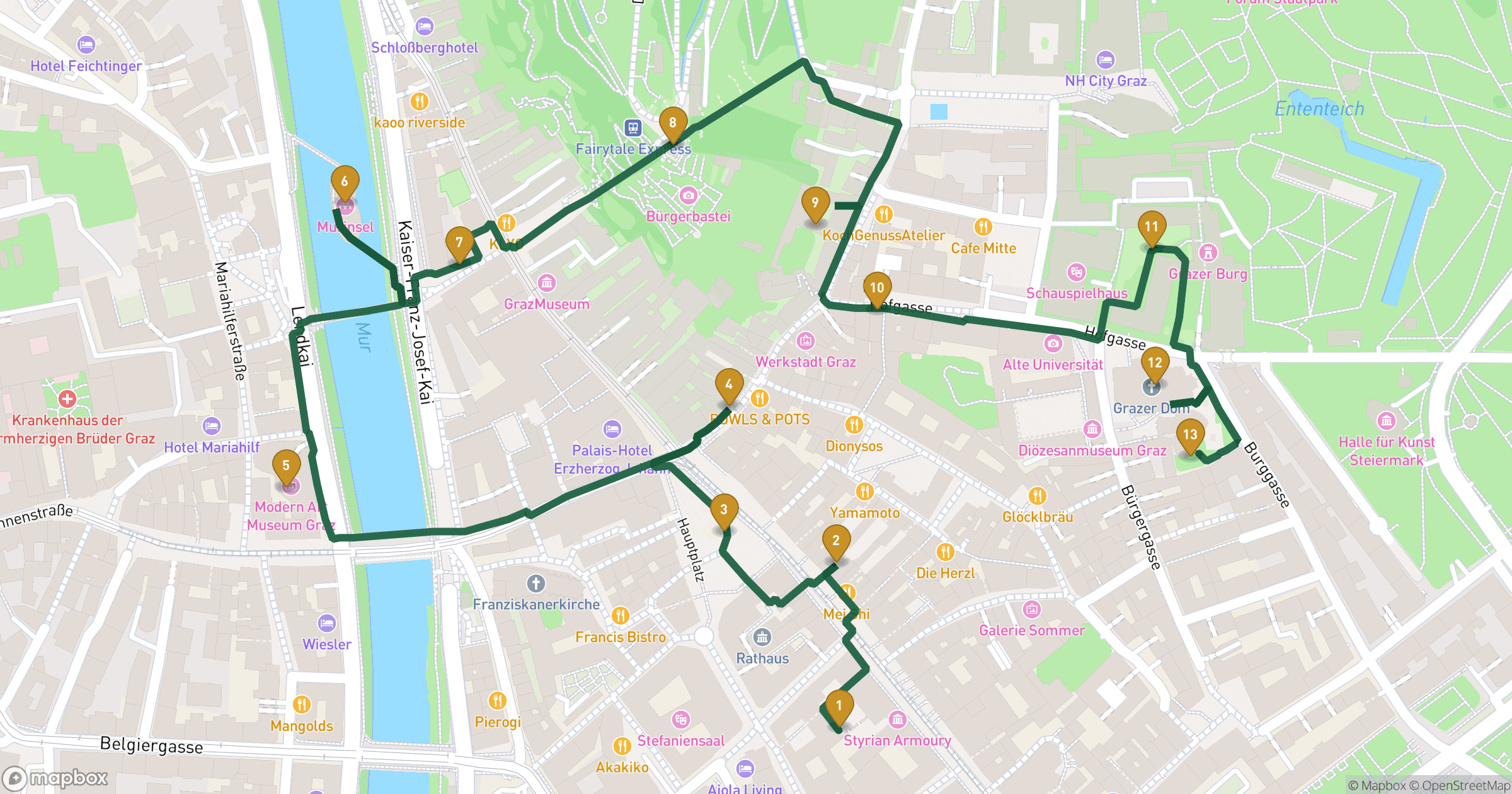
Map for Graz walking tour with 13 stops
The static map shows the tour route with Landhaus, Graz, Herzogshof (Graz), Hauptplatz, Graz, Sporgasse, Graz, and 9 more stops.

Stops along the route

All stops on this self-guided tour at a glance.

  1. Landhaus, Graz in Graz
    Olaf Kosinsky / CC BY-SA 3.0 de

    1Landhaus, GrazBuilding

    The Landhaus stands as a Renaissance political center marked by Florentine elegance. Italian architect Domenico dell'Allio shaped its main courtyard with three levels of arcades and Tuscan columns in the mid-16th century. In the center stands a 1590 bronze well adorned with metal leafwork, putti, and tiny mermaids.

    Style: Renaissance architecture · Wikidata

  2. Herzogshof (Graz) in Graz
    E.mil.mil (talk) / CC BY-SA 3.0 at

    2Herzogshof (Graz)Building

    Herrengasse's Herzogshof commands attention through the Greco-Roman deities blanketing its exterior. Painter Johann Mayer created these frescoes across the 220-square-meter facade around 1742. Long before this artistic transformation, a delegation from Trieste arrived at this former ducal estate in 1382 seeking Habsburg protection from Venice.

    Wikidata

  3. Hauptplatz, Graz in Graz
    Mgrueter / Public domain

    3Hauptplatz, GrazSquare

    Graz's trapezoid-shaped Hauptplatz has operated as the city's lively commercial core since around 1160. At its center, the Erzherzog-Johann-Brunnen honors Archduke Johann alongside four female figures representing the Styrian rivers Mur, Enns, Drau, and Sann. The square also showcases the Luegg-Haus, notable for its ornate 16th-century white stucco shell and floral motifs.

    Wikidata

  4. Sporgasse, Graz in Graz
    Cezar Suceveanu / CC BY-SA 4.0

    4Sporgasse, GrazSquare

    Climbing the Schlossberg slope, Sporgasse traces the ancient Roman trade route known as the Strata Hungarica. Named after medieval spur-makers, it houses Styria's oldest bakery, the Strehly confectionery, established at number 14 back in 1596. Looking into the Teutonic Knights' courtyard reveals traditional paving made of rounded Murnockerln gathered from the local river.

    Named after: Spurriers · Wikidata

  5. Kunsthaus Graz in Graz
    Marion Schneider & Christoph Aistleitner / CC BY-SA 2.5

    5Kunsthaus GrazTheatre

    The Kunsthaus Graz stands in stark contrast to its red-roofed neighbors with its avant-garde biomorphic form. Designed for the 2003 European Capital of Culture by Sir Peter Cook and Colin Fournier, its skin integrates photovoltaic panels among nearly 1,300 acrylic sheets. River-facing BIX lamps transform the facade into a digital screen, wrapping around the historic 1848 Iron House.

    Built: 2003 · Architect: Colin Fournier, Peter Cook · Style: Blobitecture · Wikidata

  6. Murinsel in Graz
    Isiwal / CC BY-SA 4.0

    6MurinselBridge

    Moored in the Mur river, the Murinsel serves as an artificial island linking the historic center to the Lend district. New York artist Vito Acconci designed this 47-meter steel structure for 2003 as a shifting sequence of a bowl and dome. Beneath blue nighttime navigation lights, it shelters an indoor cafe alongside an outdoor amphitheater for up to 350 visitors.

    Wikidata

  7. Schlossbergplatz in Graz
    Palickap / CC BY-SA 4.0

    7SchlossbergplatzSquare

    Schloßbergplatz links the urban streetscape directly to the vertical rock face of the fortress hill. Its open expanse originated as a sovereign buffer zone where private building was banned, beside a 13th-century Romanesque tower inside the Reinerhof. Visitors can view the cliffside air-raid tunnel entrances or climb the 260 zig-zagging steps of the Kriegssteig.

    Named after: Schlossberg · Wikidata

  8. Clock tower in Graz in Graz
    Taxiarchos228 / CC BY 3.0

    8Clock tower in GrazAttraction

    Perched on dolomite rock, the 28-meter Uhrturm features an unusual clock dial that helped early citizens read the time from afar. Its long gilded hand indicates the hour while the short hand marks the minutes, driven by clockwork Michael Sylvester Funck installed in 1712. Graz citizens even raised a ransom of 2,987 guilders in 1809 to save the tower from French demolition.

    Wikidata

  9. Palais Saurau, Graz in Graz
    Andi oisn / CC BY-SA 3.0

    9Palais Saurau, GrazBuilding

    Palais Saurau presents an imposing 16th-century facade surmounted by a curious rooftop wooden warrior brandishing a sword. Pankraz von Windisch-Graetz originally constructed the residence between 1564 and 1566 on ground provided by Emperor Ferdinand I. Facing the street, the entrance portal still displays the 1630 alliance coats of arms of Karl Graf von Saurau and his wife.

    Named after: Saurau · Wikidata

  10. Edegger-Tax bakery in Graz
    Photo: Andreas Praefcke / CC BY 3.0

    10Edegger-Tax bakeryCafé

    Operating since 1569, the Edegger-Tax bakery showcases historic trade heritage right at its 1880 location. Carpenter Anton Irschik carved the dark wooden shopfront in 1896, framing the gilded Imperial Eagle that marked its royal purveyor status granted after an 1883 imperial visit. Inside, the shop still turns out traditional regional specialties like Panthertatzen and Sissi-Busserl.

    Wikidata

  11. Castle of Graz in Graz
    E.mil.mil (talk) / CC BY-SA 3.0 at

    11Castle of Graz

    Begun in 1438 under Frederick V of Styria, the Grazer Burg served as a comfortable ducal residence rather than a military fort. Hidden inside is the late Gothic Double Spiral Staircase from around 1499, whose twin flights converge and separate on every floor. The imperial property once held a 15th-century menagerie with bears and big cats, as well as an enclosed walkway to the cathedral.

    Built: 1438 · Wikidata

  12. Graz Cathedral in Graz
    Taxiarchos228 / CC BY 3.0

    12Graz CathedralChurch

    Graz Cathedral served as the 15th-century court church of Emperor Frederick III, directly beside the imperial residence. Its exterior wall preserves the 1480 Gottesplagenbild fresco, depicting locust swarms, the Black Death, and Turkish attacks that hit Styria in a single year. Inside the church, two ornate 15th-century bridal chests crafted from ivory and bone serve as reliquaries.

    Style: Gothic architecture · Named after: Saint Giles · Wikidata

  13. Katharinenkirche und Mausoleum, Graz in Graz
    gugganij / CC BY-SA 3.0

    13Katharinenkirche und Mausoleum, GrazChurch

    Commissioned in 1614, the Mausoleum of Emperor Ferdinand II stands beside the cathedral as an assertive statement of the Counter-Reformation. Italian court artist Giovanni Pietro de Pomis designed the complex by pairing St. Catherine's Church with an adjoining oval burial chapel. Following the architect's death in 1633, Pietro Valnegro oversaw the completion of the cupolas and high tower.

    Style: Mannerism · Named after: Catherine of Alexandria · Wikidata

Download the app

This public page shows a preview. The full route, all content, and navigation are available in CityTour AI.

Cities nearby

Discover self-guided tours in nearby cities.

Frequently asked questions

The key answers before you start.

Is this a self-guided audio tour?

Yes. In the CityTour AI app (iOS and Android), this is a self-guided audio tour for Graz — start anytime, at your own pace, with map, stops, and audio narration.

What will you see on this tour?

On this tour you'll see, among others, Landhaus, Graz, Herzogshof (Graz), Hauptplatz, Graz, Sporgasse, Graz, Kunsthaus Graz, Murinsel and more sights.

Where does the tour start?

The route starts at Landhaus, Graz and ends at Katharinenkirche und Mausoleum, Graz. You can start anytime — the app guides you to the first stop.

How long does the tour take?

About 102 minutes for 13 stops — at your own pace, with breaks whenever you like.

How much does the tour cost?

This tour costs 15 credits. The exact price depends on the pack you buy and your country — roughly $5.

Is it an outdoor tour — are entry tickets included?

Yes, it's an outdoor tour: the sights are viewed from the outside. Entry tickets are not included, and step-free access cannot be guaranteed.

Is the audio guide available in my language?

The tour and audio guide are available in English, Deutsch, Français, Español, Italiano and 9 more languages. You pick your language in the app.

Can I use the tour offline?

Yes. Tours can be used offline.

Can I ask the AI questions along the way?

Yes. At every stop you can ask the AI directly if you want to know more or didn't understand something.