CityTour AI

Innsbruck self-guided walking tour

Habsburgs and High Peaks: An Innsbruck Walk

Experience the perfect blend of Alpine scenery and Imperial history on this casual stroll through the heart of Tyrol. You’ll wander from the futuristic heights of a world-class ski jump down into the medieval Old Town, where golden roofs and baroque cathedrals tell the story of the powerful Habsburg dynasty. This walk captures the essence of Innsbruck, showing you how a rugged mountain outpost transformed into a sophisticated royal capital.

Audio tourSelf-guidediOS & Android
105minutes
3.6 kmdistance
12stops
Audio guideFormat
Habsburgs and High Peaks: An Innsbruck Walk
Simon Legner (User:simon04) / CC BY-SA 4.0

Stops on this route

This tour works well for first-time visitors, weekend trips, and travelers who want to explore Innsbruck without a fixed tour time.

Route map for Innsbruck walking tour
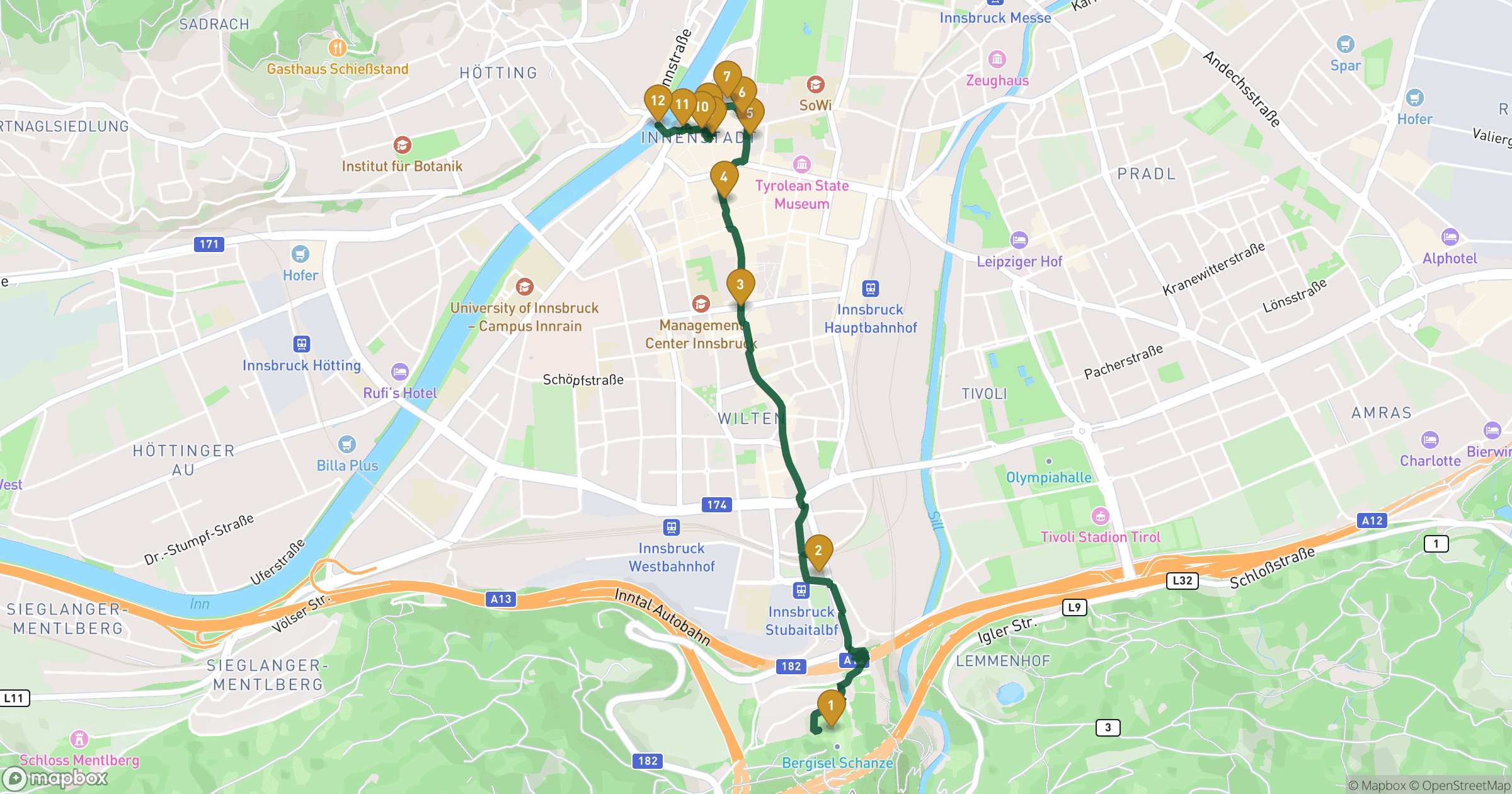
Map for Innsbruck walking tour with 12 stops
The static map shows the tour route with Bergiselschanze, Wilten Basilica churchyard, Triumphpforte, Maria-Theresien-Straße, and 8 more stops.

Stops along the route

All stops on this self-guided tour at a glance.

  1. Bergiselschanze in Innsbruck
    Veit Mueller / CC BY-SA 3.0

    1Bergiselschanze

    Bergiselschanze rises over Innsbruck as a modernist ski jump designed by Zaha Hadid, standing on ground deeply rooted in alpine warfare. In 1809, Andreas Hofer led Tyrolean rebels across this hill in four fierce battles against Napoleon's Bavarian allies. Today, the hybrid bridge-tower structure hosts the annual Four Hills Tournament every January.

    Built: 1964 · Architect: Zaha Hadid · Wikidata

  2. Wilten Basilica churchyard in Innsbruck
    Ralf Roletschek (talk) - Infos über Fahrräder auf fahrradmonteur.deWiki-Technologie für Schulen und Unternehmen / CC BY-SA 3.0

    2Wilten Basilica churchyardBuilding

    The Wilten Basilica churchyard, known as Alter Friedhof Wilten, transitions from the heights of Bergisel into the historic district's spiritual heritage. Resting in the shadow of the nearby Premonstratensian monastery, the plots feature traditional Tyrolean ironwork markers and delicate paintings. Its somber craftsmanship directly contrasts with the gilded Rococo interior of the adjacent basilica.

    Wikidata

  3. Triumphpforte in Innsbruck
    Simon Legner (User:simon04) / CC BY-SA 4.0

    3TriumphpforteMonument

    The Triumphpforte stands as a monument of contrast, commissioned by Maria Theresa for Archduke Leopold's 1765 royal wedding. Joyful southern reliefs celebrate the marriage, while northern reliefs sculpted by Balthasar Ferdinand Moll mourn Emperor Francis Stephen, who died during the festivities. Its stone structure was recycled from medieval city gates made of Höttinger Breccia.

    Built: 1765 · Wikidata

  4. Maria-Theresien-Straße in Innsbruck
    böhringer friedrich / CC BY-SA 2.5

    4Maria-Theresien-StraßeSquare

    Maria-Theresien-Straße forms the city's grand spine, originating as a thirteenth-century expansion following the path toward the Brenner Pass. St. Anne's Column rises in the center, erected in 1703 to commemorate the retreat of Bavarian troops during the War of the Spanish Succession. Farther along stands the Spitalskirche, built outside old city boundaries to separate patients from townspeople.

    Named after: Maria Theresa of Austria · Wikidata

  5. Hofkirche in Innsbruck
    Bede735c / CC BY-SA 3.0

    5HofkircheChurch

    The Hofkirche showcases Emperor Maximilian I's empty cenotaph guarded by twenty-eight colossal bronze figures known as the Black Men. Ferdinand I built this Gothic hall church because the monument was too heavy for its intended chapel, even though Maximilian is actually buried in Wiener Neustadt. The church also shelters the 1823 tomb of executed Tyrolean leader Andreas Hofer.

    Built: 1553 · Style: Gothic architecture · Named after: True Cross · Wikidata

  6. Hofburg, Innsbruck in Innsbruck
    VitVit / CC BY-SA 4.0

    6Hofburg, InnsbruckMuseum

    The Hofburg served as the Tyrolean power center of the Habsburg dynasty for over four and a half centuries. The Giants' Hall displays expansive ceiling frescoes alongside portraits of Maria Theresa's children and grandchildren. The Imperial Chapel marks the tragic spot where Emperor Francis Stephen passed away in 1765, leading the Empress to establish an adjoining convent.

    Style: Rococo · Wikidata

  7. Innsbruck Cathedral in Innsbruck
    Simon Legner (User:simon04) / CC BY-SA 4.0

    7Innsbruck CathedralChurch

    The Cathedral of St. James stands as the Baroque focal point on land considered sacred since the city market relocated here in 1180. Designed by Johann Jakob Herkomer, the interior houses Lucas Cranach the Elder's revered Maria Hilf painting above the main altar. In the north aisle sits the bronze canopied tomb of Archduke Maximilian III, completed in 1620.

    Built: 1717 · Architect: Johann Jakob Herkomer, Johann Georg Fischer · Style: baroque architecture · Named after: Saint James the Elder · Wikidata

  8. Golden Roof in Innsbruck
    Andrew Bossi / CC BY-SA 2.5

    8Golden RoofMuseum

    The Golden Roof glitters with 2,657 fire-gilded copper tiles completed in 1500 for Emperor Maximilian I's wedding to Bianca Maria Sforza. Stone balcony reliefs portray the Emperor between Bianca Maria and his first wife, Maria of Burgundy, flanked by acrobatic Moorish dancers. The imperial couple used this loggia as a royal VIP box to watch square tournaments and executions.

    Style: Gothic architecture · Wikidata

  9. Stadtturm in Innsbruck
    Ralf Roletschek (talk) - Infos über Fahrräder auf fahrradmonteur.deWiki-Technologie für Schulen und Unternehmen / CC BY-SA 3.0

    9StadtturmTower

    The Stadtturm was constructed in the mid-fifteenth century as a functional Gothic watchtower, operating watchmen around the clock until 1967. Master builder Caspar Schäbl added the copper onion dome in 1560, followed by four iron dolphin-shaped gargoyles in 1586. Lower levels once contained the town jail, while Erasmus Melchior installed the tower's first mechanical clock in 1603.

    Height: 51 m · Wikidata

  10. Helblinghaus in Innsbruck
    Sandor Bordas / CC BY-SA 3.0

    10HelblinghausBuilding

    Helblinghaus reveals Innsbruck's architectural layers, wrapping a Gothic townhouse core with an extravagant 1732 Rococo exterior. Plasterer Anton Gigl sculpted dense bows, shells, and masks in deep stucco designed to catch changing alpine light. The facade carries the name of Sebastian Helbling, who ran his early nineteenth-century business here amidst wealthy rival merchants.

    Built: 1500 · Style: baroque architecture … · Wikidata

  11. Ottoburg in Innsbruck
    Anidaat / CC BY-SA 4.0

    11OttoburgTower

    Ottoburg endures as a sturdy late-Gothic defensive residential tower built around 1494 beside the old Inntor city gate. Maximilian I gifted the property to Prince Rudolf of Anhalt-Bernburg, though it sat vacant as the Empty Castle after the prince's death. Its name stems from a mistaken eighteenth-century association with Duke Otto II, preserving original star-vaulted ceilings.

    Wikidata

  12. Innbrücke in Innsbruck
    Nicholas Hartmann / CC BY-SA 4.0

    12InnbrückeBridge

    Innbrücke marks the crossing that gave the settlement its name, established around 1165 by Berchtold V of Andechs to control trade and tolls. Emperor Maximilian I later installed a small summer house along the span to distribute alms directly to the poor. The current 1983 bridge looks across the river to the Mariahilf houses, built outside the original city walls.

    Built: 1983 · Wikidata

Download the app

This public page shows a preview. The full route, all content, and navigation are available in CityTour AI.

Cities nearby

Discover self-guided tours in nearby cities.

Frequently asked questions

The key answers before you start.

Is this a self-guided audio tour?

Yes. In the CityTour AI app (iOS and Android), this is a self-guided audio tour for Innsbruck — start anytime, at your own pace, with map, stops, and audio narration.

What will you see on this tour?

On this tour you'll see, among others, Bergiselschanze, Wilten Basilica churchyard, Triumphpforte, Maria-Theresien-Straße, Hofkirche, Hofburg, Innsbruck and more sights.

Where does the tour start?

The route starts at Bergiselschanze and ends at Innbrücke. You can start anytime — the app guides you to the first stop.

How long does the tour take?

About 105 minutes for 12 stops — at your own pace, with breaks whenever you like.

How much does the tour cost?

This tour costs 15 credits. The exact price depends on the pack you buy and your country — roughly $5.

Is it an outdoor tour — are entry tickets included?

Yes, it's an outdoor tour: the sights are viewed from the outside. Entry tickets are not included, and step-free access cannot be guaranteed.

Is the audio guide available in my language?

The tour and audio guide are available in English, Deutsch, Français, Español, Italiano and 9 more languages. You pick your language in the app.

Can I use the tour offline?

Yes. Tours can be used offline.

Can I ask the AI questions along the way?

Yes. At every stop you can ask the AI directly if you want to know more or didn't understand something.