CityTour AI

Mechelen self-guided walking tour

Mechelen: The Capital That Almost Was

Explore the former capital of the Burgundian Netherlands on a witty stroll through Mechelen’s historic core, where Renaissance power meets modern hipster charm. You will wander from the grand palaces of 16th-century regents to hidden Art Nouveau cafes and the reopened canals that once fueled the city's trade empire. This route reveals how a city of salt taxes and unfinished towers transformed into one of Belgium's most vibrant, walkable secrets.

Audio tourSelf-guidediOS & Android
103minutes
3.0 kmdistance
12stops
Audio guideFormat
Mechelen: The Capital That Almost Was
Paul Hermans / CC BY 4.0

Stops on this route

This tour works well for first-time visitors, weekend trips, and travelers who want to explore Mechelen without a fixed tour time.

Route map for Mechelen walking tour
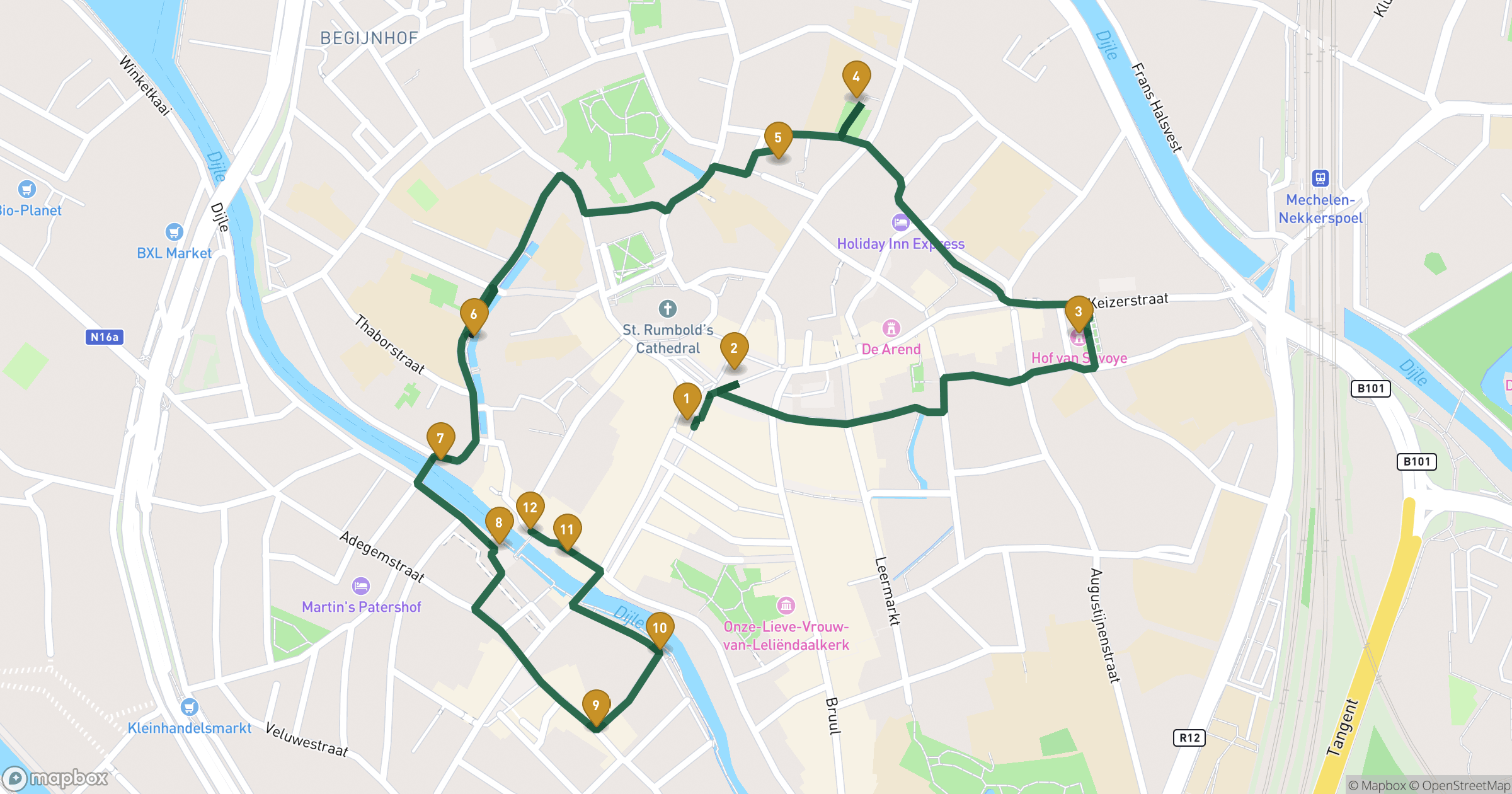
Map for Mechelen walking tour with 12 stops
The static map shows the tour route with Schepenhuis, Grote Markt, Hof van Savoye, Museum Hof van Busleyden, and 8 more stops.

Stops along the route

All stops on this self-guided tour at a glance.

  1. Schepenhuis in Mechelen
    Calips / CC BY-SA 4.0

    1SchepenhuisBuilding

    Built around 1300 as Flanders' oldest stone town hall, the Schepenhuis illustrates Mechelen's rise to the judicial heart of the Burgundian state. In 1473, Charles the Bold established the Parlement here, seating the Great Council in its halls. Inside, the ground-floor Vierschaere still preserves an oak ceiling alongside sculpted corbels crafted by Jan I Keldermans.

    Built: 1300 · Architect: Henri Louis Jacques Meyns, Andries I Keldermans · Style: Gothic Revival … · Wikidata

  2. Grote Markt in Mechelen
    Michielverbeek / CC BY-SA 4.0

    2Grote MarktSquare

    The Grote Markt functions as Mechelen's central square, dominated by an unfinished tower and layered civic architecture. Construction on St. Rumbold's Cathedral ceased in 1520 at 97 meters, inspiring the 1687 legend of residents attempting to extinguish the moon through the mist. Across the cobbles stands the City Hall, merging a 14th-century Cloth Hall with a council palace completed in 1911.

    Wikidata

  3. Hof van Savoye in Mechelen
    Viktor Hauk Viktorhauk / Public domain

    3Hof van SavoyeCastle

    The Hof van Savoye marks the arrival of Renaissance architecture in the Low Countries under Margaret of Austria, who made it her residential palace in 1507. Margaret raised the future Emperor Charles V here and hosted a twelve-year-old Anne Boleyn starting in 1513. Later serving the Great Council for nearly two centuries, the palace now houses modern law courts.

    Architect: Antoon I Keldermans, Rombout II Keldermans · Style: Renaissance architecture · Wikidata

  4. Museum Hof van Busleyden in Mechelen
    Paul Hermans / CC BY 4.0

    4Museum Hof van BusleydenCastle

    The Museum Hof van Busleyden stands as a 16th-century humanist palace built for lawyer Hieronymus van Busleyden, who hosted thinkers like Erasmus and Thomas More. Designed by the Keldermans family of architects, its brick courtyard survived a destructive fire during the First World War. Inside, it preserves rare Besloten Hofjes altarpieces filled with silk flowers and relics by the Hospital Sisters.

    Wikidata

  5. Sint-Janskerk in Mechelen
    Chris06 / Public domain

    5Sint-JanskerkChurch

    Sint-Janskerk reveals how 17th-century parish wealth fueled extraordinary Baroque commissions behind its Gothic facade. Peter Paul Rubens created the high altar's 'Adoration of the Magi' triptych in 1616 for 1,800 guilders, accompanied by a marble altar by Lucas Faydherbe. A 2008 restoration uncovered hidden 14th-century murals of Saint Christopher and Saint George behind the organ.

    Built: 1500 · Architect: Antoon I Keldermans · Style: Gothic architecture · Named after: John the Baptist, John the Evangelist · Wikidata

  6. Melaan in Mechelen
    Rafaël Delaedt (Arafi) / CC BY-SA 3.0

    6MelaanWater

    The Melaan represents Mechelen's urban past revived through the uncovering of its historic waterways. Paved over in the late 19th century for parking lots, this 250-meter channel was excavated again in 2007. The 60-centimeter-deep stream recalls the era when the city consisted of 13 separate islands connected by dozens of bridges.

    Wikidata

  7. Kraanbrug in Mechelen
    Michiel1972 / CC BY-SA 3.0

    7KraanbrugBuilding

    The Kraanbrug marks the historic crossing where Mechelen operated its medieval wool and cloth trade. A 14th-century wooden crane once stood here, hoisted by men walking inside giant treadwheels to unload cargo from the Dijle river. The bridge now offers an open vista of the river winding past St. Rumbold's Tower toward the old fish market.

  8. Haverwerf in Mechelen
    Romaine / CC BY-SA 4.0

    8HaverwerfSquare

    The Haverwerf preserves the riverfront quay that once held a strict city monopoly on the oat trade. Three side-by-side merchant facades illustrate the shift from late Gothic to Renaissance style, led by the early 16th-century wooden house De Duivels with its carved satyr brackets. Next door, Het Paradijs displays mid-16th-century reliefs of the Earthly Paradise and Adam and Eve.

  9. Onze-Lieve-Vrouwestraat in Mechelen
    Ymblanter / CC BY-SA 4.0

    9Onze-Lieve-Vrouwestraat

    Onze-Lieve-Vrouwestraat serves as a retail corridor that transformed its industrial past into a hub for independent shops and bakeries. The street derives its name from the nearby Church of Our Lady-across-the-Dijle. Traditional Flemish gables and carefully restored 19th-century storefronts frame this pedestrian link between the riverfront and residential quarters.

  10. Zoutwerf in Mechelen
    Ymblanter / CC BY-SA 4.0

    10ZoutwerfSquare

    The Zoutwerf faces the river where medieval traders unloaded and paid taxes on salt under a strict 14th-century staple right. Its focal point is De Zalm, an early Renaissance guild house designed by Willem van Wechtere between 1530 and 1534 for local fishmongers. Next to its carved golden salmon stands De Waag, the old weighing house used to measure cargo.

  11. 11De Gouden Vis

    De Gouden Vis occupies an Art Nouveau building along the river, a rare architectural style in a city dominated by Gothic and Renaissance stone. The structure operated as a cigar factory named the Manufacture de Tabacs et Cigares before its conversion into a cafe. Its rear terrace hangs directly over the waters of the Dijle away from major thoroughfares.

  12. Vismarkt in Mechelen
    DimiTalen / CC0

    12VismarktSquare

    The Vismarkt occupies the historic square once defined by fresh catches and a 19th-century protective iron roof. Historic facades along the perimeter now house restaurants and bars centered around the original public water pump. The open cobblestones mark the final transition of a utilitarian riverfront market into Mechelen's modern culinary gathering spot.

    Wikidata

Download the app

This public page shows a preview. The full route, all content, and navigation are available in CityTour AI.

Cities nearby

Discover self-guided tours in nearby cities.

Frequently asked questions

The key answers before you start.

Is this a self-guided audio tour?

Yes. In the CityTour AI app (iOS and Android), this is a self-guided audio tour for Mechelen — start anytime, at your own pace, with map, stops, and audio narration.

What will you see on this tour?

On this tour you'll see, among others, Schepenhuis, Grote Markt, Hof van Savoye, Museum Hof van Busleyden, Sint-Janskerk, Melaan and more sights.

Where does the tour start?

The route starts at Schepenhuis and ends at Vismarkt. You can start anytime — the app guides you to the first stop.

How long does the tour take?

About 103 minutes for 12 stops — at your own pace, with breaks whenever you like.

How much does the tour cost?

This tour costs 15 credits. The exact price depends on the pack you buy and your country — roughly $5.

Is it an outdoor tour — are entry tickets included?

Yes, it's an outdoor tour: the sights are viewed from the outside. Entry tickets are not included, and step-free access cannot be guaranteed.

Is the audio guide available in my language?

The tour and audio guide are available in English, Deutsch, Français, Español, Italiano and 9 more languages. You pick your language in the app.

Can I use the tour offline?

Yes. Tours can be used offline.

Can I ask the AI questions along the way?

Yes. At every stop you can ask the AI directly if you want to know more or didn't understand something.