CityTour AI

Brussels self-guided walking tour

Brussels: From Medieval Guilds to Royal Grandeur

Wander through the cobblestone heart of Europe on a journey that bridges the gap between medieval merchant pride and royal elegance. From the gold-leafed splendor of the Grand-Place to the hidden stories of the Sablon district, you’ll discover how Brussels balances its rebellious local spirit with its role as a grand continental capital. This casual stroll offers a deep dive into the city's architectural evolution, legendary landmarks, and the quirky history that makes Brussels truly unique.

Audio tourSelf-guidediOS & Android
105minutes
3.6 kmdistance
12stops
Audio guideFormat
Brussels: From Medieval Guilds to Royal Grandeur
Voyager747 / CC BY-SA 4.0

Stops on this route

This tour works well for first-time visitors, weekend trips, and travelers who want to explore Brussels without a fixed tour time.

Route map for Brussels walking tour
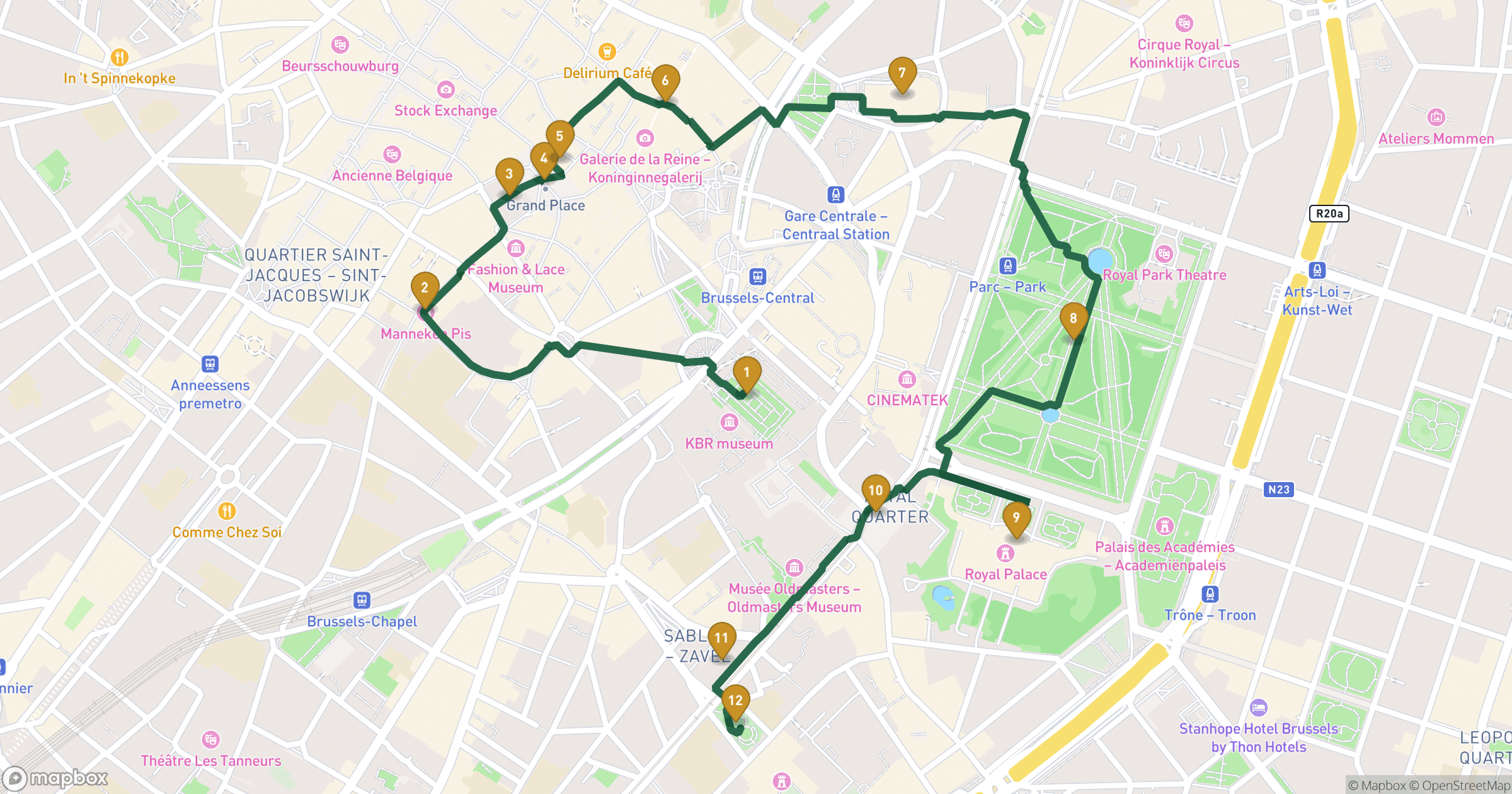
Map for Brussels walking tour with 12 stops
The static map shows the tour route with Mont des Arts - Kunstberg, Manneken Pis, Brussels Town Hall, Grand-Place, and 8 more stops.

Stops along the route

All stops on this self-guided tour at a glance.

  1. Mont des Arts - Kunstberg in Brussels
    Trougnouf (Benoit Brummer) / CC BY 4.0

    1Mont des Arts - Kunstberg

    Mont des Arts bridges the historic aristocratic upper town and the merchant lower town, shaped by King Leopold II's ambition to create a grand capital. Landscape architect René Pechère designed the geometric gardens below with precise hedges and fountains directing the view toward the Town Hall spire. Surrounded by the Royal Library and museums, the viewpoint reveals the distant Koekelberg Basilica on clear days.

    Wikidata

  2. Manneken Pis in Brussels
    Kapsuglan / CC BY-SA 4.0

    2Manneken PisAttraction

    Manneken Pis is a modest 55.5-centimeter bronze fountain statue embodying Brussels' irreverent spirit of 'zwanze'. The present figure is a 1965 replica, while the 1619 original by Jérôme Duquesnoy the Elder rests in the City Museum. Maintained by an official order, he possesses over a thousand costumes and stands within an elegant 1770 rocaille stone niche.

    Built: 1619 · Height: 61 m · Wikidata

  3. Brussels Town Hall in Brussels
    Michielverbeek / CC BY-SA 4.0

    3Brussels Town HallAttraction

    The Brussels Town Hall stands as the sole surviving medieval structure on the Grand-Place, featuring an asymmetrical facade that sparked folklore about its architect. Jan van Ruysbroeck designed the 96-meter spire, though Jacob van Thienen began the oldest left wing in 1401. A five-meter gilded Saint Michael tops the tower, which withstood French bombardment in 1695 despite serving as an artillery target.

    Architect: Willem de Vogel, Victor Jamaer … · Style: Flamboyant … · Height: 96 m · Wikidata

  4. Grand-Place in Brussels
    Alexander-93 / CC BY-SA 4.0

    4Grand-PlaceBuilding

    The Grand-Place showcases opulent merchant architecture rapidly reconstructed over five years following French bombardment in 1695. Intricate guildhalls celebrate local trades, displaying gold-leaf ornaments like Saint Boniface on the Tailors' House and Charles of Lorraine atop the Brewers' House. Every two years in August, volunteers carpet the 68 by 110-meter stone plaza with nearly a million begonias.

    Style: Flamboyant … · Heritage status: World Heritage Site · Wikidata

  5. King's House in Brussels
    Donaldytong / CC BY-SA 3.0

    5King's HouseBuilding

    The King’s House, or Broodhuis, never housed royalty and originally served as a thirteenth-century wooden bread market. It acquired its current Flamboyant Gothic Revival appearance in the late 1800s through architect Victor Jamaer following seventeenth-century bombardment damage. Now housing the Brussels City Museum, the building preserves the original 1619 Manneken Pis statue alongside its extensive wardrobe.

    Built: 1504 · Architect: Hendrik van Pede, Victor Jamaer … · Style: Gothic Revival · Named after: Charles V · Wikidata

  6. Royal Saint-Hubert Galleries in Brussels
    Diego Delso / CC BY-SA 4.0

    6Royal Saint-Hubert GalleriesMarket

    The Royal Saint-Hubert Galleries opened in 1847 under architect Jean-Pierre Cluysenaar as one of Europe's earliest glazed shopping arcades. Cluysenaar employed a cast-iron frame and glass roof to protect elite visitors, including Victor Hugo and Alexandre Dumas, from muddy streets. It is also the birthplace of the Belgian praline, invented in 1912 within Jean Neuhaus's former apothecary shop.

    Architect: Jean-Pierre Cluysenaar · Style: eclectic architecture · Named after: Hubertus · Wikidata

  7. Cathedral of St. Michael and St. Gudula in Brussels
    FrDr / CC BY-SA 4.0

    7Cathedral of St. Michael and St. GudulaChurch

    Saint Michael and Gudula Cathedral commands the Treurenberg hill, a former prison site once dubbed the Mount of Sorrows. Begun in 1226, this Brabantine Gothic co-cathedral honors Saint Gudula, a seventh-century noblewoman whose wind-blown lantern was said to be miraculously relit by an angel. Inside, sixteenth-century stained glass and massive Baroque pulpits decorate the traditional setting for royal ceremonies.

    Built: 1226 · Style: Brabantine Gothic · Height: 64 m · Named after: Gudula, Michael · Wikidata

  8. Brussels Park in Brussels
    Michaelkmd at Dutch Wikipedia (Original text: Michaelkmd) / CC BY-SA 3.0

    8Brussels Park

    Brussels Park replaced the wild hunting grounds of the Dukes of Brabant as the city's first public green space in the late 1700s. Joachim Zinner laid out its formal neoclassical avenues according to geometric axes that many link to Enlightenment Masonic symbolism. Traces of the older Warande game reserve survive in a park that witnessed fierce fighting during the 1830 Belgian Revolution.

    Built: 1776 · Wikidata

  9. Royal Palace of Brussels in Brussels
    Martin Falbisoner / CC BY-SA 3.0

    9Royal Palace of BrusselsCastle

    The Royal Palace serves as the monarch's official workplace, erected over the ruins of the medieval Coudenberg Palace. King Leopold II reshaped the complex after 1900, commissioning its grand Beaux-Arts facade to rival Paris with his personal fortune. Inside, the lavish State Rooms include a Mirror Room ceiling adorned with the iridescent wing cases of over a million Thai jewel beetles.

    Built: 1826 · Architect: Octave Flanneau, Charles Vander Straeten … · Style: Beaux-Arts … · Wikidata

  10. Place Royale - Koningsplein in Brussels
    VitVit / CC BY-SA 4.0

    10Place Royale - KoningspleinSquare

    The Royal Square displays strict eighteenth-century neoclassical symmetry over the Burnt Court ruins of Coudenberg Palace, which was razed by fire in 1731. At its center stands an equestrian monument depicting Godfrey of Bouillon departing on the First Crusade in 1096. Bordering the matched facades, the temple-like Church of St. James on Coudenberg conceals centuries of subterranean ducal history.

    Named after: king · Wikidata

  11. Church of Our Lady of Victories at the Sablon in Brussels
    Voyager747 / CC BY-SA 4.0

    11Church of Our Lady of Victories at the Sablon

    The Church of Our Lady of Victories at the Sablon grew from a modest 1304 chapel established on the sandy practice grounds of the Crossbowmen's Guild. It developed into a prominent pilgrimage site after Beatrijs Soetkens reportedly stole a miraculous statue from Antwerp in 1348 following a vision. Her river voyage inspired the annual Ommegang procession, which led nobles to finance rich Baroque expansions.

    Built: 1500 · Architect: Lucas Faydherbe · Style: Gothic architecture · Named after: Mary · Wikidata

  12. Place du Petit Sablon - Kleine Zavel in Brussels
    J.Nicolas KONDA YANS… / CC BY 3.0

    12Place du Petit Sablon - Kleine ZavelBuilding

    The Place du Petit Sablon is a late nineteenth-century garden occupying an old cemetery site opposite the Sablon church. A perimeter wrought-iron fence features 48 bronze statuettes illustrating medieval Brussels guilds, ranging from masons to fishmongers. In the center stands a monument honoring the Counts of Egmont and Hornes, who were executed on the Grand-Place in 1568.

    Wikidata

Download the app

This public page shows a preview. The full route, all content, and navigation are available in CityTour AI.

Cities nearby

Discover self-guided tours in nearby cities.

Frequently asked questions

The key answers before you start.

Is this a self-guided audio tour?

Yes. In the CityTour AI app (iOS and Android), this is a self-guided audio tour for Brussels — start anytime, at your own pace, with map, stops, and audio narration.

What will you see on this tour?

On this tour you'll see, among others, Mont des Arts - Kunstberg, Manneken Pis, Brussels Town Hall, Grand-Place, King's House, Royal Saint-Hubert Galleries and more sights.

Where does the tour start?

The route starts at Mont des Arts - Kunstberg and ends at Place du Petit Sablon - Kleine Zavel. You can start anytime — the app guides you to the first stop.

How long does the tour take?

About 105 minutes for 12 stops — at your own pace, with breaks whenever you like.

How much does the tour cost?

This tour costs 15 credits. The exact price depends on the pack you buy and your country — roughly $5.

Is it an outdoor tour — are entry tickets included?

Yes, it's an outdoor tour: the sights are viewed from the outside. Entry tickets are not included, and step-free access cannot be guaranteed.

Is the audio guide available in my language?

The tour and audio guide are available in English, Deutsch, Français, Español, Italiano and 9 more languages. You pick your language in the app.

Can I use the tour offline?

Yes. Tours can be used offline.

Can I ask the AI questions along the way?

Yes. At every stop you can ask the AI directly if you want to know more or didn't understand something.