CityTour AI

Bruges self-guided walking tour

Bruges: Grandeur and Secrets of the Golden Age

Explore the most picturesque corners of Bruges, from bustling market squares to tranquil quays. Discover how this medieval port transformed into a fairy-tale museum city while walking through the heart of European trade history. Immerse yourself in the atmosphere of Flanders' Golden Age, complete with Gothic spires and charming canals.

Audio tourSelf-guidediOS & Android
105minutes
2.4 kmdistance
13stops
Audio guideFormat
Bruges: Grandeur and Secrets of the Golden Age
Gargarapalvin / CC BY-SA 4.0

Stops on this route

This tour works well for first-time visitors, weekend trips, and travelers who want to explore Bruges without a fixed tour time.

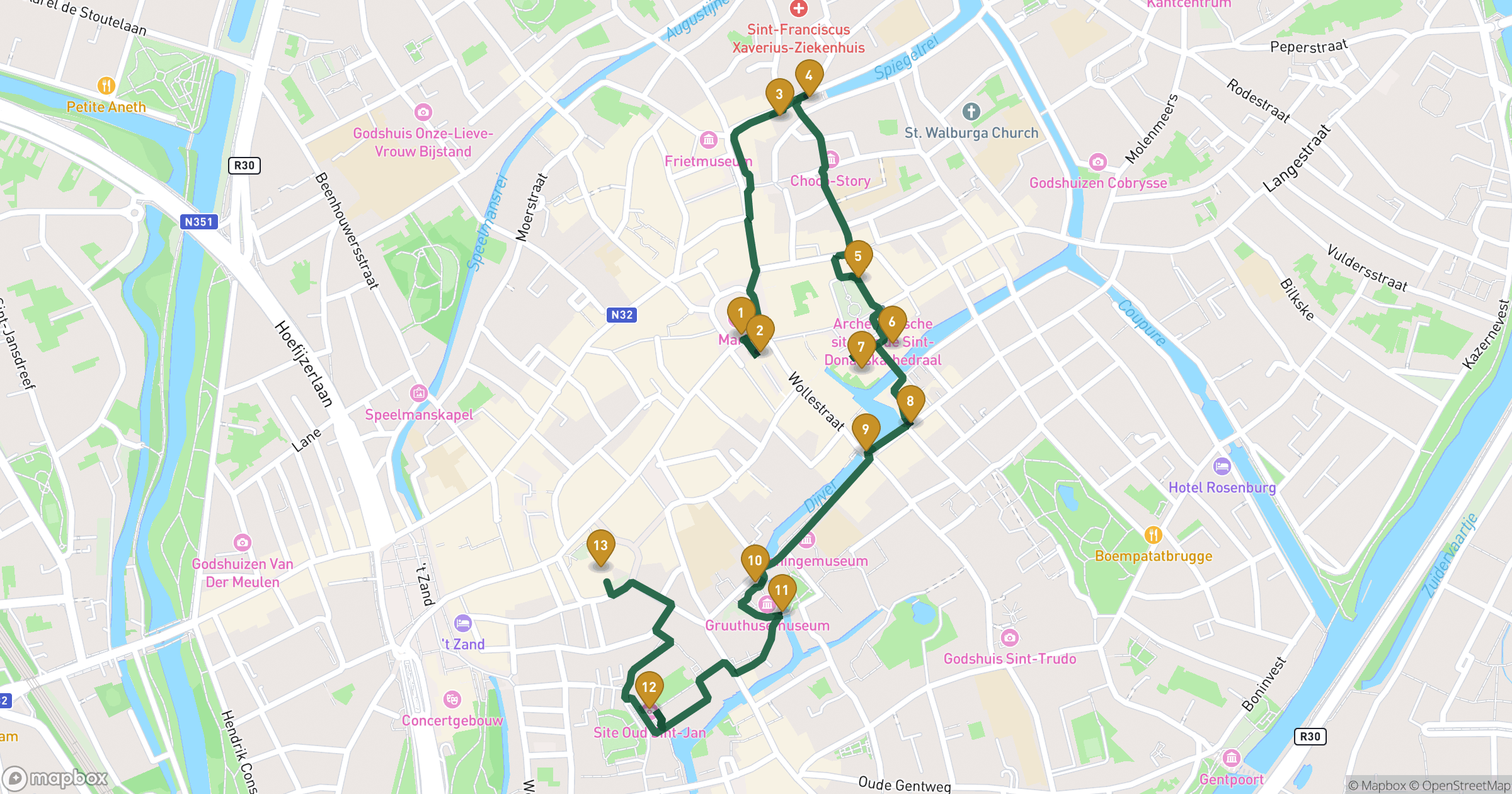
Route map for Bruges walking tour

Map for Bruges walking tour with 13 stops
The static map shows the tour route with Markt, Belfry of Bruges, Poortersloge, Jan van Eyckplein, and 9 more stops.

Stops along the route

All stops on this self-guided tour at a glance.

  1. Markt in Bruges
    Bert Kaufmann from Roermond, Netherlands / CC BY 2.0

    1MarktSquare

    Bruges' Market Square reveals the fierce rivalries of medieval trade guilds competing through ornate stepped gables. In 1302, local rebellion leaders Jan Breydel and Pieter de Coninck tested loyalties against the French using the Flemish shibboleth "Shield and friend". Today, the towering Provincial Court on the square is actually a 19th-century neo-Gothic reconstruction.

    Wikidata

  2. Belfry of Bruges in Bruges
    Dguendel / CC BY 4.0

    2Belfry of BrugesTower

    The 83-meter Belfry of Bruges served as a fortified municipal treasury housing municipal charters in an iron-doored chamber called the "Secret". Ground subsidence over centuries has left the tower visibly leaning about one meter to the left. Its 47-bell carillon once directed daily routines, famously played in the 18th century by carillonneur Joris Dumon.

    Style: Brabantine Gothic · Wikidata

  3. Poortersloge in Bruges
    Dennis G. Jarvis / CC BY-SA 2.0

    3PoorterslogeBuilding

    The Poortersloge was the private 15th-century club for wealthy citizens known as poorters, who founded the chivalric Society of the White Bear. A small stone carving of the legendary Bruges Bear, pierced by Baldwin Iron Arm, still stands in a facade niche. Wealthy merchants built the building's slender tower deliberately high to rival the authority of the Belfry.

    Wikidata

  4. Jan van Eyckplein in Bruges
    User:LimoWreck / CC BY 2.5

    4Jan van EyckpleinSquare

    Jan van Eyck Square marks the former commercial heart of medieval Bruges, where foreign ships unloaded goods at the bustling old port. Court painter Jan van Eyck pioneered new methods of mixing oil paints while serving Duke Philip the Good on secret diplomatic missions. Merchants were required to weigh goods and pay taxes at the Tolhuis, right beside the Pijndershuis.

    Wikidata

  5. Burg in Bruges
    Donar Reiskoffer / CC BY 3.0

    5BurgBuilding

    Burg Square originated in the 9th century when Count Arnulf I fortified a former Roman site against Viking incursions. The northern side once held the Cathedral of Saint Donatian, which was demolished in the late 18th century, leaving its foundations beneath a nearby hotel. The Basilica of the Holy Blood enshrines a relic brought by Thierry of Alsace in 1150.

    Wikidata

  6. Brugse Vrije in Bruges
    Fred Romero from Paris, France / CC BY 2.0

    6Brugse VrijeBuilding

    The Liberty of Bruges was the administrative and judicial center governing the independent territory surrounding the city. Inside the aldermen's chamber stands a monumental fireplace carved from oak, alabaster, and marble depicting Emperor Charles V alongside his ancestors. Facing the Groenerei canal, architect Jan van de Poele added Renaissance gold statues in the 16th century.

    Named after: Bruges · Wikidata

  7. Bruges City Hall in Bruges
    Marc Ryckaert / CC BY-SA 4.0

    7Bruges City HallAttraction

    Bruges City Hall was initiated in 1376 by Count Louis of Male, serving as an architectural blueprint for municipal halls across Brussels, Ghent, and Leuven. Its statues are 19th-century restorations following destructions wrought during the French Revolution. Adjacent lies the Blind Donkey Street, connecting the administrative hub to the historic fish market beneath gilded arches.

    Built: 1377 · Style: Gothic architecture · Heritage status: World Heritage Site · Wikidata

  8. Huidenvettersplein in Bruges
    Zeisterre / CC BY-SA 3.0

    8HuidenvetterspleinSquare

    Huidenvettersplein was the secluded enclave of the tanners' guild, placed near the canal due to the pungent trade of curing hides. A central stone column bears two lions holding the guild's heraldic crest. The former 17th-century guild meeting house still encloses the perimeter alongside historic stepped-gable residences now occupied by modern cafes.

    Wikidata

  9. Rozenhoedkaai in Bruges
    Marc Ryckaert (MJJR) / CC BY 3.0

    9RozenhoedkaaiBridge

    Rozenhoedkaai marks the picturesque junction of the Dijver and Groenerei canals, once an early medieval harbor used to unload salt for fish preservation. The quay drew its name in the 18th century from stalls selling rosary beads to pilgrims walking toward nearby churches. Brick rooftops, a famous weeping willow, and the prominent Belfry create the classic canal viewpoint.

    Wikidata

  10. Gruuthusemuseum in Bruges
    Jean Housen / CC BY-SA 4.0

    10GruuthusemuseumCastle

    The Gruuthusemuseum was the palace of Lodewijk van Gruuthuse, who derived immense wealth from monopolizing the herbal brewing mixture known as gruut. A private 15th-century prayer gallery directly connected the family residence into the adjacent Church of Our Lady. King Edward IV of England sheltered here in 1470 during his exile, later creating Lodewijk Earl of Winchester.

    Built: 1876 · Wikidata

  11. Bonifatiusbrug in Bruges
    Fred Romero from Paris, France / CC BY 2.0

    11BonifatiusbrugBridge

    Bonifacius Bridge appears centuries old yet was actually constructed between 1907 and 1908 in the historicist Neo-Bruges style. Nestled behind the Church of Our Lady, it directly borders the overhanging timber bays and brickwork of the Gruuthuse palace. The pedestrian span overlooks canal tour boats cruising directly beneath its arches, shielded from traffic noise.

    Wikidata

  12. Sint-Janshospitaal in Bruges
    sailko / CC BY-SA 3.0

    12Sint-JanshospitaalAttraction

    Saint John's Hospital provided care for pilgrims and paupers for eight centuries under Augustinian monks and nuns since the mid-12th century. The museum houses six 15th-century masterpieces by Hans Memling, highlighted by the intricate painted reliquary shrine of Saint Ursula. Large medieval hospital wards remain intact alongside an altar where patients heard Mass from bed.

    Built: 1188 · Wikidata

  13. Sint-Salvatorskathedraal in Bruges
    Gargarapalvin / CC BY-SA 4.0

    13Sint-SalvatorskathedraalChurch

    Saint Saviour's Cathedral served as a humble parish church until being elevated following the French demolition of Saint Donatian's. English architect Robert Chantrell redesigned the scorched bell tower in 1839, raising Romanesque forms over the 13th-century brick base. Inside, the choir displays 15th-century carved stalls alongside tapestries woven by Jasper van der Borcht.

    Built: 1275 · Style: Romanesque Revival architecture … · Wikidata

Download the app

This public page shows a preview. The full route, all content, and navigation are available in CityTour AI.

Cities nearby

Discover self-guided tours in nearby cities.

Frequently asked questions

The key answers before you start.

Is this a self-guided audio tour?

Yes. In the CityTour AI app (iOS and Android), this is a self-guided audio tour for Bruges — start anytime, at your own pace, with map, stops, and audio narration.

What will you see on this tour?

On this tour you'll see, among others, Markt, Belfry of Bruges, Poortersloge, Jan van Eyckplein, Burg, Brugse Vrije and more sights.

Where does the tour start?

The route starts at Markt and ends at Sint-Salvatorskathedraal. You can start anytime — the app guides you to the first stop.

How long does the tour take?

About 105 minutes for 13 stops — at your own pace, with breaks whenever you like.

How much does the tour cost?

This tour costs 15 credits. The exact price depends on the pack you buy and your country — roughly $5.

Is it an outdoor tour — are entry tickets included?

Yes, it's an outdoor tour: the sights are viewed from the outside. Entry tickets are not included, and step-free access cannot be guaranteed.

Is the audio guide available in my language?

The tour and audio guide are available in English, Deutsch, Français, Español, Italiano and 9 more languages. You pick your language in the app.

Can I use the tour offline?

Yes. Tours can be used offline.

Can I ask the AI questions along the way?

Yes. At every stop you can ask the AI directly if you want to know more or didn't understand something.