CityTour AI

Ghent self-guided walking tour

Monks, Modernism, and a Missing Zoo

Trade the crowded medieval center for a witty exploration of Ghent’s southern quarters, where socialist temples and modernist towers define the skyline. This walk blends industrial history with the city’s vibrant student energy, leading you from a 'Devil’s' fortress to a park that once housed a famous elephant. It’s a journey through hidden abbey vineyards and architectural experiments, perfect for those who prefer their history with a side of hipster charm.

Audio tourSelf-guidediOS & Android
105minutes
3.6 kmdistance
12stops
Audio guideFormat
Monks, Modernism, and a Missing Zoo
User:LimoWreck / CC BY-SA 3.0

Stops on this route

This tour works well for first-time visitors, weekend trips, and travelers who want to explore Ghent without a fixed tour time.

Route map for Ghent walking tour
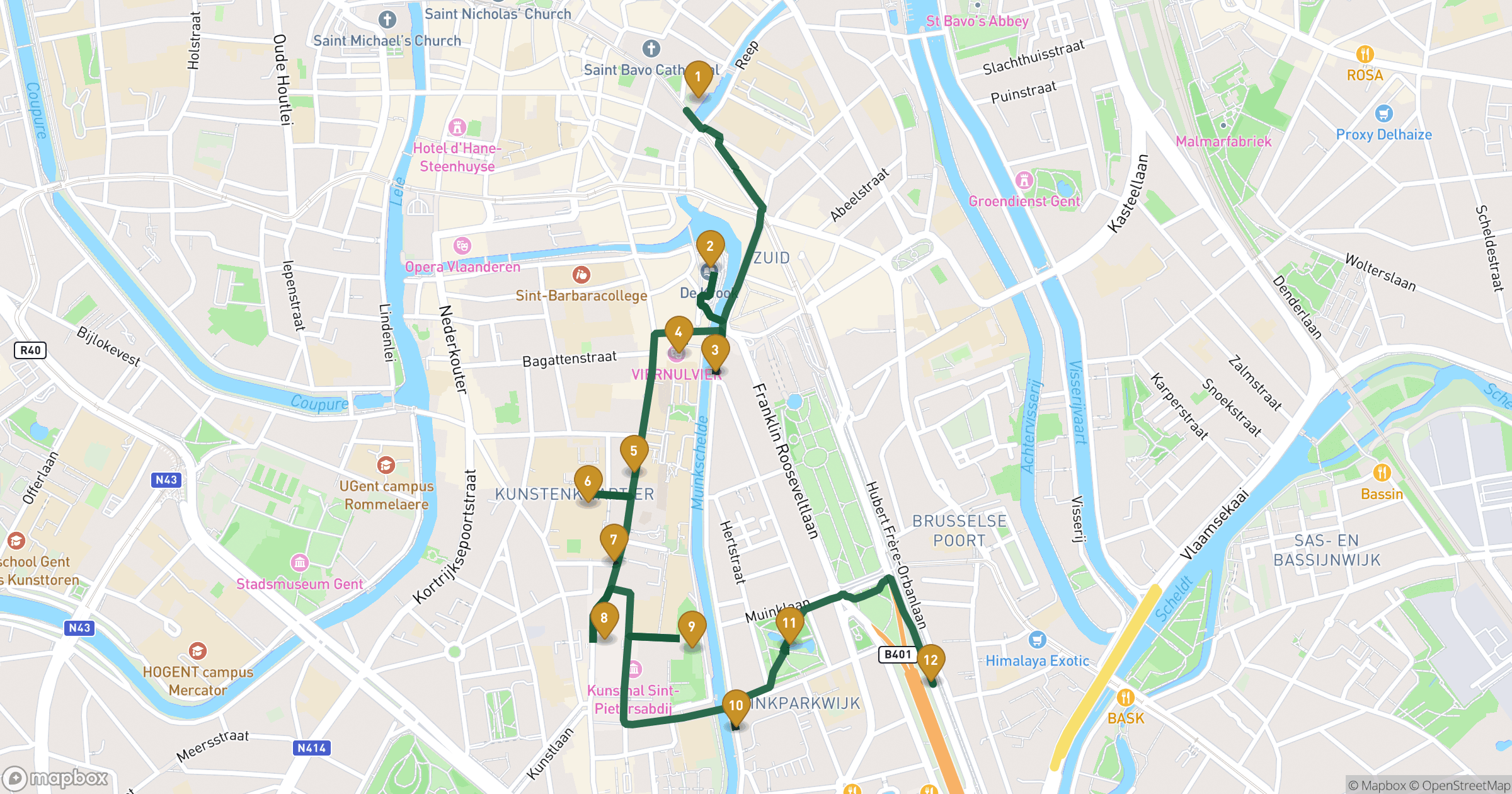
Map for Ghent walking tour with 12 stops
The static map shows the tour route with Geeraard de Duivelsteen, De Krook, Muinkkaai, De Vooruit, and 8 more stops.

Stops along the route

All stops on this self-guided tour at a glance.

  1. Geeraard de Duivelsteen in Ghent
    User:LimoWreck / CC BY-SA 3.0

    1Geeraard de DuivelsteenCastle

    Geeraard de Duivelsteen is a 13th-century Gothic fortress shaped by an ominous nickname that actually originated from a nobleman's dark complexion. Geeraard Vilain built the castle around 1225 before it successively served as an armory, insane asylum, and prison until the Rasphuis opened in 1775. The damp stone walls eventually housed the national archives and later inspired the villain's lair in the Nero comic series.

    Built: 1225 · Style: Gothic architecture · Named after: Geeraard de Duivel · Wikidata

  2. De Krook in Ghent
    Davidh820 / CC BY-SA 4.0

    2De KrookBuilding

    De Krook presents an uncompromising stack of steel slats built right along a sharp bend in the Scheldt. Architects RCR Arquitectes and Coussée & Goris unveiled this modern library in 2017 upon the old Waalse Krook coal wharves. Beyond traditional shelves, the metallic complex operates radio studios, 3D printing labs, and expansive study zones.

    Architect: Coussée en Goris Architecten, RCR Arquitectes · Named after: Waalse Krook · Wikidata

  3. Muinkkaai in Ghent
    Demeester / CC BY-SA 3.0

    3MuinkkaaiBuilding

    Muinkkaai preserves the riverside domain once held by the Benedictine monks of nearby St. Peter’s Abbey. Elegant 19th-century townhouses overlook the Muinkschelde, where the city’s textile trade once flowed continuously. Weeping willows along the banks frame the promenade, having originally been planted to stabilize the soil rather than purely decorate the water.

    Wikidata

  4. De Vooruit in Ghent
    EmDee / CC BY 4.0

    4De VooruitTheatre

    De Vooruit stands as a monument to early socialist organizing wrapped in lavish Art Nouveau architecture. Ferdinand Dierkens designed this grand cooperative hub between 1911 and 1914 to provide affordable bread, books, and union gatherings for local factory workers. The building is officially rebranded as VIERNULVIER, though its original carved facade and spirited terrace remain intact.

    Architect: Dial Architects, Callebaut Architecten … · Style: Art Nouveau architecture · Wikidata

  5. Sint-Pietersnieuwstraat in Ghent
    Demeester / CC BY-SA 3.0

    5Sint-PietersnieuwstraatMonument

    Sint-Pietersnieuwstraat serves as the frenetic uphill corridor connecting Ghent's historic core to its university district. Flemish master Hugo van der Goes is believed to have painted his renowned Portinari Altarpiece along this street between 1473 and 1478. Modern lecture halls and medieval foundations now stand alongside niche bookshops and vegan bistros.

    Wikidata

  6. Boekentoren in Ghent
    Geert Roels / CC BY-SA 4.0

    6BoekentorenBuilding

    The Boekentoren forms the city’s fourth skyline tower, constructed out of reinforced concrete to house over three million library volumes. Modernist architect Henry van de Velde began designing this 64-meter monument to functionalism in the 1930s at the age of seventy. Perched right at the summit, the glass Belvédère room served as a German military observation post during World War II.

    Built: 1817 · Wikidata

  7. Blandijnberg in Ghent
    Demeester / CC BY-SA 3.0

    7BlandijnbergBuilding

    Blandijnberg marks Ghent's natural high point, rising twenty-nine meters above sea level as a historic center for scholarship since the 7th century. In the 1950s, architect Gustave Roelants erected a modernist block of concrete and glass here to house the Faculty of Arts and Philosophy. Its open terrace grants an elevated vantage point sweeping across the city's three famous medieval spires.

    Wikidata

  8. Sint-Pietersplein in Ghent
    EvelienBauwens / CC BY-SA 4.0

    8Sint-PieterspleinSquare

    Sint-Pietersplein is a vast 19th-century neoclassical plaza laid out over grounds that long served as the abbey's cemetery. City architect Charles Leclerc-Restiaux conceived the open esplanade to frame the massive domed Baroque church conceived by Jesuit Pieter Huyssens. During the French occupation, the space became a military parade ground, whereas today it hosts the massive Halfvastenfoor carnival.

    Named after: Saint Peter · Wikidata

  9. Abdijtuin Sint-Pietersabdij in Ghent
    Demeester / CC BY-SA 3.0

    9Abdijtuin Sint-PietersabdijPark

    Abdijtuin Sint-Pietersabdij is a restored monastic garden secluded behind high stone abbey walls. A vineyard revived by the Wijnmetersgilde in the 1980s maintains viticultural practices tracing straight back to the Middle Ages. Among the lavender rows and strict geometric paths stand the romantic brick ruins of the historic abbey infirmary.

  10. Ter Platen in Ghent
    Vlaamse Gemeenschap / CC BY 4.0

    10Ter Platen

    Ter Platen developed around the heavy cotton manufacturing that powered Ghent’s 19th-century textile economy. The former mill grounds along the Muinkschelde now house a giant Kinepolis cinema complex alongside popular riverside dining terraces. Sturdy industrial brickwork still contrasts with the fine 19th-century townhouses where factory owners once watched over their workers.

    Wikidata

  11. Muinkpark in Ghent
    Van der Linden, Geert | https://id.erfgoed.net/afbeeldingen/180838 / CC BY 4.0

    11Muinkpark

    Muinkpark is an English-style landscape park built entirely within the former grounds of the Ghent Zoo. From 1851 to 1904, bourgeois crowds walked these pathways to view exotic animals like Betsy the elephant before the site went bankrupt. Today, the park's winding paths trace the original animal enclosures, framed by eclectic and Art Nouveau homes.

    Wikidata

  12. 12ZuidparklaanBuilding

    Zuidparklaan marks the entrance to King Albert I Park, laid out symmetrically across land formerly occupied by the Ghent-South railway station. Formed in the 1930s, this green expanse centers on a monumental fountain framed by broad lawns and manicured flower beds. A massive memorial honors the wartime leader who famously refused to abandon his troops in the Yser trenches.

    Wikidata

Download the app

This public page shows a preview. The full route, all content, and navigation are available in CityTour AI.

Cities nearby

Discover self-guided tours in nearby cities.

Frequently asked questions

The key answers before you start.

Is this a self-guided audio tour?

Yes. In the CityTour AI app (iOS and Android), this is a self-guided audio tour for Ghent — start anytime, at your own pace, with map, stops, and audio narration.

What will you see on this tour?

On this tour you'll see, among others, Geeraard de Duivelsteen, De Krook, Muinkkaai, De Vooruit, Sint-Pietersnieuwstraat, Boekentoren and more sights.

Where does the tour start?

The route starts at Geeraard de Duivelsteen and ends at Zuidparklaan. You can start anytime — the app guides you to the first stop.

How long does the tour take?

About 105 minutes for 12 stops — at your own pace, with breaks whenever you like.

How much does the tour cost?

This tour costs 15 credits. The exact price depends on the pack you buy and your country — roughly $5.

Is it an outdoor tour — are entry tickets included?

Yes, it's an outdoor tour: the sights are viewed from the outside. Entry tickets are not included, and step-free access cannot be guaranteed.

Is the audio guide available in my language?

The tour and audio guide are available in English, Deutsch, Français, Español, Italiano and 9 more languages. You pick your language in the app.

Can I use the tour offline?

Yes. Tours can be used offline.

Can I ask the AI questions along the way?

Yes. At every stop you can ask the AI directly if you want to know more or didn't understand something.