CityTour AI

Leuven self-guided walking tour

Leuven: From Medieval Walls to University Halls

Discover the 'Oxford of Belgium' on a casual stroll through a city where medieval history meets a vibrant student soul. You'll see the world's most ornate Gothic town hall, explore the 'longest bar in the world,' and find peace in a hidden UNESCO-listed village. This tour captures the resilient spirit and academic prestige of Leuven, all while keeping the atmosphere light and local.

Audio tourSelf-guidediOS & Android
105minutes
2.9 kmdistance
13stops
Audio guideFormat
Leuven: From Medieval Walls to University Halls
Jean Housen / CC BY-SA 4.0

Stops on this route

This tour works well for first-time visitors, weekend trips, and travelers who want to explore Leuven without a fixed tour time.

Route map for Leuven walking tour
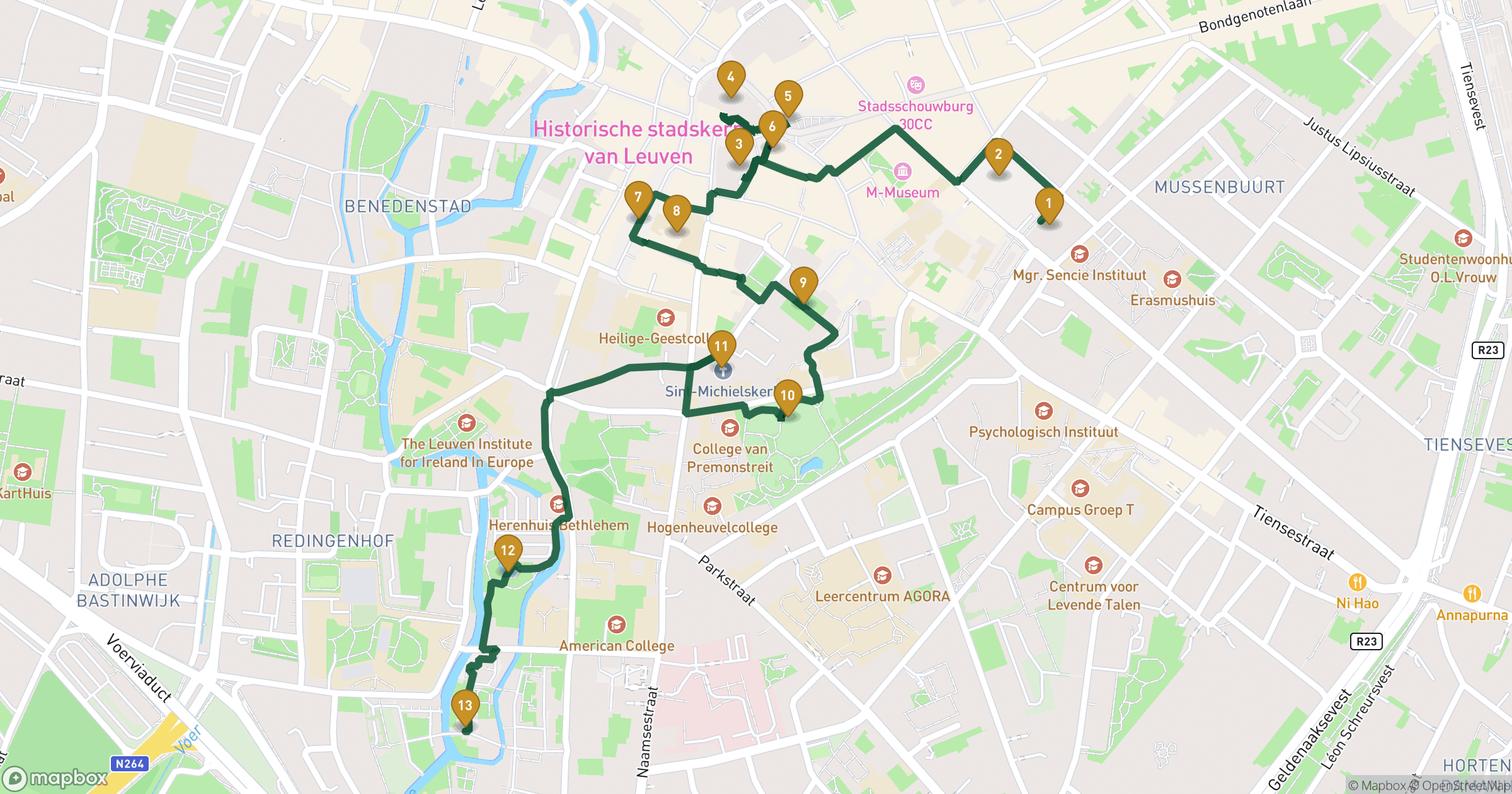
Map for Leuven walking tour with 13 stops
The static map shows the tour route with Universiteitsbibliotheek, Totem, Stadhuis van Leuven, Sint-Pieterskerk, and 9 more stops.

Stops along the route

All stops on this self-guided tour at a glance.

  1. Universiteitsbibliotheek in Leuven
    Trougnouf (Benoit Brummer) / CC BY 4.0

    1UniversiteitsbibliotheekBuilding

    Standing in Ladeuzeplein, the university library illustrates the city's resilience after being destroyed twice during the world wars. Designed by American architect Whitney Warren, the building features stones carved with the names of US schools that financed its 1928 reconstruction. The central tower houses one of the world's largest carillons, containing 63 bells gifted by American engineers.

    Wikidata

  2. Totem in Leuven
    Funke / CC BY-SA 3.0

    2TotemMonument

    In the center of the square stands Totem, an eye-catching contemporary work by Belgian artist Jan Fabre that honors KU Leuven's 575th anniversary. Unveiled in 2004, the monument consists of a 23-meter-tall stainless steel needle impaling an iridescent jewel beetle. Fabre chose the insect for its protective shell as biological memory, contrasting scientific research with the historic library behind it.

    Built: 2004 · Wikidata

  3. Stadhuis van Leuven in Leuven
    Giles Laurent / CC BY-SA 4.0

    3Stadhuis van LeuvenBuilding

    Leuven Town Hall is a Brabantine Late Gothic civic masterpiece designed by Matthijs de Layens to resemble a giant reliquary box. Constructed between 1448 and 1469, its stone-lace facade gained 236 statues only after 1850, organizing local citizens, patron saints, and nobility into three distinct vertical tiers. Beneath the figures, carved corbels illustrate moral lessons and biblical scenes laced with medieval humor.

    Built: 1439 · Architect: Matheus de Layens, Sulpitius van Vorst … · Style: Flamboyant … · Wikidata

  4. Sint-Pieterskerk in Leuven
    Johan Bakker / CC BY-SA 3.0

    4Sint-PieterskerkChurch

    Sint-Pieterskerk is the city's oldest religious site, marked by a truncated silhouette left flat after ambitious 16th-century spire plans failed. Construction of a planned 170-meter central tower was abandoned in 1613 because unstable marshy ground repeatedly triggered collapses. Inside hangs Dieric Bouts's 1460s masterpiece 'The Last Supper,' which used contemporary local Leuven citizens as models for the apostles.

    Built: 1425 · Architect: Raymond M. Lemaire, Matheus de Layens … · Style: Gothic architecture · Named after: Saint Peter · Wikidata

  5. Fonske in Leuven
    Adiel lo / CC BY-SA 3.0

    5FonskeMonument

    Located just off the main church, the bronze statue of Fonske captures Leuven's blend of high academic ambition and active student nightlife. Created by Jef Claerhout in 1975 for the university's 550th anniversary, the figure pours liquid into his head while holding a book open to a liquid behavior formula. While officially representing incoming wisdom, locals regard the beverage as a nod to Stella Artois beer.

    Built: 1975 · Wikidata

  6. Tafelrond Leuven in Leuven
    Vandevorst, Kris / CC BY 4.0

    6Tafelrond LeuvenBuilding

    The Tafelrond on the Grote Markt is a 20th-century Gothic reconstruction that resurrected a lost 15th-century guild house designed by Matthijs de Layens. Demolished in the 19th century and replaced by a Neoclassical theater that burned down in 1914, the site was deliberately rebuilt using the medieval plans. The finished building features three distinct facades and twelve bays, operating today as a luxury hotel.

    Architect: Matheus de Layens · Style: Gothic architecture · Wikidata

  7. Oude Markt in Leuven
    Latinista / CC BY-SA 3.0

    7Oude MarktSquare

    Known as the 'longest bar in the world,' the Oude Markt is lined with continuous café terraces set against reconstructed gabled facades. After fire leveled the square during the 1914 Sack of Leuven, architects rebuilt the homes in the 1920s using diverse regional Baroque and Renaissance styles. Near the terraces sits Fred Bellefroid’s 1985 bronze statue of De Kotmadam, celebrating the city's student landladies.

    Wikidata

  8. University Hall in Leuven
    Frie Van Grunderbeeck / CC BY-SA 3.0

    8University HallBuilding

    The University Hall, or Lakenhal, embodies the administrative heart of KU Leuven inside a structure originally begun in 1317 for textile trade. The building caught fire during the German invasion in August 1914, incinerating 300,000 historic books and medieval manuscripts. Above the main entrance sits a late 17th-century cartouche declaring 'Sapientia aedificavit sibi domum,' or 'Wisdom has built herself a house.'

    Architect: Lava architecten, VBM Architecten … · Wikidata

  9. Pope's College, Leuven in Leuven
    Jeanhousen / CC BY 3.0

    9Pope's College, LeuvenBuilding

    The Pope’s College was established in 1523 by Adrian VI, the only pope born in the Low Countries, to house impoverished theology students. After the original structure collapsed in 1775, architect M. Ghenne designed the present neoclassical facade seen today. The complex served as a military barracks for Napoleon's troops in 1811 before returning to its original purpose as student housing in 1835.

    Built: 1523 · Architect: Barbara Van Der Wee architects, A2D architecten · Wikidata

  10. Sint-Donatuspark in Leuven
    Funke / CC BY-SA 3.0

    10Sint-Donatuspark

    Sint-Donatuspark preserves the most substantial surviving remnants of Leuven's original 12th-century defensive fortifications. Built between 1150 and 1160, this initial sandstone circuit once stretched 2.7 kilometers and contained 31 defensive towers alongside 11 city gates. Two preserved military towers crafted from local Gobertange sandstone still rise directly alongside the park's 19th-century bandstand.

    Wikidata

  11. Sint-Michielskerk in Leuven
    Jean Housen / CC BY-SA 4.0

    11Sint-MichielskerkChurch

    Sint-Michielskerk is an exuberant Counter-Reformation church designed by Jesuit architect Willem Hesius and completed in 1671. Nicknamed the 'altar outside the church,' the building showcases a richly carved facade arranged into three distinct tiers beneath a monumental pediment. Following severe damage from 1944 aerial bombings, detailed restoration preserved its light-filled nave and ornate Baroque woodwork.

    Built: 1671 · Architect: Lucas Faydherbe, Eugène Frische … · Style: baroque architecture · Named after: Michael · Wikidata

  12. Dijlepark in Leuven
    Sally V / CC BY-SA 4.0

    12Dijlepark

    Dijlepark is a secluded retreat hidden behind residential facades that provides rare open access to the Dijle river. The site features an iron footbridge offering views along the waterway that once carried cloth and beer to fuel the medieval economy. Unlike other stretches of the river that flow underground or behind private buildings, the water here runs openly through tranquil landscaped grounds.

    Wikidata

  13. Groot Begijnhof in Leuven
    Public domain

    13Groot BegijnhofBuilding

    The Groot Begijnhof is an enclosed 13th-century community founded around 1232 for Beguines, religious women who lived without taking perpetual vows. The community's Saint John the Baptist Church was deliberately built with a modest turret instead of a bell tower to symbolize humility. Leuven's final Beguine lived here until 1988, after KU Leuven acquired the complex in 1962 for university housing.

    Wikidata

Download the app

This public page shows a preview. The full route, all content, and navigation are available in CityTour AI.

Cities nearby

Discover self-guided tours in nearby cities.

Frequently asked questions

The key answers before you start.

Is this a self-guided audio tour?

Yes. In the CityTour AI app (iOS and Android), this is a self-guided audio tour for Leuven — start anytime, at your own pace, with map, stops, and audio narration.

What will you see on this tour?

On this tour you'll see, among others, Universiteitsbibliotheek, Totem, Stadhuis van Leuven, Sint-Pieterskerk, Fonske, Tafelrond Leuven and more sights.

Where does the tour start?

The route starts at Universiteitsbibliotheek and ends at Groot Begijnhof. You can start anytime — the app guides you to the first stop.

How long does the tour take?

About 105 minutes for 13 stops — at your own pace, with breaks whenever you like.

How much does the tour cost?

This tour costs 15 credits. The exact price depends on the pack you buy and your country — roughly $5.

Is it an outdoor tour — are entry tickets included?

Yes, it's an outdoor tour: the sights are viewed from the outside. Entry tickets are not included, and step-free access cannot be guaranteed.

Is the audio guide available in my language?

The tour and audio guide are available in English, Deutsch, Français, Español, Italiano and 9 more languages. You pick your language in the app.

Can I use the tour offline?

Yes. Tours can be used offline.

Can I ask the AI questions along the way?

Yes. At every stop you can ask the AI directly if you want to know more or didn't understand something.