CityTour AI

Mostar self-guided walking tour

Mostar: A Bridge Between Eras

Experience the architectural layers of Mostar on a casual stroll that takes you from the haunting beauty of Yugoslav monuments to the world-famous Ottoman Old Bridge. You'll wander through bustling bazaars and past grand Austro-Hungarian landmarks, discovering how this resilient city has blended diverse cultures into a single, stunning landscape. It’s a journey through time that reveals the soul of Herzegovina beyond the typical tourist photos.

Audio tourSelf-guidediOS & Android
102minutes
3.5 kmdistance
12stops
Audio guideFormat
Mostar: A Bridge Between Eras
Jennifer Boyer / CC BY 2.0

Stops on this route

This tour works well for first-time visitors, weekend trips, and travelers who want to explore Mostar without a fixed tour time.

Route map for Mostar walking tour
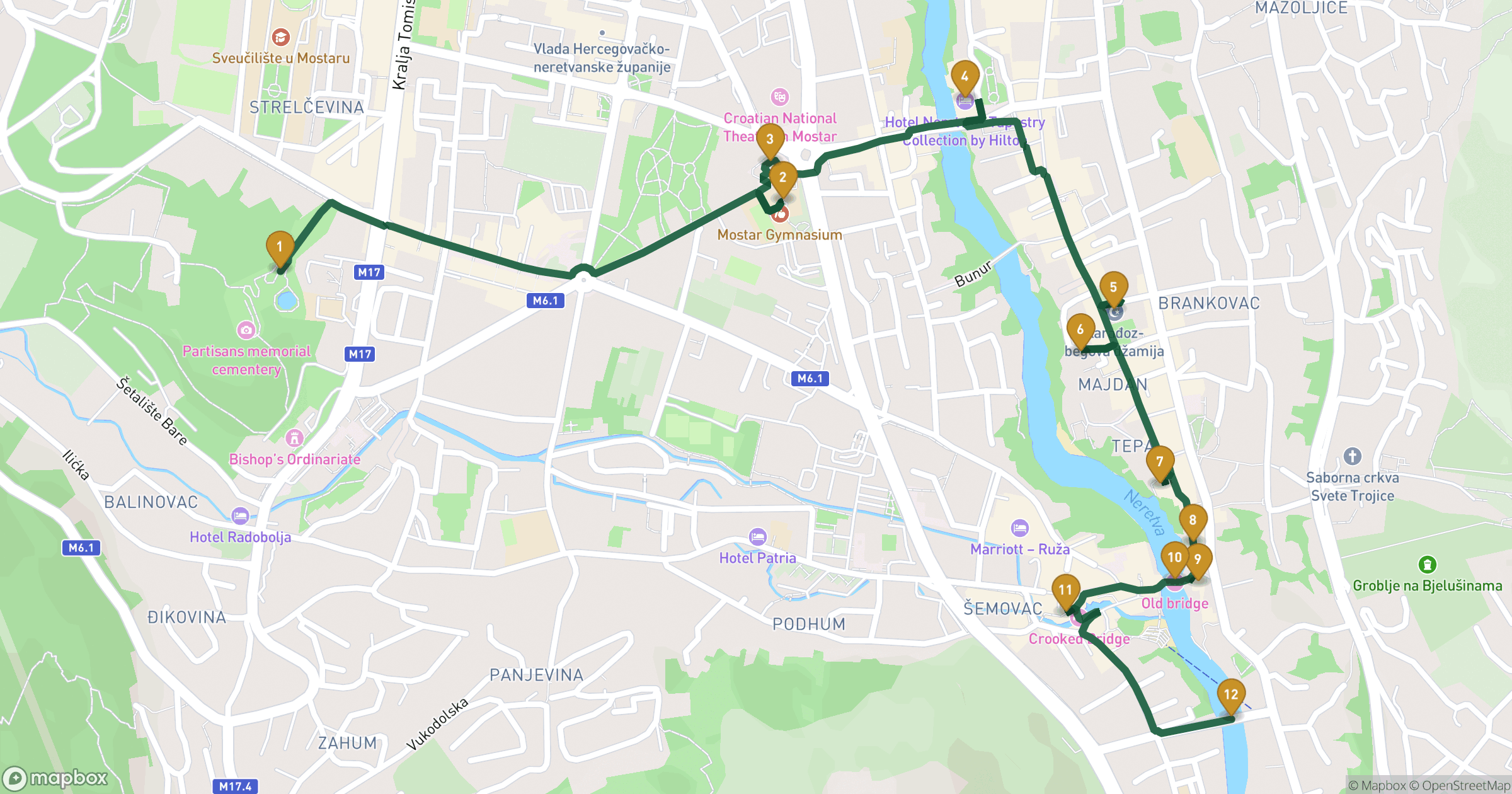
Map for Mostar walking tour with 12 stops
The static map shows the tour route with Partisan cemetery in Mostar, Gimnazija Mostar, place d'Espagne, Hotel Neretva, and 8 more stops.

Stops along the route

All stops on this self-guided tour at a glance.

  1. Partisan cemetery in Mostar in Mostar
    Kondephy / CC BY-SA 4.0

    1Partisan cemetery in MostarPark

    Set into the slopes of Bijeli Brijeg, this surrealist memorial cemetery was conceived by architect Bogdan Bogdanović to honor 810 fallen World War II fighters. Opened by Josip Broz Tito in 1965, the terraced site required engineer Ahmet Ribica to blast the hillside with dynamite. Its jagged, organic stone markers suffered heavy wartime damage and vandalism, including the smashing of hundreds of tombstones in 2022.

    Built: 1965 · Architect: Bogdan Bogdanović · Wikidata

  2. Gimnazija Mostar in Mostar
    Jennifer Boyer / CC BY 2.0

    2Gimnazija MostarBuilding

    Standing by Spanish Square, this vivid orange gymnasium showcases Moorish Revival architecture commissioned by Austro-Hungarian authorities in 1893. Under its first principal, Slovene philologist Martin Bedjanič, it pioneered local integration by bringing Catholic, Orthodox, Muslim, and Jewish pupils together under one roof. Restored after suffering wartime destruction in the 1990s, the building continues to serve as an active high school.

    Built: 1893 · Style: Moorish Revival architecture · Wikidata

  3. 3place d'EspagneMonument

    Spanish Square forms the civic center of Mostar, honoring the 23 Spanish UN peacekeepers who died during the Bosnian War. In 2012, King Juan Carlos I of Spain attended the square's major inauguration following a state-funded overhaul. Today, its central fountain and pergolas serve as a lively gathering point where local students meet between modern neighborhoods and the historic quarter.

    Wikidata

  4. Hotel Neretva in Mostar
    Unknown authorUnknown author / Public domain

    4Hotel NeretvaBuilding

    Designed by Alexander Wittek in 1892, the ruined Hotel Neretva showcases a striped pseudo-Moorish facade that once defined the city's high society. Prague-trained chefs served Viennese specialties in an elegant salon that hosted figures ranging from Emperor Franz Joseph to Josip Broz Tito. Severely damaged in 1992 during the conflict, the vacant building shell now awaits restoration into a modern hotel.

    Built: 1892 · Wikidata

  5. Karadzozbey Mosque in Mostar
    donchili / CC BY-SA 2.0

    5Karadzozbey MosqueChurch

    Rising beside an octagonal drum, the Karađoz Bey Mosque is a 1557 classical Ottoman work attributed to chief architect Mimar Sinan. Local patron Mehmed Beg, brother to a high-ranking vizier, funded the cubic prayer hall beneath a massive dome measuring over 10 meters across. Although its 34.5-meter minaret and roof sustained direct shell strikes in the 1990s, complete reconstruction finished in 2004.

    Built: 1557 · Architect: Mimar Sinan · Style: Ottoman architecture · Named after: Karagöz Mehmet Paşa · Wikidata

  6. Residential complex of Biščević-Lakšić in Mostar
    LBM1948 / CC BY-SA 4.0

    6Residential complex of Biščević-LakšićBuilding

    The 18th-century Biščević House highlights the domestic routines of a prominent local clan that settled in the city during the early 1600s. Its standout feature is the ćošak, an overhanging timber balcony supported high above the Neretva River by two soaring stone pillars. Behind the enclosed family quarters and walled courtyard, the residence now functions as a private museum filled with period furnishings.

    Wikidata

  7. Koski Mehmed Pasha Mosque in Mostar
    rene boulay / CC BY-SA 3.0

    7Koski Mehmed Pasha MosqueChurch

    Overlooking the Neretva from a rocky bank, the 1618 Koski Mehmed Pasha Mosque is one of only three in the city topped with a lead-covered dome. Chronicler Koski Mehmed Pasha died before construction finished, leaving his brother Mahmud to complete the project and its preserved 17th-century tree murals. Visitors can climb 78 stone steps inside the 30-meter minaret or view an antique carpet gifted by Franz Joseph.

    Built: 1618 · Style: Ottoman architecture · Wikidata

  8. Kujundžiluk (Mostar) in Mostar
    11sasapus11 / CC BY-SA 4.0

    8Kujundžiluk (Mostar)Monument

    Paved with river stone, Kujundžiluk is the oldest market street in town and once bustled with over 500 craft workshops. In 1631, famed artisan Hadži Osman made silver pafte buckles here before coppersmiths replaced the early goldsmiths. A devastating 1861 fire nearly detonated the gunpowder stockpiled inside the Tara Tower, though merchants still trade from timber shop fronts called ćepenci today.

    Wikidata

  9. Kula Tara in Mostar
    Mister No / CC BY 3.0

    9Kula TaraMonument

    Guarding the eastern riverbank, the semi-circular Tara Tower gained its massive 3.5-meter-thick stone walls in 1676 to shield the crossing. Named after the mostari toll collectors who once lived here, the fortification historically doubled as a volatile gunpowder and ammunition cache. Today, its five interior floors contain the Old Bridge Museum, which exhibits archaeological artifacts brought up from the riverbed.

  10. Stari Most in Mostar
    Ramirez / CC BY-SA 4.0

    10Stari MostBridge

    The iconic Stari Most arch was erected in 1566 by Mimar Hayruddin, who nervously prepared his own grave before removing the scaffolding. Built from tenelija stone blocks held together by molten lead, the mortared bridge plunged into the Neretva during heavy shelling in 1993. Faithfully restored in 2004 using original quarry material, its 24-meter-high crest remains a traditional diving platform for local youth.

    Built: 1566 · Style: Ottoman architecture · Height: 24 m · Wikidata

  11. Kriva Ćuprija in Mostar
    Christian Bickel / CC BY-SA 2.0 de

    11Kriva ĆuprijaBuilding

    Tucked along the Radobolja tributary, the 1558 Crooked Bridge served as an early stone prototype to verify single-arch techniques ahead of the main bridge's construction. Architect Ćejvan Ketoda adjusted the masonry to compensate for the unequal heights of the opposing riverbanks, leaving a distinctly asymmetrical curve. After collapsing under a massive flood in 2000, it was reassembled using original stones salvaged from the water.

    Style: Ottoman architecture · Wikidata

  12. Lučki most in Mostar
    Raphael Schön from Vienna, Austria / CC BY 2.0

    12Lučki mostBridge

    Erected in 1913, the Lučki most was the first reinforced concrete crossing in Bosnia and Herzegovina, reflecting late-Secessionist styling. Philanthropic mayor Mujaga Komadina funded the bridge, creating an odd toll system where travelers paid only when crossing from the right bank to the left. Rebuilt in 2005 after wartime destruction, its broad sidewalks provide the premier vantage point to photograph the Old Bridge.

    Wikidata

Download the app

This public page shows a preview. The full route, all content, and navigation are available in CityTour AI.

Cities nearby

Discover self-guided tours in nearby cities.

Frequently asked questions

The key answers before you start.

Is this a self-guided audio tour?

Yes. In the CityTour AI app (iOS and Android), this is a self-guided audio tour for Mostar — start anytime, at your own pace, with map, stops, and audio narration.

What will you see on this tour?

On this tour you'll see, among others, Partisan cemetery in Mostar, Gimnazija Mostar, place d'Espagne, Hotel Neretva, Karadzozbey Mosque, Residential complex of Biščević-Lakšić and more sights.

Where does the tour start?

The route starts at Partisan cemetery in Mostar and ends at Lučki most. You can start anytime — the app guides you to the first stop.

How long does the tour take?

About 102 minutes for 12 stops — at your own pace, with breaks whenever you like.

How much does the tour cost?

This tour costs 15 credits. The exact price depends on the pack you buy and your country — roughly $5.

Is it an outdoor tour — are entry tickets included?

Yes, it's an outdoor tour: the sights are viewed from the outside. Entry tickets are not included, and step-free access cannot be guaranteed.

Is the audio guide available in my language?

The tour and audio guide are available in English, Deutsch, Français, Español, Italiano and 9 more languages. You pick your language in the app.

Can I use the tour offline?

Yes. Tours can be used offline.

Can I ask the AI questions along the way?

Yes. At every stop you can ask the AI directly if you want to know more or didn't understand something.