CityTour AI

Sarajevo self-guided walking tour

Sarajevo: Where East Meets West

Experience the soul of the Balkans on this casual stroll through Sarajevo’s historic core, where the Ottoman East meets the Austro-Hungarian West. You’ll wander from the rhythmic copper-lined alleys of the old bazaar to the grand boulevards of the European era, uncovering stories of resilience and coexistence. This walk captures the unique atmosphere of the 'Jerusalem of Europe,' blending world-altering history with the everyday charm of a city that refuses to be forgotten.

Audio tourSelf-guidediOS & Android
105minutes
2.9 kmdistance
14stops
Audio guideFormat
Sarajevo: Where East Meets West
Ladislav Boháč / CC0

Stops on this route

This tour works well for first-time visitors, weekend trips, and travelers who want to explore Sarajevo without a fixed tour time.

Route map for Sarajevo walking tour
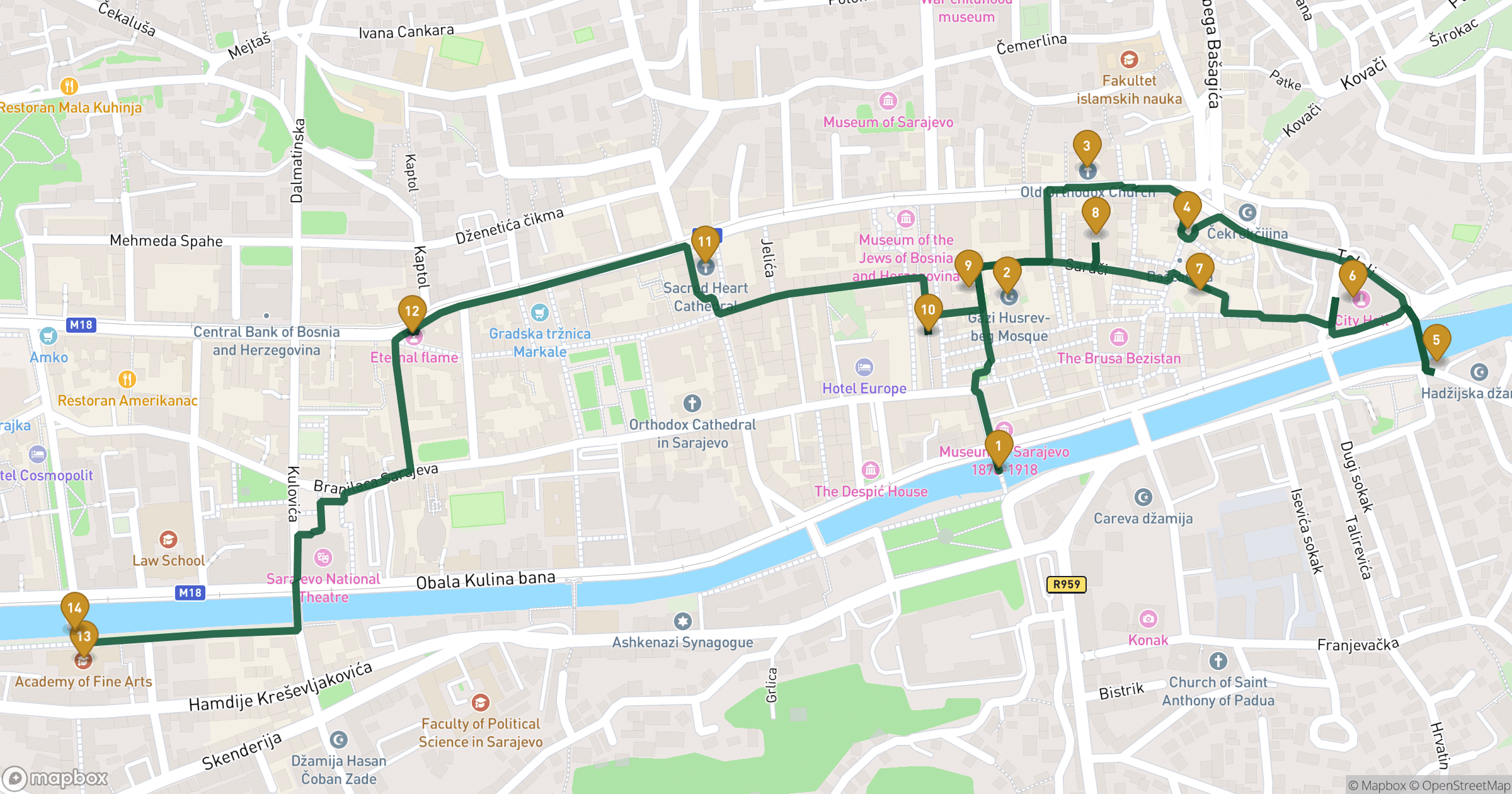
Map for Sarajevo walking tour with 14 stops
The static map shows the tour route with Latin Bridge, Gazi Husrev-beg Mosque, Sarajevo Old Orthodox Church, Sebilj, and 10 more stops.

Stops along the route

All stops on this self-guided tour at a glance.

  1. Latin Bridge in Sarajevo
    sundeviljeff / CC BY 2.0

    1Latin Bridge

    Latin Bridge is an Ottoman stone bridge best known as the scene of the fateful 1914 assassination that triggered World War I. At its northern end, Gavrilo Princip waited for Archduke Franz Ferdinand's motorcade to slow down for the turn before firing the fatal shots. Rebuilt in stone in 1565, it takes its name from Latinluk, the historic neighborhood of Sarajevo's Catholic population.

    Style: Ottoman architecture · Wikidata

  2. Gazi Husrev-beg Mosque in Sarajevo
    Brian Eager from Livno, Bosnia and Herzegovina / CC BY 2.0

    2Gazi Husrev-beg MosqueChurch

    Gazi Husrev-beg Mosque stands as the core of Ottoman Sarajevo, established in 1530 as part of an expansive urban endowment. Designed primarily by imperial architect Acem Ali Tabrizi, its construction drew skilled stone masons from Ragusa, today's Dubrovnik. Under Austro-Hungarian rule in 1898, this historic sanctuary became the first mosque in the world to be electrified.

    Built: 1531 · Architect: Mimar Sinan · Style: Ottoman architecture … · Named after: Gazi Husrev-beg · Wikidata

  3. Sarajevo Old Orthodox Church in Sarajevo
    Niegodzisie / CC BY-SA 4.0

    3Sarajevo Old Orthodox Church

    The Old Orthodox Church, dedicated to the Archangels Michael and Gabriel, has an unusual floor plan that is notably wider than it is long. Ottoman regulations barred non-Islamic sanctuaries from exceeding mosques in height or prominence, forcing builders to sink the floor below ground and expand horizontally. Founded in 1889, its museum preserves the rare 14th-century Sarajevo Codex.

    Built: 1539 · Named after: Gabriel · Wikidata

  4. Sebilj in Sarajevo
    Natalie Wilson from Edinburgh, Scotland / CC BY 2.0

    4SebiljWater

    The Sebilj is an iconic wooden, mushroom-shaped public kiosk fountain in the heart of Baščaršija Square. Austrian architect Alexander Wittek designed the current pseudo-Moorish structure in 1891, drawing inspiration from the kiosks of Istanbul after the 1753 original burned down. According to popular local belief, anyone who drinks water from this fountain will one day return to Sarajevo.

    Built: 1753 · Style: Neoclassical architecture · Wikidata

  5. Inat house in Sarajevo
    CeeGee / CC BY-SA 4.0

    5Inat houseAttraction

    Inat kuća, or the House of Spite, embodies local stubbornness across the Miljacka river from the grand City Hall. When Austro-Hungarian officials requisitioned the land, a resident named Benderija demanded a sack of gold ducats and insisted his home be moved brick by brick to the opposite bank. Today it operates as a restaurant, retaining interior quirks like windows set flush with the floor.

    Wikidata

  6. Vijećnica in Sarajevo
    Ladislav Boháč / CC0

    6VijećnicaMonument

    Sarajevo City Hall, or Vijećnica, is a distinctive triangular building constructed in the Pseudo-Moorish style. Archduke Franz Ferdinand attended a formal reception here on June 28, 1914, just minutes before he was assassinated. Later home to the National and University Library, it was deliberately shelled and burned during the 1992 siege, destroying nearly two million books.

    Built: 1891 · Architect: Karel Pařík · Wikidata

  7. Kazandžiluk in Sarajevo
    11sasapus11 / CC BY-SA 4.0

    7KazandžilukSquare

    Kazandžiluk is a narrow Baščaršija alley filled with the rhythmic metallic tapping of hammers shaping raw copper. Part of a protected urban ensemble, this lane has served as the hub of the city's coppersmith trade since the 16th century. Artisans working at small anvils still handcraft intricate plates and traditional coffee sets using techniques handed down for generations.

    Wikidata

  8. Morića Han in Sarajevo
    Jennifer Boyer from Fredrick, Maryland, USA / CC BY 2.0

    8Morića HanMarket

    Morića Han is an authentic Ottoman caravanserai that once provided shelter to Silk Road traders and their pack animals. At its height, the inn accommodated up to 300 travelers on the upper floor above ground-level stables built for 70 horses. Carefully rebuilt after a 1957 fire, its wooden galleries feature Persian calligraphy painted with verses by poet Omar Khayyám.

    Wikidata

  9. Clock Tower of Sarajevo in Sarajevo
    Dans / CC BY-SA 4.0

    9Clock Tower of Sarajevo

    Sarajevo Clock Tower is a 30-meter stone landmark that keeps lunar time, striking twelve exactly at sunset to mark the Maghrib prayer. In 1874, the tower's original Turkish mechanism was replaced with a precision clock imported from the London firm Gillett & Bland. A specialist timekeeper, the muvakkit, climbs the tower weekly to calibrate the gears using astronomical tools.

    Built: 17 · Style: vernacular architecture … · Wikidata

  10. Gazi Husrev-beg bezistan in Sarajevo
    Christian Bickel / CC BY-SA 2.0 de

    10Gazi Husrev-beg bezistanMarket

    Gazi Husrev Bey's Bezistan is a 109-meter-long vaulted stone market hall that has functioned as a trade center since 1555. Masons from Dubrovnik built the structure with sunken floors, ensuring it remains naturally cool during warm Bosnian summers. It originally formed part of an interconnected complex alongside the Tashlihan, a stone inn destroyed by fire in 1879.

    Named after: Gazi Husrev-beg · Wikidata

  11. Cathedral of Jesus' Heart in Sarajevo
    acediscovery / CC BY 4.0

    11Cathedral of Jesus' HeartChurch

    Sacred Heart Cathedral is a grand Neo-Gothic landmark completed in 1889 that reflects Sarajevo's Austro-Hungarian development. Architect Josip Vancaš, who was only 25 when he took on the project, modeled the building's facade after the Church of Notre-Dame in Dijon. The altar of the Immaculate Conception in the western aisle was a personal gift from Emperor Franz Joseph I.

    Built: 1889 · Architect: Josip Vancaš · Style: Gothic Revival · Wikidata

  12. Eternal Flame Memorial in Sarajevo
    Francisco Antunes from London, United Kingdom / CC BY 2.0

    12Eternal Flame MemorialMonument

    The Eternal Flame Memorial is a street-level monument unveiled on April 6, 1946, to honor the city's liberation from World War II fascist occupation. Set into the former Landesbank building, the natural-gas flame burns continuously within a bronze hearth designed by architect Juraj Neidhardt. Because April 6 also marks the start of the 1992 siege, it now commemorates victims of both wars.

    Built: 1946 · Wikidata

  13. Academy of Fine Arts Sarajevo in Sarajevo
    Mister No / CC BY 3.0

    13Academy of Fine Arts SarajevoBuilding

    The Academy of Fine Arts occupies a domed riverfront landmark originally built in 1899 as Sarajevo's sole Evangelical church. Czech architect Karlo Paržik combined Romanesque-Byzantine forms with Austrian Secessionist details to create its distinctive stone facade. Prominent artists including painter Mersad Berber helped repurpose the sanctuary into an art school in 1972.

    Built: 1972 · Wikidata

  14. Festina lente in Sarajevo
    Julian Nyča / CC BY-SA 3.0

    14Festina lenteBridge

    Festina Lente is a modern pedestrian bridge over the Miljacka river whose Latin name translates to 'make haste slowly'. Opened in August 2012, its design was created by Adnan Alagić, Amila Hrustić, and Bojana Kanlić while studying at the neighboring Academy of Fine Arts. A 38-meter looping steel gate houses two wooden benches, offering passersby a place to pause over the water.

    Wikidata

Download the app

This public page shows a preview. The full route, all content, and navigation are available in CityTour AI.

Cities nearby

Discover self-guided tours in nearby cities.

Frequently asked questions

The key answers before you start.

Is this a self-guided audio tour?

Yes. In the CityTour AI app (iOS and Android), this is a self-guided audio tour for Sarajevo — start anytime, at your own pace, with map, stops, and audio narration.

What will you see on this tour?

On this tour you'll see, among others, Latin Bridge, Gazi Husrev-beg Mosque, Sarajevo Old Orthodox Church, Sebilj, Inat house, Vijećnica and more sights.

Where does the tour start?

The route starts at Latin Bridge and ends at Festina lente. You can start anytime — the app guides you to the first stop.

How long does the tour take?

About 105 minutes for 14 stops — at your own pace, with breaks whenever you like.

How much does the tour cost?

This tour costs 15 credits. The exact price depends on the pack you buy and your country — roughly $5.

Is it an outdoor tour — are entry tickets included?

Yes, it's an outdoor tour: the sights are viewed from the outside. Entry tickets are not included, and step-free access cannot be guaranteed.

Is the audio guide available in my language?

The tour and audio guide are available in English, Deutsch, Français, Español, Italiano and 9 more languages. You pick your language in the app.

Can I use the tour offline?

Yes. Tours can be used offline.

Can I ask the AI questions along the way?

Yes. At every stop you can ask the AI directly if you want to know more or didn't understand something.