CityTour AI

Sofia self-guided walking tour

Sofia’s Layers: From Serdica to Little Vienna

Experience the fascinating layers of one of Europe's oldest capitals on this casual stroll through Sofia’s historic center. You’ll explore a unique landscape where Roman ruins, golden-domed cathedrals, and socialist monuments stand side-by-side. This tour highlights the city's famous 'Square of Religious Tolerance' and the grand architecture that earned Sofia the nickname 'Little Vienna.'

Audio tourSelf-guidediOS & Android
98minutes
3.0 kmdistance
12stops
Audio guideFormat
Sofia’s Layers: From Serdica to Little Vienna
MrPanyGoff / CC BY-SA 3.0

Stops on this route

This tour works well for first-time visitors, weekend trips, and travelers who want to explore Sofia without a fixed tour time.

Route map for Sofia walking tour
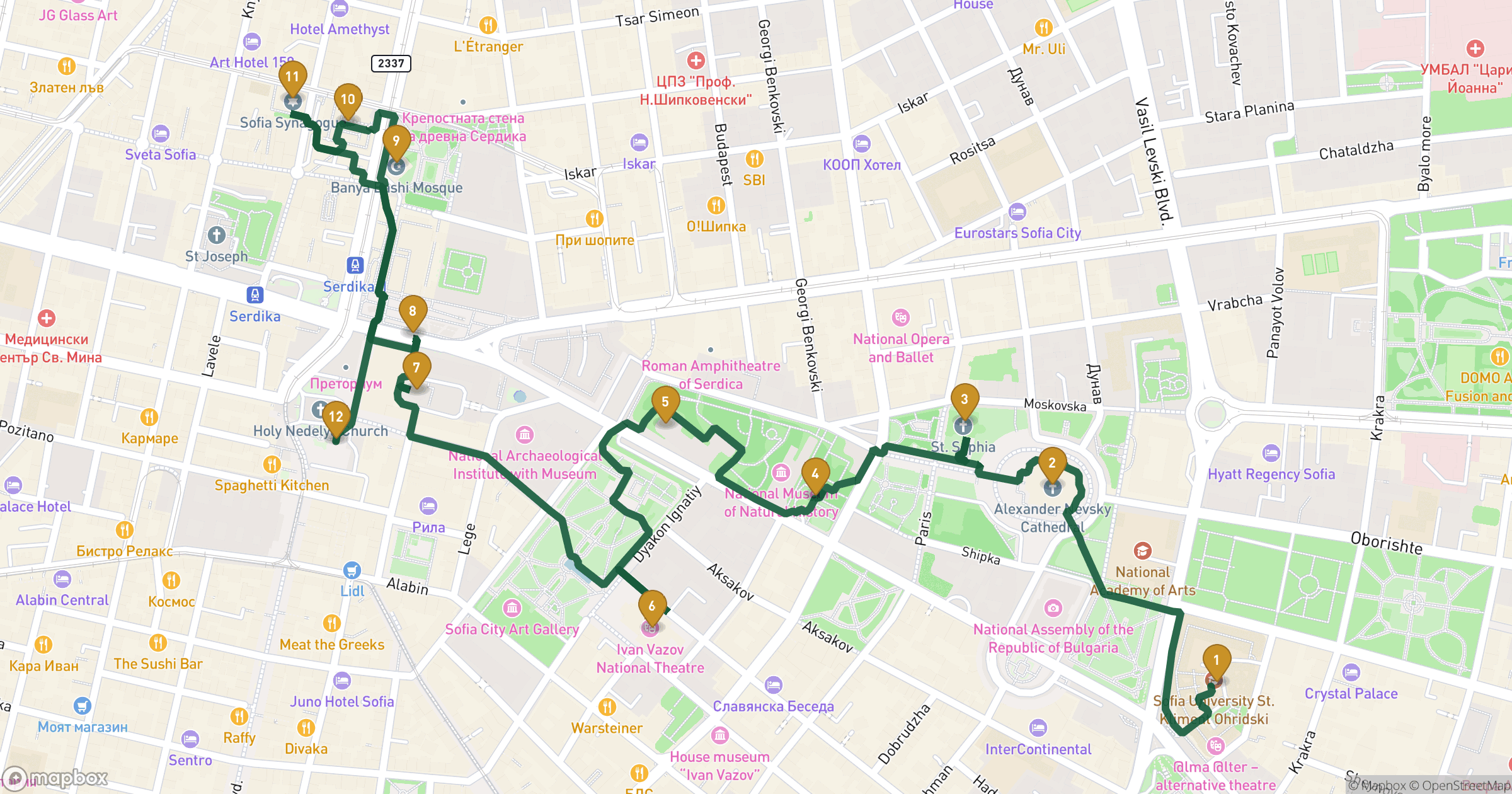
Map for Sofia walking tour with 12 stops
The static map shows the tour route with Sofia University, Alexander Nevsky Cathedral, Saint Sophia Church, Russian Church, Sofia, and 8 more stops.

Stops along the route

All stops on this self-guided tour at a glance.

  1. Sofia University in Sofia
    MrPanyGoff / CC BY-SA 3.0

    1Sofia UniversityBuilding

    Sofia University St. Kliment Ohridski embodies modern Bulgaria's academic ambition through its monumental Baroque Revival design. Brothers Evlogi and Hristo Georgiev provided the crucial funding, with Evlogi stipulating in his will that the institution be a Higher School located strictly in Sofia. Flanking the main entrance, two bronze seated statues commemorate the brothers.

    Built: 1888 · Named after: Clement of Ohrid · Wikidata

  2. Alexander Nevsky Cathedral in Sofia
    Plamen Agov (user:MrPanyGoff) / CC BY-SA 4.0

    2Alexander Nevsky CathedralChurch

    Alexander Nevsky Cathedral stands as a vast memorial to 200,000 soldiers who died during the Russo-Turkish War of 1877–1878. Lead architect Alexander Pomerantsev coordinated European artisans, importing metal gates from Berlin and Vienna and mosaics from Venice. Its 53-meter bell tower holds 12 bells, ranging from a 10-kilogram chime to a colossal 12-ton piece.

    Built: 1882 · Architect: Alexander Pomerantsev · Style: Byzantine Revival architecture · Height: 53 m · Wikidata

  3. Saint Sophia Church in Sofia
    Klearchos Kapoutsis from Paleo Faliro, Greece / CC BY 2.0

    3Saint Sophia Church

    Saint Sofia Church gave the city its modern name after gaining fame as a 6th-century Byzantine basilica built during Justinian I's reign. The building rests directly over an ancient Roman necropolis containing a subterranean network of tombs and early Christian mosaics. Because the fragile brick structure lacks a bell tower, the church bell hangs from an old tree outside.

    Built: 501 · Style: Early Christian architecture … · Named after: Holy Wisdom · Wikidata

  4. Russian Church, Sofia in Sofia
    Dudva / CC BY-SA 3.0

    4Russian Church, Sofia

    The Church of St. Nicholas the Miracle-Maker was built in 1914 in the Russian Revival style as the church for the adjacent Russian Embassy. In the crypt, visitors follow a tradition of placing handwritten prayers and wishes into a box beside the sarcophagus of Archbishop Seraphim. The exterior is defined by five golden onion domes and an emerald-green tiled roof.

    Built: 1914 · Architect: Mikhail Preobrazhensky · Style: Russian Revival architecture · Named after: Saint Nicholas · Wikidata

  5. National Art Gallery of Bulgaria in Sofia
    MrPanyGoff / CC BY-SA 3.0

    5National Art Gallery of BulgariaMuseum

    The National Art Gallery occupies a former Ottoman administrative konak transformed into a royal palace under Prince Alexander Battenberg and Tsar Ferdinand. Architect Friedrich Grünanger designed its east wing, integrating private royal suites and a lift. Today, the gallery holds over 50,000 Bulgarian artworks and sits along Battenberg Square's ceramic yellow bricks.

    Built: 1946 · Wikidata

  6. Ivan Vazov National Theatre in Sofia
    Fiorenzo Fiorenza / CC BY-SA 4.0

    6Ivan Vazov National Theatre

    The Ivan Vazov National Theatre opened in 1907 under the design of renowned Viennese theatre architects Hermann Helmer and Ferdinand Fellner. Following a severe fire during a 1923 performance, German architect Martin Dülfer meticulously reconstructed the damaged interior. The Neoclassical facade features a sculpted Apollo with the Muses, and its image appears on the 50 levs note.

    Built: 1907 · Architect: Fellner & Helmer · Style: Neoclassical architecture · Named after: Ivan Vazov · Wikidata

  7. Saint George Rotunda Church in Sofia
    No machine-readable author provided. Preslav~commonswiki assumed (based on copyright claims). / Public domain

    7Saint George Rotunda Church

    The Saint George Rotunda was built in the 4th century as Roman baths before becoming the oldest standing building in Sofia. The surrounding ruins preserve a Roman street with original drainage and the hypocaust underfloor heating tiles of an ancient bathhouse. Inside, the dome displays five distinct layers of frescoes, including 22 over-two-meter-tall prophet figures.

    Built: 330 · Style: Early Christian architecture · Named after: Saint George · Wikidata

  8. Nezavisimost Square in Sofia
    Deensel / CC BY 2.0

    8Nezavisimost Square

    Nezavisimost Square exemplifies 1950s Socialist Classicism with an ensemble comprising the former Party House, Presidency, and Council of Ministers. A copper and bronze statue of Saint Sophia holding a laurel wreath and an owl now occupies the spot where a Lenin monument once stood. Central glass domes open downward into the ancient gates and streets of Roman Serdica.

    Named after: Bulgarian Declaration of Independence · Wikidata

  9. Banya Bashi Mosque in Sofia
    xiquinhosilva from Cacau / CC BY 2.0

    9Banya Bashi MosqueChurch

    Banya Bashi Mosque was designed by imperial architect Mimar Sinan and completed in 1566 over active thermal springs. On cool days, steam vents through the ground near the exterior walls of this sole functioning mosque in Sofia. Its traditional Ottoman masonry features red brick, stone, a single slender minaret, and a lead-covered dome spanning 15 meters.

    Built: 1566 · Architect: Mimar Sinan · Style: Ottoman architecture · Wikidata

  10. Central Sofia Market Hall in Sofia
    Bin im Garten / CC BY-SA 3.0

    10Central Sofia Market HallBuilding

    The Central Sofia Market Hall, designed by Naum Torbov and opened in 1911, blends Neo-Renaissance architecture with Byzantine and Baroque elements. A relief of Sofia's coat of arms by Haralampi Tachev and a three-dial clock tower decorate the main entrance. Modernized to house a Kaufland supermarket, the hall still operates beneath its original century-old iron framework.

    Style: Byzantine Revival architecture · Wikidata

  11. Central Synagogue of Sofia in Sofia
    Plamen Agov (Пламен Агов) / CC BY-SA 3.0

    11Central Synagogue of SofiaChurch

    The Sofia Synagogue, inaugurated on September 9, 1909, in the presence of King Ferdinand I, ranks as Southeastern Europe's largest Sephardic temple. Its main prayer hall features Carrara marble columns and a 1.7-tonne brass chandelier, the heaviest in Bulgaria. The Moorish Revival landmark has also housed the Jewish Museum of History on site since 1992.

    Built: 1909 · Architect: Friedrich Grünanger · Style: Moorish Revival architecture · Wikidata

  12. Sveta Nedelya in Sofia
    MrPanyGoff / CC BY-SA 3.0

    12Sveta NedelyaSquare

    Sveta Nedelya Square marks the historic central crossroads where the city's major boulevards converge around a medieval church site. The existing Neo-Byzantine church took shape after enduring a devastating 1925 assault that prompted an extensive reconstruction. Named after Saint Kyriaki, the landmark remains a prime gathering point above Sofia's ancient layered ruins.

    Named after: Kyriaki · Wikidata

Download the app

This public page shows a preview. The full route, all content, and navigation are available in CityTour AI.

Cities nearby

Discover self-guided tours in nearby cities.

Frequently asked questions

The key answers before you start.

Is this a self-guided audio tour?

Yes. In the CityTour AI app (iOS and Android), this is a self-guided audio tour for Sofia — start anytime, at your own pace, with map, stops, and audio narration.

What will you see on this tour?

On this tour you'll see, among others, Sofia University, Alexander Nevsky Cathedral, Saint Sophia Church, Russian Church, Sofia, National Art Gallery of Bulgaria, Ivan Vazov National Theatre and more sights.

Where does the tour start?

The route starts at Sofia University and ends at Sveta Nedelya. You can start anytime — the app guides you to the first stop.

How long does the tour take?

About 98 minutes for 12 stops — at your own pace, with breaks whenever you like.

How much does the tour cost?

This tour costs 15 credits. The exact price depends on the pack you buy and your country — roughly $5.

Is it an outdoor tour — are entry tickets included?

Yes, it's an outdoor tour: the sights are viewed from the outside. Entry tickets are not included, and step-free access cannot be guaranteed.

Is the audio guide available in my language?

The tour and audio guide are available in English, Deutsch, Français, Español, Italiano and 9 more languages. You pick your language in the app.

Can I use the tour offline?

Yes. Tours can be used offline.

Can I ask the AI questions along the way?

Yes. At every stop you can ask the AI directly if you want to know more or didn't understand something.