CityTour AI

Beijing self-guided walking tour

Beijing: From Imperial Red Walls to Futuristic Curves

Explore the heart of Beijing on this walking tour through historic districts, from the exotic St. Joseph's Cathedral to the futuristic Galaxy SOHO. Discover hidden Hutong memories, listen to 500-year-old temple music, and enjoy a panoramic view of the Forbidden City from Jingshan Park. This journey blends Ming and Qing history with modern art and revolutionary landmarks.

Audio tourSelf-guidediOS & Android
189minutes
10.7 kmdistance
11stops
Audio guideFormat
Beijing: From Imperial Red Walls to Futuristic Curves
N509FZ / CC BY-SA 4.0

Stops on this route

This tour works well for first-time visitors, weekend trips, and travelers who want to explore Beijing without a fixed tour time.

Route map for Beijing walking tour
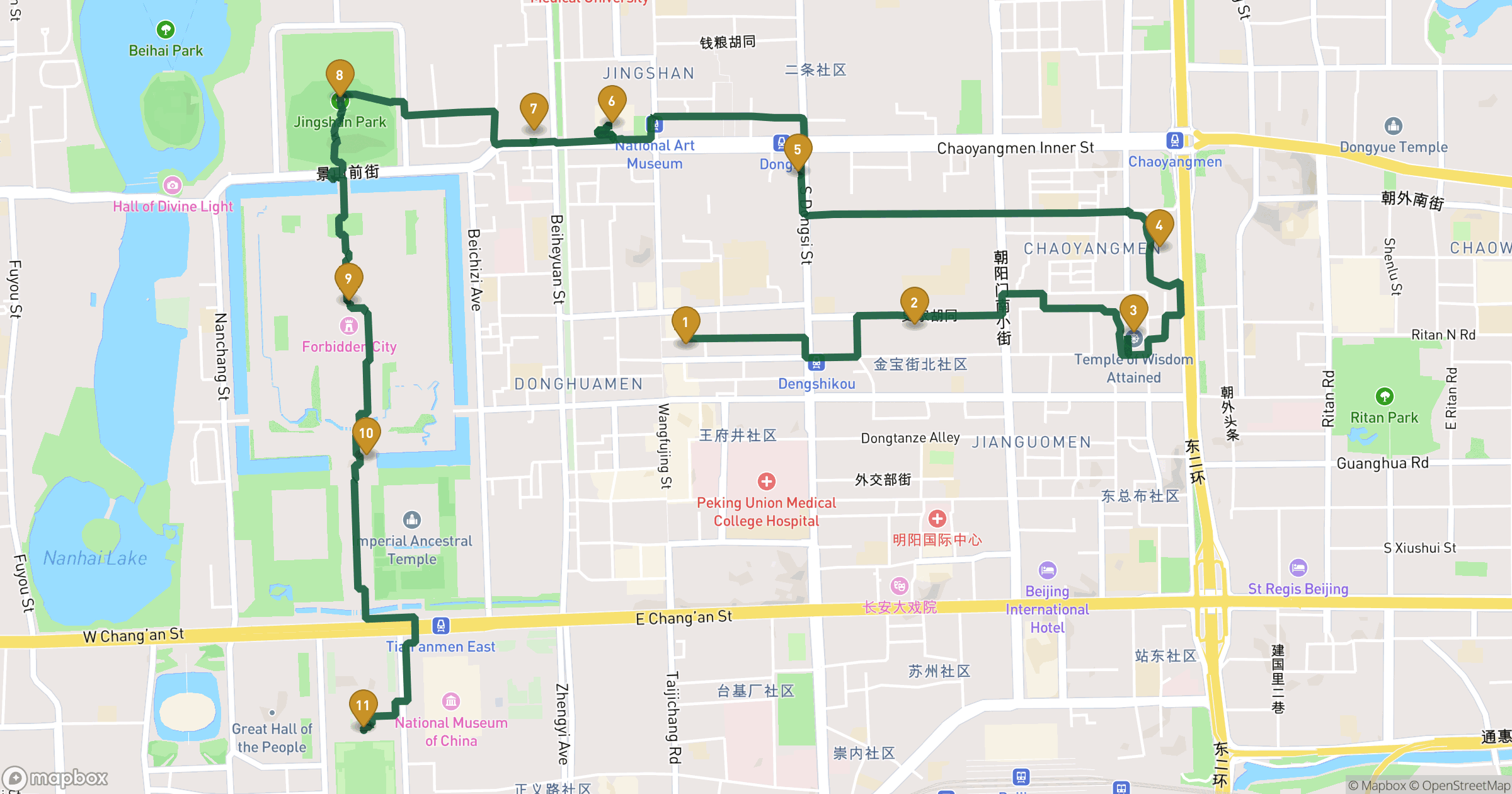
Map for Beijing walking tour with 11 stops
The static map shows the tour route with St. Joseph's Church, Beijing, Historian Alley Museum, Zhihua Temple, Galaxy SOHO, and 7 more stops.

Stops along the route

All stops on this self-guided tour at a glance.

  1. St. Joseph's Church, Beijing in Beijing
    Andrzej Otrębski / CC BY-SA 4.0

    1St. Joseph's Church, Beijing

    Wangfujing Catholic Church, known locally as the Eastern Church, stands as a Romanesque Revival sanctuary amid modern shopping malls. Founded in the late Ming or early Qing era by priests Buglio and Magalhães, who were once captured in Sichuan and held as slaves before building here, the current structure dates to 1904. The grey brick facade blends Western framework with subtle traditional Chinese details, opening onto a lively public square.

    Built: 1904 · Style: Romanesque Revival architecture · Wikidata

  2. 2Historian Alley Museum

    The Shijia Hutong Museum preserves the classic two-courtyard compound of author Ling Shuhua, whose literary salon once gathered Tagore and Xu Zhimo. In 1990, near the end of her life, Ling returned to find the home converted into a kindergarten and whispered a poignant phrase about coming home for dinner. Inside, the Hutong Sounds gallery plays recordings of pigeon whistles and historic street vendor cries collected from courtyard life.

    Wikidata

  3. Zhihua Temple in Beijing
    ScareCriterion12 / CC BY-SA 4.0

    3Zhihua TempleChurch

    Zhihua Temple preserves rare Ming architecture commissioned in 1443 by the influential court eunuch Wang Zhen as his private shrine. Marked by uncommon black glazed tiles signifying wind that subdues evil, the complex features exquisite multi-tiered halls bridging Song and Qing styles. For over five centuries, resident musicians have preserved the ancient Beijing Music tradition, still performed using original Gongche notation.

    Built: 1443 · Wikidata

  4. Galaxy SOHO in Beijing
    Rob Deutscher / CC BY 2.0

    4Galaxy SOHO

    Galaxy SOHO introduces a futuristic cluster designed by Zaha Hadid, featuring four fluid, curving masses interconnected by sky bridges. Hadid drew inspiration from traditional Chinese courtyards to eliminate sharp angles, wrapping the complex in horizontal white aluminum bands. Facing the historic alleys nearby, the illuminated courtyards form an open urban landmark that showcases the capital's modernist ambitions.

    Built: 2012 · Architect: Zaha Hadid · Wikidata

  5. Dongsi Mosque in Beijing
    N509FZ / CC BY-SA 4.0

    5Dongsi MosqueChurch

    Dongsi Mosque merges Islamic devotion with classic Chinese wooden architecture, featuring a main hall topped with a traditional hipped roof. Within the sanctuary, twenty gilded pillars bearing passionflower motifs support beams inscribed with Arabic verses from the Quran. The site preserves an exceptional Yuan dynasty handwritten Quran and historically served as an official imperial mosque honored by Emperor Jingtai.

    Wikidata

  6. 中国美术馆 in Beijing
    CNHowey / CC BY-SA 4.0

    6中国美术馆Attraction

    The National Art Museum of China exemplifies 1950s modernist exploration of traditional forms, crowned with yellow glazed tiles once reserved for royalty. Designed by architect Dai Nianci, the facade integrates pavilion-style roofs, corridors, and ornate latticed windows into a reinforced concrete structure. Its sweeping eaves sit at Wusi Dajie, deliberately echoing the classical silhouette of nearby Jingshan and the Forbidden City.

  7. Honglou in Beijing
    N509FZ / CC BY-SA 4.0

    7Honglou

    The Red Building of Peking University served as the cradle of the May Fourth and New Culture movements, completed in 1918 with funds from a Belgian loan. Between 1918 and 1919, a young Mao Zedong worked inside as a library assistant in the second reading room under Li Dazhao. During the second Sino-Japanese war, Japanese military police commandeered the brick landmark and converted its basement into a prison.

    Wikidata

  8. Jingshan Park in Beijing
    N509FZ / CC BY-SA 4.0

    8Jingshan Park

    Jingshan Park crowns the central axis of Beijing atop five peaks piled from soil dug out to form the Forbidden City moats and lakes. On its eastern slope stands the site where the Chongzhen Emperor hanged himself in 1644, marked later by the Qing with a chained tree deemed the Guilt Locust. The summit pavilion offers a panoramic view over the golden roofs and rigid symmetrical plan of the imperial palace.

    Built: 1928 · Wikidata

  9. The Palace Museum in Beijing
    user:kallgan / CC BY-SA 3.0

    9The Palace Museum

    The Palace Museum occupies the sprawling imperial palace built between 1406 and 1420, which served twenty-four Ming and Qing emperors. In 1924, General Feng Yuxiang sent troops to evict the abdicated emperor Puyi, who had secretly smuggled away over twelve hundred prized scrolls and paintings. Over one million relics were later evacuated south during the Sino-Japanese War before returning to form the present collection.

    Built: 1420 · Style: Chinese architecture · Wikidata

  10. Meridian Gate in Beijing
    Balon Greyjoy / CC0

    10Meridian GateCastle

    The Meridian Gate stands as the U-shaped southern entrance to the Forbidden City, crowned by five pavilion towers nicknamed the Five Phoenixes. Contrary to common myths of executions here, emperors used this gate for solemn ceremonies such as presenting war captives and issuing the annual calendar. Ming rulers did, however, inflict public rod floggings on disgraced ministers, which led to fatal beatings in the square below.

    Wikidata

  11. Tiananmen Square in Beijing
    N509FZ / CC BY-SA 4.0

    11Tiananmen Square

    Tiananmen Square evolved from a closed, T-shaped imperial corridor into one of the largest public urban plazas in the world. During the 1949 founding ceremony, scarcity forced organizers to build the first twenty-two-meter flagpole out of four welded water pipes. Today, the thirty-meter replacement flagpole aligns with dawn and dusk for precise daily ceremonies opposite the Monument to the People's Heroes and Zhengyangmen.

    Built: 1417 · Named after: Tiananmen · Wikidata

Download the app

This public page shows a preview. The full route, all content, and navigation are available in CityTour AI.

Cities nearby

Discover self-guided tours in nearby cities.

Frequently asked questions

The key answers before you start.

Is this a self-guided audio tour?

Yes. In the CityTour AI app (iOS and Android), this is a self-guided audio tour for Beijing — start anytime, at your own pace, with map, stops, and audio narration.

What will you see on this tour?

On this tour you'll see, among others, St. Joseph's Church, Beijing, Historian Alley Museum, Zhihua Temple, Galaxy SOHO, Dongsi Mosque, 中国美术馆 and more sights.

Where does the tour start?

The route starts at St. Joseph's Church, Beijing and ends at Tiananmen Square. You can start anytime — the app guides you to the first stop.

How long does the tour take?

About 189 minutes for 11 stops — at your own pace, with breaks whenever you like.

How much does the tour cost?

This tour costs 30 credits. The exact price depends on the pack you buy and your country — roughly $10.

Is it an outdoor tour — are entry tickets included?

Yes, it's an outdoor tour: the sights are viewed from the outside. Entry tickets are not included, and step-free access cannot be guaranteed.

Is the audio guide available in my language?

The tour and audio guide are available in English, Deutsch, Français, Español, Italiano and 9 more languages. You pick your language in the app.

Can I use the tour offline?

Yes. Tours can be used offline.

Can I ask the AI questions along the way?

Yes. At every stop you can ask the AI directly if you want to know more or didn't understand something.