CityTour AI

Larnaca self-guided walking tour

Larnaca: Between St. Lazarus, Colonial Heritage, and Coastal Charm

Join us on a journey through the historic heart of Larnaca, where ancient legends meet colonial elegance. We stroll from the medieval coastal fortress along the lively palm promenade to the mystical catacombs and the magnificent tomb of Saint Lazarus. This relaxed walk reveals the hidden layers of a city that has been the gateway between East and West for millennia.

Audio tourSelf-guidediOS & Android
95minutes
3.7 kmdistance
10stops
Audio guideFormat
Larnaca: Between St. Lazarus, Colonial Heritage, and Coastal Charm
Chris06 / CC BY-SA 4.0

Stops on this route

This tour works well for first-time visitors, weekend trips, and travelers who want to explore Larnaca without a fixed tour time.

Route map for Larnaca walking tour
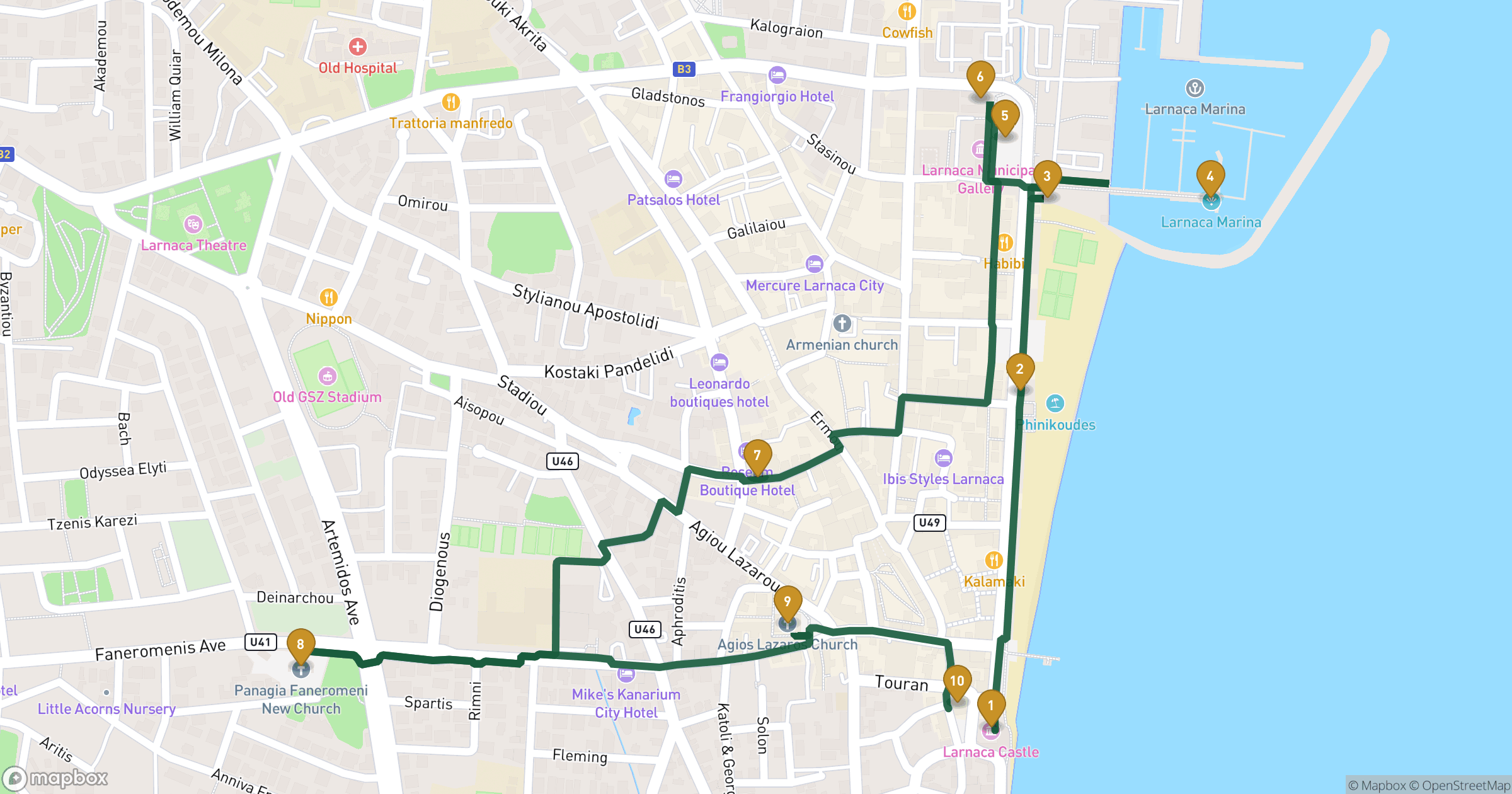
Map for Larnaca walking tour with 10 stops
The static map shows the tour route with Larnaca Castle, Phinikoudes, Armenian Genocide Memorial in Larnaca, Larnaca Marina, and 6 more stops.

Stops along the route

All stops on this self-guided tour at a glance.

  1. Larnaca Castle in Larnaca
    Diego Delso / CC BY-SA 4.0

    1Larnaca Castle

    Larnaca Castle stands by the harbor as a fortress shaped by centuries of changing rulers and military needs. King James I expanded the structure between 1382 and 1388 after the Genoese captured nearby Famagusta. During British colonial rule, a gallows was installed inside, where executions were carried out until 1948 before the courtyard became an open-air theater.

    Wikidata

  2. Phinikoudes in Larnaca
    Pedro Krtička / CC BY 3.0

    2Phinikoudes

    The Phinikoudes promenade is the central seaside avenue of Larnaca, stretching right in front of the castle. Its iconic rows of palm trees were originally planted in 1922 along what was previously just a simple gravel track. Today, the avenue borders a sandy beach on one side and cafes occupying colonial-era buildings on the other.

    Wikidata

  3. Armenian Genocide Memorial in Larnaca in Larnaca
    Armineaghayan / CC BY-SA 4.0

    3Armenian Genocide Memorial in LarnacaMonument

    The Armenian Genocide Memorial commemorates the thousands of refugees who reached the coast of Larnaca during the 1920s fleeing Ottoman persecution. The site marks the exact arrival point where survivors landed and found a new home in Cyprus. A bronze sculpture surrounded by a quiet garden serves as a tribute to the victims of 1915 and the local community that welcomed them.

    Wikidata

  4. Larnaca Marina in Larnaca
    A.Savin / FAL

    4Larnaca MarinaViewpoint

    Larnaca Marina accommodates roughly 450 vessels, serving as a hub for sailors navigating the eastern Mediterranean. Alongside legitimate trade in carob and salt, this coastline historically operated as a notorious haven for smuggling into the nearby alleys. Today, yachts and traditional fishing boats moor side by side along wooden walkways.

  5. Europe square in Larnaca
    Valantis Antoniades / CC BY-SA 3.0

    5Europe square

    Europe Square showcases a cluster of two-story colonial structures constructed by the British in 1881. Originally built as customs warehouses and administrative offices right after the start of British rule, the buildings handled cargo rolled directly from harbor ships. Today, these restored premises house cultural institutions like the Municipal Art Gallery and the Paleontological Museum.

    Wikidata

  6. Επαρχιακή Διοίκηση Λάρνακος in Larnaca
    Viaggiamocela / CC BY-SA 4.0

    6Επαρχιακή Διοίκηση Λάρνακος

    The Larnaca District Administration building stands beside Europe Square as a monument of British colonial governance. It served as the central administrative hub of Cyprus before Nicosia took over, deciding matters from infrastructure planning to tax collection. Its exterior features strict symmetry and distinctive rows of windows designed to project imperial authority.

  7. Ιατρικό Μουσείο Κυριαζή in Larnaca
    A.Savin / FAL

    7Ιατρικό Μουσείο ΚυριαζήMuseum

    The Kyriazis Medical Museum occupies a traditional 1927 town house showcasing the darker and more unusual chapters of Cypriot medicine. The collection assembled by Dr. Marios Kyriazis exhibits historical instruments ranging from Roman antiquity to early X-ray machines and amputation saws. A reconstructed historic pharmacy features hand-labeled ceramic jars used for folk remedies.

  8. Panagia Faneromeni New Church in Larnaca
    A.Savin / FAL

    8Panagia Faneromeni New Church

    Panagia Faneromeni combines a twentieth-century church with an adjacent rock-cut tomb tracing back to Phoenician or Mycenaean times. Carved into limestone with two chambers, the underground site later sheltered early Christians practicing their faith in secret. A traditional custom involves sick visitors circling the church three times and leaving behind a piece of clothing or hair for healing.

    Wikidata

  9. Church of Saint Lazarus, Larnaca in Larnaca
    Chris06 / CC BY-SA 4.0

    9Church of Saint Lazarus, Larnaca

    The Church of Saint Lazarus was erected around 890 over the tomb of Lazarus, who served as Kition's bishop for thirty years after his resurrection. Legend recounts that he smiled only once on Cyprus, dryly remarking 'clay steals clay' when witnessing a pot being stolen. Inside, a gold-plated wooden iconostasis and the empty stone tomb beneath the altar survive from this Byzantine foundation.

    Built: 801 · Style: Byzantine architecture · Wikidata

  10. Djami Kebir mosque in Larnaca
    Chris06 / CC BY-SA 4.0

    10Djami Kebir mosqueChurch

    Djami Kebir, also known as the Great Mosque, stands beside Larnaca Castle at the entrance to the old Skala quarter. The current 1836 building integrates the remains of a fourteenth-century Catholic church dedicated to Saint Catherine that was converted into Cyprus's first mosque after the 1570 Ottoman conquest. Gothic window arches remain visible alongside the minaret and courtyard fountain.

    Built: 1836 · Wikidata

Download the app

This public page shows a preview. The full route, all content, and navigation are available in CityTour AI.

Cities nearby

Discover self-guided tours in nearby cities.

Frequently asked questions

The key answers before you start.

Is this a self-guided audio tour?

Yes. In the CityTour AI app (iOS and Android), this is a self-guided audio tour for Larnaca — start anytime, at your own pace, with map, stops, and audio narration.

What will you see on this tour?

On this tour you'll see, among others, Larnaca Castle, Phinikoudes, Armenian Genocide Memorial in Larnaca, Larnaca Marina, Europe square, Επαρχιακή Διοίκηση Λάρνακος and more sights.

Where does the tour start?

The route starts at Larnaca Castle and ends at Djami Kebir mosque. You can start anytime — the app guides you to the first stop.

How long does the tour take?

About 95 minutes for 10 stops — at your own pace, with breaks whenever you like.

How much does the tour cost?

This tour costs 15 credits. The exact price depends on the pack you buy and your country — roughly $5.

Is it an outdoor tour — are entry tickets included?

Yes, it's an outdoor tour: the sights are viewed from the outside. Entry tickets are not included, and step-free access cannot be guaranteed.

Is the audio guide available in my language?

The tour and audio guide are available in English, Deutsch, Français, Español, Italiano and 9 more languages. You pick your language in the app.

Can I use the tour offline?

Yes. Tours can be used offline.

Can I ask the AI questions along the way?

Yes. At every stop you can ask the AI directly if you want to know more or didn't understand something.