CityTour AI

Český Krumlov self-guided walking tour

Beyond the Castle Walls: The Heart of Český Krumlov

Step back in time on a casual stroll through the winding medieval streets and lush gardens of this UNESCO-listed gem. You’ll discover the fascinating tension between the grand life of the castle lords and the everyday stories of the townspeople, all while following the graceful curves of the Vltava River. This tour reveals the layers of history that make Český Krumlov more than just a pretty postcard, from hidden monastic courtyards to panoramic viewpoints.

Audio tourSelf-guidediOS & Android
95minutes
3.0 kmdistance
12stops
Audio guideFormat
Beyond the Castle Walls: The Heart of Český Krumlov
Ray Swi-hymn from Sijhih-Taipei, Taiwan / CC BY-SA 2.0

Stops on this route

This tour works well for first-time visitors, weekend trips, and travelers who want to explore Český Krumlov without a fixed tour time.

Route map for Český Krumlov walking tour
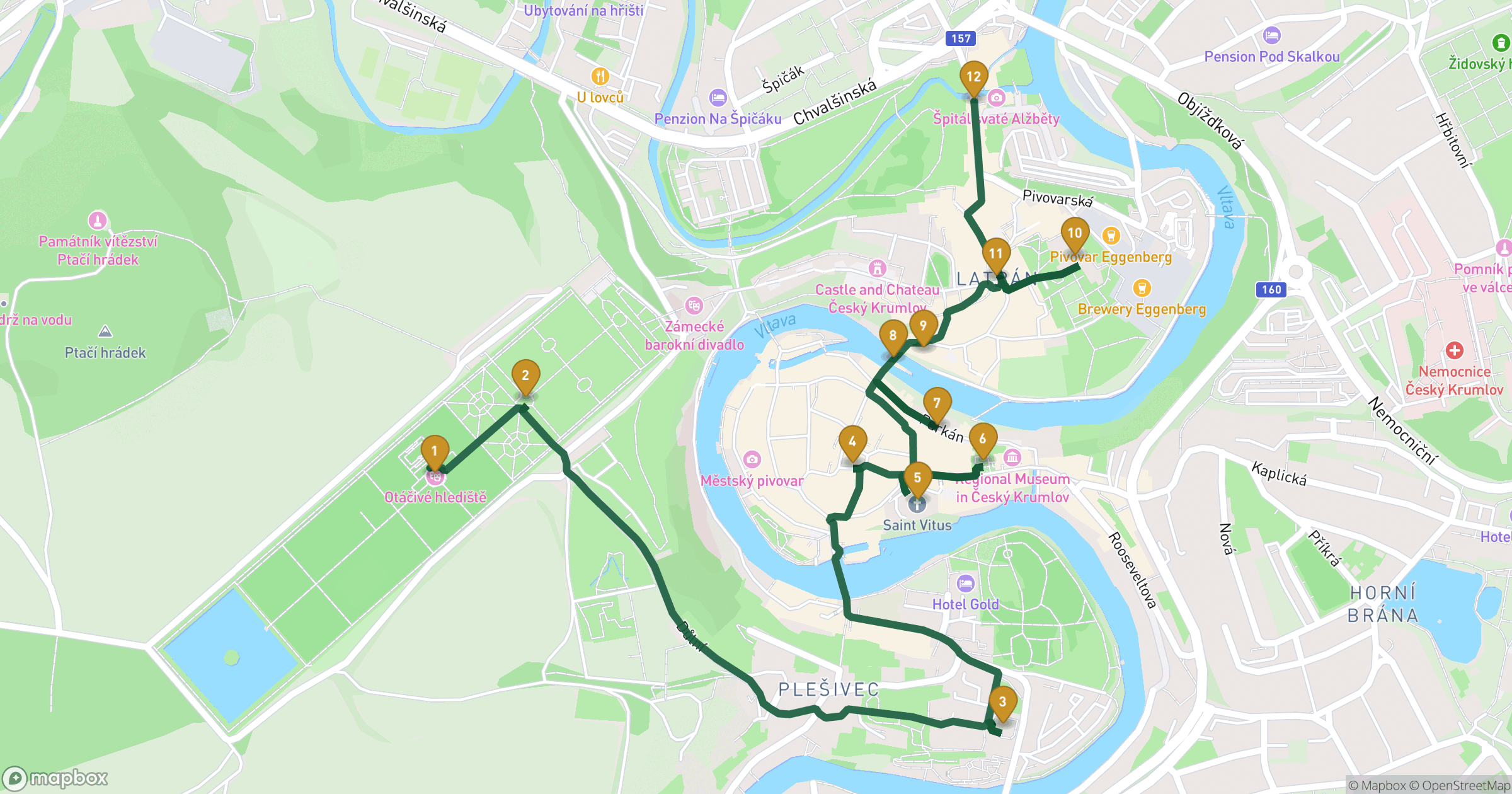
Map for Český Krumlov walking tour with 12 stops
The static map shows the tour route with Otáčivé hlediště Český Krumlov, Cascade fountain in Český Krumlov, Synagogue in Český Krumlov, Náměstí Svornosti, and 8 more stops.

Stops along the route

All stops on this self-guided tour at a glance.

  1. Otáčivé hlediště Český Krumlov in Český Krumlov
    SimcaCZE / CC BY-SA 3.0

    1Otáčivé hlediště Český KrumlovTheatre

    The Revolving Auditorium in the castle gardens stands as an open-air theater that sparks ongoing debate with preservationists. Conceived in 1958 by Joan Brehms and Otto Haas, it began as a human-powered wooden turntable seating just sixty spectators for the play 'Ztracená tvář'. Today, a 650-ton steel structure built by Škoda Plzeň spins with four electric motors amid calls from UNESCO for its removal.

    Architect: Joan Brehms · Wikidata

  2. Cascade fountain in Český Krumlov in Český Krumlov
    Tanya Dedyukhina / CC BY 3.0

    2Cascade fountain in Český Krumlov

    The Cascade Fountain serves as a stone Baroque centerpiece connecting different levels of the castle's upper park. Commissioned by the Eggenberg and Schwarzenberg families, its tiers are built of shelly limestone dotted with tiny fossilized remains. Statues of water deities, nymphs, and ornate vases weather quietly here after once serving as the backdrop for lavish garden parties.

    Wikidata

  3. Synagogue in Český Krumlov in Český Krumlov
    Czeva / CC BY-SA 3.0

    3Synagogue in Český KrumlovChurch

    The Synagogue in the Plešivec district reflects the modern architectural history and former Jewish community of the town. Designed by Victor Kafka in 1909, it combined Neo-Romanesque arches with Art Nouveau lines and was the city's first structure built with reinforced concrete. Having survived wartime use as a warehouse and later conversion into a Christian Hussite church, it now operates as a restored cultural venue.

    Built: 1909 · Architect: Victor Kafka · Style: Romanesque Revival architecture · Wikidata

  4. Náměstí Svornosti in Český Krumlov
    Alexander Migl / CC BY-SA 4.0

    4Náměstí Svornosti

    Náměstí Svornosti marks the town's civic heart, laid out on an open meadow in 1274 as a rectangular grid. Its Renaissance Town Hall was formed in 1597 by joining two Gothic houses and still displays the Rosenberg five-petaled rose alongside later noble shields. In the center stands Matyáš Václav Jäckel's 1712 Plague Column, linked to a stone fountain added in 1843 by Josef Hauber.

    Wikidata

  5. Church of Saint Vitus in Český Krumlov
    Martin Vavřík / Public domain

    5Church of Saint Vitus

    The Church of Saint Vitus dominates the town's skyline as the historic spiritual counterpart to the castle. Funded by the Rosenberg family, the late-Gothic sanctuary was erected between 1407 and 1438 featuring sophisticated net vaulting inspired by Peter Parler. Master stonemason Jan Staněk mysteriously abandoned the construction, and the family's central mausoleum was later removed during Jesuit Counter-Reformation remodeling.

    Built: 1309 · Style: Gothic Revival … · Named after: Vitus · Wikidata

  6. Garden of the jesuite seminary in Český Krumlov in Český Krumlov
    Barocco / CC0

    6Garden of the jesuite seminary in Český KrumlovPark

    The Garden of the Jesuit Seminary offers an open terrace overlooking the winding Vltava River and the castle tower. Established in the late sixteenth century by Wilhelm von Rosenberg, the complex supported the Jesuit mission during the Counter-Reformation. Rather than elaborate flower beds, the open green space provided the order with a breezy, private retreat for quiet contemplation.

    Wikidata

  7. Parkán in Český Krumlov
    Jirka Dl / CC BY-SA 4.0

    7ParkánSquare

    Parkán traces the narrow defensive zone once wedged between two medieval wall circuits. As the town expanded, residents converted the military strip into living quarters directly against the fortifications. Today, several riverside houses still rest on foundations formed by the original fourteenth-century town wall along the edge of the Vltava.

    Wikidata

  8. Lazebnický bridge in Český Krumlov
    Juandev / CC BY-SA 3.0

    8Lazebnický bridge

    Barber’s Bridge connects the Old Town with the Latrán district across the Vltava River. It takes its name from an old bathhouse and surgical barber's shop once operating at Latrán No. 1 by the riverbank. Built in the 1830s after earlier wooden spans suffered flood damage, the crossing carries a bronze statue of Saint John of Nepomuk alongside a large wooden Crucifixion.

    Wikidata

  9. Church of Saint Judoc in Český Krumlov in Český Krumlov
    Ray Swi-hymn from Sijhih-Taipei, Taiwan / CC BY-SA 2.0

    9Church of Saint Judoc in Český KrumlovBuilding

    The Church of Saint Judoc is distinguished by its green, five-tiered tower with a baroque onion dome above the Latrán district. Founded around 1317 by Peter I of Rožmberk after the birth of his son, it was later given a Renaissance redesign by architect Dominico Benedetto Cometta. Emperor Joseph II deconsecrated the sanctuary in the eighteenth century, leading to its present use housing a marionette museum.

    Architect: Dominico Benedetto Cometta z Eckthurnu · Style: baroque architecture · Named after: Judoc · Wikidata

  10. Minorite monastery in Český Krumlov in Český Krumlov
    H2k4 / CC BY-SA 3.0

    10Minorite monastery in Český KrumlovBuilding

    The Minorite Monastery forms a sprawling complex in Latrán that originally united Minorites, Poor Clares, and Beguines. Catherine of Rožmberk and her four sons founded the site in 1350, leaving Gothic cloisters and roof trusses alongside later Baroque upgrades. Following its forced closure under the Communist 'Plan K' in 1950, recent restorations revived the grounds, including the Paradise Garden and the Chapel of Our Lady of Einsiedeln.

    Built: 1350 · Wikidata

  11. Latrán in Český Krumlov
    Juandev / CC BY-SA 3.0

    11LatránBuilding

    Latrán developed as a dedicated district beneath the fortress walls, housing the castle's craftsmen, servants, and officials. A fierce rivalry over brewing and taxes ended in 1555 when Vilém of Rožmberk decreed that Latrán and the Old Town merge into one municipality. Its winding medieval street still showcases merchant homes decorated with sixteenth-century sgraffito patterns.

    Wikidata

  12. Budějovice Gate in Český Krumlov
    Mister No / CC BY 3.0

    12Budějovice GateCastle

    The Budějovice Gate remains the lone survivor of nine original fortifications that once controlled entry to the town. Italian architect Domenico Benedetto Cometta designed it between 1598 and 1602 for Petr Vok of Rožmberk, who gifted it on the condition that the council maintain it perpetually. The gateway features a defensive wedge-shaped northern front contrasted by a bright red southern facade adorned with sundials and Renaissance frescoes.

    Built: 1598 · Architect: Domenico Benedetto Cometta · Style: Renaissance architecture · Wikidata

Download the app

This public page shows a preview. The full route, all content, and navigation are available in CityTour AI.

Cities nearby

Discover self-guided tours in nearby cities.

Frequently asked questions

The key answers before you start.

Is this a self-guided audio tour?

Yes. In the CityTour AI app (iOS and Android), this is a self-guided audio tour for Český Krumlov — start anytime, at your own pace, with map, stops, and audio narration.

What will you see on this tour?

On this tour you'll see, among others, Otáčivé hlediště Český Krumlov, Cascade fountain in Český Krumlov, Synagogue in Český Krumlov, Náměstí Svornosti, Church of Saint Vitus, Garden of the jesuite seminary in Český Krumlov and more sights.

Where does the tour start?

The route starts at Otáčivé hlediště Český Krumlov and ends at Budějovice Gate. You can start anytime — the app guides you to the first stop.

How long does the tour take?

About 95 minutes for 12 stops — at your own pace, with breaks whenever you like.

How much does the tour cost?

This tour costs 15 credits. The exact price depends on the pack you buy and your country — roughly $5.

Is it an outdoor tour — are entry tickets included?

Yes, it's an outdoor tour: the sights are viewed from the outside. Entry tickets are not included, and step-free access cannot be guaranteed.

Is the audio guide available in my language?

The tour and audio guide are available in English, Deutsch, Français, Español, Italiano and 9 more languages. You pick your language in the app.

Can I use the tour offline?

Yes. Tours can be used offline.

Can I ask the AI questions along the way?

Yes. At every stop you can ask the AI directly if you want to know more or didn't understand something.