CityTour AI

Copenhagen self-guided walking tour

Copenhagen’s Royal Heart and Historic Harbors

Discover the architectural evolution of Denmark's capital, from the fairytale spires of the Renaissance to the grand Neoclassical squares of the royal elite. You will wander through historic gardens, stand beneath massive domes, and stroll along the iconic colorful harbor while uncovering the stories of the kings and creators who shaped the city. This relaxed journey captures the essence of Copenhagen’s royal heritage and its vibrant, modern spirit.

Audio tourSelf-guidediOS & Android
104minutes
4.8 kmdistance
9stops
Audio guideFormat
Copenhagen’s Royal Heart and Historic Harbors
Jebulon / CC0

Stops on this route

This tour works well for first-time visitors, weekend trips, and travelers who want to explore Copenhagen without a fixed tour time.

Route map for Copenhagen walking tour
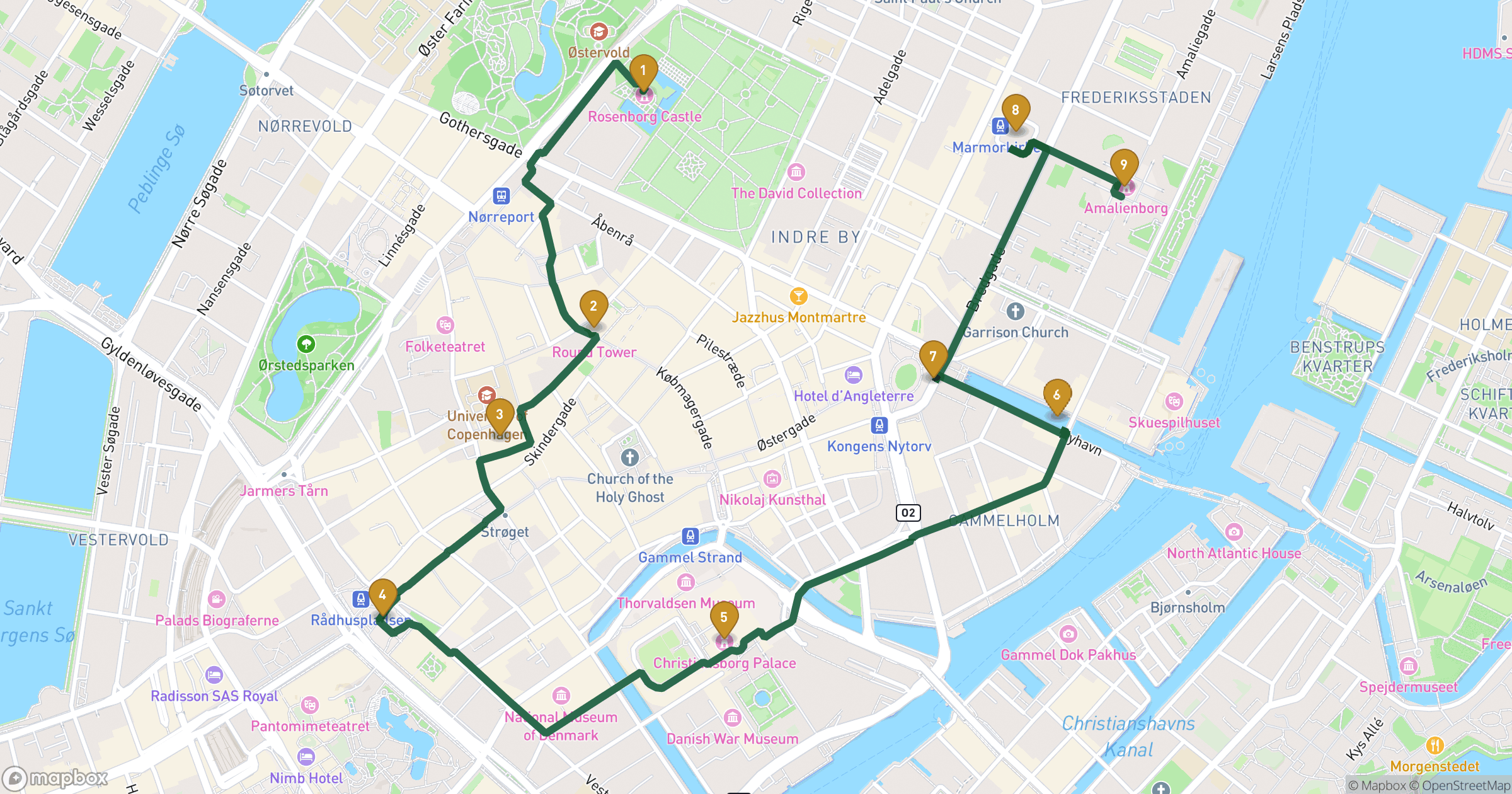
Map for Copenhagen walking tour with 9 stops
The static map shows the tour route with Rosenborg Castle, Rundetaarn, Church of Our Lady, City Hall Square, and 5 more stops.

Stops along the route

All stops on this self-guided tour at a glance.

  1. Rosenborg Castle in Copenhagen
    Marie Thérèse Hébert & Jean Robert Thibault from Québec, Canada / CC BY-SA 2.0

    1Rosenborg Castle

    Rosenborg Castle began in 1606 as Christian IV's modest summer retreat away from the cramped city. After the court moved out around 1710, it served as an emergency residence only twice, including during the 1801 British bombardment. Inside the Knight’s Hall, three life-sized silver lions guard the absolutist coronation thrones, symbolizing Denmark's three straits.

    Built: 1606 · Architect: Hans van Steenwinckel the Younger · Style: Renaissance architecture · Named after: rose · Wikidata

  2. Rundetaarn in Copenhagen
    Avda / CC BY-SA 3.0

    2RundetaarnTower

    The Round Tower was constructed in 1642 as an observatory to preserve the astronomical legacy of Tycho Brahe. Instead of stairs, a 209-meter spiral equestrian ramp winds up the hollow core, allowing Tsar Peter the Great to ride a horse to the top in 1716. Christian IV specifically imported Dutch bricks for the facade because local options failed his quality standards.

    Built: 1642 · Architect: Hans van Steenwinckel the Younger · Style: baroque architecture · Height: 34.8 m · Wikidata

  3. Church of Our Lady in Copenhagen
    Ib Rasmussen / Public domain

    3Church of Our Lady

    The Church of Our Lady is Copenhagen's neoclassical cathedral, rebuilt by C.F. Hansen after British bombardment leveled the area in 1807. Inside, Bertel Thorvaldsen's renowned monumental statues of Christ and the twelve apostles line the calm, temple-like nave. The choir holds another Thorvaldsen masterpiece: a delicate marble angel serving as the baptismal font.

    Built: 1829 · Architect: Christian Frederik Hansen · Style: Neoclassical architecture … · Named after: Mary · Wikidata

  4. City Hall Square in Copenhagen
    Bill Ebbesen / Public domain

    4City Hall Square

    City Hall Square marks Denmark's official zero point, formerly serving as an extramural hay market until the 1850s. High on the Richshuset building, the gilded Weather Girl sculpture once turned a bicycling girl out for sunshine and an umbrella-bearing girl for rain. Martin Nyrop modeled the 1905 City Hall on the communal palace of Siena, adding distinct Nordic details.

    Named after: Copenhagen City Hall · Wikidata

  5. Christiansborg Palace in Copenhagen
    eimoberg from Changwon, South Korea / CC BY 2.0

    5Christiansborg PalaceCastle

    Christiansborg Palace on Slotsholmen holds the unique distinction of housing all three branches of the Danish government under one roof. The present 1928 complex is the third on site, built over the original 1167 curtain wall foundations left by Bishop Absalon. Royal stables and showgrounds from the 1740s survived the disastrous fires of 1794 and 1884.

    Built: 1740 · Architect: Elias David Häusser · Style: baroque architecture · Named after: Christian VI of Denmark · Wikidata

  6. Nyhavn in Copenhagen
    kallerna / CC BY-SA 4.0

    6NyhavnAttraction

    Nyhavn canal was dug between 1670 and 1675 by Swedish prisoners of war to connect ships directly to Kongens Nytorv. Hans Christian Andersen lived in multiple houses along the quayside over 18 years, including numbers 18 and 67. House number 9, dating to 1681, remains completely unaltered among the historic wooden ships docked in the harbor.

    Wikidata

  7. Kongens Nytorv in Copenhagen
    European Environment Agency / CC BY 2.0

    7Kongens NytorvBuilding

    Kongens Nytorv was laid out in 1670 by Christian V to replace a muddy wasteland outside the walls with a Paris-inspired public plaza. An equestrian statue of the king has anchored the center ever since the square was cleared. Christian V even had Gothersgade constructed directly to tether his grand square to the rest of the expanding capital.

    Wikidata

  8. Frederik's Church in Copenhagen
    Jebulon / CC0

    8Frederik's Church

    The Marble Church features Scandinavia's largest dome, an Italianate marvel that sat as an abandoned ruin for nearly 150 years. Financier Carl Frederik Tietgen acquired the site without cash in 1874, funding its completion in exchange for local land development rights. The exterior stands ringed with statues of theologians beneath a 31-meter dome inspired by St. Peter's.

    Built: 1749 · Architect: Ferdinand Meldahl, Nicolai Eigtved · Style: baroque architecture … · Wikidata

  9. Amalienborg in Copenhagen
    Tony Webster / CC BY 2.0

    9AmalienborgCastle

    Amalienborg consists of four identical neoclassical palaces enclosing an octagonal square centered on an equestrian statue of Frederick V. Originally constructed for noble families, the royals took up residence here after Christiansborg Palace was gutted by fire in 1794. Royal Life Guards stand watch in bearskin caps beneath rooftops flying the monarch's standard.

    Built: 1760 · Architect: Nicolai Eigtved · Style: Rococo · Named after: Sophie Amalienborg · Wikidata

Download the app

This public page shows a preview. The full route, all content, and navigation are available in CityTour AI.

Cities nearby

Discover self-guided tours in nearby cities.

Frequently asked questions

The key answers before you start.

Is this a self-guided audio tour?

Yes. In the CityTour AI app (iOS and Android), this is a self-guided audio tour for Copenhagen — start anytime, at your own pace, with map, stops, and audio narration.

What will you see on this tour?

On this tour you'll see, among others, Rosenborg Castle, Rundetaarn, Church of Our Lady, City Hall Square, Christiansborg Palace, Nyhavn and more sights.

Where does the tour start?

The route starts at Rosenborg Castle and ends at Amalienborg. You can start anytime — the app guides you to the first stop.

How long does the tour take?

About 104 minutes for 9 stops — at your own pace, with breaks whenever you like.

How much does the tour cost?

This tour costs 15 credits. The exact price depends on the pack you buy and your country — roughly $5.

Is it an outdoor tour — are entry tickets included?

Yes, it's an outdoor tour: the sights are viewed from the outside. Entry tickets are not included, and step-free access cannot be guaranteed.

Is the audio guide available in my language?

The tour and audio guide are available in English, Deutsch, Français, Español, Italiano and 9 more languages. You pick your language in the app.

Can I use the tour offline?

Yes. Tours can be used offline.

Can I ask the AI questions along the way?

Yes. At every stop you can ask the AI directly if you want to know more or didn't understand something.