CityTour AI

Aarhus self-guided walking tour

Aarhus: From Viking Roots to Modern Roofs

Explore the soul of Denmark's 'City of Smiles' on this casual stroll through a millennium of history. From the hidden Viking foundations beneath your feet to the rainbow-topped heights of modern art, you will experience how ancient cobblestones and cutting-edge design live side-by-side. It is the perfect way to see the city’s most iconic landmarks while discovering the cozy, local corners that give Aarhus its unique character.

Audio tourSelf-guidediOS & Android
102minutes
3.2 kmdistance
12stops
Audio guideFormat
Aarhus: From Viking Roots to Modern Roofs
Zairon / CC BY-SA 3.0

Stops on this route

This tour works well for first-time visitors, weekend trips, and travelers who want to explore Aarhus without a fixed tour time.

Route map for Aarhus walking tour
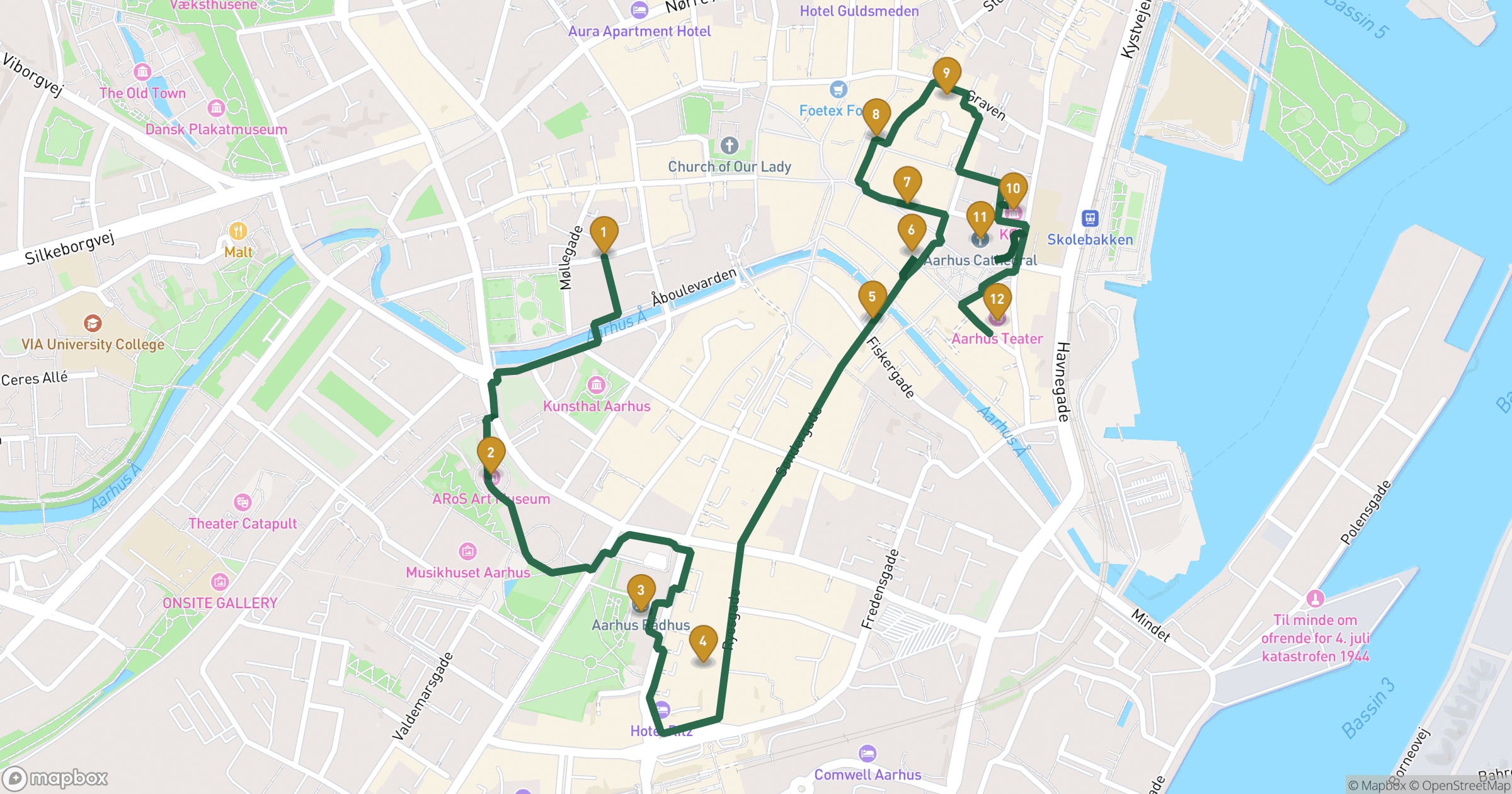
Map for Aarhus walking tour with 12 stops
The static map shows the tour route with Møllestien, ARoS Aarhus Kunstmuseum, Aarhus City Hall, Catholic Church of Our Lady, and 8 more stops.

Stops along the route

All stops on this self-guided tour at a glance.

  1. Møllestien in Aarhus
    IK's World Trip, Flickr / CC BY 2.0

    1MøllestienAttraction

    Møllestien is a historic cobbled lane whose modern fairytale charm contrasts sharply with its working-class past. The street traces back to before 1300 near an old mill, though most of its colorful homes were built between 1870 and 1885. Once nicknamed 'Aarhus' Amager' for backyard vegetable gardens, it became a run-down pocket without electricity in the 1920s.

    Wikidata

  2. ARoS Aarhus Kunstmuseum in Aarhus
    Cristianrodenas / CC BY-SA 3.0

    2ARoS Aarhus KunstmuseumTheatre

    ARoS Art Museum was designed around Dante Alighieri's 'The Divine Comedy' to take visitors on a physical journey from hell to heaven. In the basement, the dark '9 Spaces' galleries symbolize the nine circles of hell. Atop the modernist cube sits 'Your rainbow panorama', a 140-ton circular glass walkway added in 2011 by artist Ólafur Elíasson.

    Built: 2004 · Architect: Schmidt Hammer Lassen · Wikidata

  3. Aarhus City Hall in Aarhus
    Jens Cederskjold / CC BY 3.0

    3Aarhus City HallBuilding

    Aarhus City Hall is a Functionalist masterpiece designed by Arne Jacobsen and Erik Møller, shaped heavily by local public opposition. The original 1937 competition-winning blueprint lacked a tower, prompting protests that forced the addition of the 60-meter clock tower. Completed in 1941 during the German occupation, it is clad in 6,000 square meters of Norwegian grey marble.

    Built: 1941 · Architect: Arne Jacobsen · Style: functionalism · Wikidata

  4. Catholic Church of Our Lady in Aarhus
    Insights Unspoken / CC BY-SA 2.0

    4Catholic Church of Our Lady

    The Catholic Church of Our Lady is a Gothic Revival structure tucked tightly into the bustling Ryesgade pedestrian area. Priest Augustin Sträter recruited architect Franz Schmitz from the Cologne Cathedral construction site to design the 53-meter tower and copper spire. Originally built on an open field between 1877 and 1880, it is now wedged between modern commercial blocks.

    Built: 1880 · Wikidata

  5. Saint Clement Bridge in Aarhus
    Leif Jørgensen / CC BY-SA 4.0

    5Saint Clement BridgeSquare

    Saint Clement Bridge spans the river valley as the crucial nineteenth-century link between ancient Aarhus and its new railway district. Completed in 1884, the elevated crossing was nearly postponed after the city spent 350,000 DKK purchasing a gas works. Today it forms an integral section of the Strøget shopping street, carrying pedestrians directly above the lower riverbank roads.

    Named after: Clement · Wikidata

  6. Viking Museum in Aarhus
    RhinoMind / CC BY-SA 4.0

    6Viking Museum

    The Viking Museum is an underground site preserved directly where archaeological crews uncovered the original ninth-century settlement of Aros. Workers stumbled upon the ruins three meters below street level in the early 1960s while excavating foundations for the Nordea bank building. Beneath active modern offices, the display features a human skeleton, ancient tools, and early earthen ramparts.

    Wikidata

  7. Store Torv in Aarhus
    Eduard47 / CC BY-SA 4.0

    7Store TorvSquare

    Store Torv served as the primary public stage and center of judicial discipline in Aarhus starting around the year 1200. Until 1685, the massive Borgporten gate and watchtower stood here, dividing this open triangle from Lille Torv before being demolished to relieve traffic. The square hosted public whippings, pillories, and gallows outside the jailhouse beneath the medieval city hall.

    Wikidata

  8. Pustervig Torv in Aarhus
    Gardar Rurak / CC BY-SA 4.0

    8Pustervig TorvSquare

    Pustervig Torv is an intimate square in the Latin Quarter where the narrow lanes of Badstuegade and Rosensgade converge. Archaeological excavations revealed traces of a Viking settlement dating to roughly 770 AD directly beneath the paving stones. The small plaza is anchored by traditional brick architecture, including the heritage-listed townhouse at Badstuegade 1H built in 1809.

    Wikidata

  9. Latin Quarter in Aarhus
    Kenny Arne Lang Antonsen / CC BY-SA 4.0

    9Latin QuarterBuilding

    The Latin Quarter features the city's oldest network of streets, escaping modernization to retain homes dating back to the 1500s. Though its street layout originated in the late 14th century, the neighborhood only acquired its bohemian Parisian-inspired name during the 1990s. Along Klostergade and Volden, historical courtyards now coexist with KaosPilots, an alternative business school.

    Wikidata

  10. KØN - Gender Museum Denmark in Aarhus
    RhinoMind / CC BY-SA 4.0

    10KØN - Gender Museum Denmark

    KØN occupies the 1857 historicist building designed by Ferdinand Thielemann that initially served as the Aarhus City Hall. Founded in 1982 as a grassroots women's history museum, the institution expanded in 2021 to examine the broader cultural history of gender. Outside lies a garden honoring nineteenth-century feminist author Mathilde Fibiger, whose debut novel sparked the Clara Raphael controversy.

    Built: 1982 · Architect: Ferdinand Thielemann · Wikidata

  11. Aarhus Cathedral in Aarhus
    Zairon / CC BY-SA 3.0

    11Aarhus CathedralChurch

    Aarhus Cathedral holds national records as both the longest and tallest church in Denmark, reaching 93 meters in length. Founded in 1201 by Bishop Peder Vognsen, it was rebuilt in Brick Gothic after a catastrophic fourteenth-century fire. Inside, elaborate medieval frescoes sit alongside anchor symbols honoring Saint Clement, the patron saint of sailors who drowned tied to an anchor.

    Built: 1201 · Style: Brick Gothic · Height: 96 m · Named after: Clement · Wikidata

  12. Aarhus Theatre in Aarhus
    Matthias Süßen / CC BY-SA 4.0

    12Aarhus Theatre

    Aarhus Theatre is an Art Nouveau venue designed by Hack Kampmann, who oversaw every structural and decorative element as a unified artwork. It opened in 1900 to replace an overcrowded, poorly ventilated local hall unceremoniously dubbed 'Svedekassen', or the Sweat-box. Kampmann collaborated with artists Hansen Reistrup and Hans Tegner, crafting a detailed facade adorned with natural motifs.

    Built: 1900 · Architect: Hack Kampmann · Style: Art Nouveau architecture · Wikidata

Download the app

This public page shows a preview. The full route, all content, and navigation are available in CityTour AI.

Cities nearby

Discover self-guided tours in nearby cities.

Frequently asked questions

The key answers before you start.

Is this a self-guided audio tour?

Yes. In the CityTour AI app (iOS and Android), this is a self-guided audio tour for Aarhus — start anytime, at your own pace, with map, stops, and audio narration.

What will you see on this tour?

On this tour you'll see, among others, Møllestien, ARoS Aarhus Kunstmuseum, Aarhus City Hall, Catholic Church of Our Lady, Saint Clement Bridge, Viking Museum and more sights.

Where does the tour start?

The route starts at Møllestien and ends at Aarhus Theatre. You can start anytime — the app guides you to the first stop.

How long does the tour take?

About 102 minutes for 12 stops — at your own pace, with breaks whenever you like.

How much does the tour cost?

This tour costs 15 credits. The exact price depends on the pack you buy and your country — roughly $5.

Is it an outdoor tour — are entry tickets included?

Yes, it's an outdoor tour: the sights are viewed from the outside. Entry tickets are not included, and step-free access cannot be guaranteed.

Is the audio guide available in my language?

The tour and audio guide are available in English, Deutsch, Français, Español, Italiano and 9 more languages. You pick your language in the app.

Can I use the tour offline?

Yes. Tours can be used offline.

Can I ask the AI questions along the way?

Yes. At every stop you can ask the AI directly if you want to know more or didn't understand something.