CityTour AI

Ribe self-guided walking tour

Ribe: A Walk Through Denmark's Oldest Town

Step back over a thousand years on a stroll through Denmark’s oldest town, where Viking history meets medieval grandeur. You’ll wander past leaning half-timbered houses and grand stone cathedrals while uncovering stories of powerful kings and resilient merchants. This casual walk captures the unique atmosphere of a city that has remained remarkably preserved since the Middle Ages.

Audio tourSelf-guidediOS & Android
104minutes
2.3 kmdistance
14stops
Audio guideFormat
Ribe: A Walk Through Denmark's Oldest Town
Arne Müseler / CC BY-SA 4.0

Stops on this route

This tour works well for first-time visitors, weekend trips, and travelers who want to explore Ribe without a fixed tour time.

Route map for Ribe walking tour
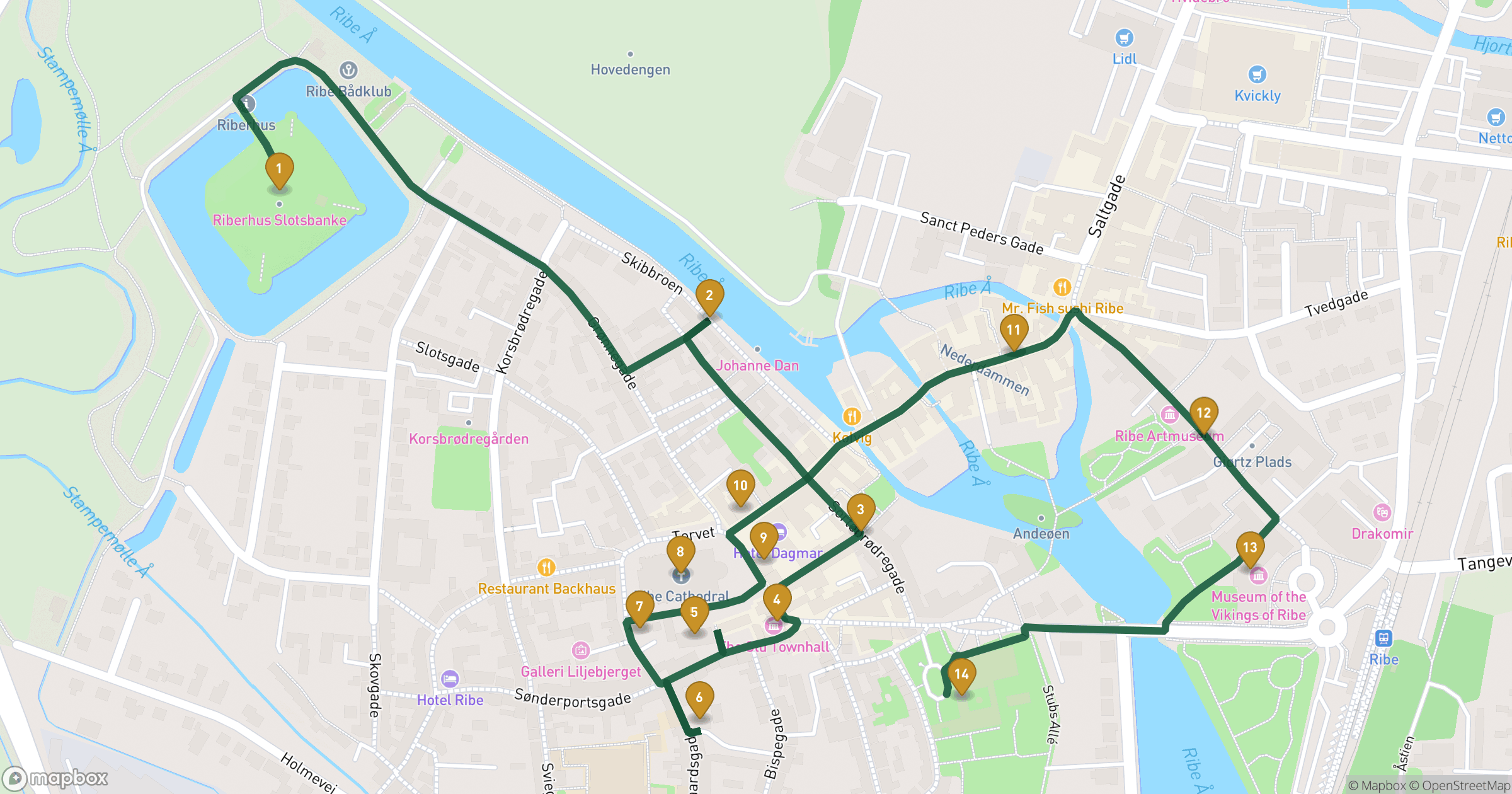
Map for Ribe walking tour with 14 stops
The static map shows the tour route with Riberhus, Skibbroen, Sortebrødregade, The old townhall of Ribe, and 10 more stops.

Stops along the route

All stops on this self-guided tour at a glance.

  1. Riberhus in Ribe
    Ajepbah / CC BY-SA 3.0 de

    1RiberhusPark

    An eight-meter earthen embankment surrounded by a deep moat marks the site of Riberhus, once a formidable royal fortress. A 1320 charter forced King Christopher III to demolish royal castles, but Riberhus was one of only three strongholds he was permitted to retain. At the southern corner stands a bronze statue of Queen Dagmar, who according to legend died here in 1212 after pleading with the king to free prisoners and exempt peasants from taxes.

    Built: 1260 · Wikidata

  2. Skibbroen in Ribe
    Thomas Dahlstrøm Nielsen / CC BY-SA 4.0

    2SkibbroenSquare

    Skibbroen quay lines the Ribe River before it reaches the Wadden Sea, recalling the town's maritime trade. Beside the door at number 19, a simple wooden board features flood marks hand-carved by local resident Hans Jørgen Rasmussen to record historic surges such as the 1634 deluge. Across the way at number 13, the timbered house from around 1600 was bought from a shoemaker's heirs in 1969 and restored by architect Hans Henrik Engqvist.

    Wikidata

  3. Sortebrødregade in Ribe
    This file was made by Robert de Jong and should be credited as Photo: Robert de Jong. If you make use of this picture outside of the Wiki community, a message on my user talk would be appreciated. If you would like a better version of this or any other image i.e. a higher resolution (max. 2592x1944) or use it under another license please feel free to contact me. / CC BY 3.0

    3SortebrødregadeSquare

    Sortebrødregade traces a medieval route named after the 13th-century Dominican friars whose monastery stood nearby. Its timber-framed residences feature upper floors that project out over the lane, an intentional design to gain interior space without narrowing the street for passing carts. Restored oak beams and textured brickwork still reflect the route monks walked between the cathedral and their monastic grounds.

    Wikidata

  4. The old townhall of Ribe in Ribe
    Hjart / CC BY-SA 4.0

    4The old townhall of RibeMuseum

    The Old Townhall unites two separate 1496 stone residences merged in 1528 by cathedral canon Niels Torkilsen. Facing Søndersportsgade, his stepped gables decorate a building that the town council bought in 1709 from Anne Terpager for 386 rigsdaler to replace a crumbling municipal seat. Its cellar served as a debtors' prison until 1891, before architect Hans Christian Amberg added the south wing and rear tower in the 1890s.

    Built: 1400 · Wikidata

  5. Kannikegården in Ribe
    Hjart / CC BY-SA 4.0

    5KannikegårdenMuseum

    Kannikegården encloses medieval monastic archaeology beneath an elevated structure of rusted steel and clay tiles completed in 2015. Through ground-level glass panels, visitors can inspect the exposed brick foundations of the cathedral's canon monastery dating to the 1100s. Designed by Lundgaard & Tranberg, the award-winning modern shelter mimics the gables of surrounding historic buildings while functioning as a parish hall.

    Built: 2015 · Architect: Lundgaard & Tranberg · Wikidata

  6. Taarnborg in Ribe
    Hjart / CC BY-SA 4.0

    6TaarnborgCastle

    Taarnborg is a late 16th-century Renaissance stone residence built with a hexagonal stair tower and cross-bond brickwork. Hymn writer Hans Adolf Brorson lived within these walls after becoming Bishop of Ribe in 1742, penning sacred verses here before selling the property to the state in 1760. Architect H.C. Amberg rebuilt the stair tower in the early 1900s after it had been demolished in 1821.

    Wikidata

  7. Hans Tausens Hus in Ribe
    Schorle / CC BY-SA 4.0

    7Hans Tausens HusBuilding

    Hans Tausens Hus remains as the only surviving wing of Ribe's original Bishop's Palace. Known as the Danish Luther after studying under Martin Luther in Wittenberg, Hans Tausen lived and worked here while serving as bishop from 1542 until his death. The building's thick stone masonry provided defensive fortification during the religious tensions of the Reformation, standing out against the town's typical timber construction.

    Named after: Hans Tausen · Wikidata

  8. Ribe Cathedral in Ribe
    Arne Müseler / CC BY-SA 4.0

    8Ribe CathedralChurch

    Ribe Cathedral was founded around 860 when the monk Ansgar persuaded the pagan King Horik I to allow a wooden church on the site. Construction of the current stone cathedral began around 1130 using greenish-grey volcanic tuff shipped from Germany's Eifel region. The massive 14th-century brick Commoner's Tower served the townspeople both as a belfry and as a lookout against North Sea floods and invading armies.

    Built: 1130 · Style: Romanesque architecture · Wikidata

  9. Porsborg in Ribe
    Hjart / CC BY-SA 4.0

    9PorsborgBuilding

    Porsborg stands on the market square as an elaborate Dutch Renaissance home built in 1590 for a wealthy merchant. Its facade reflects late 16th-century commercial prosperity through decorative brickwork, distinctive gables, and costly wide windows. Today the historic merchant dwelling houses the local tourist office.

    Built: 1590 · Wikidata

  10. Weis Stue in Ribe
    Hjart / CC BY-SA 4.0

    10Weis StueBuilding

    Weis Stue is a timber-framed inn built around 1600 that still operates as a traditional dining and lodging house. Over four centuries of settling have left its wooden beams noticeably tilted and crooked. Inside, low ceilings and original decorations preserve the atmosphere of an authentic 17th-century gathering place where locals met to trade news.

    Built: 1600 · Wikidata

  11. Nederdammen in Ribe
    Hjart / CC BY-SA 4.0

    11NederdammenSquare

    Nederdammen follows the millstream where water power once drove Ribe's early grain mills. At number 38, the Ydermøllen features a massive wooden waterwheel that still turns with the current. Nearby at Postgården, a stone embedded in the pavement marks the site of the vanished Nørreport gate, where a severed iron hand once warned travelers of Ribe's notoriously harsh criminal court.

    Wikidata

  12. Sanct Nicolaj Gade in Ribe
    Thomas Dahlstrøm Nielsen / CC BY-SA 4.0

    12Sanct Nicolaj GadeSquare

    Sanct Nicolaj Gade developed into a 19th-century manufacturing district on land that once grew food for the royal castle. In June 1880, a massive gas explosion tore through Balthazar Giørtz's steam weaving mill, shaking the entire town and financially ruining the underinsured owner. Decades later in March 1943, Danish resistance fighters bombed a wartime auto workshop operating in the remaining mill buildings.

    Wikidata

  13. Museet Ribes Vikinger in Ribe
    Hjart / CC BY-SA 4.0

    13Museet Ribes VikingerMuseum

    The Museum of the Vikings of Ribe occupies a 1992 brick building erected over the town's original early medieval marketplace. Displays showcase Christian graves from the mid-800s uncovered during major excavations at Ribe Cathedral between 2008 and 2012. Artefacts ranging from delicate jewelry to common tools reveal the everyday life of the artisans and merchants who established Denmark's oldest town.

    Built: 1992 · Architect: Niels Frithiof Truelsen · Wikidata

  14. St. Catherine's Priory in Ribe
    Hjart / CC BY-SA 4.0

    14St. Catherine's PrioryChurch

    St. Catherine's Priory preserves the most complete monastery complex in Denmark, founded in 1228 by Bishop Tuve for Dominican friars. A major fire prompted King Christian I to donate funds for repairs in 1480, helping finance the expansion into a three-aisled Gothic church. A sheltered cloister continues to frame the central courtyard where the mendicant brothers prayed until the monastery's dissolution in 1536.

    Built: 1430 · Style: Romanesque architecture · Named after: Catherine of Alexandria · Wikidata

Download the app

This public page shows a preview. The full route, all content, and navigation are available in CityTour AI.

Cities nearby

Discover self-guided tours in nearby cities.

Frequently asked questions

The key answers before you start.

Is this a self-guided audio tour?

Yes. In the CityTour AI app (iOS and Android), this is a self-guided audio tour for Ribe — start anytime, at your own pace, with map, stops, and audio narration.

What will you see on this tour?

On this tour you'll see, among others, Riberhus, Skibbroen, Sortebrødregade, The old townhall of Ribe, Kannikegården, Taarnborg and more sights.

Where does the tour start?

The route starts at Riberhus and ends at St. Catherine's Priory. You can start anytime — the app guides you to the first stop.

How long does the tour take?

About 104 minutes for 14 stops — at your own pace, with breaks whenever you like.

How much does the tour cost?

This tour costs 15 credits. The exact price depends on the pack you buy and your country — roughly $5.

Is it an outdoor tour — are entry tickets included?

Yes, it's an outdoor tour: the sights are viewed from the outside. Entry tickets are not included, and step-free access cannot be guaranteed.

Is the audio guide available in my language?

The tour and audio guide are available in English, Deutsch, Français, Español, Italiano and 9 more languages. You pick your language in the app.

Can I use the tour offline?

Yes. Tours can be used offline.

Can I ask the AI questions along the way?

Yes. At every stop you can ask the AI directly if you want to know more or didn't understand something.