CityTour AI

Tallinn self-guided walking tour

Tallinn’s Hanseatic Heart: A Medieval Journey

Step back in time on a journey through Tallinn’s UNESCO-listed Old Town, where medieval fortifications meet the legacy of the Hanseatic League. You’ll wander from the heights of Toompea Hill down to the bustling Town Hall Square, discovering hidden passages and ancient merchant homes along the way. This casual stroll captures the spirit of a city that was once the wealthiest port in the North.

Audio tourSelf-guidediOS & Android
103minutes
2.7 kmdistance
14stops
Audio guideFormat
Tallinn’s Hanseatic Heart: A Medieval Journey
Ivar Leidus / CC BY-SA 3.0 ee

Stops on this route

This tour works well for first-time visitors, weekend trips, and travelers who want to explore Tallinn without a fixed tour time.

Route map for Tallinn walking tour
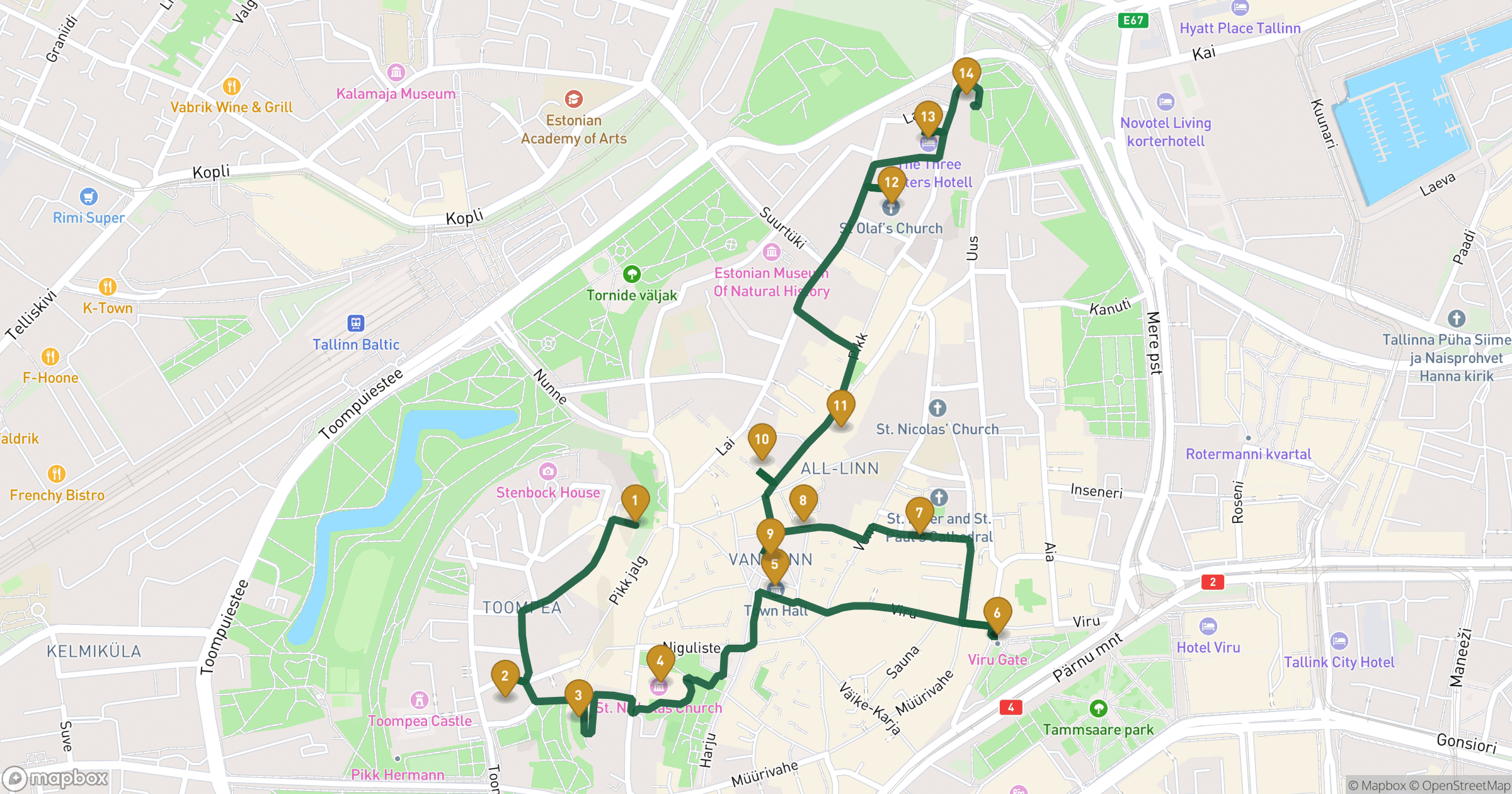
Map for Tallinn walking tour with 14 stops
The static map shows the tour route with Kohtuotsa viewing platform, Alexander Nevsky Cathedral, Danish King's Garden, St. Nicholas' Church, and 10 more stops.

Stops along the route

All stops on this self-guided tour at a glance.

  1. Kohtuotsa viewing platform in Tallinn
    Guillaume Speurt / CC BY-SA 2.0

    1Kohtuotsa viewing platformViewpoint

    Perched on the northern edge of Toompea Hill, this lookout offers a vantage point across the medieval Lower Town and modern glass towers. Centering the historic skyline is the massive spire of St. Olaf’s Church, which once served as a literal lighthouse for Baltic sailors. Across the horizon, views extend from 13th-century fortifications to the Gulf of Finland and Pirita.

    Wikidata

  2. Alexander Nevsky Cathedral in Tallinn
    Ren12 / CC BY-SA 3.0 ee

    2Alexander Nevsky CathedralChurch

    Set against medieval surroundings, this grand Russian Revival cathedral was designed by Mikhail Preobrazhensky and built between 1894 and 1900. It houses Tallinn's most powerful bell ensemble, including a massive 16-ton bell that outweighs the other ten combined. Originally viewed as a symbol of imperial oppression, the cathedral narrowly escaped a planned demolition in May 1929.

    Built: 1895 · Architect: Mikhail Preobrazhensky · Style: Russian Revival architecture · Height: 58 m · Wikidata

  3. Danish King's Garden in Tallinn
    Eric Fischer / CC BY 2.0

    3Danish King's GardenPark

    Resting on the slopes of Toompea, this quiet garden is celebrated by legend as the exact 1219 birthplace of the Dannebrog, the national flag of Denmark. During the Battle of Lyndanisse, a red banner with a white cross reportedly fell from the sky, an event still commemorated every June 15th. Today, three faceless bronze statues of monks stand watch beside the Maiden's Tower.

    Wikidata

  4. St. Nicholas' Church in Tallinn
    Ivar Leidus / CC BY-SA 3.0 ee

    4St. Nicholas' Church

    Erected in the mid-13th century by Westphalian merchants, this Gothic church was designed to double as a fortified refuge with high windows and barred doors. During the Protestant Reformation in the 1520s, the congregational leader saved it from iconoclasts by pouring molten lead into the door locks. Now a museum, it houses Bernt Notke’s famous Dance of Death painting.

    Built: 1201 · Style: Gothic architecture · Height: 105 m · Named after: Saint Nicholas · Wikidata

  5. Tallinn Town Hall in Tallinn
    jonathan exon / CC BY-SA 3.0

    5Tallinn Town HallBuilding

    Completed in 1404, this Gothic civic hall features a distinct ground-floor arcade and colorful dragon-headed waterspouts along the roofline. Since 1530, the 64-meter spire has been topped by the weather vane Old Thomas, named after a peasant boy turned legendary city guard. The municipal administration operated continuously out of this building all the way until 1970.

    Built: 1404 · Style: Gothic architecture · Wikidata

  6. Viru Gate in Tallinn
    Horx321 / CC BY-SA 4.0

    6Viru GateCastle

    Dating from the 14th century, these twin round towers were originally the outer foregates of a much larger defensive system. The primary rectangular gate tower behind them was demolished in 1888 to accommodate Tallinn’s first horse-drawn tramway. The name Viru comes from nearby clay pits, marking the historic road that once led directly to Narva and the Russian border.

    Wikidata

  7. St. Catherine's Passage in Tallinn
    Jaan Künnap / CC BY-SA 4.0

    7St. Catherine's PassageBuilding

    This winding cobblestone alleyway links Vene and Müürivahe streets, framed by massive overhead stone arches originally built to keep leaning buildings apart. Lined along the northern wall are enormous 14th- and 15th-century limestone tombstones salvaged from the neighboring monastery sanctuary. Small active workshops along the path still practice traditional glassblowing and pottery.

    Named after: Saint Catherine's Monastery · Wikidata

  8. Raeapteek in Tallinn
    Diego Delso / CC BY-SA 3.0

    8RaeapteekMuseum

    Operating on the main square since at least 1422, this historic apothecary was run across ten generations by the Burchart family, where every eldest son was named Johann. Early sales included peculiar folklore remedies such as dried toads, hedgehog blood, and powdered narwhal tusks sold as unicorn horn. Russian Emperor Peter the Great reportedly sought medical treatment from here.

    Built: 1415 · Wikidata

  9. Town Hall Square in Tallinn
    Bahnfrend / CC BY-SA 4.0

    9Town Hall Square

    This historic market square has served as the municipal gathering point since at least 1322, hosting events, festivals, and executions. In 1441, the Brotherhood of Blackheads placed a decorated evergreen here, marking one of the world's earliest documented public Christmas trees. Colorful gabled merchant houses built to flaunt Hanseatic trade status continue to frame the perimeter.

    Wikidata

  10. Great Guild Hall in Tallinn
    Kenny McFly / CC BY-SA 3.0

    10Great Guild HallBuilding

    Erected in 1410 with 20-meter gables, this limestone hall served as the powerhouse for an elite guild restricted to married German merchants. Downstairs lies the famous historic wine cellar known as 'The Sweet Hole', which operated as a drinking venue into the 20th century. The interior preserves original Gothic arches and heavy doors from its Hanseatic trading prime.

    Built: 1410 · Style: Gothic architecture · Height: 20.5 m · Wikidata

  11. House of the Blackheads in Tallinn
    Photograph by Mike Peel (www.mikepeel.net). / CC BY-SA 4.0

    11House of the BlackheadsTheatre

    Acquired in 1517 by an elite brotherhood of unmarried merchants, this guildhall showcases a Dutch Renaissance facade sculpted in 1597 by Arent Passer. The Moor’s head carved above the 1640s red, green, and gold door portrays the brotherhood's patron saint, Saint Maurice. Russian Emperors Peter the Great and Alexander I visited the society and were granted honorary memberships.

    Style: Renaissance architecture · Wikidata

  12. St. Olaf's Church in Tallinn
    Olga Itenberg / CC BY 2.0

    12St. Olaf's Church

    Dominating the skyline at 123.7 meters, this church had a spire so tall in the 16th century that it served as a navigational beacon across the Baltic. Local folklore claims its builder, Olev, fell to his death when his name was discovered, with a toad and snake crawling from his mouth. Decades later during the Soviet era, the KGB commandeered the tower for radio surveillance.

    Built: 1201 · Style: Gothic architecture · Height: 123.7 m · Named after: Olaf II of Norway · Wikidata

  13. Three Sisters in Tallinn
    Velirand / CC BY-SA 4.0

    13Three SistersBuilding

    Built in the 1430s, this trio of Hanseatic merchant houses combines residential quarters with dry-storage lofts complete with upper gable hoisting beams. The buildings made early use of central heating through a basement furnace system that piped hot air through floor vents. The leftmost facade features an intricate mid-17th-century Baroque door carved by Franz Hoppenstätt.

    Wikidata

  14. Fat Margaret in Tallinn
    Photograph by Mike Peel (www.mikepeel.net). / CC BY-SA 4.0

    14Fat MargaretTower

    Guarding the Great Coastal Gate, this 1530 artillery tower was built by Westphalian master mason Gert Koningk with flagstone walls up to five meters thick. Later converted into a prison, it was stormed in 1917 by rebellious sailors and workers who freed the inmates. Today the interior exhibits a well-preserved 14th-century merchant cog excavated nearby in 2015.

    Wikidata

Download the app

This public page shows a preview. The full route, all content, and navigation are available in CityTour AI.

Cities nearby

Discover self-guided tours in nearby cities.

Frequently asked questions

The key answers before you start.

Is this a self-guided audio tour?

Yes. In the CityTour AI app (iOS and Android), this is a self-guided audio tour for Tallinn — start anytime, at your own pace, with map, stops, and audio narration.

What will you see on this tour?

On this tour you'll see, among others, Kohtuotsa viewing platform, Alexander Nevsky Cathedral, Danish King's Garden, St. Nicholas' Church, Tallinn Town Hall, Viru Gate and more sights.

Where does the tour start?

The route starts at Kohtuotsa viewing platform and ends at Fat Margaret. You can start anytime — the app guides you to the first stop.

How long does the tour take?

About 103 minutes for 14 stops — at your own pace, with breaks whenever you like.

How much does the tour cost?

This tour costs 15 credits. The exact price depends on the pack you buy and your country — roughly $5.

Is it an outdoor tour — are entry tickets included?

Yes, it's an outdoor tour: the sights are viewed from the outside. Entry tickets are not included, and step-free access cannot be guaranteed.

Is the audio guide available in my language?

The tour and audio guide are available in English, Deutsch, Français, Español, Italiano and 9 more languages. You pick your language in the app.

Can I use the tour offline?

Yes. Tours can be used offline.

Can I ask the AI questions along the way?

Yes. At every stop you can ask the AI directly if you want to know more or didn't understand something.