CityTour AI

Tartu self-guided walking tour

Tartu: The Spirit of Estonia’s Intellectual Heart

Explore the intellectual heart of Estonia on a casual stroll through Tartu’s historic center and the lush slopes of Toome Hill. You’ll discover medieval ruins, world-record-holding pubs, and the prestigious university buildings that define the city’s famous Spirit. This walk blends grand Neoclassical architecture with quirky local legends, offering a deep dive into the stories that shaped the oldest city in the Baltics.

Audio tourSelf-guidediOS & Android
102minutes
2.7 kmdistance
13stops
Audio guideFormat
Tartu: The Spirit of Estonia’s Intellectual Heart
HendrixEesti / Public domain

Stops on this route

This tour works well for first-time visitors, weekend trips, and travelers who want to explore Tartu without a fixed tour time.

Route map for Tartu walking tour
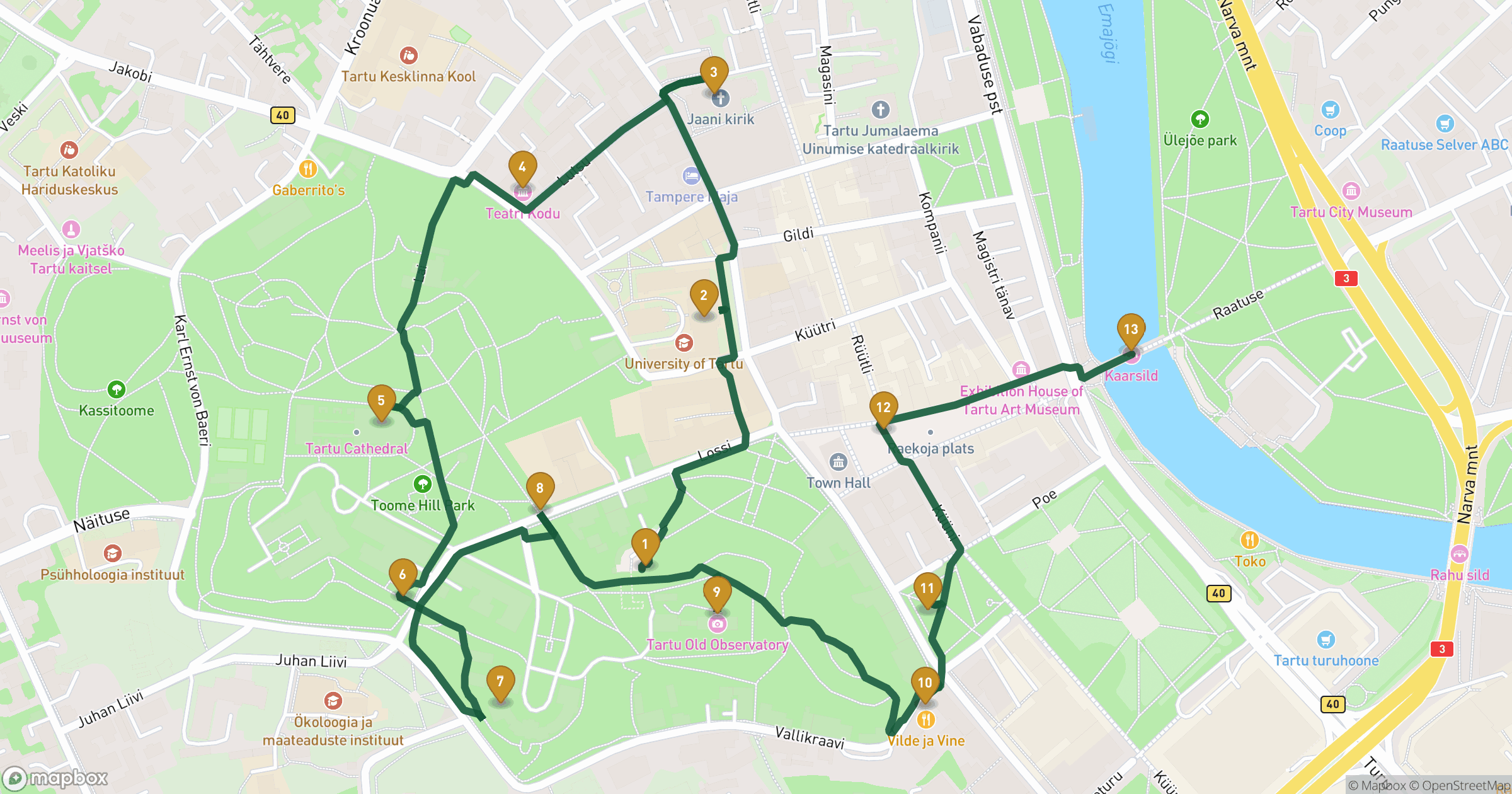
Map for Tartu walking tour with 13 stops
The static map shows the tour route with Gunpowder Cellar of Tartu, main building of the University of Tartu, St. John's Church, Lutsu 2, and 9 more stops.

Stops along the route

All stops on this self-guided tour at a glance.

  1. Gunpowder Cellar of Tartu in Tartu
    Lauri Veerde / CC BY-SA 4.0

    1Gunpowder Cellar of TartuMonument

    Tucked into a hillside, this massive brick gunpowder cellar reveals Tartu’s knack for turning military fortifications into student haunts. Built between 1768 and 1778 by order of Catherine II of Russia, it later hosted university science lectures where professors balanced gear on powder kegs. Today it holds the Guinness World Record for the highest pub ceiling at 11 meters.

    Wikidata

  2. main building of the University of Tartu in Tartu
    Ivar Leidus / CC BY-SA 3.0 ee

    2main building of the University of Tartu

    Six white classical columns introduce the main university building as the focal point of student life and strict academic discipline. In the 19th century, the university maintained its own lock-up rooms in the attic, detaining students for weeks over unpaid debts or late library books. Carefully restored after a devastating 1965 fire, it remains the university's administrative center.

    Architect: Johann Wilhelm Krause · Style: Neoclassical architecture · Wikidata

  3. St. John's Church in Tartu
    Jeroenm / CC BY-SA 3.0

    3St. John's Church

    This 14th-century Brick Gothic church stands out across Europe for the terracotta sculptures adorning its facade. Around 200 handmade clay figurines survived wars and the 1775 fire, each featuring distinct facial features modeled after actual medieval residents. Pioneer actress Amalie Konsa received her only formal education here in the late 19th century when it ran a charity school.

    Built: 1323 · Style: Brick Gothic · Height: 63 m · Named after: John the Baptist · Wikidata

  4. Lutsu 2 in Tartu
    Oop / CC BY-SA 3.0 ee

    4Lutsu 2Museum

    This rare wooden Baroque residence illustrates how Tartu looked before neoclassical stone architecture swept the city. Built in the mid-18th century, it miraculously escaped the devastating fire of 1775 that consumed nearly two hundred local buildings. The preserved wooden structure now forms part of the Tartu Toy Museum complex as the Theater Home.

    Style: baroque architecture · Wikidata

  5. Tartu Cathedral in Tartu
    Ivar Leidus / CC BY-SA 3.0 ee

    5Tartu CathedralChurch

    The towering Brick Gothic ruins atop Toome Hill mark the shift from an ancient Estonian pagan fort to a major Christian center. In 1726, French traveler Aubry de La Mottraye noted that the cathedral's towers rose as high as those of Notre-Dame in Paris before Protestant iconoclasts smashed the interior. In the early 1800s, the choir was converted into the university library.

    Built: 1300 · Style: Brick Gothic · Named after: Saint Peter · Wikidata

  6. Kuradisild in Tartu
    Ivo Kruusamägi / CC BY-SA 4.0

    6KuradisildBridge

    Erected in 1913, this dark concrete bridge commemorates the 300th anniversary of the Romanov dynasty. Student lore ties the bridge's sinister name to university surgery professor Werner Zoege von Manteuffel, drawing on the German word Teufel. The Art Nouveau structure features the dates 1613 and 1913 on one side and a bronze portrait relief of Emperor Alexander I on the other.

    Named after: devil, Alexander I of Russia · Wikidata

  7. Old Anatomical Theatre in Tartu
    The Prince of Tartu / CC BY-SA 4.0

    7Old Anatomical TheatreBuilding

    Architect Johann Wilhelm Krause converted an old Swedish military bastion of King Charles X Gustav into this temple-like medical theater. Completed in 1805, the central rotunda holds a tiered anatomical amphitheater accented by grisaille murals painted by Karl August Senff. Semicircular wings were later added by Krause and expanded in the 1850s by Carl Rathhaus.

    Architect: Johann Wilhelm Krause, Carl Rathhaus · Wikidata

  8. Inglisild in Tartu
    Laima Gūtmane (simka) / CC BY-SA 3.0

    8InglisildAttraction

    The yellow Angel’s Bridge crosses Toome Hill with a Neoclassical timber-and-stone design that replaced an earlier wooden span in 1838. It was engineered by Moritz Hermann von Jacobi, the physicist credited with inventing electrotyping. A central bronze relief honors the university’s first rector, Georg Friedrich Parrot, above the Latin motto Otium reficit vires.

    Wikidata

  9. University of Tartu Old Observatory in Tartu
    Kristjan Rea / CC BY-SA 3.0

    9University of Tartu Old ObservatoryBuilding

    Perched on the highest point of the hill, this 1811 Neoclassical observatory served as the anchor station for the UNESCO-listed Struve Geodetic Arc. In 1824, Friedrich Georg Wilhelm von Struve used its Fraunhofer Great Dorpat Refractor to achieve the first accurate measurement of the distance to the star Vega. Astronomer Ernst Öpik later calculated the distance to the Andromeda Galaxy here.

    Built: 1811 · Architect: Johann Wilhelm Krause · Style: Neoclassical architecture · Wikidata

  10. Sculpture to Oscar Wilde and Eduard Vilde in Tartu in Tartu
    Ilme Parik / CC BY-SA 3.0

    10Sculpture to Oscar Wilde and Eduard Vilde in TartuMonument

    A bronze bench on Vallikraavi Street stages an impossible encounter between playwright Oscar Wilde and Estonian writer Eduard Vilde. Sculptor Tiiu Kirsipuu crafted the fictional meeting in 1999, contrasting the Irishman's flamboyant tailoring with the Estonian's sober attire despite Wilde never visiting the city. A replica of this charming sculpture now sits in Galway, Ireland.

    Built: 1999 · Wikidata

  11. Barclay de Tolly Monument in Tartu
    HendrixEesti / CC BY-SA 3.0

    11Barclay de Tolly Monument

    Set within a 19th-century park, this bronze monument honors Field Marshal Michael Andreas Barclay de Tolly, a hero of the Napoleonic Wars of Scottish descent. Unveiled in 1849, the Empire-style sculpture was designed by Vasily Demut-Malinovsky, surrounded by military trophies. It commemorates the general whose controversial scorched-earth strategy ultimately broke Napoleon's army.

    Built: 1849 · Wikidata

  12. Town Hall Square in Tartu
    Kamma / CC BY-SA 4.0

    12Town Hall Square

    Tartu’s vibrant trapezoidal main square is framed by pastel facades erected following the Great Fire of 1775. Overlooking the riverward slant stands the pink 1789 Town Hall, combining late Baroque and Neoclassical styles. In the center, Mati Karmin's 1998 Kissing Students fountain serves as a romantic symbol of the energetic university town.

    Wikidata

  13. Kaarsild in Tartu
    HendrixEesti / Public domain

    13KaarsildBridge

    Spanning the Emajõgi River, this concrete arch bridge stands on the site of the grand 1784 Stone Bridge destroyed during World War II. Built between 1957 and 1959, the minimalist structure hosts a daring student rite of passage that involves balancing across the curved top of the concrete span. An extensive 2017 renovation transformed the functionalist crossing into an interactive art piece.

    Built: 1959 · Wikidata

Download the app

This public page shows a preview. The full route, all content, and navigation are available in CityTour AI.

Cities nearby

Discover self-guided tours in nearby cities.

Frequently asked questions

The key answers before you start.

Is this a self-guided audio tour?

Yes. In the CityTour AI app (iOS and Android), this is a self-guided audio tour for Tartu — start anytime, at your own pace, with map, stops, and audio narration.

What will you see on this tour?

On this tour you'll see, among others, Gunpowder Cellar of Tartu, main building of the University of Tartu, St. John's Church, Lutsu 2, Tartu Cathedral, Kuradisild and more sights.

Where does the tour start?

The route starts at Gunpowder Cellar of Tartu and ends at Kaarsild. You can start anytime — the app guides you to the first stop.

How long does the tour take?

About 102 minutes for 13 stops — at your own pace, with breaks whenever you like.

How much does the tour cost?

This tour costs 15 credits. The exact price depends on the pack you buy and your country — roughly $5.

Is it an outdoor tour — are entry tickets included?

Yes, it's an outdoor tour: the sights are viewed from the outside. Entry tickets are not included, and step-free access cannot be guaranteed.

Is the audio guide available in my language?

The tour and audio guide are available in English, Deutsch, Français, Español, Italiano and 9 more languages. You pick your language in the app.

Can I use the tour offline?

Yes. Tours can be used offline.

Can I ask the AI questions along the way?

Yes. At every stop you can ask the AI directly if you want to know more or didn't understand something.