CityTour AI

Montélimar self-guided walking tour

Montélimar: From Medieval Fortress to Nougat Capital

Discover the hidden stories of Montélimar on this relaxing walk through its historic heart. From the imposing Adhémar Castle to elegant 19th-century boulevards, experience the city's transformation into the sunny capital of nougat. A perfect blend of architecture, local anecdotes, and the unmistakable atmosphere of the Drôme.

Audio tourSelf-guidediOS & Android
99minutes
3.3 kmdistance
11stops
Audio guideFormat
Montélimar: From Medieval Fortress to Nougat Capital
Marianne Casamance / CC BY-SA 3.0

Stops on this route

This tour works well for first-time visitors, weekend trips, and travelers who want to explore Montélimar without a fixed tour time.

Route map for Montélimar walking tour
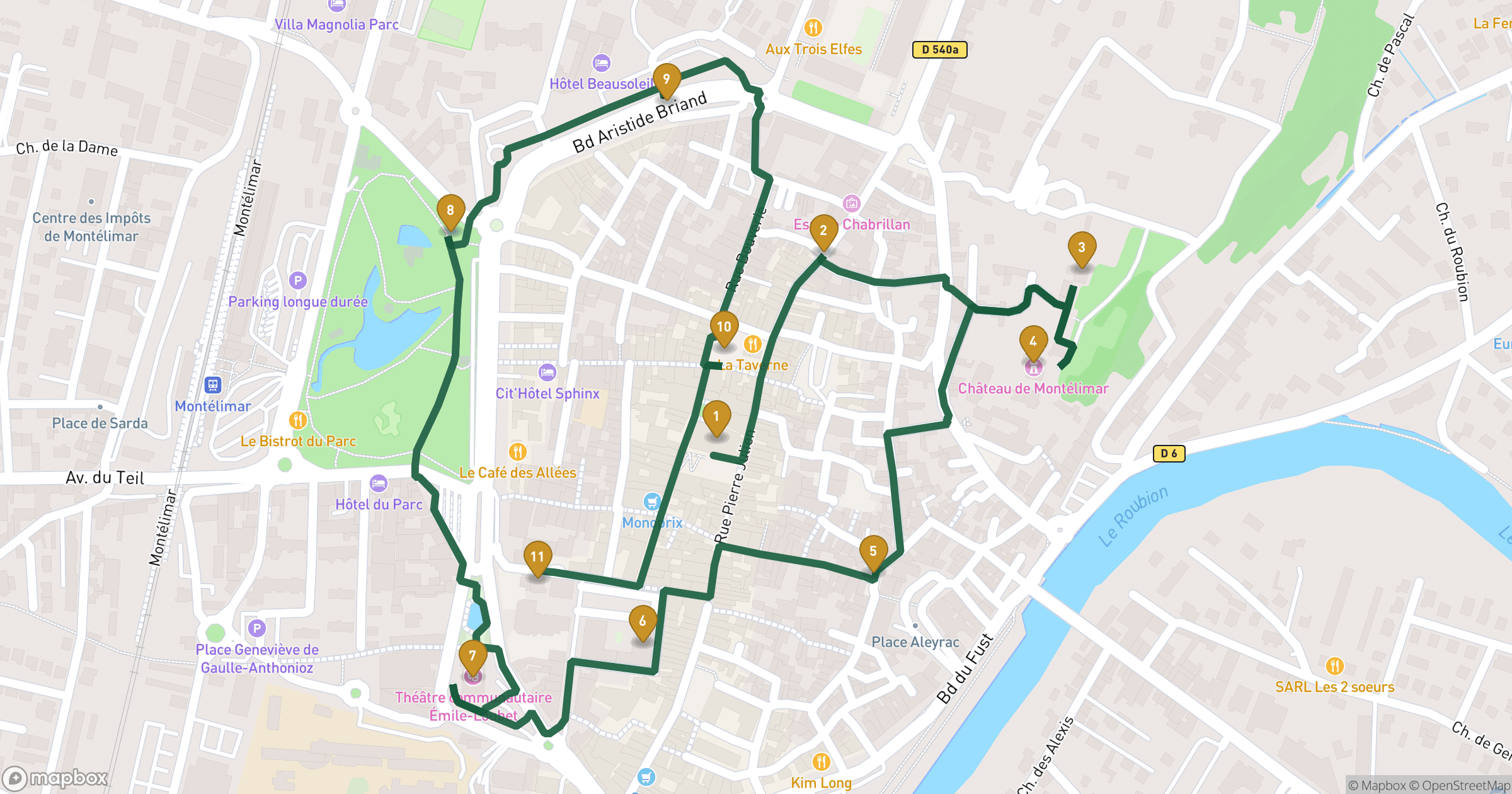
Map for Montélimar walking tour with 11 stops
The static map shows the tour route with Collégiale Sainte-Croix, Rue Pierre Julien, Tour de Narbonne, Château des Adhémar, and 7 more stops.

Stops along the route

All stops on this self-guided tour at a glance.

  1. Collégiale Sainte-Croix in Montélimar
    Abaddon1337 / CC BY-SA 3.0

    1Collégiale Sainte-CroixChurch

    The Collégiale Sainte-Croix stands as the spiritual heart of Montélimar, bearing the scars of the 16th-century Wars of Religion when Protestant forces nearly destroyed the medieval church. Its subsequent reconstruction shaped the Counter-Reformation facade visible today alongside rich 18th-century choir stalls. Inside, the church preserves a 19th-century organ crafted by the celebrated organ builder Aristide Cavaillé-Coll.

    Wikidata

  2. 2Rue Pierre JulienBuilding

    Rue Pierre Julien is the main artery of old Montélimar, named after a local 20th-century resistance fighter. Among its blend of medieval dwellings and aristocratic winter retreats stands the Hôtel de Chabrillan, distinguished by elegant wrought-iron balconies. At the northern end, the 18th-century ceremonial Porte Saint-Martin marks where travelers from Lyon once entered through the former medieval defenses.

  3. Tour de Narbonne in Montélimar
    Eagertourist / CC0

    3Tour de NarbonneTower

    The 12th-century Tour de Narbonne formed an essential part of the fortifications guarding the Adhémar castle. Built with finely dressed Romanesque masonry, the tower features a clever transition from a square base to a pentagonal upper section, designed to eliminate blind spots and deflect incoming projectiles. Its massive walls stood as the final refuge for garrison troops, surviving the demolition of the town's outer walls.

    Wikidata

  4. Château des Adhémar in Montélimar
    ChateauxDrôme / CC BY-SA 4.0

    4Château des AdhémarCastle

    The Château des Adhémar gave Montélimar its name when the powerful Adhémar de Monteil family constructed their 12th-century Romanesque palace here. Giraud and Lambert Adhémar built the residential wing, whose facade retains exquisite twin-arched windows that reflect the wealth of a clan that included the papal legate of the First Crusade. The complex features the arched chapel of Saint-Pierre and served as a prison in the 16th century.

    Wikidata

  5. 5Place Léopold BlancSquare

    Place Léopold Blanc opened up during 19th-century urban modernization when railway expansion and the nougat boom transformed the city. Named after the former mayor who led these civic improvements, the square showcases symmetrical architecture reflecting the rising bourgeoisie. At its center stands a fountain that long served as a meeting place and the site of bustling local markets.

  6. town hall of Montélimar in Montélimar
    Abaddon1337 / CC BY-SA 3.0

    6town hall of MontélimarBuilding

    The town hall of Montélimar serves as the seat of local democracy and administrative autonomy, set between the historic core and newer districts. The site has hosted regional administration since Roman times, preserving municipal traditions beneath its formal exterior. Its interior rooms host city council debates and civic marriages just a short walk from the theater named after France's eighth president.

    Wikidata

  7. Emile Loubet Theatre in Montélimar
    Abaddon1337 / CC BY-SA 3.0

    7Emile Loubet Theatre

    The Théâtre Émile-Loubet opened in 1885 with a classical facade designed by architect Adam Niewarowicz to offer the local bourgeoisie a center for culture. It takes its name from local native Émile Loubet, who rose to become the eighth president of France. In 1899, Loubet took the courageous political step of pardoning Alfred Dreyfus during one of the country's fiercest national scandals.

    Architect: Adam Niewarowicz · Named after: Émile Loubet · Wikidata

  8. 8Jardin Public

    The Jardin Public was created around 1850 in the English landscape style, trading straight avenues for curved paths and a pond. Centenarian trees planted more than a century and a half ago still shade the grounds, which became popular for Sunday strolls under Napoleon III. A classical bandstand recalls open-air concerts by military bands, complemented by a small zoo that has welcomed families for generations.

  9. 9Les Allées Provencales

    Les Allées Provençales is a sweeping promenade laid directly along the path of Montélimar's former medieval walls after they were cleared in the 19th century. Stately plane trees line the broad avenue to cast summer shade over bustling outdoor cafe and aperitif terraces. As the heart of social life in the city, the boulevard hosts vibrant local markets, festivals, and pétanque competitions.

  10. Place du Marché in Montélimar
    Médiathèques Valence Romans agglomération | https://www.flickr.com/photos/mediathequesvalenceromansagglo/33873348494/ / CC BY 2.0

    10Place du MarchéSquare

    Place du Marché has long driven the local economy, defined by surrounding homes with covered stone arcades that sheltered merchants from sun and rain. The square was central to the confection that made the town famous, trading the almonds, honey, and sugar essential for nougat production. Wear marks from centuries of cart traffic and commerce remain visible along the arcade pillars.

  11. Temple protestant in Montélimar
    Ulf Heinsohn / CC BY-SA 4.0

    11Temple protestantChurch

    The Temple Protestant began its religious journey in 1612 as a chapel built for the Ursuline convent with the permission of King Louis XIII. Protestantism was fiercely suppressed in the city following the 1685 revocation of the Edict of Nantes and dragonnade raids, leaving their original temple destroyed. Religious freedom returned under Napoleon Bonaparte, who granted this convent chapel to Protestant worshipers on July 19, 1802.

    Built: 1612 · Wikidata

Download the app

This public page shows a preview. The full route, all content, and navigation are available in CityTour AI.

Cities nearby

Discover self-guided tours in nearby cities.

Frequently asked questions

The key answers before you start.

Is this a self-guided audio tour?

Yes. In the CityTour AI app (iOS and Android), this is a self-guided audio tour for Montélimar — start anytime, at your own pace, with map, stops, and audio narration.

What will you see on this tour?

On this tour you'll see, among others, Collégiale Sainte-Croix, Rue Pierre Julien, Tour de Narbonne, Château des Adhémar, Place Léopold Blanc, town hall of Montélimar and more sights.

Where does the tour start?

The route starts at Collégiale Sainte-Croix and ends at Temple protestant. You can start anytime — the app guides you to the first stop.

How long does the tour take?

About 99 minutes for 11 stops — at your own pace, with breaks whenever you like.

How much does the tour cost?

This tour costs 15 credits. The exact price depends on the pack you buy and your country — roughly $5.

Is it an outdoor tour — are entry tickets included?

Yes, it's an outdoor tour: the sights are viewed from the outside. Entry tickets are not included, and step-free access cannot be guaranteed.

Is the audio guide available in my language?

The tour and audio guide are available in English, Deutsch, Français, Español, Italiano and 9 more languages. You pick your language in the app.

Can I use the tour offline?

Yes. Tours can be used offline.

Can I ask the AI questions along the way?

Yes. At every stop you can ask the AI directly if you want to know more or didn't understand something.