CityTour AI

Arbois self-guided walking tour

Arbois: Wine, Science, and Heritage

This walking tour of Arbois blends the scientific breakthroughs of Louis Pasteur with the centuries-old winemaking traditions of the Jura. Explore architectural treasures ranging from medieval defensive towers to elegant 18th-century arcades while enjoying views over the Cuisance valley. The route offers a deep understanding of the symbiosis between craftsmanship, faith, and research that defines this town in the Revermont.

Audio tourSelf-guidediOS & Android
104minutes
3.9 kmdistance
11stops
Audio guideFormat
Arbois: Wine, Science, and Heritage
Damien Boilley / CC BY 2.0

Stops on this route

This tour works well for first-time visitors, weekend trips, and travelers who want to explore Arbois without a fixed tour time.

Route map for Arbois walking tour
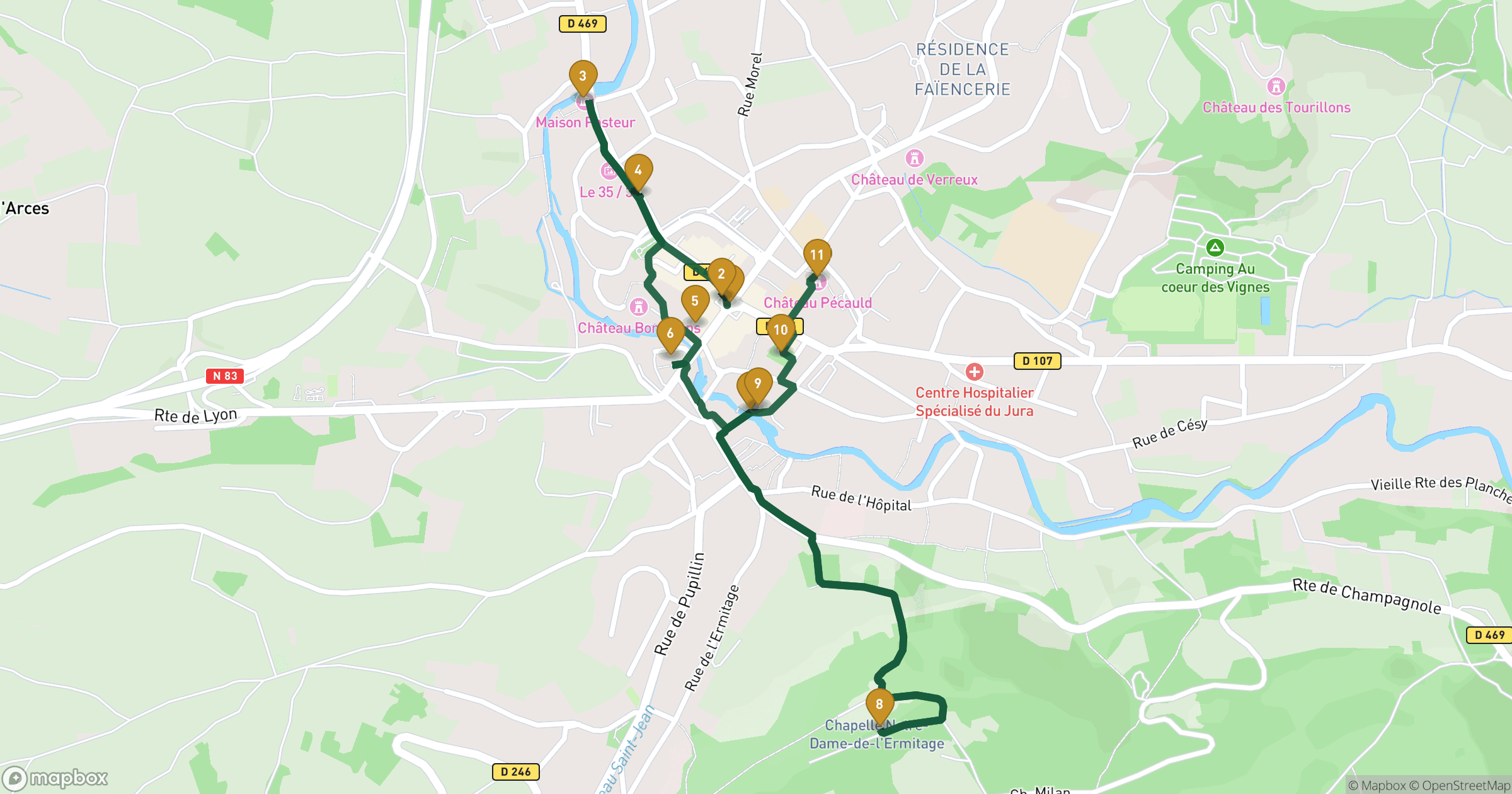
Map for Arbois walking tour with 11 stops
The static map shows the tour route with Fontaine aux Lions, Place de la Liberté, Maison paternelle de Pasteur, Rue de Courcelles, and 7 more stops.

Stops along the route

All stops on this self-guided tour at a glance.

  1. Fontaine aux Lions in Arbois
    Espirat / CC BY-SA 4.0

    1Fontaine aux Lions

    The Fontaine aux Lions forms the decorative centerpiece of Arbois' main square and illustrates the rise of municipal water monuments in the 19th century. Erected in 1833 during a major infrastructure expansion, the fountain served as both a practical water source and a social hub. Its precisely carved lion figures symbolize strength and showcase the fine Franche-Comté stonemasonry of the era.

  2. Place de la Liberté in Arbois
    Wikipedro / CC BY-SA 4.0

    2Place de la Liberté

    Place de la Liberté represents the urban core of Arbois, designed according to the ideals of Enlightenment architecture and the reign of Louis XV. Elegant houses with sweeping arcades provided sheltered space for commerce while reflecting the wealth generated by the local wine trade. Today, cafes and small shops line these historic arches, framing views across the surrounding monuments.

  3. Maison paternelle de Pasteur in Arbois
    Arnaud 25 / CC BY-SA 3.0

    3Maison paternelle de PasteurMuseum

    Maison de Louis Pasteur at 83 Rue de Courcelle was the childhood home of the world-famous microbiologist and stands protected as a historic monument since 1937. Originally a tannery run by his father Jean-Joseph on the banks of the Cuisance, Pasteur expanded it to include his private laboratory for experiments on fermentation and spontaneous generation. The 19th-century interior remains almost completely intact with instruments and furniture he personally chose.

    Wikidata

  4. 4Rue de Courcelles

    Rue de Courcelles offers an authentic glimpse into the daily life and architectural legacy of regional winemaking families. Massive round-arched limestone portals built in the 17th and 18th centuries allowed loaded carts and giant wine barrels to enter deep cellars below. These compact, steeply roofed houses reflect the dense settlement inside the former town walls where generations produced Vin Jaune and Vin de Paille.

  5. Hôtel de ville d'Arbois in Arbois
    Stefan64 / CC0

    5Hôtel de ville d'Arbois

    The Hôtel de Ville occupies a monumental complex that originated as an Ursuline convent founded in 1617. Architect Jean-Charles Colombot designed the current main building between 1764 and 1768, creating a facade poised between Baroque and Classicism. Acquired by the city in 1802 following secularization during the French Revolution, the site cleverly integrates the former convent chapel into modern civic administration.

    Wikidata

  6. Église Saint-Just d'Arbois in Arbois
    GO69 / CC BY-SA 4.0

    6Église Saint-Just d'ArboisChurch

    The Église Saint-Just is the prominent parish church of Arbois, tracing its origins to a 12th-century Romanesque Benedictine priory. After fireworks triggered a devastating fire that destroyed the original 75-meter bell tower in 1651, the present 57-meter tower was built in 1716 using Montesserin limestone and a signature Comtois dome. Inside stands a 1728 Marin Carouge organ alongside a carillon with Franche-Comté's largest bourdon bell, weighing over four tons.

    Style: Romanesque architecture · Wikidata

  7. Pont des Capucins in Arbois
    Хрюша / CC BY-SA 3.0

    7Pont des CapucinsBridge

    Pont des Capucins is a historic stone-arch footbridge over the Cuisance river that exposes the functional layout of Arbois' early leather industry. Looking upstream reveals the backs of former tanners' houses, featuring distinctive open galleries under the eaves where hides were left to air-dry. The bridge's robust masonry links the tight residential quarters directly to the riverside topography.

    Wikidata

  8. Belvédère de l'Ermitage in Arbois
    Espirat / CC BY-SA 4.0

    8Belvédère de l'ErmitageViewpoint

    Belvédère de l'Ermitage perches above the town center near the Chapelle de l'Ermitage, revealing Arbois' position in the Revermont landscape between the Bresse plain and the Jura plateau. From this vantage point, the medieval core clearly traces the course of the Cuisance valley, dominated by the towers of Saint-Just and the Tour Gloriette. The surrounding hillside slopes remain almost entirely covered with vineyards that have underpinned the local economy for centuries.

  9. Tour Gloriette in Arbois
    JGS25 / CC BY-SA 4.0

    9Tour GlorietteTower

    Tour Gloriette stands as a square defensive bastion from Arbois' medieval fortifications, which once stretched 1.2 kilometers around the town. After a massive flood of the Cuisance undermined its foundations in 1503 and caused it to collapse, the 17-meter-high tower was rebuilt from local limestone in the 16th century. Today, its surviving exterior displays distinct construction phases that contrast with its later, more decorative name.

    Wikidata

  10. 10Square Sarret de GrozonPark

    Square Sarret de Grozon is a public park bordering an 18th-century mansion, illustrating the garden culture of Arbois' local aristocracy. The estate belonged to the influential Sarret de Grozon family, whose historic residence now preserves cultural collections of the town. With mature trees and classical paths, the grounds form a green threshold between the monumental town center and peaceful residential lanes.

  11. Château Pécauld in Arbois
    Damien Boilley / CC BY 2.0

    11Château PécauldCastle

    Château Pécauld evolved from a 13th-century defensive bastion of the city wall, known as Tour Velfaux, into a Renaissance residence. Nicolas Perrenot de Granvelle, a key statesman under Emperor Charles V, bought the property in the early 16th century and rebuilt it around the medieval tower to signal his political status. Since a major renovation in 1993, this city-owned estate houses the Jura Wine Museum and celebrates the production of Vin Jaune.

    Wikidata

Download the app

This public page shows a preview. The full route, all content, and navigation are available in CityTour AI.

Cities nearby

Discover self-guided tours in nearby cities.

Frequently asked questions

The key answers before you start.

Is this a self-guided audio tour?

Yes. In the CityTour AI app (iOS and Android), this is a self-guided audio tour for Arbois — start anytime, at your own pace, with map, stops, and audio narration.

What will you see on this tour?

On this tour you'll see, among others, Fontaine aux Lions, Place de la Liberté, Maison paternelle de Pasteur, Rue de Courcelles, Hôtel de ville d'Arbois, Église Saint-Just d'Arbois and more sights.

Where does the tour start?

The route starts at Fontaine aux Lions and ends at Château Pécauld. You can start anytime — the app guides you to the first stop.

How long does the tour take?

About 104 minutes for 11 stops — at your own pace, with breaks whenever you like.

How much does the tour cost?

This tour costs 15 credits. The exact price depends on the pack you buy and your country — roughly $5.

Is it an outdoor tour — are entry tickets included?

Yes, it's an outdoor tour: the sights are viewed from the outside. Entry tickets are not included, and step-free access cannot be guaranteed.

Is the audio guide available in my language?

The tour and audio guide are available in English, Deutsch, Français, Español, Italiano and 9 more languages. You pick your language in the app.

Can I use the tour offline?

Yes. Tours can be used offline.

Can I ask the AI questions along the way?

Yes. At every stop you can ask the AI directly if you want to know more or didn't understand something.