CityTour AI

Baden-Baden self-guided walking tour

Baden-Baden: Between Belle Époque and Spa Culture

Experience the incomparable charm of the "Summer Capital of Europe" on a relaxed stroll through magnificent parks and the historic old town. From the glamorous facades of the Belle Époque to the steaming thermal springs, discover why Baden-Baden has enchanted people from all over the world for millennia. This tour combines architectural highlights with hidden corners and tells the story of a city that perfectly combines wellness and world culture.

Audio tourSelf-guidediOS & Android
103minutes
3.2 kmdistance
13stops
Audio guideFormat
Baden-Baden: Between Belle Époque and Spa Culture
Txllxt TxllxT / CC BY-SA 4.0

Stops on this route

This tour works well for first-time visitors, weekend trips, and travelers who want to explore Baden-Baden without a fixed tour time.

Route map for Baden-Baden walking tour
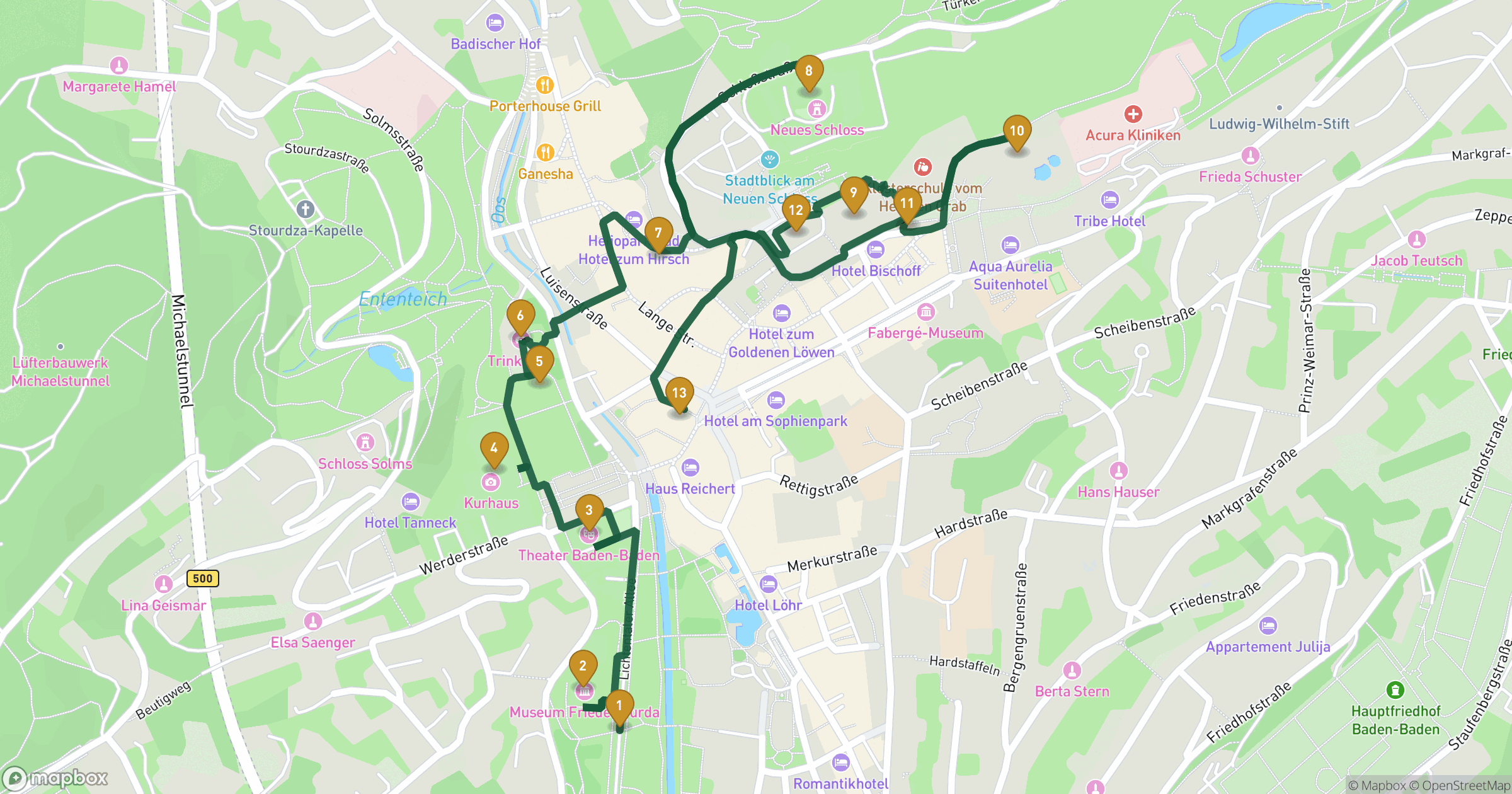
Map for Baden-Baden walking tour with 13 stops
The static map shows the tour route with Lichtentaler Allee, Museum Frieder Burda, Theater Baden-Baden, Kurhaus of Baden-Baden, and 9 more stops.

Stops along the route

All stops on this self-guided tour at a glance.

  1. Lichtentaler Allee in Baden-Baden
    Txllxt TxllxT / CC BY-SA 4.0

    1Lichtentaler AlleeMonument

    Lichtentaler Allee is a 2.3-kilometer park promenade along the Oos River that transformed from a simple convent path into a world-famous avenue. Casino lessee Edouard Bénazet poured gambling profits into shaping it like an English landscape garden. Giant sequoias and blooming magnolias line this protected cultural monument alongside grand historic villas.

    Named after: Lichtental · Wikidata

  2. Museum Frieder Burda in Baden-Baden
    A.Savin / CC BY-SA 3.0

    2Museum Frieder Burda

    Museum Frieder Burda is a luminous, stark white gallery built directly inside the park by Pritzker laureate Richard Alan Meier in 2004. German publisher and collector Frieder Burda often visited the museum in person to watch guests engage with his 20th- and 21st-century collection. A glass pedestrian bridge connects the daylight-filled building directly to the Staatliche Kunsthalle.

    Built: 2004 · Architect: Richard Meier · Wikidata

  3. Theater Baden-Baden in Baden-Baden
    Till Niermann / CC BY-SA 4.0

    3Theater Baden-BadenTheatre

    Theater Baden-Baden on Goetheplatz was designed by Charles Couteau in Second Empire style after the Paris Opera. Composer Hector Berlioz personally conducted the premiere of his opera Beatrice et Benedict here for its opening in August 1862. Its red sandstone facade and opulent interior decorated with gold and red velvet were funded under casino lessee Edouard Bénazet.

    Built: 1862 · Architect: Charles Couteau · Wikidata

  4. Kurhaus of Baden-Baden in Baden-Baden
    A.Savin / CC BY-SA 3.0

    4Kurhaus of Baden-BadenAttraction

    The Kurhaus Baden-Baden represents the city's classical grandeur with eight Corinthian columns designed between 1821 and 1824 by Friedrich Weinbrenner. Marlene Dietrich praised its casino as the most beautiful in the world, while Fyodor Dostoevsky lost his fortune here before channeling the disaster into his novel The Gambler. French castle-style halls host grand galas today.

    Wikidata

  5. Kurgarten in Baden-Baden
    Gerd Eichmann / CC BY-SA 4.0

    5KurgartenPark

    The Kurgarten serves as the central open-air meeting place connecting the Kurhaus with the theater. Its geometric floral beds undergo seasonal plantings, framed by historic cast-iron candelabras that illuminate the paths in the evening. A central band shell hosts regular spa concerts where strict class-based walking rules once dictated who was permitted to stroll.

  6. Trinkhalle Baden-Baden in Baden-Baden
    A.Savin / CC BY-SA 3.0

    6Trinkhalle Baden-BadenAttraction

    The Trinkhalle is a 90-meter open colonnade built by Heinrich Hübsch in the mid-19th century beside the Kurgarten. Jakob Götzenberger painted 14 interior murals depicting local Black Forest legends, including water nymphs in Lake Mummelsee and the Maiden of Fremersberg. An indoor fountain provided thermal mineral water that European monarchs drank during their daily cure.

    Wikidata

  7. Hirschstraße 8 (Baden-Baden) in Baden-Baden
    Gerd Eichmann / CC BY-SA 4.0

    7Hirschstraße 8 (Baden-Baden)

    Hirschstraße 8 is a protected monument exemplifying historic residential life tucked away from the grand spa quarter. Located in the tangled alleys of the Old Town, it preserves the town's pre-19th-century fabric before the international building boom began. Ground floors along this former artisan route now house small studios and independent boutiques beneath modest facades.

    Wikidata

  8. Neues Schloss Baden-Baden in Baden-Baden
    Rainer Lück http://1RL.de / CC BY-SA 3.0

    8Neues Schloss Baden-BadenCastle

    The New Castle on the Florentine Hill originated around 1370 when Margrave Rudolf VI sought a more comfortable seat than Hohenbaden. Tsar Alexander I and his wife Elisabeth Alexejewna stayed here, cementing long-standing ties between Baden-Baden and Russian royalty. While the privately owned palace is closed inside, its open terrace overlooks the spa quarter and collegiate church.

    Built: 1370 · Wikidata

  9. Friedrichsbad in Baden-Baden
    Gerd Eichmann / CC BY-SA 4.0

    9FriedrichsbadBuilding

    Friedrichsbad is a Neo-Renaissance bathhouse designed by Karl Dernfeld over ancient Roman springs and opened in 1877. Mark Twain claimed to forget the world while taking its 17-step bathing ritual to soothe his rheumatism. The facade bears the Latin inscription Benedicite Fontes Domino, while a domed hall with ornate tiles still preserves the Roman-Irish bathing tradition.

    Wikidata

  10. Caracalla Therme in Baden-Baden
    Gerd Eichmann / CC BY-SA 4.0

    10Caracalla Therme

    Caracalla Spa is a modern wellness complex named after the Roman emperor who sought relief for joint pain in ancient Aquae during the 3rd century. Opened in 1985 beneath a glass dome, it pumps mineral-rich thermal water from a depth of 2,000 meters at a blistering 68 degrees Celsius. Interior columns evoke ancient thermal baths while cooling the waters for modern pools.

    Named after: Caracalla · Wikidata

  11. Roman bath ruins, Baden-Baden in Baden-Baden
    Gerd Eichmann / CC BY-SA 4.0

    11Roman bath ruins, Baden-BadenMuseum

    The Roman Bath Ruins lie underground, uncovered during 19th-century excavations for the adjacent Friedrichsbad. Built for legionaries stationed at the empire's frontier, the complex preserves hypocaust underfloor heating channels once used by Emperor Caracalla. Surviving stone masonry and intact basins reveal ancient Aquae as the earliest root of the city's bathing culture.

    Wikidata

  12. Stiftskirche in Baden-Baden
    3268zauber / CC BY-SA 3.0

    12StiftskircheChurch

    The Stiftskirche is a late Gothic collegiate church marked by its distinctive yellow tower and completed largely in 1474. Inside stands a sandstone crucifix over five meters tall, sculpted from a single stone block in 1467 by Niclas Gerhaert van Leyden. The church houses the Baroque tomb of Margrave Ludwig Wilhelm, alongside tower modifications by architect Friedrich Weinbrenner.

    Built: 1474 · Architect: Friedrich Weinbrenner, Nikolaus Gerhaert · Style: Romanesque architecture · Named after: Feast of Saints Peter and Paul · Wikidata

  13. Villa Hamilton in Baden-Baden
    Gerd Eichmann / CC BY 4.0

    13Villa Hamilton

    Villa Hamilton stands as the very first grand building erected outside the medieval city walls, designed in 1808 by Friedrich Weinbrenner. Grand Duchess Stephanie of Baden, adoptive daughter of Napoleon, used the neoclassical mansion as a dower house after Grand Duke Leopold purchased it in 1824. Named after her daughter Marie Amalie and the 11th Duke of Hamilton, it now houses a bank.

    Architect: Friedrich Weinbrenner · Style: Neoclassicism · Wikidata

Download the app

This public page shows a preview. The full route, all content, and navigation are available in CityTour AI.

Cities nearby

Discover self-guided tours in nearby cities.

Frequently asked questions

The key answers before you start.

Is this a self-guided audio tour?

Yes. In the CityTour AI app (iOS and Android), this is a self-guided audio tour for Baden-Baden — start anytime, at your own pace, with map, stops, and audio narration.

What will you see on this tour?

On this tour you'll see, among others, Lichtentaler Allee, Museum Frieder Burda, Theater Baden-Baden, Kurhaus of Baden-Baden, Kurgarten, Trinkhalle Baden-Baden and more sights.

Where does the tour start?

The route starts at Lichtentaler Allee and ends at Villa Hamilton. You can start anytime — the app guides you to the first stop.

How long does the tour take?

About 103 minutes for 13 stops — at your own pace, with breaks whenever you like.

How much does the tour cost?

This tour costs 15 credits. The exact price depends on the pack you buy and your country — roughly $5.

Is it an outdoor tour — are entry tickets included?

Yes, it's an outdoor tour: the sights are viewed from the outside. Entry tickets are not included, and step-free access cannot be guaranteed.

Is the audio guide available in my language?

The tour and audio guide are available in English, Deutsch, Français, Español, Italiano and 9 more languages. You pick your language in the app.

Can I use the tour offline?

Yes. Tours can be used offline.

Can I ask the AI questions along the way?

Yes. At every stop you can ask the AI directly if you want to know more or didn't understand something.