CityTour AI

Ulm self-guided walking tour

Ulm's Unique Spirit: World Records and City Tales

Experience Ulm on a relaxed walking tour that takes you from architectural world records to the winding alleys of the Fishermen's Quarter. Discover how Swabian ingenuity and civic pride have shaped the cityscape between the Danube and the Minster. Look forward to a mix of impressive monuments, curious leaning buildings, and gripping stories from Ulm's judicial and criminal history.

Audio tourSelf-guidediOS & Android
104minutes
3.2 kmdistance
13stops
Audio guideFormat
Ulm's Unique Spirit: World Records and City Tales
Flocci Nivis / CC BY 4.0

Stops on this route

This tour works well for first-time visitors, weekend trips, and travelers who want to explore Ulm without a fixed tour time.

Route map for Ulm walking tour
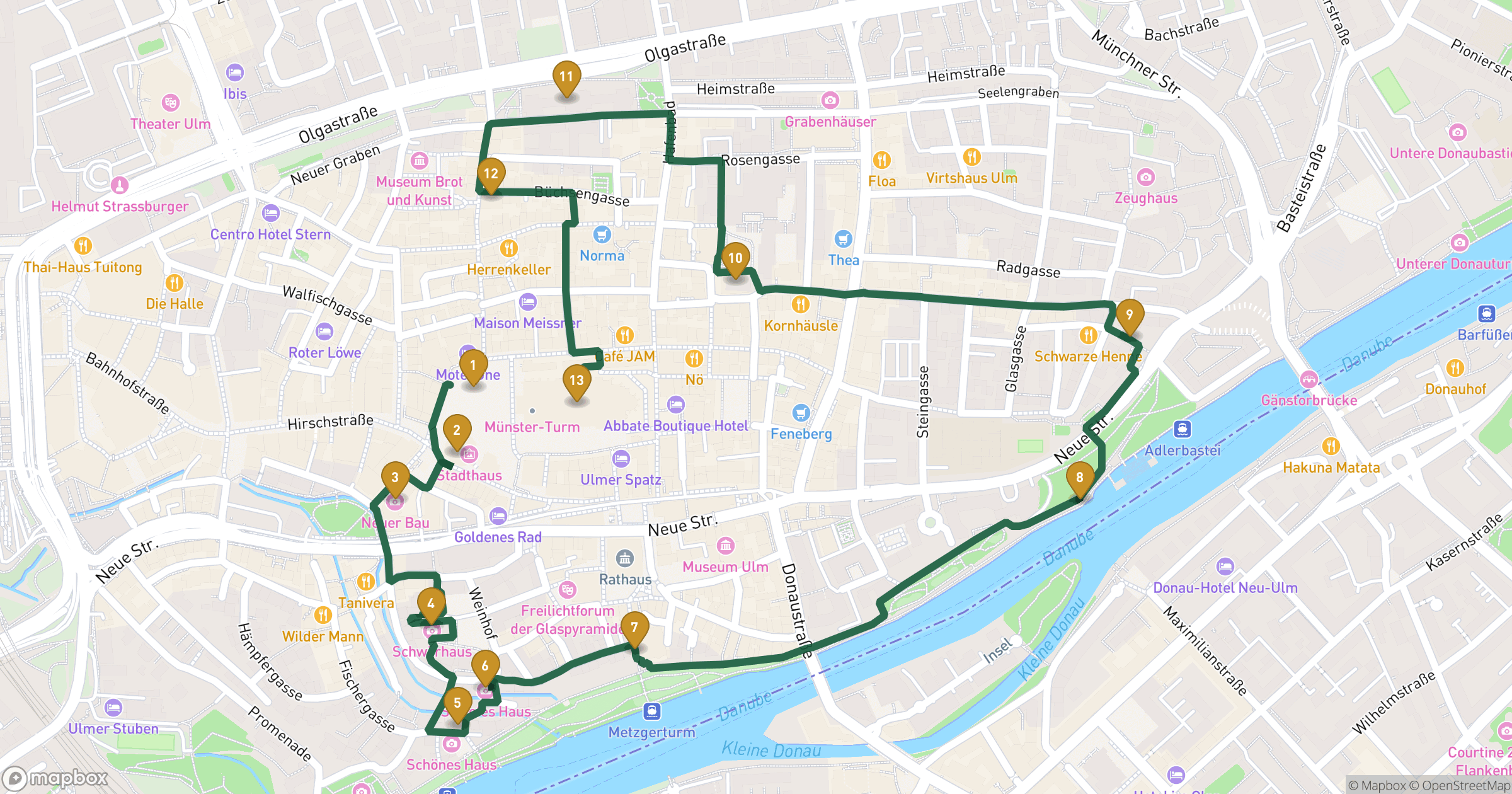
Map for Ulm walking tour with 13 stops
The static map shows the tour route with Löwenbrunnen, Stadthaus, Neuer Bau, Schwörhaus, and 9 more stops.

Stops along the route

All stops on this self-guided tour at a glance.

  1. Löwenbrunnen in Ulm
    Kreuzschnabel / CC BY-SA 3.0

    1LöwenbrunnenAttraction

    The Löwenbrunnen on Münsterplatz catches the eye with its mannerist column and elongated golden lions. Believed to have been created by stonemason Peter Schmid in the late 16th century, it was first recorded on a 1597 city map and later removed in the late 19th century for the construction of the minster tower. Today's figures were sculpted in 1961 by Franz Dornacher.

    Wikidata

  2. Stadthaus in Ulm
    Kent Wang / CC BY 4.0

    2Stadthaus

    Next to the Gothic minster stands the Stadthaus, designed by Richard Meier in his signature white, geometric New York Five style. Its opening in the early 1990s stirred fierce debate and even sparked an attempt at a public referendum by citizens who found it too modern. Today, large glass facades frame views of the cathedral, integrating it into the cultural venue inside.

    Architect: Richard Meier · Wikidata

  3. Neuer Bau in Ulm
    PiotrMig / CC BY-SA 4.0

    3Neuer BauAttraction

    The Neuer Bau is a late Renaissance brick structure that swapped its mercantile past for criminal investigations. Built between 1585 and 1593 by architect Hans Kunz as a municipal storehouse for grain and goods, it boasts a massive roof structure that was an engineering marvel of its time. Rebuilt after severe damage in World War II, it now serves as the Ulm Police Headquarters.

    Wikidata

  4. Schwörhaus in Ulm
    Stadtarchiv ulm / CC BY-SA 4.0

    4SchwörhausAttraction

    The Schwörhaus anchors municipal political life around a constitutional ritual dating back to the Great Oath Letter of 1397. Each year on Schwörmontag, the mayor appears on its balcony to deliver an accountability speech, concluding with the pledge to serve rich and poor alike. Originally built in 1612 as a storehouse and library, it was rebuilt after 1944 and now houses the city archive.

    Wikidata

  5. Zunfthaus der Schiffleute in Ulm
    CEphoto, Uwe Aranas | Photo by CEphoto, Uwe Aranas or alternatively © CEphoto, Uwe Aranas / CC BY-SA 3.0

    5Zunfthaus der Schiffleute

    Set beside the water in the fishermen's quarter, the Zunfthaus der Schiffleute reflects the wealth of Danube fishers and boatmen. Erected in 1480, this half-timbered building served as the guildhall for mariners who steered simple single-use boats known as Ulmer Schachteln downstream to Vienna or Belgrade. Sold as firewood at their destination, the boats left their crews to return on foot.

  6. Schiefes Haus in Ulm
    Diego Delso / CC BY-SA 4.0

    6Schiefes Haus

    The late Gothic Schiefes Haus along the Blau river holds a Guinness World Record as the world's most leaning hotel. Dating to the 14th century, its structure tilts at 9.4 degrees because unstable gravel soil caused the river-facing side to sink over centuries. Butchers initially worked here to dump offal straight into running water, while today's overnight guests sometimes awaken feeling dizzy.

    Built: 1443 · Wikidata

  7. Metzgerturm in Ulm
    Unterillertaler / CC BY-SA 3.0

    7MetzgerturmCastle

    The 14th-century Metzgerturm is a square brick fortification with a noticeable tilt of about two meters to the northwest. While marshy Danube soil destabilized its base, local legend claims dishonest butchers huddled in one corner in fear when the mayor discovered they diluted sausages with sawdust. A remnant of the medieval town wall still adjoins the base.

    Height: 36 m · Named after: slaughterhouse · Wikidata

  8. Berblinger-Turm in Ulm
    Flocci Nivis / CC BY 4.0

    8Berblinger-TurmTower

    The Berblinger-Turm marks the site where aviation pioneer Albrecht Ludwig Berblinger plunged into the Danube in 1811. Known as the Tailor of Ulm, he attempted a glider flight before the King of Württemberg, but poor thermal winds left him exposed to public mockery and poverty. The openwork steel tower twists at a 10-degree incline, echoing the feeling of takeoff or an impending fall.

    Built: 2020 · Height: 20 m · Wikidata

  9. Gänsturm in Ulm
    Flocci Nivis / CC BY 4.0

    9GänsturmCastle

    The Gänsturm is a 14th-century defensive city gate named for the geese driven past it toward the Danube meadows. Heightened in the 15th century, the square stone tower long housed municipal prison cells in its upper stories under a steep hipped roof. Centuries ago, an astronomical clock was installed on the exterior facade to display time to passersby.

    Built: 1360 · Height: 37.5 m · Wikidata

  10. Kornhaus in Ulm
    Schlaier / CC BY-SA 3.0

    10KornhausBuilding

    The late 16th-century Kornhaus served as Ulm's municipal granary, turning civic emergency planning into a grand architectural statement. Its late Renaissance facade is crowned with a large volute gable, while massive interior oak beams bore the weight of stored grain. Today, the palace-like storage building hosts concerts and cultural events.

    Built: 1594 · Wikidata

  11. Landgericht Ulm in Ulm
    Christian Wolf (www.c-w-design.de) / CC BY-SA 3.0 de

    11Landgericht UlmBuilding

    Built between 1894 and 1898 by Karl von Sauter and Albert von Bok, the Landgericht Ulm is a neo-Renaissance sandstone courthouse set atop the old town wall. In 1958, it hosted the Ulm Einsatzgruppen Trial, prosecuting ten former squad members for 1941 mass murders along the Lithuanian-German border. The trial prompted the creation of West Germany's Nazi crime investigation agency.

    Wikidata

  12. Büchsenstadel in Ulm
    Fred Romero from Paris, France / CC BY 2.0

    12BüchsenstadelBuilding

    The Büchsenstadel was the central arsenal of the imperial city of Ulm, storing artillery, muskets, and ammunition. Built with thick walls and wide gates designed to roll heavy cannon carts through, its robust layout prioritized fire safety for gunpowder storage. Today, this massive military complex functions as a cultural center and youth house.

    Wikidata

  13. Ulmer Münster in Ulm
    Patrick Six; German Wikipedia (original page) / CC BY-SA 3.0

    13Ulmer MünsterChurch

    The citizens of Ulm funded the Ulmer Münster themselves after Karl IV besieged the city in 1376, making the walk to their old parish church outside the walls deadly. Construction began in 1377, but master builder Matthäus Böblinger miscalculated the tower's load-bearing design and fled the city in 1494 to escape charges. Finished in 1890, it reaches 161.53 meters in height.

    Built: 1377 · Architect: Ulrich Ensingen · Style: Gothic architecture · Height: 162 m · Wikidata

Download the app

This public page shows a preview. The full route, all content, and navigation are available in CityTour AI.

Cities nearby

Discover self-guided tours in nearby cities.

Frequently asked questions

The key answers before you start.

Is this a self-guided audio tour?

Yes. In the CityTour AI app (iOS and Android), this is a self-guided audio tour for Ulm — start anytime, at your own pace, with map, stops, and audio narration.

What will you see on this tour?

On this tour you'll see, among others, Löwenbrunnen, Stadthaus, Neuer Bau, Schwörhaus, Zunfthaus der Schiffleute, Schiefes Haus and more sights.

Where does the tour start?

The route starts at Löwenbrunnen and ends at Ulmer Münster. You can start anytime — the app guides you to the first stop.

How long does the tour take?

About 104 minutes for 13 stops — at your own pace, with breaks whenever you like.

How much does the tour cost?

This tour costs 15 credits. The exact price depends on the pack you buy and your country — roughly $5.

Is it an outdoor tour — are entry tickets included?

Yes, it's an outdoor tour: the sights are viewed from the outside. Entry tickets are not included, and step-free access cannot be guaranteed.

Is the audio guide available in my language?

The tour and audio guide are available in English, Deutsch, Français, Español, Italiano and 9 more languages. You pick your language in the app.

Can I use the tour offline?

Yes. Tours can be used offline.

Can I ask the AI questions along the way?

Yes. At every stop you can ask the AI directly if you want to know more or didn't understand something.