CityTour AI

Aschaffenburg self-guided walking tour

Aschaffenburg: Red Sandstone and Roman Dreams

Explore the "Bavarian Nice" on a relaxed stroll that bridges the gap between Roman antiquity and post-war modernism. You’ll wander from the bustling river harbor to the towering red walls of Schloss Johannisburg, discovering how archbishops and industrialists shaped this unique riverside gem. It’s a walk filled with grand palace views, narrow medieval alleys, and the surprising sight of a Mediterranean villa perched above the Main.

Audio tourSelf-guidediOS & Android
178minutes
6.6 kmdistance
19stops
Audio guideFormat
Aschaffenburg: Red Sandstone and Roman Dreams
Jörg Braukmann / CC BY-SA 4.0

Stops on this route

This tour works well for first-time visitors, weekend trips, and travelers who want to explore Aschaffenburg without a fixed tour time.

Route map for Aschaffenburg walking tour
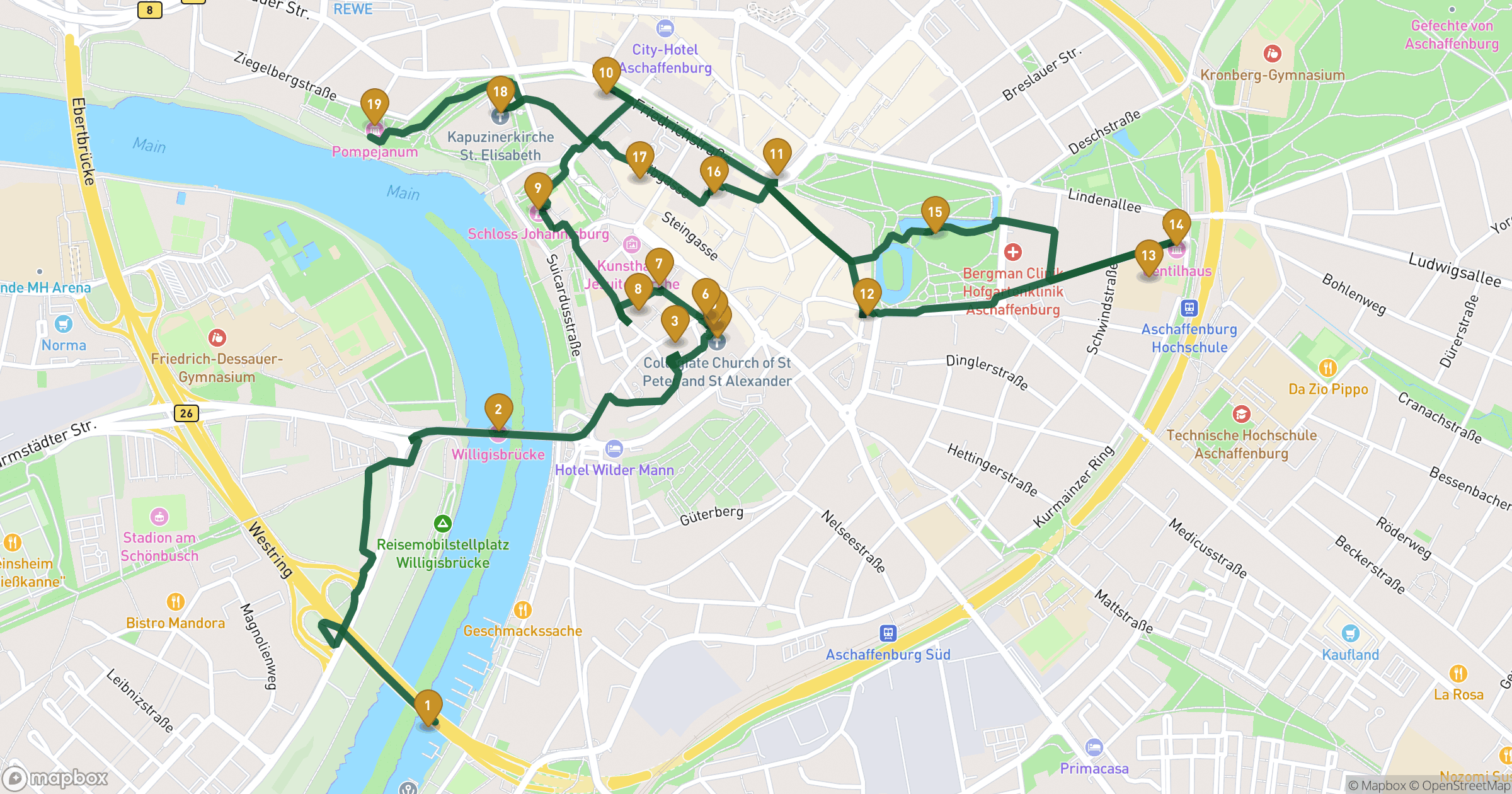
Map for Aschaffenburg walking tour with 19 stops
The static map shows the tour route with Floßhafen, Willigisbrücke, Rathaus, Basilica of SS. Peter and Alexander, and 15 more stops.

Stops along the route

All stops on this self-guided tour at a glance.

  1. Floßhafen in Aschaffenburg
    Fritz Geller-Grimm supported by Rüdiger Wandke / CC BY-SA 3.0

    1Floßhafen

    The Floßhafen reveals how timber from the surrounding forest literally built Aschaffenburg and fueled the regional economy. During the 1800s, raftsmen guided massive platforms of Spessart logs down the Main River to be hauled ashore here. Much of this wood was exported downriver to supply growing cities such as Frankfurt and Mainz.

  2. 2WilligisbrückeBridge

    Spanning the Main, the Willigisbrücke recalls the 10th-century Archbishop of Mainz who chose a wheelwright's wheel for his coat of arms to honor his humble origins. That white wheel on red remains an emblem seen across the city today. Completely rebuilt after serving as a strategic World War II site, the bridge offers views of Schloss Johannisburg and the Pompejanum.

    Wikidata

  3. Rathaus in Aschaffenburg
    Lutz Hartmann; Own work (Original text: eigene Aufnahme) / CC BY-SA 3.0

    3RathausBuilding

    Completed in 1958, the Rathaus introduced bold post-war modernism to signal transparent governance after wartime devastation. Its controversial design features red sandstone laid in a rhythmic pattern alongside large sheets of glass. Today, the administrative headquarters stands as a protected architectural monument of the city's post-1945 reconstruction.

    Built: 1956 · Wikidata

  4. Basilica of SS. Peter and Alexander in Aschaffenburg
    Johann H. Addicks / [email protected]; Johann H. Addicks - [email protected] / CC BY-SA 3.0

    4Basilica of SS. Peter and AlexanderChurch

    Founded in the 10th century, the Collegiate Church of St Peter and St Alexander was established by Liudolf and his wife Ida around 957 rather than by their son Duke Otto I. Following Otto's death from an epidemic in Lucca in 982, loyal followers carried his body across the Alps for burial on this hill. Inside stands a millennium-old crucifix known as the Triumphkreuz.

    Architect: Georg Eberlein · Style: Romanesque architecture · Named after: Saint Peter · Wikidata

  5. Stiftsmuseum in Aschaffenburg
    Tropp84 / CC BY-SA 3.0

    5Stiftsmuseum

    The Stiftsmuseum occupies the former chapter house where influential canons once administered city affairs from behind thick medieval walls. The church treasury displays gold, gems, and relics, alongside the rare Aschaffenburger Tafelbild panel painting. Its vaulted corridors and ceilings reflect eight centuries of clerical governance and scholarly administration.

    Built: 1854 · Wikidata

  6. Löwenapotheke in Aschaffenburg
    Tropp84 / CC BY-SA 3.0

    6LöwenapothekeBuilding

    The half-timbered Löwenapotheke on Stiftsplatz exemplifies the merchant residences that once defined the medieval marketplace. Heavily damaged by aerial bombing in 1944, the building was meticulously reconstructed to restore its intricate wooden beams. Above the entrance, a golden lion statue continues to watch over the historic shop.

    Wikidata

  7. Pfaffengasse in Aschaffenburg
    Tilman2007 / CC BY-SA 4.0

    7PfaffengasseBuilding

    Pfaffengasse is a winding lane that housed the collegiate church's elite canons, linking the basilica directly to the castle. The humanist scholar Conrad Celtis lived here, finding the quiet alleys ideal for refining poetry despite distractions from local wine. Carved coats of arms from noble families still mark many of the historic doorways.

  8. Stadttheater Aschaffenburg in Aschaffenburg
    Tilman2007 / CC BY-SA 4.0

    8Stadttheater AschaffenburgTheatre

    Built in 1811, the Neoclassical Stadttheater was commissioned by Karl Theodor von Dalberg to turn the town into an elegant second residence. Architect Emanuel Herigoyen reportedly whispered instructions from the unfinished stage to test the hall's acoustics down to the back row. After wartime air raids, the city rebuilt the theater in the 1960s with its restored classicist facade.

    Architect: Emanuel Herigoyen · Wikidata

  9. Schloss Johannisburg in Aschaffenburg
    Jörg Braukmann / CC BY-SA 4.0

    9Schloss JohannisburgCastle

    Constructed from red Buntsandstein between 1605 and 1614, Schloss Johannisburg was designed by Georg Ridinger with four symmetrical wings and corner towers. During the 17th century, the palace served as the administrative backdrop for trials that accused hundreds of sorcery. Its surviving Renaissance chapel altar remains intact alongside the world's largest collection of cork architectural models.

    Built: 1605 · Architect: Georg Ridinger · Style: Renaissance architecture … · Named after: John the Baptist, Johann Schweikhard von Kronberg · Wikidata

  10. Landgericht Aschaffenburg in Aschaffenburg
    Lutz Hartmann; Own work (Original text: eigene Aufnahme) / CC BY-SA 3.0

    10Landgericht AschaffenburgBuilding

    The Landgericht Aschaffenburg embodies the shift from princely religious rule to modern secular justice following the city's incorporation into the Kingdom of Bavaria. Established in 1879 during nationwide reforms, it replaced the older Stadtgericht that dated back to 1808. For well over a century, its imposing halls have hosted the region's most significant criminal trials.

    Wikidata

  11. Herstallturm in Aschaffenburg
    KaiBorgeest / CC BY 4.0

    11HerstallturmTower

    Dating to 1545, the Herstallturm is the surviving round turret of the barbican that protected the eastern approach from Goldbach. From 1801, its gates were locked each night, leaving latecomers stranded outside until morning. When nearby railway traffic in 1854 caused large carts to jam in the narrow passage, the city demolished the rest of the gate complex in 1869.

    Wikidata

  12. Sandkirche in Aschaffenburg
    Lutz Hartmann; Own work (Original text: eigene aufnahme) / CC BY-SA 3.0

    12SandkircheChurch

    Erected in the mid-1700s, the Baroque Sandkirche owes its name to the large sand dune on which it was founded outside the former town walls. The church was built to enshrine a revered image of the Virgin Mary, quickly turning the site into a pilgrimage destination. Master builder Johann Röder allegedly refused to lay the foundation until he found a lucky river stone to bury beneath the altar.

    Wikidata

  13. Dalberg-Gymnasium in Aschaffenburg
    Lutz Hartmann | Own work ( Original text: eigene Aufnahme ) / CC BY-SA 3.0

    13Dalberg-GymnasiumBuilding

    The Dalberg-Gymnasium stems from Bavaria's first state higher educational institution for girls, founded in 1875 alongside a teacher-training seminar. Rising student numbers prompted construction of the Franconian Renaissance building on Grünewaldstraße, where the foundation stone was laid in 1905. Today, the school maintains this scholarly focus with specializations in music, arts, and languages.

  14. Gentilhaus in Aschaffenburg
    Lui1959 / CC BY-SA 4.0

    14GentilhausMuseum

    Built in the early 1920s, the Gentilhaus served as the eclectic home and studio of local industrialist Anton Gentil. An avid maker as well as a collector, Gentil cast several bronze bells in his own foundry to display alongside medieval sculptures and folk art. The interior features a labyrinthine layout designed entirely by Gentil to exhibit his personal treasures.

    Wikidata

  15. Landschaftspark Schöntal in Aschaffenburg
    Aschaffenburczyk / CC BY-SA 3.0

    15Landschaftspark Schöntal

    Landschaftspark Schöntal traces a shift from an archiepiscopal zoo and kitchen garden into a public landscape. Stone arch ruins from a 15th-century convent of Beguines still stand nestled among the trees. The park is also home to the Magnolienhain, recognized as one of the oldest and largest magnolia groves in Germany.

    Wikidata

  16. Wolfsthalplatz in Aschaffenburg
    Lutz Hartmann; Own work (Original text: eigene Aufnahme) / CC BY-SA 3.0

    16WolfsthalplatzSquare

    Wolfsthalplatz marks the site of the oriental-style synagogue inaugurated in 1893, which featured a ten-column dome that was destroyed after being set ablaze in 1938. Next door, the 17th-century Vorburgschen Haus survived, having served as a school, ritual bath, and rabbinate after its purchase in 1805. Since 1983, that building has housed the Museum of Jewish History and Culture.

    Wikidata

  17. Stadthalle am Schloss in Aschaffenburg
    Lutz Hartmann | Own work ( Original text: eigene Aufnahme ) / CC BY-SA 3.0

    17Stadthalle am SchlossTheatre

    Erected in the late 1980s, the Stadthalle am Schloss provides a functionalist counterpart of concrete and glass to the red sandstone palace beside it. Architect Cosanne designed the transparent venue to host civic gatherings ranging from concerts to political conventions. Its exterior glass walls mirror the historic towers of Schloss Johannisburg across the surrounding plazas.

  18. Kapuzinerkloster in Aschaffenburg
    Tilman AB / Public domain

    18KapuzinerklosterChurch

    The Kapuzinerkloster served as a military hospital in 1813 until careless orderlies with open flames sparked a blaze that destroyed the church and over 4,000 books. Rebuilt in 1908 by architect Friedrich von Thiersch, the church retains older elements, including a green sandstone figure of St. Elizabeth carved around 1627. The Capuchin order remained active here until 2010.

    Architect: Friedrich von Thiersch · Named after: Elizabeth of Hungary · Wikidata

  19. Pompejanum in Aschaffenburg
    Foto: Sven Teschke; Sven Teschke, Büdingen / CC BY-SA 3.0 de

    19PompejanumMuseum

    Perched above the Main, the Pompejanum is a full-scale replica of Pompeii's House of Castor and Pollux commissioned by King Ludwig I of Bavaria in the 1840s. Architect Friedrich von Gärtner incorporated an open-air rainwater atrium and colorful mythological wall frescoes. Mediterranean grapevines and fig trees flourish in the inner garden thanks to the area's mild climate.

    Built: 1848 · Architect: Friedrich von Gärtner · Style: neo-pompeian style · Named after: Pompeii · Wikidata

Download the app

This public page shows a preview. The full route, all content, and navigation are available in CityTour AI.

Cities nearby

Discover self-guided tours in nearby cities.

Frequently asked questions

The key answers before you start.

Is this a self-guided audio tour?

Yes. In the CityTour AI app (iOS and Android), this is a self-guided audio tour for Aschaffenburg — start anytime, at your own pace, with map, stops, and audio narration.

What will you see on this tour?

On this tour you'll see, among others, Floßhafen, Willigisbrücke, Rathaus, Basilica of SS. Peter and Alexander, Stiftsmuseum, Löwenapotheke and more sights.

Where does the tour start?

The route starts at Floßhafen and ends at Pompejanum. You can start anytime — the app guides you to the first stop.

How long does the tour take?

About 178 minutes for 19 stops — at your own pace, with breaks whenever you like.

How much does the tour cost?

This tour costs 30 credits. The exact price depends on the pack you buy and your country — roughly $10.

Is it an outdoor tour — are entry tickets included?

Yes, it's an outdoor tour: the sights are viewed from the outside. Entry tickets are not included, and step-free access cannot be guaranteed.

Is the audio guide available in my language?

The tour and audio guide are available in English, Deutsch, Français, Español, Italiano and 9 more languages. You pick your language in the app.

Can I use the tour offline?

Yes. Tours can be used offline.

Can I ask the AI questions along the way?

Yes. At every stop you can ask the AI directly if you want to know more or didn't understand something.