CityTour AI

Bamberg self-guided walking tour

Bridges, Beer, and Bishops: A Bamberg Walk

Explore the UNESCO-listed heart of Bamberg on a casual stroll that bridges the gap between the lively merchant district and the grand episcopal hills. You'll wander past iconic half-timbered houses, smell the unique aroma of traditional smoked beer, and marvel at the architectural feats of a city built on water and stone. It’s the perfect way to experience the 'Franconian Rome' through the eyes of a local.

Audio tourSelf-guidediOS & Android
100minutes
2.4 kmdistance
13stops
Audio guideFormat
Bridges, Beer, and Bishops: A Bamberg Walk
Berthold Werner / CC BY-SA 3.0

Stops on this route

This tour works well for first-time visitors, weekend trips, and travelers who want to explore Bamberg without a fixed tour time.

Route map for Bamberg walking tour
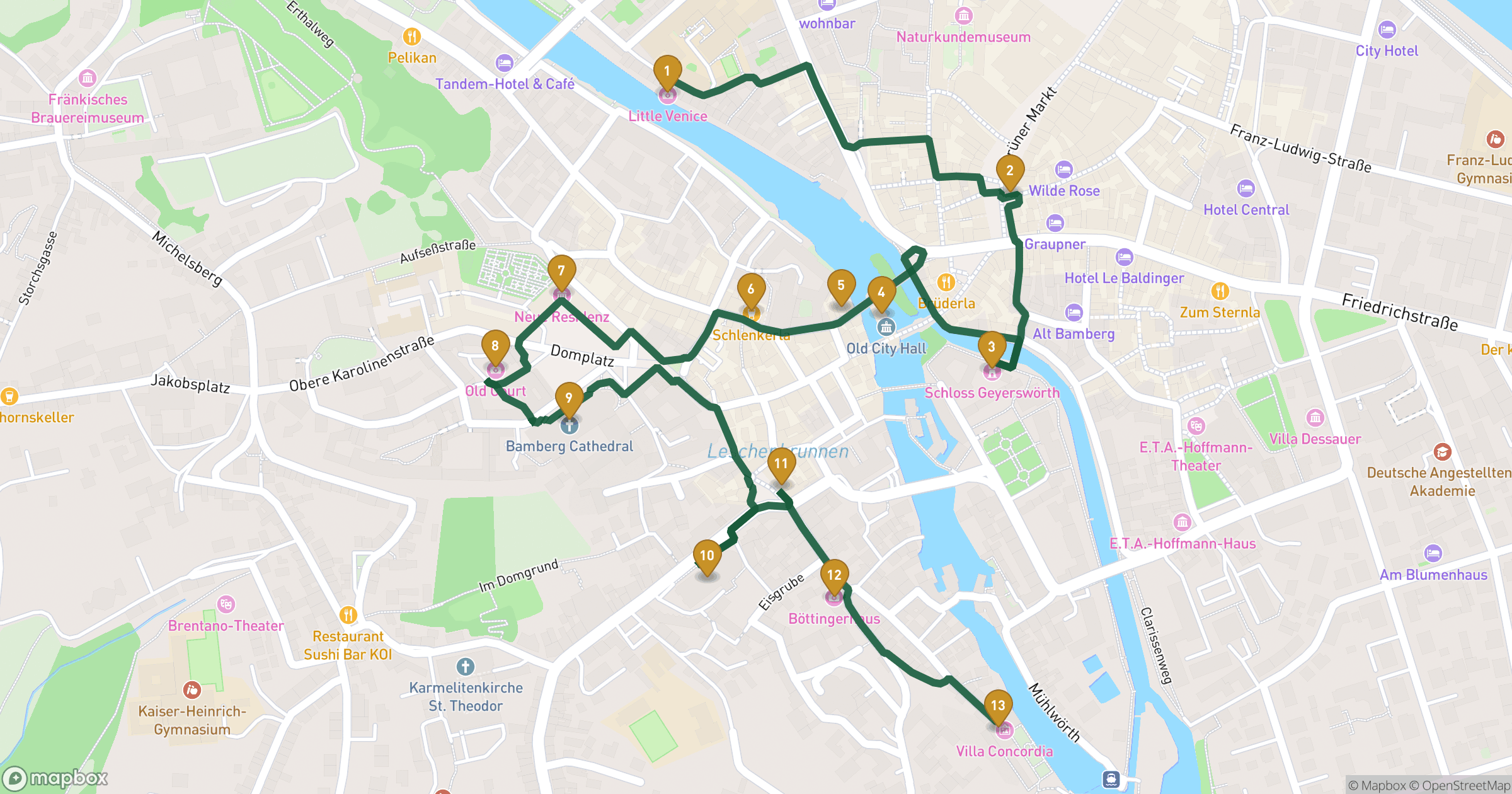
Map for Bamberg walking tour with 13 stops
The static map shows the tour route with Klein Venedig, Gabelmann, Residenzschloss Geyerswörth, old town hall, and 9 more stops.

Stops along the route

All stops on this self-guided tour at a glance.

  1. Klein Venedig in Bamberg
    W. Bulach / CC BY-SA 4.0

    1Klein VenedigAttraction

    Klein-Venedig reveals a row of seventeenth-century half-timbered houses built as a hardworking fishermen's quarter. Fishermen used the long wooden balconies to dry heavy nets above the tightly packed riverbank. The river devastated the area during a massive flood in 1784, but upstream weirs manage water levels today.

    Wikidata

  2. Gabelmann in Bamberg
    Tilman2007 / CC BY-SA 3.0

    2GabelmannBuilding

    The Gabelmann fountain depicts Neptune, known locally as the 'Man with the Fork' since its installation in 1698. Long before this statue, a 1337 well drew water through hollowed-out tree trunks crossing beneath the river from Stephansberg hill. Funding came from councilman Ludwig Krug, whose legacy was smuggled out of Nuremberg hidden inside a salt disk.

    Wikidata

  3. Residenzschloss Geyerswörth in Bamberg
    Pudelek (Marcin Szala) / CC BY-SA 3.0

    3Residenzschloss GeyerswörthBuilding

    Residenzschloss Geyerswörth shows how a fourteenth-century patrician residence became a major Renaissance seat of the prince-bishops. Prince-Bishop Ernst von Mengersdorf oversaw its conversion, leaving his coat of arms carved on the southwest facade. The northern roofline took on a simpler look after its two ornate Renaissance gables collapsed in the 1740s.

    Wikidata

  4. old town hall in Bamberg
    Bärwinkel,Klaus / CC BY-SA 4.0

    4old town hallAttraction

    The Old City Hall rests on an artificial river island created when the local bishop refused to grant citizens land for a town hall. Johann Jakob Michael Küchel added a Rococo exterior in the mid-1700s featuring a three-dimensional cherub leg protruding from the painted frescoes. The ornate timber-framed Rottmeisterhäuschen overhangs the water on one side of the island.

    Architect: Martin Mayer · Style: baroque architecture · Wikidata

  5. Untere Brücke 4 in Bamberg
    Tilman2007 / CC BY-SA 4.0

    5Untere Brücke 4Building

    Untere Brücke 4 stands beside the stone bridge connecting the merchant-led Island City with the bishop-ruled Mountain City. The heritage-protected house at number 4 exemplifies the functional architecture lining this river crossing. From this bridge, the Old City Hall is visible sitting amid the currents of the Regnitz.

    Wikidata

  6. Schlenkerla in Bamberg
    Franzfoto / CC BY-SA 3.0

    6SchlenkerlaBuilding

    Historic brewpub Schlenkerla has operated since 1405 and is synonymous with traditional smoked beer. Its name comes from the limping gait of a former brewer, an image still featured on modern bottle labels. The tavern dries grain over open beechwood fires and marks Smokebeer Preservation Day each July 23rd to celebrate rejecting smoke-free kilns.

    Built: 1405 · Wikidata

  7. New Residence, Bamberg in Bamberg
    W. Bulach / CC BY-SA 4.0

    7New Residence, BambergMuseum

    The New Residence on the Domberg replaced the older palace as the prince-bishops' seat beginning in 1604. Builder Lothar Franz von Schönborn ran out of funds, leaving visible toothing stones sticking out near Obere Karolinenstraße. In 1815, Napoleonic Marshal Louis-Alexandre Berthier died falling from an upper window, marked today by a street plaque.

    Style: baroque architecture · Wikidata

  8. Bischofspfalz in Bamberg
    Bärwinkel,Klaus / CC BY-SA 4.0

    8BischofspfalzAttraction

    The Old Court occupies the site of the tenth-century Castrum Babenberg fortress where Emperor Henry II later established his imperial seat. Prince-Bishop Philipp von Henneberg added the late-fifteenth-century half-timbered wing, carving his coat of arms above the rear gate. Local legend claims Empress Cunigunde proved her innocence here by walking barefoot over glowing plowshares.

    Wikidata

  9. Bamberg Cathedral in Bamberg
    Berthold Werner / CC BY-SA 3.0

    9Bamberg CathedralChurch

    Bamberg Cathedral is a four-towered landmark showcasing the architectural transition from Romanesque to Gothic. Tilman Riemenschneider took fourteen years to carve the marble tomb of Emperor Henry II and Empress Cunigunde. The cathedral houses the only papal burial north of the Alps, the tomb of Pope Clement II, beside the mysterious Bamberg Horseman statue.

    Built: 1004 · Architect: Leonhard Romeis, Friedrich von Gärtner · Style: Romanesque architecture · Named after: Saint Peter · Wikidata

  10. Obere Pfarre in Bamberg
    Ermell / CC BY-SA 4.0

    10Obere PfarreChurch

    The Obere Pfarre was founded in 1338 as Bamberg's sole purely Gothic parish church, serving local townspeople rather than bishops. The high church tower holds a watchman's quarters added in the 1530s to look out for city fires. Inside rests Jacopo Tintoretto's massive painting of the Assumption of Mary, originally destined for the cathedral.

    Wikidata

  11. Pfahlplätzchen 3 in Bamberg
    Tilman2007 / CC BY-SA 3.0

    11Pfahlplätzchen 3Building

    Pfahlplätzchen is a quiet square whose name references the wooden piles driven into marshy ground to support early hillside homes. The building at number 3, known as the Haus zum goldenen Fässlein, displays residential styles common among the medieval middle class. Narrow facades and steep roofs characterize the surrounding streetscape of the historic Bürgerstadt.

    Wikidata

  12. Palast in Bamberg
    Fred Romero from Paris, France / CC BY 2.0

    12PalastAttraction

    The Böttingerhaus is a grand Baroque townhouse built between 1707 and 1713 for wealthy court official Johann Ignaz Michael Tobias Böttinger. Architect Johann Dientzenhofer carved increasingly deep stone reliefs on the upper floors so ornaments would catch daylight along the narrow street. Inside, the rooms preserve ornate plasterwork created by stuccoist Johann Jakob Vogel.

    Architect: Johann Dientzenhofer · Wikidata

  13. Palast in Bamberg
    W. Bulach / CC BY-SA 4.0

    13PalastTheatre

    Villa Concordia was erected on the Regnitz between 1716 and 1722 as a riverside summer retreat for court official Ignaz Tobias Böttinger. Johann Dientzenhofer is credited with designing the symmetrical Baroque facade directly overlooking the water. Since 1997, the Bavarian state has operated the mansion as a residency for invited visual artists, writers, and musicians.

    Wikidata

Download the app

This public page shows a preview. The full route, all content, and navigation are available in CityTour AI.

Cities nearby

Discover self-guided tours in nearby cities.

Frequently asked questions

The key answers before you start.

Is this a self-guided audio tour?

Yes. In the CityTour AI app (iOS and Android), this is a self-guided audio tour for Bamberg — start anytime, at your own pace, with map, stops, and audio narration.

What will you see on this tour?

On this tour you'll see, among others, Klein Venedig, Gabelmann, Residenzschloss Geyerswörth, old town hall, Untere Brücke 4, Schlenkerla and more sights.

Where does the tour start?

The route starts at Klein Venedig and ends at Palast. You can start anytime — the app guides you to the first stop.

How long does the tour take?

About 100 minutes for 13 stops — at your own pace, with breaks whenever you like.

How much does the tour cost?

This tour costs 15 credits. The exact price depends on the pack you buy and your country — roughly $5.

Is it an outdoor tour — are entry tickets included?

Yes, it's an outdoor tour: the sights are viewed from the outside. Entry tickets are not included, and step-free access cannot be guaranteed.

Is the audio guide available in my language?

The tour and audio guide are available in English, Deutsch, Français, Español, Italiano and 9 more languages. You pick your language in the app.

Can I use the tour offline?

Yes. Tours can be used offline.

Can I ask the AI questions along the way?

Yes. At every stop you can ask the AI directly if you want to know more or didn't understand something.