CityTour AI

Erlangen self-guided walking tour

Baroque Erlangen: Huguenots, Margraves, and Scholars

Discover the "Franconian Versailles" on a relaxed walk through the perfectly planned streets of Erlangen's New Town. Experience the fascinating blend of French religious history and Margravial splendor that shapes the cityscape to this day. This route leads you from magnificent palaces to green oases in the heart of this traditional university city.

Audio tourSelf-guidediOS & Android
99minutes
2.5 kmdistance
13stops
Audio guideFormat
Baroque Erlangen: Huguenots, Margraves, and Scholars
Janericloebe / CC BY 3.0

Stops on this route

This tour works well for first-time visitors, weekend trips, and travelers who want to explore Erlangen without a fixed tour time.

Route map for Erlangen walking tour
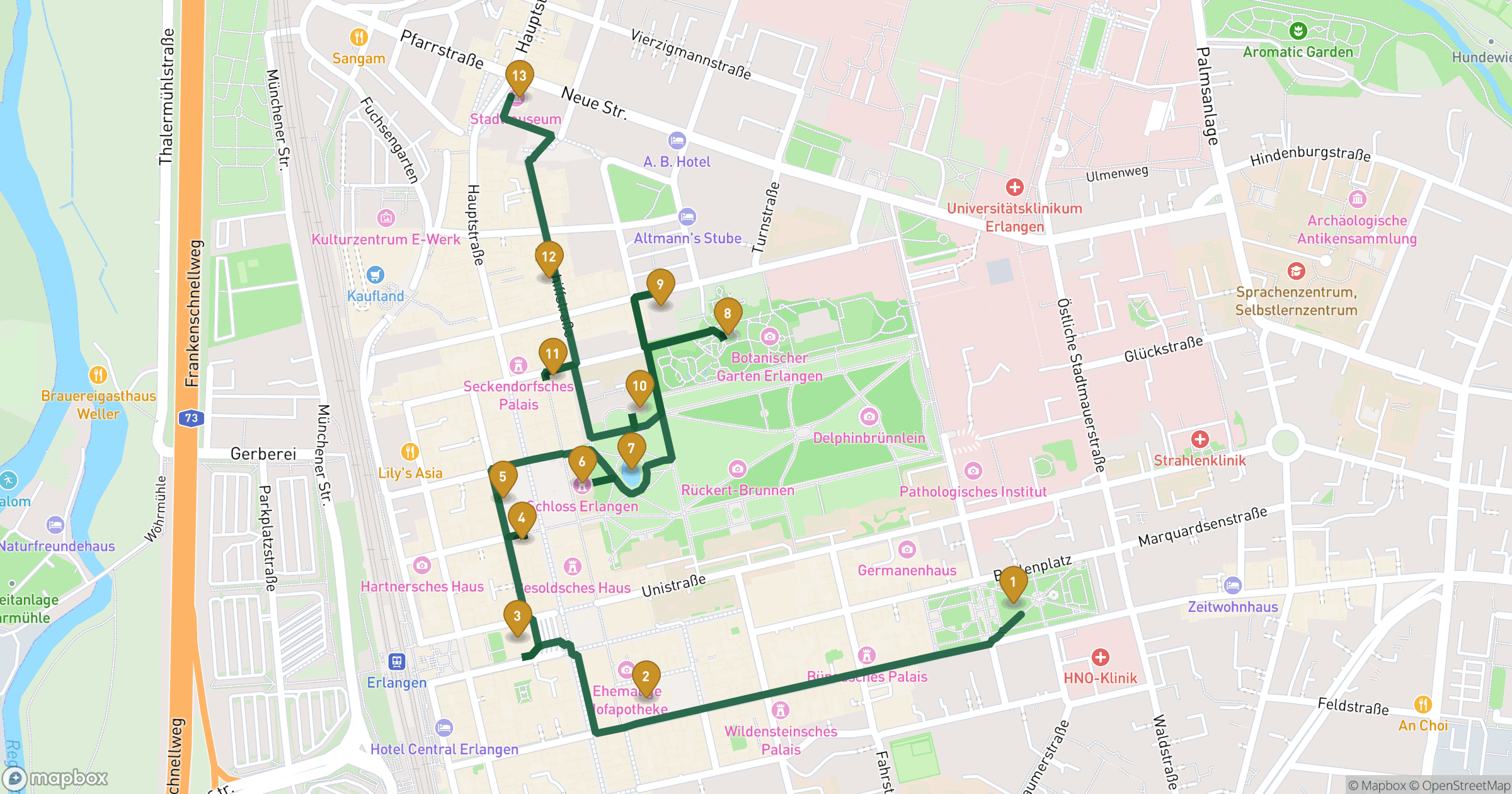
Map for Erlangen walking tour with 13 stops
The static map shows the tour route with Bohlenplatz, Neustädter Kirche, Erlangen, Huguenot Church (Erlangen), Erlangen City Library, and 9 more stops.

Stops along the route

All stops on this self-guided tour at a glance.

  1. Bohlenplatz in Erlangen
    Janericloebe / CC BY 3.0

    1BohlenplatzPark

    Bohlenplatz reflects the grid-like planning of Erlangen's baroque new town and reveals a curious transformation in reputation. Derisively called Polenplatz in the nineteenth century due to local disorder, it was renamed in 1872 to evoke an orderly lumberyard. Mulberry trees were planted here in 1826 for silkworm breeding, and the former German Reformed church at its center now serves as an event venue.

    Wikidata

  2. Neustädter Kirche, Erlangen in Erlangen
    Helmlechner / CC BY-SA 3.0

    2Neustädter Kirche, ErlangenChurch

    Neustädter Kirche shapes the city skyline as a university church and landmark of Protestant baroque design. Begun in 1722, construction cost 35,000 guilders raised through begging in taverns and traveling collection campaigns across neighboring regions. Together with the Huguenot church and Old Town Trinity Church, its tower forms Erlangen's signature church-spire trio.

    Wikidata

  3. Huguenot Church (Erlangen) in Erlangen
    Daniel Arnold; own photo taken by Daniel Arnold / CC BY 2.5

    3Huguenot Church (Erlangen)

    The Hugenottenkirche is the oldest church outside France still used by Huguenot congregations, built according to architect Johann Moritz Richter's urban grid plan. The parish rejected the name Hugenottenkirche in 1936, pointing out that Waldensian, Swiss, and Dutch refugees had also found shelter here. Constructed between 1686 and 1693, the sandstone structure received its tower decades later in the 1730s.

    Architect: Johann Moritz Richter · Style: baroque architecture · Wikidata

  4. Erlangen City Library in Erlangen
    Stadtbibliothek Erlangen / CC BY-SA 4.0

    4Erlangen City Library

    Palais Stutterheim, housing the city library on Marktplatz, showcases civic baroque architecture while recounting the expansion of public reading. Two-thirds of the registered readers in its early days as a municipal library were working-class citizens. In 1933, nearly 10,000 books were removed from the collection on political grounds under National Socialist rule.

    Built: 1921 · Wikidata

  5. Castle and Market Square in Erlangen
    Philipp Hienstorfer; photo taken by Philipp Hienstorfer / CC BY-SA 4.0

    5Castle and Market Square

    Schloß- und Marktplatz forms the bustling center of Erlangen's planned baroque district, originally laid out as a single grand square called Grande Place. King Ludwig I of Bavaria donated the central statue of Margrave Friedrich in 1843, making it the first monument in Germany dedicated to a university founder. A ground plaque commemorates the book burning that occurred here in 1933.

    Wikidata

  6. Margravial Palace Erlangen in Erlangen
    Janericloebe / CC BY 3.0

    6Margravial Palace ErlangenCastle

    Erlangen Castle stands as the centerpiece of local baroque planning and Franconia's first cohesive baroque ensemble. A fire erupted in the attic on the night of January 14, 1814, and extreme temperatures of minus 25 degrees froze water in the hoses before it could extinguish the flames. Today, the rebuilt castle accommodates the administration of Friedrich Alexander University.

    Built: 1700 · Architect: Gottfried von Gedeler, Antonio della Porta · Style: baroque architecture · Wikidata

  7. Hugenottenbrunnen in Erlangen
    Buendia22 / CC BY-SA 4.0

    7HugenottenbrunnenAttraction

    The Hugenottenbrunnen presents a multi-tiered sandstone monument honoring the ruler and the French refugees who reshaped Erlangen's economy. Sculptor Elias Räntz crafted the fountain in 1706, crowning it with a statue of Margrave Christian Ernst portrayed as a victor over the Ottoman Turks. Its lower levels depict the incoming refugees, who introduced specialized trades like glove and stocking manufacturing.

  8. Botanischer Garten Erlangen in Erlangen
    Ra Boe / Wikipedia; © Ra Boe / Wikipedia / CC BY-SA 3.0 de

    8Botanischer Garten ErlangenPark

    The university's botanical garden offers a historic research ground relocated to this site in 1828. Gardener Adam Rümmelein directed the grounds for 54 years, managing its plantings from 1771 until 1825. A key curiosity is the Neischl Grotto, an artificial stalactite cave built in 1907 to demonstrate the geological interior of Franconian Switzerland.

    Wikidata

  9. Markgrafentheater Erlangen in Erlangen
    TheaterErlangen / CC BY-SA 3.0

    9Markgrafentheater ErlangenTheatre

    The Markgrafentheater is southern Germany's oldest performing baroque theater, designed to offer an intimate, community-oriented atmosphere. It opened in 1719 under Margrave Georg Wilhelm with a performance of the opera Argenis und Poliarchus. The horseshoe-shaped auditorium features three tiers and a canopy above the princely box supported by allegorical figures of Comedy and Tragedy.

    Style: baroque architecture · Named after: George William, Margrave of Brandenburg-Bayreuth · Wikidata

  10. Orangerie in Erlangen
    Janericloebe / CC BY 3.0

    10Orangerie

    The Orangerie sits beside the palace garden, built between 1704 and 1706 to shelter bitter orange trees during the winter months. Gottfried von Gedeler directed its construction, designing large windows to maximize sunlight alongside a central Wassersaal used for court concerts. Following the margravial era, the building passed to the university and now houses the Institute for Church Music.

  11. Wasserturm Apfelstraße in Erlangen
    Janericloebe / CC BY 3.0

    11Wasserturm Apfelstraße

    The Old Water Tower operated as the hidden technological engine supplying water to the surrounding palace gardens and Orangerie. Erected around 1705, it pumped water into an upper reservoir to generate the necessary pressure for the garden fountains. Its square ground plan and tented roof allowed this functional engineering installation to blend directly into the baroque estate.

    Wikidata

  12. Schiffstraße 7 in Erlangen
    Sariputra / CC BY-SA 3.0

    12Schiffstraße 7

    This townhouse illustrates the pragmatic sandstone architecture developed for citizens in Erlangen's planned baroque new town. Notable features include small roof dormers known as Erlanger Nasen, which provided ventilation for attic workshops and storage. Strict municipal regulations required uniform building heights and wide streets capable of accommodating fire brigades.

    Wikidata

  13. Stadtmuseum Erlangen in Erlangen
    Janericloebe / CC BY 3.0

    13Stadtmuseum Erlangen

    The former Old Town Hall on Martin-Luther-Platz combines administrative authority with the monumental facade of a sandstone palace. Completed in 1740, its open ground-floor hall rested on four sandstone pillars to house the official municipal weigh scales. The upper council chambers preserve elaborate 1739 stucco work by Martin Grasser, displaying delicate lattice patterns, vases, and birds.

    Built: 1740 · Wikidata

Download the app

This public page shows a preview. The full route, all content, and navigation are available in CityTour AI.

Cities nearby

Discover self-guided tours in nearby cities.

Frequently asked questions

The key answers before you start.

Is this a self-guided audio tour?

Yes. In the CityTour AI app (iOS and Android), this is a self-guided audio tour for Erlangen — start anytime, at your own pace, with map, stops, and audio narration.

What will you see on this tour?

On this tour you'll see, among others, Bohlenplatz, Neustädter Kirche, Erlangen, Huguenot Church (Erlangen), Erlangen City Library, Castle and Market Square, Margravial Palace Erlangen and more sights.

Where does the tour start?

The route starts at Bohlenplatz and ends at Stadtmuseum Erlangen. You can start anytime — the app guides you to the first stop.

How long does the tour take?

About 99 minutes for 13 stops — at your own pace, with breaks whenever you like.

How much does the tour cost?

This tour costs 15 credits. The exact price depends on the pack you buy and your country — roughly $5.

Is it an outdoor tour — are entry tickets included?

Yes, it's an outdoor tour: the sights are viewed from the outside. Entry tickets are not included, and step-free access cannot be guaranteed.

Is the audio guide available in my language?

The tour and audio guide are available in English, Deutsch, Français, Español, Italiano and 9 more languages. You pick your language in the app.

Can I use the tour offline?

Yes. Tours can be used offline.

Can I ask the AI questions along the way?

Yes. At every stop you can ask the AI directly if you want to know more or didn't understand something.