CityTour AI

Munich self-guided walking tour

Munich: From Salt Trade to Royal Splendor

Experience the grand evolution of Bavaria’s capital on this casual stroll through Munich’s historic Altstadt. You’ll discover how medieval salt routes transformed into royal boulevards, visiting everything from hidden Rococo gems to world-famous beer halls and bustling open-air markets. It’s a perfect introduction to the city’s unique blend of Italian-inspired architecture and traditional Bavarian warmth.

Audio tourSelf-guidediOS & Android
104minutes
3.2 kmdistance
13stops
Audio guideFormat
Munich: From Salt Trade to Royal Splendor
Diliff / CC BY 2.5

Stops on this route

This tour works well for first-time visitors, weekend trips, and travelers who want to explore Munich without a fixed tour time.

Route map for Munich walking tour
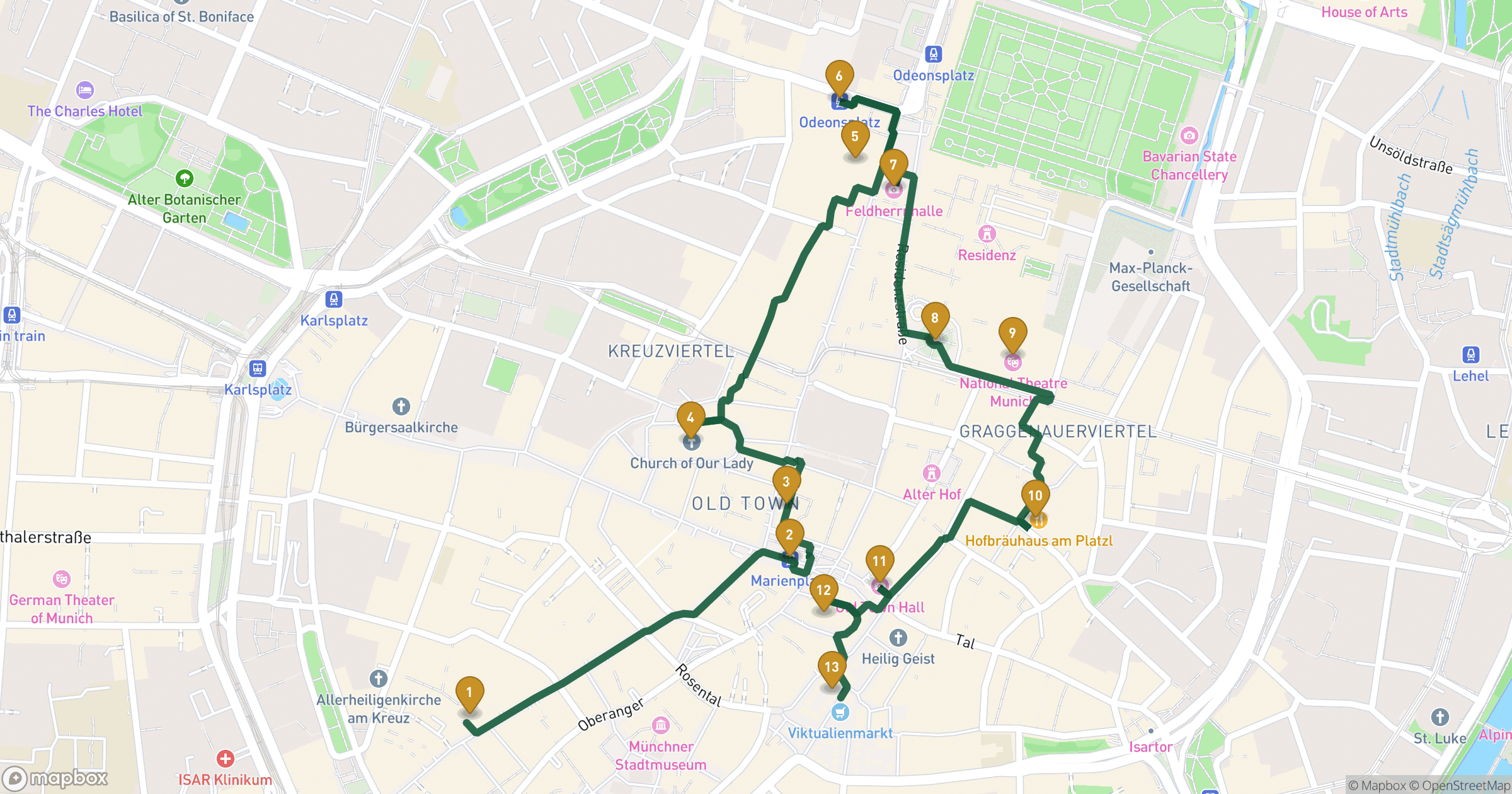
Map for Munich walking tour with 13 stops
The static map shows the tour route with Sankt Johann Nepomuk, Marienplatz, Neues Rathaus, Frauenkirche, and 9 more stops.

Stops along the route

All stops on this self-guided tour at a glance.

  1. Sankt Johann Nepomuk in Munich
    Wikiolo, derivative work Lämpel / CC BY-SA 4.0

    1Sankt Johann NepomukChurch

    The Asam Church stands out on a busy shopping street as an unrestricted showcase of late Baroque theatrum sacrum. Brothers Egid Quirin and Cosmas Damian Asam funded and constructed it between 1733 and 1746 purely as their private chapel. Egid Quirin even installed a private window in his adjacent residence looking directly at the high altar to attend mass from home.

    Built: 1746 · Architect: Asam brothers · Style: baroque architecture … · Named after: Asam brothers, John of Nepomuk · Wikidata

  2. Marienplatz in Munich
    Burkhard Mücke / CC BY-SA 4.0

    2MarienplatzSquare

    Marienplatz has served as Munich's central square since Henry the Lion founded the settlement in 1158. In the center stands the Mariensäule, erected in 1638 after Elector Maximilian I vowed to honor Mary if Swedish forces spared the occupied city during the Thirty Years' War. The column's base features four putti battling beasts representing hunger, war, plague, and heresy.

    Built: 1158 · Named after: Mary · Wikidata

  3. Neues Rathaus in Munich
    Burkhard Mücke / CC BY-SA 4.0

    3Neues RathausAttraction

    The New Town Hall dominates Marienplatz with a Gothic Revival facade designed by twenty-five-year-old Georg von Hauberrisser. Its famous Glockenspiel operates Europe's fourth-largest chime, using 43 bells and 32 figures to reenact a 1568 royal tournament and the 1517 Coopers' Dance. Limestone reactions with the environment deliberately gave the exterior its weathered, blackened appearance.

    Built: 1909 · Architect: Georg von Hauberrisser · Style: Gothic Revival · Wikidata

  4. Frauenkirche in Munich
    Diliff / CC BY 2.5

    4FrauenkircheChurch

    The Frauenkirche is Munich's cathedral, constructed rapidly from local red bricks under architect Jörg von Halspach due to a lack of stone quarries. Its entrance preserves the Devil's Footprint, a dark floor mark left according to legend when the devil realized internal columns hid all windows from that angle. The signature onion domes were added later in 1525.

    Built: 1401 · Architect: Jörg von Halsbach · Style: Gothic architecture · Height: 99 m · Wikidata

  5. Theatinerkirche St. Kajetan in Munich
    Strubbl / CC BY-SA 4.0

    5Theatinerkirche St. KajetanChurch

    The Theatinerkirche St. Kajetan brought Italian Baroque architecture to Munich with its Mediterranean-yellow exterior. Princess Henriette Adelaide of Savoy commissioned it as a thank-offering following the 1662 birth of crown heir Max Emanuel. Inside, the grand white stucco interior houses the royal crypt where members of the Wittelsbach dynasty, including King Otto of Greece, are buried.

    Built: 1663 · Architect: Agostino Barelli, Lorenzo Perti · Style: baroque architecture · Named after: Saint Cajetan · Wikidata

  6. Odeonsplatz in Munich
    Diego Delso / CC BY-SA 3.0

    6OdeonsplatzBuilding

    Odeonsplatz marks the northern entrance to the old town and showcases King Ludwig I’s ambition to build an Isar Athens. The square features the Feldherrnhalle loggia, modeled after Florence's Loggia dei Lanzi to honor the Bavarian army. During the Third Reich, locals avoiding the mandatory salute at the 1923 putsch memorial detoured through an alley nicknamed shirker's lane.

    Built: 1827 · Named after: Odeon · Wikidata

  7. Feldherrnhalle in Munich
    Thomas Wolf, www.foto-tw.de / CC BY-SA 3.0 de

    7FeldherrnhalleAttraction

    The Feldherrnhalle is a grand open loggia commissioned by King Ludwig I and completed in 1844 by Friedrich von Gärtner. Bronze statues of Count Tilly and Prince Wrede stand under the arches, though the site also marked the bloody end of the 1923 Beer Hall Putsch. A bronze pavement plaque honors the four Bavarian police officers killed during that failed coup.

    Built: 1844 · Architect: Friedrich von Gärtner · Style: Neoclassical architecture · Wikidata

  8. Max-Joseph-Platz in Munich
    Tony Castle / CC BY-SA 4.0

    8Max-Joseph-PlatzSquare

    Max-Joseph-Platz forms the neoclassical centerpiece of King Maximilian I Joseph’s urban development, framed by the Munich Residenz and the National Theatre. Designed by Leo von Klenze, the open plaza was deliberately laid out with clean symmetry to break away from cramped medieval streets. The central statue depicts Bavaria's first king seated rather than standing to appear unpretentious.

    Built: 1802 · Architect: Leo von Klenze · Named after: Maximilian I Joseph of Bavaria · Wikidata

  9. Bayerisches Nationaltheater in Munich
    Burkhard Mücke / CC BY-SA 4.0

    9Bayerisches NationaltheaterTheatre

    The National Theatre stands as the grand home of the Bavarian State Opera, framed by prominent Corinthian columns. After an 1823 fire destroyed the original hall while frozen pipes allegedly prompted an attempt to extinguish flames with beer, Leo von Klenze led its reconstruction. The five-tier auditorium hosted the world premieres of Richard Wagner operas such as Das Rheingold.

    Built: 1818 · Architect: Leo von Klenze, Karl von Fischer · Style: Neoclassical architecture · Wikidata

  10. Hofbräuhaus in Munich
    Burkhard Mücke / CC BY-SA 4.0

    10HofbräuhausMonument

    The Hofbräuhaus originated in 1589 when Duke Wilhelm V established his own court brewery to avoid importing expensive beer from Lower Saxony. King Ludwig I opened the hall to the general public in 1828, giving rise to long-held family Stammtisch tables and locked iron Maßkrugtresor mug cabinets. The upper festival hall was the venue where the Nazi Party presented its 25-point program in 1920.

    Built: 1589 · Wikidata

  11. Altes Rathaus in Munich
    Mister No / CC BY 3.0

    11Altes RathausAttraction

    The Old Town Hall stands beside its larger neighbor as a fifteenth-century Gothic landmark designed by Jörg von Halsbach. Stepped gables and a white tower define the exterior, while the rebuilt interior features a restored Gothic ballroom with a carved wooden ceiling. Today, the historic tower houses the Munich Toy Museum, showcasing vintage collections from tin soldiers to Barbie dolls.

    Built: 1480 · Architect: Jörg von Halsbach · Style: Late Gothic … · Height: 56 m · Wikidata

  12. St. Peter's Church, Munich in Munich
    Strubbl / CC BY-SA 4.0

    12St. Peter's Church, Munich

    St. Peter's Church, known locally as Alter Peter, is Munich's oldest parish church, featuring foundations that predate the city's 1158 founding. Alongside a golden Saint Peter high altar, the interior displays the jewel-draped, gold-leaf-covered skeleton of Saint Munditia holding a vial of her dried blood. A climb up 306 tower steps opens views across Marienplatz toward the Alps.

    Architect: Rudolf Esterer, Isaak Pader … · Style: Gothic architecture · Named after: Saint Peter · Wikidata

  13. Viktualienmarkt in Munich
    Wikiolo / CC BY-SA 3.0

    13ViktualienmarktMarket

    Viktualienmarkt serves as Munich's open-air food hub, established in 1807 when King Maximilian I Joseph relocated overcrowded merchant stalls from Marienplatz. A blue-and-white Maypole rises at its center, adorned with craft figures honoring city trades like brewers and butchers. Memorial fountains dot the market stalls, including one dedicated to surrealist comedian Karl Valentin.

    Built: 1807 · Wikidata

Download the app

This public page shows a preview. The full route, all content, and navigation are available in CityTour AI.

Cities nearby

Discover self-guided tours in nearby cities.

Frequently asked questions

The key answers before you start.

Is this a self-guided audio tour?

Yes. In the CityTour AI app (iOS and Android), this is a self-guided audio tour for Munich — start anytime, at your own pace, with map, stops, and audio narration.

What will you see on this tour?

On this tour you'll see, among others, Sankt Johann Nepomuk, Marienplatz, Neues Rathaus, Frauenkirche, Theatinerkirche St. Kajetan, Odeonsplatz and more sights.

Where does the tour start?

The route starts at Sankt Johann Nepomuk and ends at Viktualienmarkt. You can start anytime — the app guides you to the first stop.

How long does the tour take?

About 104 minutes for 13 stops — at your own pace, with breaks whenever you like.

How much does the tour cost?

This tour costs 15 credits. The exact price depends on the pack you buy and your country — roughly $5.

Is it an outdoor tour — are entry tickets included?

Yes, it's an outdoor tour: the sights are viewed from the outside. Entry tickets are not included, and step-free access cannot be guaranteed.

Is the audio guide available in my language?

The tour and audio guide are available in English, Deutsch, Français, Español, Italiano and 9 more languages. You pick your language in the app.

Can I use the tour offline?

Yes. Tours can be used offline.

Can I ask the AI questions along the way?

Yes. At every stop you can ask the AI directly if you want to know more or didn't understand something.