CityTour AI

Nuremberg self-guided walking tour

Nuremberg: From Imperial Grandeur to Human Rights

Explore the winding streets of Nuremberg's Old Town, where medieval timber-framed houses stand alongside grand Gothic churches and thought-provoking modern monuments. This casual walking tour reveals the city's dual identity as a former imperial powerhouse and a modern champion of human rights. You'll discover hidden riverside views, legendary fountains, and the stories of the people—from master artists to outcasted executioners—who shaped this Bavarian gem.

Audio tourSelf-guidediOS & Android
103minutes
2.7 kmdistance
14stops
Audio guideFormat
Nuremberg: From Imperial Grandeur to Human Rights
Calips / CC BY-SA 3.0

Stops on this route

This tour works well for first-time visitors, weekend trips, and travelers who want to explore Nuremberg without a fixed tour time.

Route map for Nuremberg walking tour
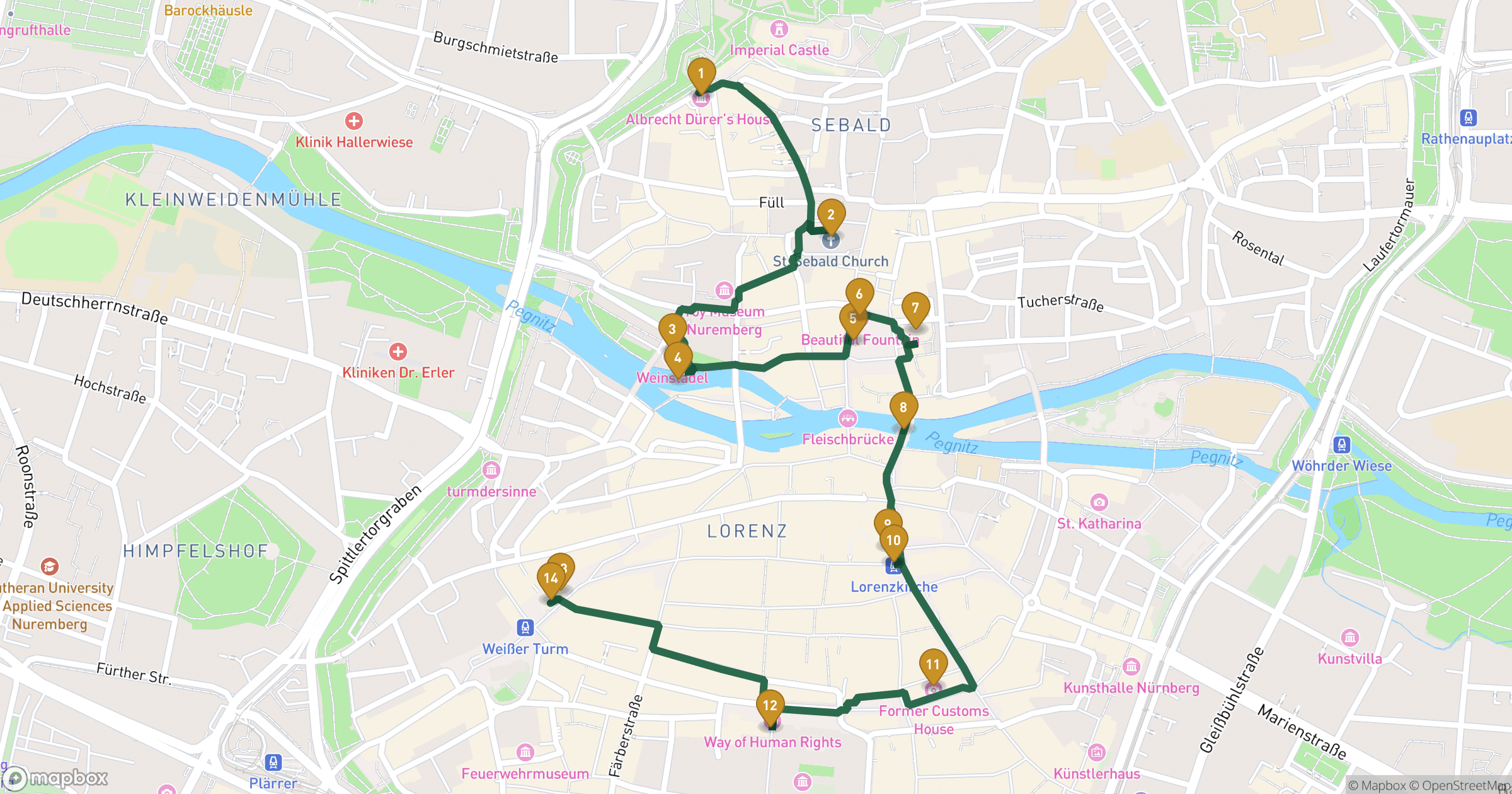
Map for Nuremberg walking tour with 14 stops
The static map shows the tour route with Albrecht Dürer's House, St. Sebaldus, Weinstadel, Henkersteg, and 10 more stops.

Stops along the route

All stops on this self-guided tour at a glance.

  1. Albrecht Dürer's House in Nuremberg
    Rufus46 / CC BY-SA 4.0

    1Albrecht Dürer's HouseMuseum

    Standing beneath the castle walls, this massive timber-framed house reveals the daily world and bustling workshop of artist Albrecht Dürer. Before Dürer moved here in 1509, the wealthy merchant Bernhard Walther altered the roof with small windows to create a private astronomical observatory. Inside today, traditional printmaking techniques are still demonstrated in a recreated studio.

    Built: 1826 · Wikidata

  2. St. Sebaldus in Nuremberg
    Calips / CC BY-SA 3.0

    2St. SebaldusChurch

    St. Sebald, the city's oldest parish church begun in 1225, preserves a visible transition from Romanesque rounded arches to soaring Late Gothic stone. The interior houses the bronze Shrine of St. Sebaldus, a decade-long masterpiece crafted with intricate detail by the Vischer family. Carvings by sculptor Veit Stoss also survived the heavy World War II bombings.

    Built: 1225 · Architect: Parler family · Style: Gothic architecture · Named after: Sebaldus · Wikidata

  3. Weinstadel in Nuremberg
    Photo: Andreas Praefcke / CC BY 3.0

    3WeinstadelAttraction

    Stretching 48 meters along the Pegnitz, this massive half-timbered hall originally housed lepers who were admitted into the city for only three days during Holy Week. The building's eastern facade still bears Nuremberg's oldest roof dormer, which dates back to the initial construction in 1448. Since 1950, the former municipal wine depot and workhouse has served as a student dormitory.

    Wikidata

  4. Henkersteg in Nuremberg
    Schlaier / CC BY-SA 3.0

    4HenkerstegBridge

    This covered wooden walkway from 1457 provided Nuremberg's executioner with a direct, secluded path from his island residence into the city. In January 1595, a sudden jam of river ice gave way under eight curious onlookers standing on the bridge, sweeping them to their deaths. Rebuilt in 1954, the dark timber structure still connects directly to the executioner's massive stone tower.

    Wikidata

  5. Hauptmarkt in Nuremberg
    Nicohofmann / CC BY-SA 3.0

    5HauptmarktMonument

    Nuremberg's central five-thousand-square-meter market square was paved over the ruins of a Jewish ghetto demolished during a violent pogrom in 1349. Architect Heinrich Beheim transformed the site in the late 1300s into a civic showpiece for Imperial trade. On weekdays, farmers continue to sell local produce, gingerbread, and flowers from traditional red-and-green striped stalls.

    Wikidata

  6. Schöner Brunnen in Nuremberg
    Mark Ahsmann / CC BY-SA 3.0

    6Schöner BrunnenAttraction

    Resembling an ornate church spire, this nineteen-meter Gothic fountain was designed by Heinrich Beheim with forty figures that represent the worldview of the Holy Roman Empire. World War II bombing left it undamaged because the entire monument had been enclosed in a thick protective concrete shell. Visitors seek out Paulus Kuhn's seamless 1587 brass ring set inside the iron railing.

    Built: 1385 · Style: Gothic architecture · Wikidata

  7. Frauenkirche in Nuremberg
    Chris06 / CC BY-SA 4.0

    7FrauenkircheChurch

    Commissioned by Emperor Charles IV on the rubble of the demolished Jewish synagogue, this brick Gothic church was designed to display the Imperial Regalia from its balcony. Every day at noon, its 1506 mechanical clock springs to life as seven figures of the Electors circle the seated Emperor. Inside, the sanctuary preserves the Tucher Altar dating from around 1440.

    Built: 1352 · Architect: Peter Parler · Style: Gothic architecture · Named after: Mary · Wikidata

  8. Museumsbrücke (Nürnberg) in Nuremberg
    Kayron TB / CC0

    8Museumsbrücke (Nürnberg)Square

    Spanning the Pegnitz toward the Holy Spirit Hospital, this bridge was rebuilt in 1954 to reflect the 1700 stone crossing that preceded it. Two baroque stone pulpits along the railings preserve historic inscriptions for Emperor Leopold I alongside the coats of arms of local council members. Its modern name came from a local social and reading club that met adjacent to the span.

    Wikidata

  9. Nassauer Haus in Nuremberg
    Tilman2007 / CC BY-SA 4.0

    9Nassauer HausAttraction

    This red sandstone structure across from St. Lawrence Church is the last surviving residential tower house built by medieval patrician families for defense and status. The lower floors date back to the 1200s, while the upper levels and corner turrets were added during the 15th century. A frieze of coats of arms lines the top story, and an ancient cross-ribbed vault remains in the cellar.

    Wikidata

  10. St. Lawrence in Nuremberg
    Chris06 / CC BY-SA 4.0

    10St. LawrenceChurch

    Dominating the city skyline with its twin Gothic towers, this 13th-century church showcases extraordinary works of medieval German religious art. Suspended in the center of the choir hangs the massive Angelic Salutation carved in wood by the volatile sculptor Veit Stoss. Nearby, Adam Kraft carved his own self-portrait into the base of the curving, ceiling-high stone tabernacle.

    Built: 1250 · Architect: Mathes Roriczer, Conrad Roritzer · Style: Gothic architecture · Height: 80 m · Wikidata

  11. Mauthalle in Nuremberg
    Chris06 / CC BY-SA 4.0

    11MauthalleAttraction

    Completed in 1502 by architect Hans Beheim the Elder, this colossal 84-meter granary ensured Nuremberg had enough grain to endure prolonged famines and sieges. Adam Kraft sculpted the eastern portal in 1502, integrating the Imperial Eagle alongside the city's coat of arms. Today, the vaulted cellar supported by 26 stone pillars operates as a traditional brewery and restaurant.

    Style: Gothic architecture · Wikidata

  12. Way of Human Rights in Nuremberg
    Tuxyso / CC BY-SA 3.0

    12Way of Human RightsMonument

    Created by Israeli artist Dani Karavan in 1993, this outdoor installation lines the path to the Germanic National Museum to reinvent Nuremberg as an emblem of peace. Exactly thirty elements, including twenty-seven white concrete pillars and an oak tree, are engraved with articles of the Universal Declaration of Human Rights. Every two years, the city presents its human rights award here.

    Built: 1989 · Named after: human rights · Wikidata

  13. Ehekarussell in Nuremberg
    W. Bulach / CC BY-SA 4.0

    13EhekarussellWater

    Commissioned in the late 1970s to disguise a subway ventilation shaft, this bronze fountain illustrates Hans Sachs's 16th-century poem about the bittersweet stages of marriage. Sculptor Jürgen Weber arranged six grotesque scenes around the basin, moving from passionate young love to domestic fighting and death. A pink marble heart set into the base displays Sachs's original verses.

    Wikidata

  14. Weißer Turm in Nuremberg
    Calips / CC BY-SA 3.0

    14Weißer TurmTower

    Originally plastered in white around 1250, this former gate tower once guarded Nuremberg's second defensive wall and collected tolls from arriving travelers. A citizen campaign in the 19th century saved the sandy-brown structure from being demolished to clear space for street traffic. Today, modern commuters descend into a subway station through an escalator fitted directly into its arch.

    Wikidata

Download the app

This public page shows a preview. The full route, all content, and navigation are available in CityTour AI.

Cities nearby

Discover self-guided tours in nearby cities.

Frequently asked questions

The key answers before you start.

Is this a self-guided audio tour?

Yes. In the CityTour AI app (iOS and Android), this is a self-guided audio tour for Nuremberg — start anytime, at your own pace, with map, stops, and audio narration.

What will you see on this tour?

On this tour you'll see, among others, Albrecht Dürer's House, St. Sebaldus, Weinstadel, Henkersteg, Hauptmarkt, Schöner Brunnen and more sights.

Where does the tour start?

The route starts at Albrecht Dürer's House and ends at Weißer Turm. You can start anytime — the app guides you to the first stop.

How long does the tour take?

About 103 minutes for 14 stops — at your own pace, with breaks whenever you like.

How much does the tour cost?

This tour costs 15 credits. The exact price depends on the pack you buy and your country — roughly $5.

Is it an outdoor tour — are entry tickets included?

Yes, it's an outdoor tour: the sights are viewed from the outside. Entry tickets are not included, and step-free access cannot be guaranteed.

Is the audio guide available in my language?

The tour and audio guide are available in English, Deutsch, Français, Español, Italiano and 9 more languages. You pick your language in the app.

Can I use the tour offline?

Yes. Tours can be used offline.

Can I ask the AI questions along the way?

Yes. At every stop you can ask the AI directly if you want to know more or didn't understand something.