CityTour AI

Regensburg self-guided walking tour

Regensburg: Towers, Trade, and the Danube

Experience the 'Manhattan of the Middle Ages' on this casual stroll through Regensburg’s UNESCO-listed Old Town. You’ll weave through narrow 13th-century alleys, stand beneath soaring patrician towers, and discover how Roman ruins and imperial politics shaped this Bavarian gem. It’s a relaxed journey through 2,000 years of history, ending at the legendary Stone Bridge with a view of the Danube.

Audio tourSelf-guidediOS & Android
104minutes
2.3 kmdistance
15stops
Audio guideFormat
Regensburg: Towers, Trade, and the Danube
W. Bulach / CC BY-SA 4.0

Stops on this route

This tour works well for first-time visitors, weekend trips, and travelers who want to explore Regensburg without a fixed tour time.

Route map for Regensburg walking tour
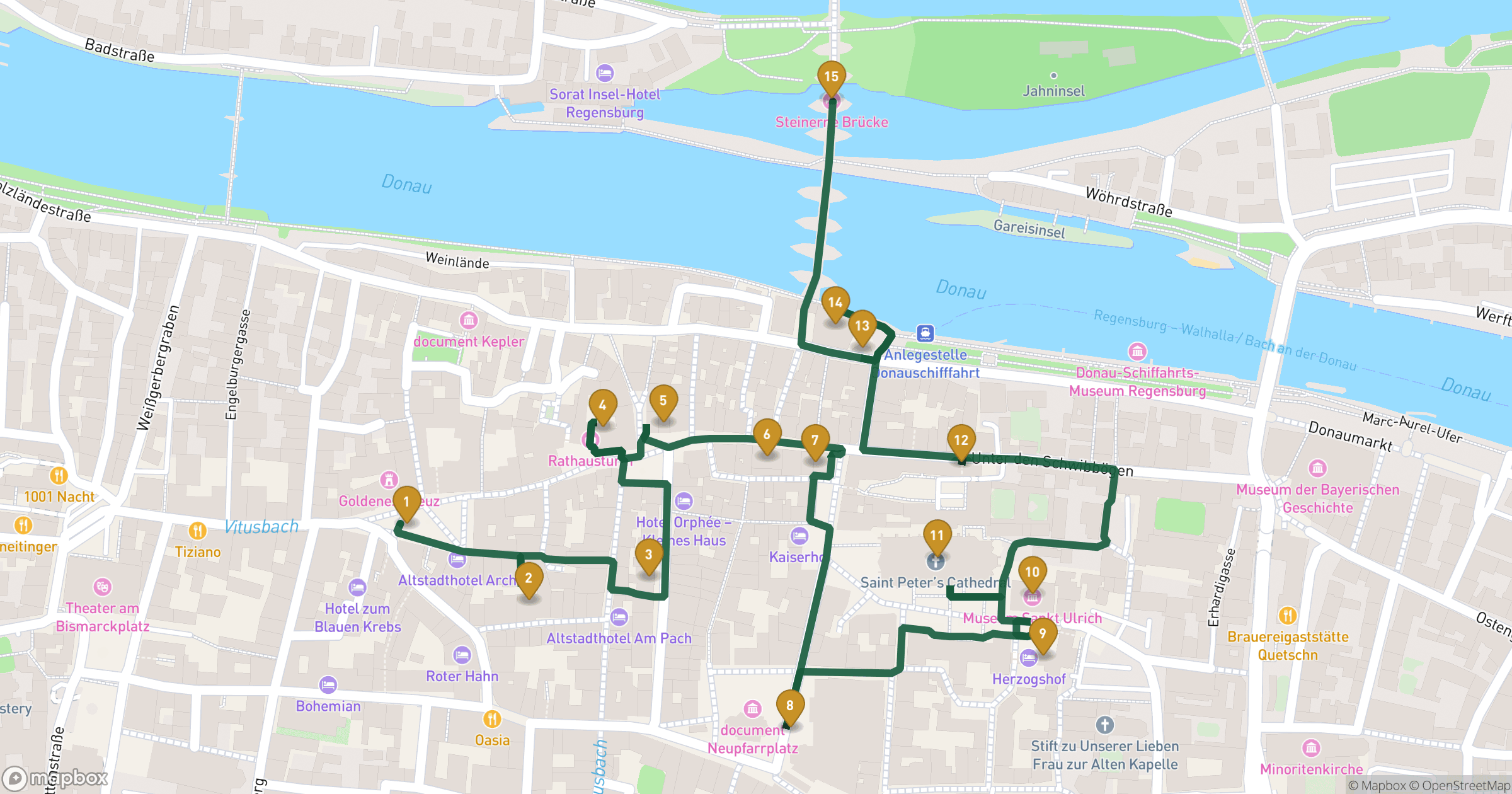
Map for Regensburg walking tour with 15 stops
The static map shows the tour route with Haidplatz, Hinter der Grieb 8 Regensburg, Goldener Turm, Altes Rathaus, Regensburg, and 11 more stops.

Stops along the route

All stops on this self-guided tour at a glance.

  1. Haidplatz in Regensburg
    W. Bulach / CC BY-SA 4.0

    1HaidplatzSquare

    This triangular central square in the old town traces its name back to the Old High German word for uncultivated brushwood before it became an arena for medieval knightly tournaments. The Goldenes Kreuz palace hosted Emperor Charles V, whose romance with local Barbara Blomberg led to the birth of Don Juan de Austria. Until a major traffic-calming effort in the 1990s, the historic area served as a busy parking lot.

    Wikidata

  2. Hinter der Grieb 8 Regensburg in Regensburg
    Paep56 / CC BY-SA 4.0

    2Hinter der Grieb 8 RegensburgBuilding

    This narrow, winding 13th-century alley captures how medieval merchants organized their daily trade and domestic lives. The preserved stone building at number 8, the former Gravenreutherhaus, leans inward toward its neighbors to maximize usable interior space within the protective city walls. Over the centuries, the sturdy structure evolved from a private residence and warehouse into a guesthouse and community meeting space.

    Wikidata

  3. Goldener Turm in Regensburg
    Bärwinkel,Klaus / CC BY-SA 4.0

    3Goldener TurmTower

    Rising 50 meters above Wahlenstraße, this patrician tower built around 1260 by the Haymo family stands as the tallest structure of its kind north of the Alps. Following a 1706 fire at the main market tower, the city converted it into a municipal watchtower by installing an interior staircase and a cramped apartment under the pyramid roof. Today, the four-winged city castle and its Renaissance courtyard arcade house student apartments.

    Built: 1260 · Wikidata

  4. Altes Rathaus, Regensburg in Regensburg
    Helmlechner / CC0

    4Altes Rathaus, RegensburgAttraction

    The Old Town Hall was the diplomatic nerve center of the Holy Roman Empire, anchored by the Reichssaal where the Perpetual Imperial Diet convened from 1663 to 1806. Outside, the stone portal figures Schutz and Trutz stand guard over the entrance, symbolizing the sovereignty of the Free Imperial City. Beneath the diplomatic hall, the complex still retains its original medieval prison cells and the Fragstatt interrogation room intact.

    Style: Gothic art · Wikidata

  5. Kohlenmarkt 2 (Regensburg) in Regensburg
    GFreihalter / CC BY-SA 4.0

    5Kohlenmarkt 2 (Regensburg)Monument

    This historic marketplace served as the bustling municipal center for the vital charcoal trade that heated homes and fueled kitchens across the city. The area changed permanently in 1706 when a massive market tower burned down, prompting the construction of Baroque additions to the adjoining town hall complex. That redesign created neighboring Zieroldsplatz, which displays a commemorative statue of Don Juan de Austria.

    Wikidata

  6. Goliathhaus in Regensburg
    Dr. Bernd Gross / CC BY-SA 3.0 de

    6GoliathhausAttraction

    Built around 1220 upon Roman wall foundations, this fortified residential tower belonging to the merchant Tundorfer family catches the eye with a massive exterior painting of David and Goliath. Rather than the biblical giant, local historians connect the name to wandering poets and bohemian students known as Goliards who occupied an earlier building here. The current facade mural was completed in 1900 by Franz Rinner.

    Wikidata

  7. Watmarkt 9 Regensburg in Regensburg
    Dguendel / CC BY 3.0

    7Watmarkt 9 RegensburgBuilding

    This narrow medieval lane preserves the legacy of the international cloth trade where merchants bargained over textiles beneath soaring patrician towers. The historic Adler-Apotheke at number 9 illustrates how a wealthy trader's domestic residence transitioned into a center of science. Ground floors along the passage feature wide arched openings originally designed for displaying fabrics, with residential quarters set directly above.

    Wikidata

  8. Neupfarrplatz in Regensburg
    Matthias Ripp / CC BY 2.0

    8NeupfarrplatzSquare

    White stone markers in the square trace the original outlines of the Roman camp Castra Regina above a site shaped by civic upheaval. In 1519, the city council ordered the expulsion of the entire Jewish population and completely razed the medieval Jewish quarter that had thrived since roughly the year 1000. Unfinished during the Reformation, the Neupfarrkirche arose as a pilgrimage church on the demolished site.

    Wikidata

  9. Herzogshof in Regensburg
    Allie_Caulfield / CC BY 2.0

    9HerzogshofBuilding

    Originally housing the Agilolfing dukes in the 6th century, this historic ducal seat later served as a royal palace for Charlemagne between 788 and 803. The complex includes the Herzogssaal dating to around 1220, which connects via a 1937 stone arch to the massive Römerturm. Despite its name, this defensive tower is actually a medieval structure erected using salvaged Roman stones.

    Wikidata

  10. Dompfarrkirche St. Ulrich in Regensburg
    Manuel Strehl / CC BY-SA 2.5

    10Dompfarrkirche St. UlrichChurch

    Constructed around 1225 as a palatine chapel for Bavarian dukes, this building stands as one of the earliest Gothic structures in Germany with its transitional pointed and rounded arches. After an 1273 fire devastated the nearby Romanesque cathedral, this parish church served the entire city for nearly two centuries. King Ludwig I of Bavaria intervened in the 19th century to halt its planned demolition.

    Named after: Ulrich of Augsburg · Wikidata

  11. Regensburg Cathedral in Regensburg
    Hpschaefer http://www.reserv-art.de / CC BY-SA 3.0

    11Regensburg CathedralChurch

    Taking over 600 years to reach completion, this French Gothic cathedral features towering twin spires that were finalized in 1872. In the late 15th century, master builder Mathes Roriczer published a treatise on quadrature, the geometric secret used by stonemasons to calculate pinnacle proportions using only a square and compass. Small stone figures known as Dommännchen perch along the exterior ledges.

    Built: 1520 · Architect: Manfred Schuller, Conrad Roritzer … · Style: Gothic architecture · Height: 105 m · Wikidata

  12. Porta Praetoria in Regensburg in Regensburg
    Granada / CC BY-SA 4.0

    12Porta Praetoria in RegensburgAttraction

    Dating to 179 AD, this monumental gateway served as the northern portal of Castra Regina for the Third Italic Legion. The ancient structure was entirely encased within the walls of a local brewery for centuries until demolition work in 1885 uncovered the massive limestone blocks. Alongside the Porta Nigra in Trier, it remains one of only two surviving Roman gates located north of the Alps.

    Wikidata

  13. Regensburg Sausage Kitchen in Regensburg
    -wuppertaler / CC BY 4.0

    13Regensburg Sausage KitchenMonument

    Operating right beside the river, this compact building began in 1135 as the construction office for the Stone Bridge before converting into a cookshop for dockers and stonemasons in 1146. Until around 1800, the kitchen specialized in boiled meat before the family that took over in 1806 pivoted to charcoal-grilled sausages. Today the tiny kitchen turns out approximately 6,000 grilled sausages every day.

    Wikidata

  14. Salzstadel in Regensburg
    -wuppertaler / CC BY 4.0

    14SalzstadelBuilding

    Constructed between 1616 and 1620, this massive riverfront storehouse was built to hold rock and table salt shipped along the Danube from Salzburg and Hallstatt. Under its sprawling roof, the structure incorporates three main floors supported on deep wooden piles topped by five separate attic levels. In 1619, premature overloading with salt snapped heavy oak beams, forcing workers to install emergency stone pillars.

    Wikidata

  15. Stone Bridge in Regensburg
    W. Bulach / CC BY-SA 4.0

    15Stone Bridge

    Completed in 1146 after just eleven years of construction, this sixteen-arch stone span was the only bridge across the Danube in the city for more than 800 years. King Louis VII of France led his army across the crossing in 1147 during the Second Crusade. Upstream river vessels struggled against the fierce currents under the arches, requiring an electric winch system to pull boats through until 1964.

    Wikidata

Download the app

This public page shows a preview. The full route, all content, and navigation are available in CityTour AI.

Cities nearby

Discover self-guided tours in nearby cities.

Frequently asked questions

The key answers before you start.

Is this a self-guided audio tour?

Yes. In the CityTour AI app (iOS and Android), this is a self-guided audio tour for Regensburg — start anytime, at your own pace, with map, stops, and audio narration.

What will you see on this tour?

On this tour you'll see, among others, Haidplatz, Hinter der Grieb 8 Regensburg, Goldener Turm, Altes Rathaus, Regensburg, Kohlenmarkt 2 (Regensburg), Goliathhaus and more sights.

Where does the tour start?

The route starts at Haidplatz and ends at Stone Bridge. You can start anytime — the app guides you to the first stop.

How long does the tour take?

About 104 minutes for 15 stops — at your own pace, with breaks whenever you like.

How much does the tour cost?

This tour costs 15 credits. The exact price depends on the pack you buy and your country — roughly $5.

Is it an outdoor tour — are entry tickets included?

Yes, it's an outdoor tour: the sights are viewed from the outside. Entry tickets are not included, and step-free access cannot be guaranteed.

Is the audio guide available in my language?

The tour and audio guide are available in English, Deutsch, Français, Español, Italiano and 9 more languages. You pick your language in the app.

Can I use the tour offline?

Yes. Tours can be used offline.

Can I ask the AI questions along the way?

Yes. At every stop you can ask the AI directly if you want to know more or didn't understand something.