CityTour AI

Würzburg self-guided walking tour

Würzburg: Baroque Splendor and Franconian Joie de Vivre

Experience the irresistible charm of this Lower Franconian metropolis on a relaxed walk between UNESCO World Heritage sites and a vibrant wine culture. Discover the architectural masterpieces of the prince-bishops, feel the pulse of the old town by the Main river, and learn how tradition and civic spirit restored Würzburg to its former glory. An authentic tour that brings history to life and captures the famous Franconian lifestyle.

Audio tourSelf-guidediOS & Android
103minutes
3.3 kmdistance
12stops
Audio guideFormat
Würzburg: Baroque Splendor and Franconian Joie de Vivre
Krzysztof Golik / CC BY-SA 4.0

Stops on this route

This tour works well for first-time visitors, weekend trips, and travelers who want to explore Würzburg without a fixed tour time.

Route map for Würzburg walking tour
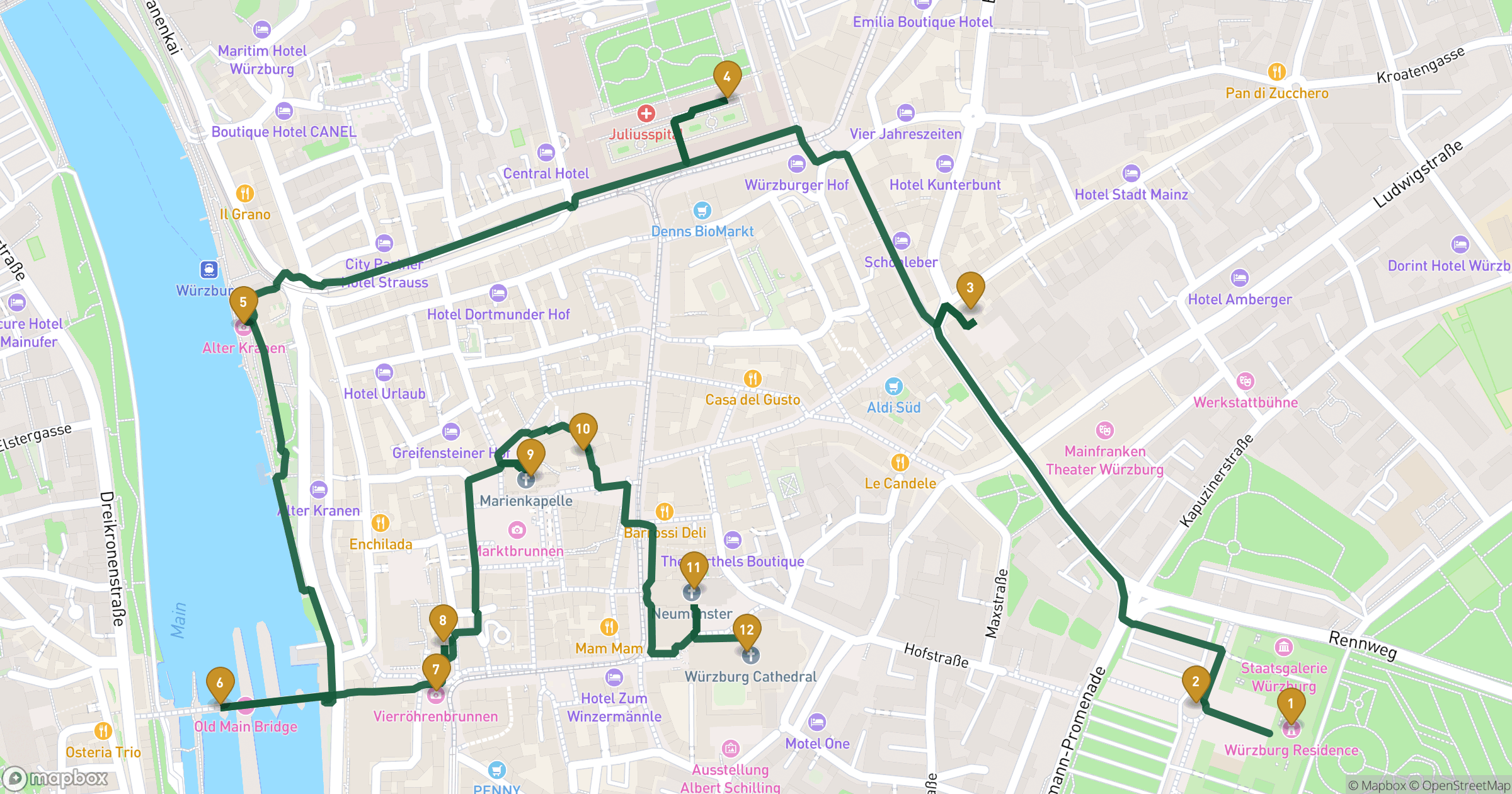
Map for Würzburg walking tour with 12 stops
The static map shows the tour route with Würzburg Residence, Frankoniabrunnen, Spital, Juliusspital, and 8 more stops.

Stops along the route

All stops on this self-guided tour at a glance.

  1. Würzburg Residence in Würzburg
    Krzysztof Golik / CC BY-SA 4.0

    1Würzburg ResidenceCastle

    The Würzburg Residence showcases the architectural daring of former bell founder Balthasar Neumann. Confident in his unsupported grand staircase, Neumann offered to fire cannons beneath the vault to prove its strength, a structure that later survived Second World War bombing. Above it stretches Giovanni Battista Tiepolo's ceiling fresco depicting four continents, featuring Neumann in artillery uniform alongside the painter.

    Built: 1719 · Architect: Johann Balthasar Neumann · Style: baroque architecture · Wikidata

  2. Frankoniabrunnen in Würzburg
    Flocci Nivis / CC BY 4.0

    2FrankoniabrunnenAttraction

    Standing on the Residenzplatz, the Frankoniabrunnen highlights regional pride over individual vanity. When the city sought to honor Prince Regent Luitpold of Bavaria for his 70th birthday in 1894, he refused a likeness of himself and requested a monument celebrating Franconia instead. At the feet of patron goddess Frankonia sit bronze statues of Walther von der Vogelweide, Matthias Grünewald, and Tilman Riemenschneider.

    Built: 1894 · Architect: Ferdinand von Miller · Wikidata

  3. Spital in Würzburg
    Aarp65 / CC BY-SA 3.0

    3SpitalChurch

    The Bürgerspital zum Heiligen Geist embodies over seven centuries of citizen-led social care. Founded around 1316 by patrician Johann von Steren and his wife Mergardis, the hospital was intentionally placed under civic rather than church or noble administration. Today it operates one of Germany's oldest wineries, reputed origin of the Franconian Bocksbeutel bottle, and retains its original Gothic chapel.

    Wikidata

  4. Juliusspital in Würzburg
    © José Luiz Bernardes Ribeiro; José Luiz / CC BY-SA 4.0

    4Juliusspital

    Founded in 1576 by Prince-Bishop Julius Echter von Mespelbrunn, the Juliusspital combined a hospital, orphanage, and home for the elderly. Its construction leveled an old Jewish cemetery, an event marked today by a memorial stone in the courtyard. The still-functioning complex features an original Rococo pharmacy on the ground floor and sits atop a 250-meter-long wooden barrel cellar.

    Style: classical architecture · Wikidata

  5. Würzburg old crane in Würzburg
    Welleschik / CC BY-SA 3.0

    5Würzburg old craneAttraction

    Along the Main riverbank stands the Alter Kranen, an 18th-century baroque harbor crane engineered by Franz Ignaz Michael Neumann. Inside, two massive treadwheels were turned by convict or laborer runners to lift heavy river cargo. Having survived the Second World War largely intact, the crane was reactivated after 1945 to load tons of urban rubble onto boats, and now displays flood marks on its stone base.

    Wikidata

  6. Alte Mainbrücke in Würzburg
    Moritz Tilman / CC BY-SA 3.0

    6Alte MainbrückeBridge

    The Alte Mainbrücke connects the old town to the river quarter with its line of monumental sandstone statues added in the 18th century. Among the four-and-a-half-meter figures stands Saint Kilian, holding a golden sword recalling his murder after criticizing the local duke's marriage. Alongside saints, statues of King Pepin the Younger and Charlemagne mark the crossing where locals gather for a glass of wine.

    Built: 1703 · Wikidata

  7. Brunnen in Würzburg
    Tilman2007 / CC BY-SA 3.0

    7BrunnenAttraction

    Dating to 1766, the Vierröhrenbrunnen served as a vital public water source fed through wooden pipes from the Fäßleinsbrunn spring. Court sculptor Lukas van der Auwera designed the monument, meticulously balancing the scales of Justice among the four cardinal virtues surrounding the central obelisk. Crowned by the statue of Franken-Patrona, the fountain continues to pour water in the heart of the marketplace.

    Wikidata

  8. Grafeneckart in Würzburg
    Calips / CC BY-SA 3.0

    8Grafeneckart

    The Grafeneckart is a Romanesque residential tower from the 12th century that forms the oldest part of the town hall. It survived the firestorm of March 16, 1945, which destroyed most of the historic city, and now houses a ground-floor memorial room dedicated to that raid. Postwar Mayor Helmuth Zimmerer fought to preserve its historical form, debating plaster shades to ensure an authentic reconstruction.

    Wikidata

  9. Marienkapelle in Würzburg
    Bärwinkel,Klaus / CC BY-SA 4.0

    9MarienkapelleChurch

    The red sandstone Marienkapelle on the marketplace is a Gothic hall church begun in 1377 over the ruins of a destroyed synagogue. Late Gothic sculptor Tilman Riemenschneider created the naturalistic statues of Adam and Eve for the south portal before being imprisoned and mistreated in the town hall during the Peasants' War. The portal features copies of his work, while the interior holds knight Konrad von Schaumberg's tomb.

    Architect: Johann Balthasar Neumann · Style: Gothic architecture · Named after: Mary · Wikidata

  10. Falkenhaus in Würzburg
    Mussklprozz / CC BY-SA 3.0

    10FalkenhausAttraction

    Adjoining the marketplace, the Falkenhaus is distinguished by an exuberant rococo facade of shells, scrolls, and flowers. In 1751, the innkeeper's widow Meininger hired itinerant Upper Bavarian stucco plasterers to transform the plain guest house and attract wealthy visitors. After burning down during the Second World War, the stucco ornamentation was reconstructed in the 1950s using historic photographs.

    Wikidata

  11. Neumünster in Würzburg
    Daderot / CC0

    11NeumünsterChurch

    Behind its curved red sandstone facade, the Neumünster enshrines the burial site of Saint Kilian and his fellow martyrs. An adjoining north passage leads to the quiet Lusamgärtchen, a former cloister housing the memorial stone of medieval minnesinger Walther von der Vogelweide. A local legend says Walther's will provided for birds to be fed daily at his tomb as thanks for inspiring his poetry.

    Architect: Valentino Pezzani, Johann Dientzenhofer … · Style: Romanesque architecture · Named after: John the Baptist · Wikidata

  12. Dom St. Kilian in Würzburg
    Krzysztof Golik / CC BY-SA 4.0

    12Dom St. KilianChurch

    St. Kilian's Cathedral is Germany's fourth-largest Romanesque church, distinguished by twin towers and a nave stretching over one hundred meters. Inside, Balthasar Neumann designed the Schönborn Chapel, repeatedly altering window layouts to guide natural light directly onto the prince-bishops' tombs. The interior also displays bishop epitaphs carved by sculptor Tilman Riemenschneider.

    Built: 1040 · Architect: Hans Schädel, Johann Balthasar Neumann … · Style: Romanesque architecture · Named after: Saint Kilian · Wikidata

Download the app

This public page shows a preview. The full route, all content, and navigation are available in CityTour AI.

Cities nearby

Discover self-guided tours in nearby cities.

Frequently asked questions

The key answers before you start.

Is this a self-guided audio tour?

Yes. In the CityTour AI app (iOS and Android), this is a self-guided audio tour for Würzburg — start anytime, at your own pace, with map, stops, and audio narration.

What will you see on this tour?

On this tour you'll see, among others, Würzburg Residence, Frankoniabrunnen, Spital, Juliusspital, Würzburg old crane, Alte Mainbrücke and more sights.

Where does the tour start?

The route starts at Würzburg Residence and ends at Dom St. Kilian. You can start anytime — the app guides you to the first stop.

How long does the tour take?

About 103 minutes for 12 stops — at your own pace, with breaks whenever you like.

How much does the tour cost?

This tour costs 15 credits. The exact price depends on the pack you buy and your country — roughly $5.

Is it an outdoor tour — are entry tickets included?

Yes, it's an outdoor tour: the sights are viewed from the outside. Entry tickets are not included, and step-free access cannot be guaranteed.

Is the audio guide available in my language?

The tour and audio guide are available in English, Deutsch, Français, Español, Italiano and 9 more languages. You pick your language in the app.

Can I use the tour offline?

Yes. Tours can be used offline.

Can I ask the AI questions along the way?

Yes. At every stop you can ask the AI directly if you want to know more or didn't understand something.