CityTour AI

Eschwege self-guided walking tour

Eschwege: Half-Timbered Houses, Towers, and Mother Holle

Explore Eschwege’s historic old town, where half-timbered architecture meets the legends of towers and churches. This walk takes you from the landgrave’s residence to the enchanting Frau Holle fountain, revealing the city's rich craftsmanship and history. It is a compact route perfect for discovering both intricate facade details and the grand narrative of the city.

Audio tourSelf-guidediOS & Android
88minutes
2.3 kmdistance
12stops
Audio guideFormat
Eschwege: Half-Timbered Houses, Towers, and Mother Holle
User:Any1s and Christoph Braun / CC0

Stops on this route

This tour works well for first-time visitors, weekend trips, and travelers who want to explore Eschwege without a fixed tour time.

Route map for Eschwege walking tour
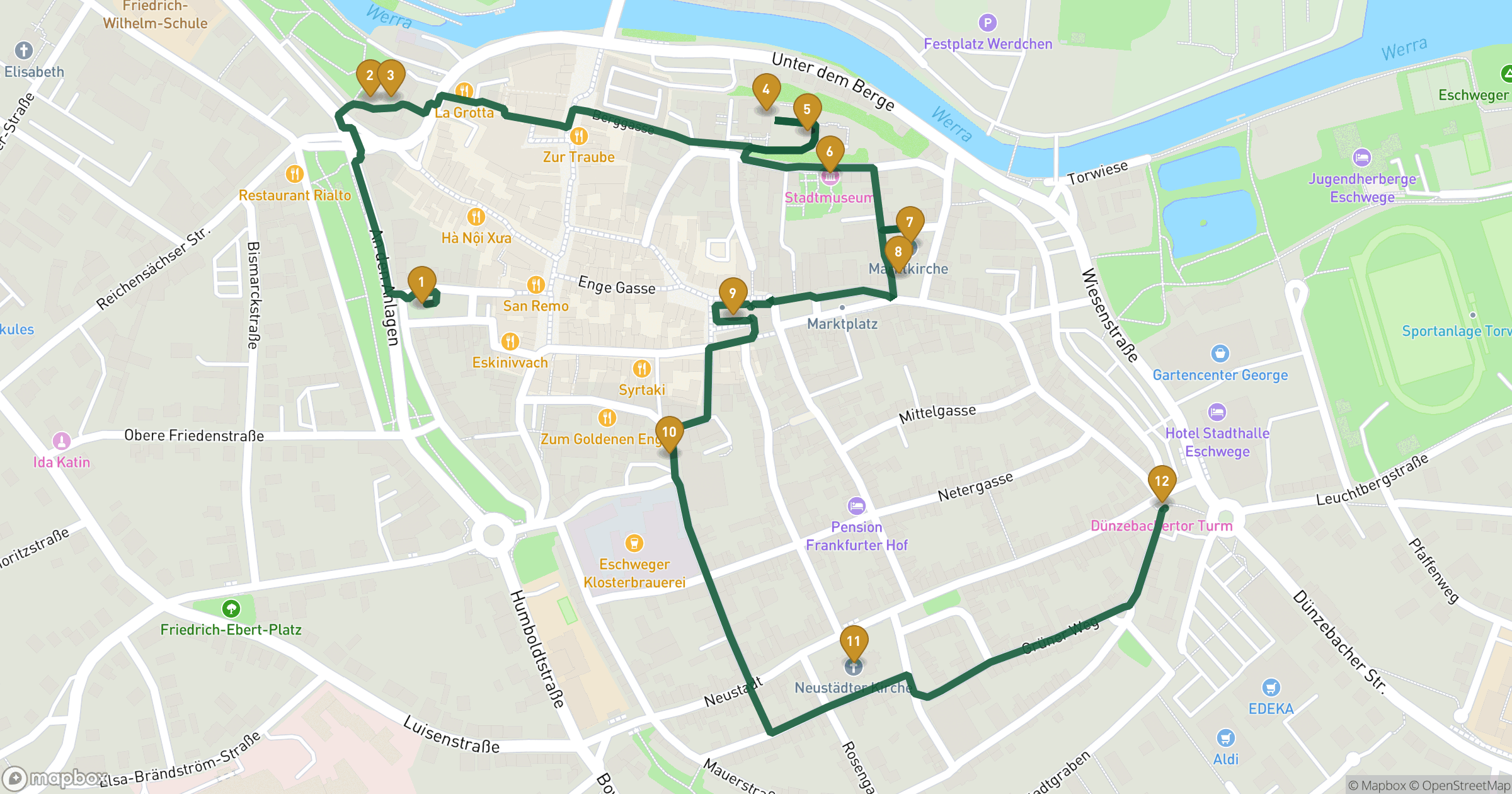
Map for Eschwege walking tour with 12 stops
The static map shows the tour route with Nikolai-Tower, Schloss Eschwege, Frau-Holle-Brunnen, Hochzeitshaus, and 8 more stops.

Stops along the route

All stops on this self-guided tour at a glance.

  1. Nikolai-Tower in Eschwege
    Tilman2007 / CC BY-SA 4.0

    1Nikolai-Tower

    Standing isolated on Nikolaiplatz, the Nikolaiturm reveals itself not as a purpose-built lookout, but as the lone surviving section of the demolished St. Godehard church. After fire gutted it during the destruction of Eschwege in 1637, the city rebuilt the ruin between 1733 and 1736 to serve as a fire watchtower. A bell dating to 1736 remains at its base alongside old gravestones.

    Height: 47.6 m · Named after: Saint Nicholas · Wikidata

  2. Schloss Eschwege in Eschwege
    User:Any1s and Christoph Braun / CC0

    2Schloss Eschwege

    Eschwege Castle brings together defensive medieval roots and grand territorial expansions, beginning with Landgraf Balthasar of Thuringia’s fortress from around 1385. Following his 1627 abdication, Landgraf Moritz the Learned lived here until his death, adding an eastern pavilion. That pavilion houses an astronomical clock with the Dietemann figure, which blows its horn on the hour.

    Wikidata

  3. Frau-Holle-Brunnen in Eschwege
    Tilman2007 / CC BY-SA 4.0

    3Frau-Holle-Brunnen

    The Frau Holle Fountain in the castle courtyard translates the famous local folktale into eight shell-limestone reliefs created in 1930. The stone carvings trace Goldmarie's journey as she tends the baking oven, shakes the ripe apple tree, and fluffs beddings until snow falls. This twentieth-century courtyard installation directly echoes regional lore centered on the nearby Hohe Meißner.

  4. Hochzeitshaus in Eschwege
    Gunther Falchner / CC BY-SA 3.0

    4Hochzeitshaus

    The Hochzeitshaus was constructed in 1578 as a civic hall where guild members assembled and townspeople celebrated collective festivities. Its ornate Renaissance architecture reflected Eschwege’s rising importance in the Landgraviate after definitively joining Hesse in 1433. The building later transitioned into a schoolhouse before becoming municipal offices on the Schulberg.

    Wikidata

  5. Karlsturm in Eschwege
    Tilman2007 / CC BY-SA 4.0

    5Karlsturm

    The square Karlsturm stands on the Schulberg as the sole surviving remnant of the twelfth-century St. Cyriakus collegiate church. That women's religious community was founded around 1000 by Sophia, daughter of Emperor Otto II, but in 1249 Günther von Arnsberg seized the monastery and turned it into a castle. Until the nineteenth century, a civic watchman still resided within the tower.

    Wikidata

  6. Stadtmuseum in Eschwege
    Heinz K. S. / CC BY-SA 4.0

    6Stadtmuseum

    The town museum occupies an eighteenth-century tobacco warehouse, highlighting an industry that once processed crops grown across the Werra valley. Originally founded in 1913 inside the castle's knight hall, the collection moved into this dedicated storehouse in 1964. Displays showcase traditional local trades such as tanners and linen weavers, alongside Hesse's largest shoe.

    Wikidata

  7. Marktkirche St. Dionys in Eschwege
    GFreihalter / CC BY-SA 3.0

    7Marktkirche St. Dionys

    The Marktkirche St. Dionys traces its roots to early medieval foundations located beside a royal Frankish court. While the hall and choir were erected in stages between 1451 and 1521, an imperial Croatian attack in 1637 set the church ablaze and prompted a decades-long reconstruction. Below the choir, the princely crypt holds the coffins of Landgraf Friedrich and his family.

    Style: Gothic architecture · Named after: Saint Dionysius · Wikidata

  8. Theophanu-Denkmal in Eschwege
    Gunther Falchner / CC BY-SA 3.0

    8Theophanu-Denkmal

    Standing outside the Marktkirche, a 2006 bronze sculpture portrays the Byzantine princess and Holy Roman Empress Theophanu. The monument commemorates an imperial deed from 974 in which Otto II granted her Eschwege, producing the earliest written record of the settlement. The contemporary figure ties directly to the nearby Karlsturm, founded by Theophanu's daughter Sophia.

  9. Rathaus Eschwege in Eschwege
    Tilman2007 / CC BY-SA 4.0

    9Rathaus Eschwege

    Eschwege’s Old Town Hall on the marketplace showcases timber framing erected in 1660 during post-fire reconstruction. Its entrance portal bears the Latin inscription Eschwegia alongside columns carved with strapwork, double spirals, and an unusual creature with a fish body and bear head. A side doorway features carved angel heads, and the façade comes alive with a chiming glockenspiel.

  10. Hospitalplatz in Eschwege
    Sipalius / CC BY-SA 3.0

    10Hospitalplatz

    Hospitalplatz preserves surviving elements of an Augustinian Hermit monastery originally established in 1278. Among these remains are a double chapel, a vaulted cellar beneath the former dormitory, and a monastic building dating from 1501. The site also includes the Kemenate, a rare surviving secular stone residence, before large sections were repurposed as a brewery.

  11. St. Katharina in Eschwege
    Gunther Falchner / CC BY-SA 3.0

    11St. Katharina

    The Neustädter Kirche St. Katharina anchors the district's open square with a 75-meter spire, making it the tallest church tower in Eschwege. Inside stands its foremost treasure: an ornate stone pulpit completed in 1509 featuring reliefs of Mary, Christ crowned with thorns, and Mary of Bethany. Outside on the open square rests the Blue Stone, a basalt block discovered nearby in 1967.

    Architect: Georg Gottlob Ungewitter · Style: Gothic architecture · Wikidata

  12. Dünzebachertor Turm in Eschwege
    Tilman2007 / CC BY-SA 4.0

    12Dünzebachertor Turm

    The 25-meter Dünzebacher Torturm survives as the sole remaining gate tower from Eschwege's medieval city fortifications. Built in the sixteenth century, the defensive entrance later found an unexpected domestic purpose by serving for many years as the municipal jail. Its stone core is crowned by a striking pointed roof punctuated by three hexagonal half-timbered oriels.

    Wikidata

Download the app

This public page shows a preview. The full route, all content, and navigation are available in CityTour AI.

Cities nearby

Discover self-guided tours in nearby cities.

Frequently asked questions

The key answers before you start.

Is this a self-guided audio tour?

Yes. In the CityTour AI app (iOS and Android), this is a self-guided audio tour for Eschwege — start anytime, at your own pace, with map, stops, and audio narration.

What will you see on this tour?

On this tour you'll see, among others, Nikolai-Tower, Schloss Eschwege, Frau-Holle-Brunnen, Hochzeitshaus, Karlsturm, Stadtmuseum and more sights.

Where does the tour start?

The route starts at Nikolai-Tower and ends at Dünzebachertor Turm. You can start anytime — the app guides you to the first stop.

How long does the tour take?

About 88 minutes for 12 stops — at your own pace, with breaks whenever you like.

Is it an outdoor tour — are entry tickets included?

Yes, it's an outdoor tour: the sights are viewed from the outside. Entry tickets are not included, and step-free access cannot be guaranteed.

Is the audio guide available in my language?

The tour and audio guide are available in English, Deutsch, Français, Español, Italiano and 9 more languages. You pick your language in the app.

Can I use the tour offline?

Yes. Tours can be used offline.

Can I ask the AI questions along the way?

Yes. At every stop you can ask the AI directly if you want to know more or didn't understand something.