CityTour AI

Fritzlar self-guided walking tour

Fritzlar Cathedral City: Stone Witnesses and Half-Timbered Magic

Join us on a charming journey through medieval Fritzlar, where magnificent half-timbered houses meet monumental church history. Experience the contrast between the centuries-old town hall, the massive defensive towers, and the spiritual aura of the cathedral. This walk brings the legends of kings and missionaries to life in the winding alleys of this North Hessian imperial city.

Audio tourSelf-guidediOS & Android
89minutes
2.4 kmdistance
12stops
Audio guideFormat
Fritzlar Cathedral City: Stone Witnesses and Half-Timbered Magic
Tilman2007 / CC BY-SA 4.0

Stops on this route

This tour works well for first-time visitors, weekend trips, and travelers who want to explore Fritzlar without a fixed tour time.

Route map for Fritzlar walking tour
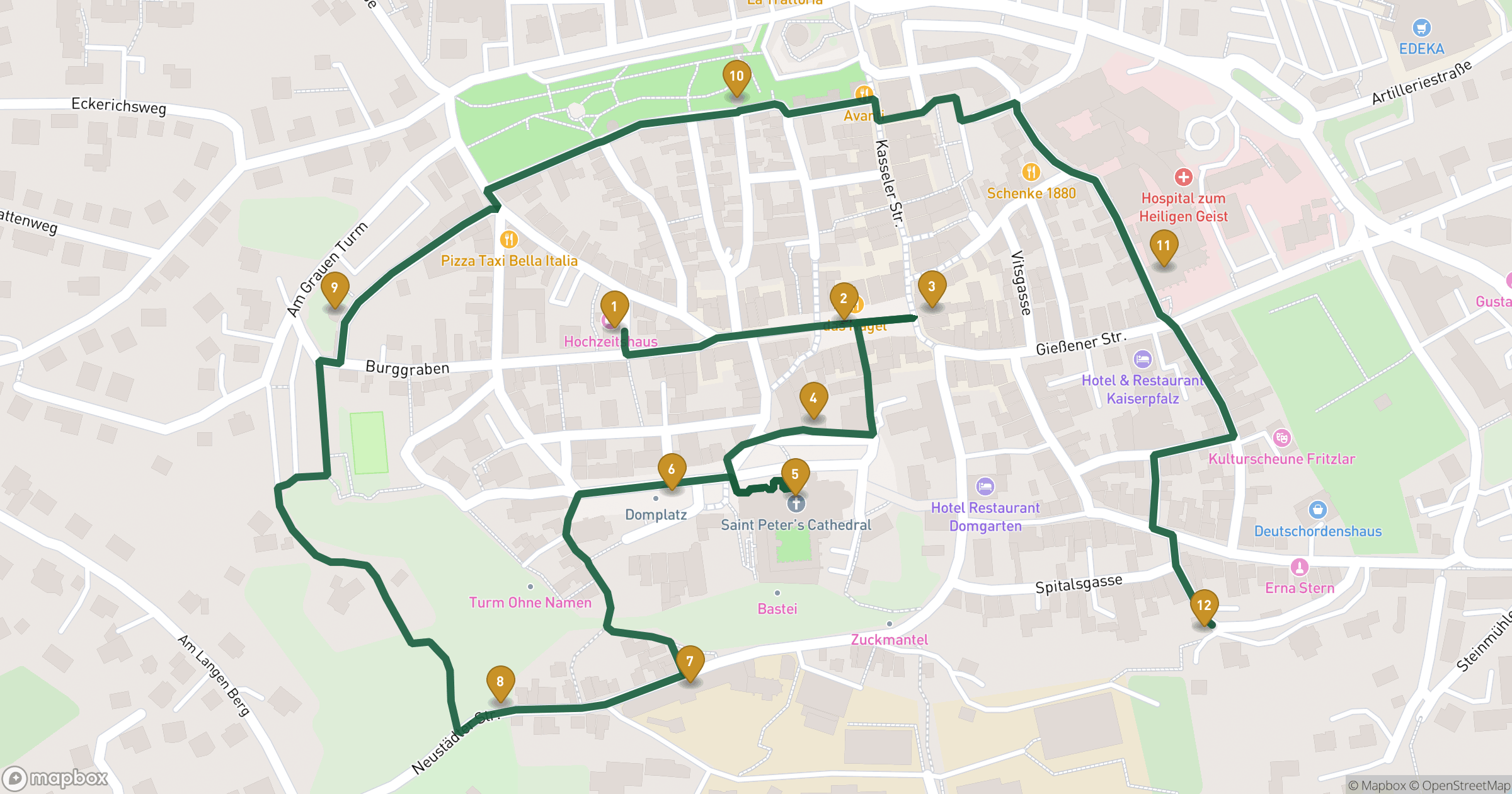
Map for Fritzlar walking tour with 12 stops
The static map shows the tour route with Museum Hochzeitshaus Fritzlar, Marktplatz, Gildehaus Fritzlar / Ferienwohnung, Rathaus Fritzlar, and 8 more stops.

Stops along the route

All stops on this self-guided tour at a glance.

  1. Museum Hochzeitshaus Fritzlar in Fritzlar
    Tilman2007 / CC BY-SA 4.0

    1Museum Hochzeitshaus Fritzlar

    This monumental timber-framed building showcases how a grand civic festival house transformed across centuries. Built around 1580/90 on the former grounds of the Haina monastery estate, it features an elaborate Renaissance portal attributed to Andreas Herber. It served as a military hospital in the Seven Years' War and as a school before opening as a museum in 1956.

    Wikidata

  2. Marktplatz in Fritzlar
    Tilman2007 / CC BY-SA 4.0

    2Marktplatz

    The central market square reveals how civic order, trade, and regional power were staged around a monumental Renaissance water source. Standing in the middle, the Rolandsbrunnen was installed in 1564 and features a statue of Roland armed with a shield and lance-banner. Four coats of arms encircle the basin, marking Mainz archbishops, stone masons, and the town itself.

  3. Gildehaus Fritzlar / Ferienwohnung in Fritzlar
    Tilman2007 / CC BY-SA 4.0

    3Gildehaus Fritzlar / Ferienwohnung

    This gothic post-and-beam building dates to around 1475 and preserves the legacy of Fritzlar's merchant guild. It served as the guild house of the Brotherhood of St. Michael, an association formed in the 12th century with trade links reaching as far as Flanders and Novgorod. Carved directly onto the central timber post, Saint Michael is visible fighting evil with a flaming sword.

  4. Rathaus Fritzlar in Fritzlar
    Cosal / CC BY-SA 4.0

    4Rathaus Fritzlar

    The town hall stands on Dr.-Jestädt-Platz as a site of civic law and municipal administration spanning over 900 years. First documented as an archbishopric praetorium in 1109, it has functioned as the town hall since 1274 despite being nearly destroyed by fire around 1435. Three pointed turrets crown its south gable, while timber-framed upper floors were reconstructed in 1963/64.

    Wikidata

  5. Saint Peter's Church, Fritzlar in Fritzlar
    ErwinMeier / CC BY-SA 4.0

    5Saint Peter's Church, Fritzlar

    The cathedral of St. Peter traces its origins through centuries of construction and an early missionary legend. Tradition claims Saint Boniface felled Thor's Oak at nearby Geismar in 723, using the timber to build an initial prayer house that evolved into later stone basilicas. In a tragic event on December 7, 1868, a violent gale tore off the south tower's roof, killing 21 people.

    Architect: Georg Gottlob Ungewitter · Style: Romanesque architecture · Wikidata

  6. Bonifatius-Denkmal in Fritzlar
    Chattus / CC BY-SA 4.0

    6Bonifatius-Denkmal

    This modern bronze monument on Domplatz commemorates the missionary who set Fritzlar's founding legend in motion. Sculpted by Ubbo Enninga and dedicated in 1999, it depicts Boniface standing on a tree stump with an axe in one hand and a model of a church in the other. The statue references the legendary felling of Thor's Oak in 723, an event that actually occurred in nearby Geismar.

  7. Ursulinenkloster Fritzlar in Fritzlar
    Cosal / CC BY-SA 4.0

    7Ursulinenkloster Fritzlar

    The Ursuline convent illustrates centuries of religious renewal and educational persistence following the Reformation. Three Ursulines established a new community here in 1711, constructing the current baroque convent building from 1713 onward and erecting their first schoolhouse in 1735. Despite expulsions in 1877 and under the Gestapo in 1941, classes resumed as early as Easter 1946.

    Wikidata

  8. Winterturm in Fritzlar
    Tilman2007 / CC BY-SA 4.0

    8Winterturm

    Rising about 25 meters, the Winterturm demonstrates the ingenious defensive layout of Fritzlar's medieval fortifications. Its walls are pierced by small arrow slits angled in multiple directions, enabling defenders to monitor the open terrain outside the two-and-a-half-kilometer wall. Its name likely recalls local vintners who once passed through this gate toward their hillside vineyards.

  9. Grauer Turm, Fritzlar in Fritzlar
    Tilman2007 / CC BY-SA 4.0

    9Grauer Turm, Fritzlar

    Standing at 38.5 meters, the Grauer Turm formed the vital command post of the town's defensive circuit. It was erected after the devastation of Fritzlar in 1232 to safeguard the exposed northwest flank, maintaining contact with seven outer watchtowers via signals. Inside, its former ground-floor dungeon and four floors now exhibit a 1500-era town model and Boniface's plaster cast.

    Wikidata

  10. Rosenturm in Fritzlar
    Cosal / CC BY-SA 4.0

    10Rosenturm

    The Rosenturm displays how medieval defenses were rebuilt directly atop ruins after severe attacks. Its horseshoe-shaped base dates to the 12th century, a tactical design that prevented attackers from slipping past its flanks. After the destruction of 1232 left only the foundation, citizens erected the round upper section that survives as one of Fritzlar's oldest remaining towers.

    Wikidata

  11. Evang. Stadtkirche in Fritzlar
    Tilman2007 / CC BY-SA 4.0

    11Evang. Stadtkirche

    Now an Evangelical parish church, this 14th-century gothic hall church originated with the Franciscan mendicant order. Arriving in 1237, the friars built directly against the town wall due to space constraints, omitting both a transept and a tower in keeping with their vow of simplicity. Monastic life ceased in 1811, and the building began its new role as a Protestant church in 1817.

    Style: Gothic architecture · Wikidata

  12. Regilturm in Fritzlar
    Tilman2007 / CC BY-SA 4.0

    12Regilturm

    The Regilturm marks one of the few surviving access points that define the old boundary between town and countryside. Originating in the 14th century, it retains an authentic medieval base beneath a pointed conical tile roof added during an 1883 restoration. Its gateway stands where the fortifications were breached during the Seven Years' War, leading to later 19th-century gate removals.

Download the app

This public page shows a preview. The full route, all content, and navigation are available in CityTour AI.

Cities nearby

Discover self-guided tours in nearby cities.

Frequently asked questions

The key answers before you start.

Is this a self-guided audio tour?

Yes. In the CityTour AI app (iOS and Android), this is a self-guided audio tour for Fritzlar — start anytime, at your own pace, with map, stops, and audio narration.

What will you see on this tour?

On this tour you'll see, among others, Museum Hochzeitshaus Fritzlar, Marktplatz, Gildehaus Fritzlar / Ferienwohnung, Rathaus Fritzlar, Saint Peter's Church, Fritzlar, Bonifatius-Denkmal and more sights.

Where does the tour start?

The route starts at Museum Hochzeitshaus Fritzlar and ends at Regilturm. You can start anytime — the app guides you to the first stop.

How long does the tour take?

About 89 minutes for 12 stops — at your own pace, with breaks whenever you like.

Is it an outdoor tour — are entry tickets included?

Yes, it's an outdoor tour: the sights are viewed from the outside. Entry tickets are not included, and step-free access cannot be guaranteed.

Is the audio guide available in my language?

The tour and audio guide are available in English, Deutsch, Français, Español, Italiano and 9 more languages. You pick your language in the app.

Can I use the tour offline?

Yes. Tours can be used offline.

Can I ask the AI questions along the way?

Yes. At every stop you can ask the AI directly if you want to know more or didn't understand something.