CityTour AI

Kassel self-guided walking tour

Kassel: Between Royal Splendor and documenta Modernism

Experience the exciting contrast between Baroque grandeur and bold post-war architecture on this relaxed walk through Kassel's city center. Discover how Germany's first pedestrian zone and the world-famous documenta city rose from the ruins of WWII. Join us to follow the footsteps of the Brothers Grimm and learn why Kassel is a unique open-air museum for modern art.

Audio tourSelf-guidediOS & Android
105minutes
3.7 kmdistance
12stops
Audio guideFormat
Kassel: Between Royal Splendor and documenta Modernism
Jardín de flores / CC BY-SA 4.0

Stops on this route

This tour works well for first-time visitors, weekend trips, and travelers who want to explore Kassel without a fixed tour time.

Route map for Kassel walking tour
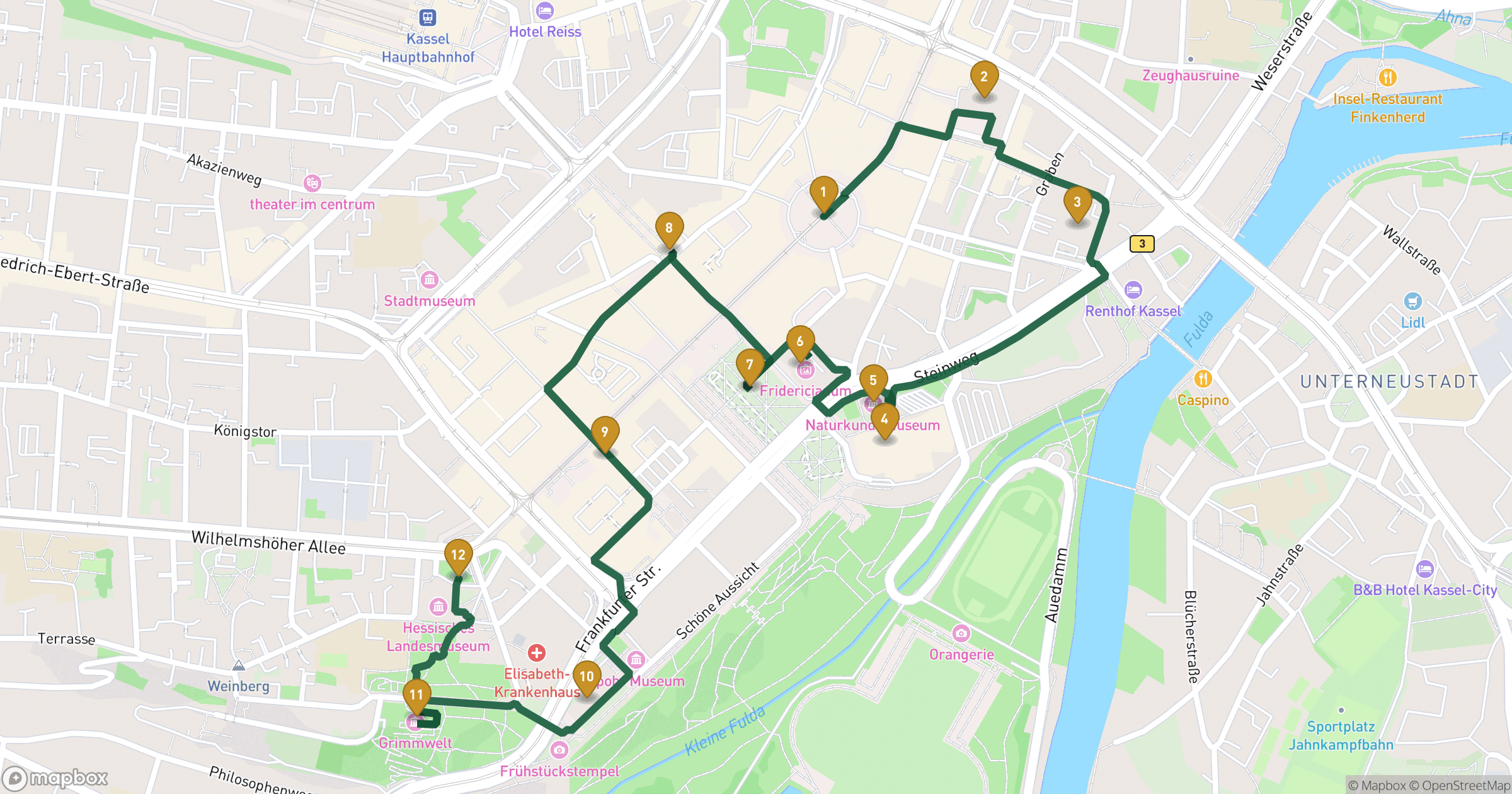
Map for Kassel walking tour with 12 stops
The static map shows the tour route with Königsplatz, Martinskirche, Markthalle, Staatstheater Kassel, and 8 more stops.

Stops along the route

All stops on this self-guided tour at a glance.

  1. Königsplatz in Kassel
    ChristosV / CC BY-SA 3.0

    1KönigsplatzSquare

    This circular square was laid out in 1767 by Simon Louis du Ry and named after Landgrave Friedrich I, who was also King of Sweden. In 1812 Jérôme Bonaparte erected a marble statue of Napoleon in a toga here, which frustrated locals demolished after the French withdrew in 1813. Decades later, a wooden documenta staircase placed in the center was torn down during a night raid in 2000.

    Built: 1767 · Named after: Frederick I of Sweden · Wikidata

  2. Martinskirche in Kassel
    ErwinMeier / CC BY-SA 4.0

    2MartinskircheChurch

    Kassel's largest church blends original Gothic fabric from 1343 with striking asymmetric postwar towers. In 1437 Landgrave Ludwig I brought a relic of the True Cross here, causing old records to label it the Holy Cross monastery. Landgrave Philip the Magnanimous introduced Lutheranism in 1524, establishing the church as the burial site of the Hessian landgraves for centuries.

    Architect: Heinrich Otto Vogel · Style: Gothic architecture · Named after: Martin of Tours · Wikidata

  3. Markthalle in Kassel
    Андрей Романенко / CC BY-SA 4.0

    3MarkthalleMarket

    This 1960s market hall designed by Werner Noell intentionally quotes the facade of the site's previous building, the former Landgrave stables. Local regional producers fill the listed hall between Thursday and Saturday, selling items such as North Hessian Ahle Wurscht. Outside on the open area, a regular weekly market complements the bustling social meeting place.

    Built: 1966 · Wikidata

  4. Staatstheater Kassel in Kassel
    Paul Broeker / CC BY-SA 4.0

    4Staatstheater KasselTheatre

    Built by Paul Bode between 1955 and 1959, this post-war modernist theater replaced the destroyed neo-Baroque court theater that had blocked views of the Karlsaue park. Kassel's deep stage tradition traces back to Landgrave Moritz, who built Germany's first permanent theater building here in the early 17th century. A monument on Opernplatz honors composer and conductor Louis Spohr.

    Architect: Paul Bode · Wikidata

  5. Ottoneum in Kassel
    Jardín de flores / CC BY-SA 4.0

    5OttoneumMuseum

    The Ottoneum now houses a natural history museum, but Landgrave Moritz built it between 1603 and 1606 as Germany's first permanent theater building. Named after Moritz's favorite son Otto, the building features an unusual trapezoidal layout suited for early theatrical performances. After later serving as an art house, tax office, and jury court, it was rebuilt after 1943 bomb damage.

    Wikidata

  6. Fridericianum in Kassel
    Jens Haines / CC BY-SA 3.0

    6FridericianumMuseum

    Completed in 1779 by Simon Louis du Ry for Landgrave Friedrich II, the Fridericianum opened as the first purpose-built public museum on mainland Europe. Du Ry incorporated a medieval defense structure, the Zwehrenturm, into the museum's side and converted it into an observatory. Jérôme Bonaparte later turned it into the Palast der Stände, creating the first parliament on German soil.

    Built: 1779 · Architect: Simon Louis du Ry · Wikidata

  7. Friedrichsplatz in Kassel
    Matthias Nonnenmacher / CC BY-SA 4.0

    7Friedrichsplatz

    This 18th-century expanse ranks among Germany's largest urban squares and connects the upper city with the green slope of the Karlsaue. A statue by sculptor Johann August Nahl portrays Landgrave Friedrich II in an unusually peaceful pose right in the center. Every five years, the massive open grounds transform into the central stage for the global contemporary art exhibition documenta.

  8. Treppenstraße in Kassel
    H. Helmlechner / CC BY-SA 4.0

    8TreppenstraßeSquare

    Inaugurated in 1953 under planner Werner Hasper, this stepped street was designed as Germany's very first planned pedestrian zone. Across 104 stairs and a 15-meter elevation drop, it showcases 1950s curved lines, replacing the demolished Rococo Nahl house. In 1960 Heinz Erhardt filmed scenes on these steps for the movie Der letzte Fußgänger, followed by Curd Jürgens in another production.

    Wikidata

  9. 9Rathaus

    Kassel's town hall was erected between 1905 and 1909 by Karl Roth in a mix of Neo-Baroque and Neo-Renaissance styles. After being gutted by 1943 air raids, the complex was rebuilt in the 1950s with a simplified facade paired with later modern rear extensions. Directly outside the main entrance stands the Aschrottbrunnen, an artistic reconstruction of a Jewish donor's monument destroyed in 1939.

  10. Neue Galerie in Kassel
    YPS / Public domain

    10Neue GalerieMuseum

    The Neue Galerie sits perched on the Schöne Aussicht hillside, designed in Neo-Renaissance style by Heinrich von Dehn-Rotfelser between 1871 and 1877. Dehn-Rotfelser modeled the building on Munich's Alte Pinakothek, though on a smaller scale to suit Kassel. During Jérôme Bonaparte's rule, a previous palace here had mezzanine ceilings inserted that ruined its state-of-the-art skylights.

    Architect: Heinrich Dehn-Rotfelser · Wikidata

  11. Grimmwelt Kassel in Kassel
    XenonX3 / CC0

    11Grimmwelt KasselMuseum

    Set on the Weinberg hillside, the Grimmwelt museum opened in 2015 to celebrate the work of Jacob and Wilhelm Grimm. Kadawittfeldarchitektur clad the building in light Gauinger travertine and organized the 25 galleries alphabetically around entries from the brothers' German dictionary. Excavations during construction yielded gilded glasses and poultry shears, now on display alongside panoramic roof views.

    Named after: Brothers Grimm · Wikidata

  12. Brüder-Grimm-Platz in Kassel
    User: Pedelecs at wikivoyage shared; Pedelecs / CC BY-SA 3.0

    12Brüder-Grimm-PlatzSquare

    This junction links Kassel's inner city directly to Wilhelmshöher Allee and was named for the Grimm brothers, who lived for a time at number 5. The square was originally a circular plaza known as Weißensteiner Platz, taking its name from the former city gate. Two preserved gatehouses still stand as surviving remnants of the old customs wall, looking toward the distant Hercules monument.

    Named after: Brothers Grimm · Wikidata

Download the app

This public page shows a preview. The full route, all content, and navigation are available in CityTour AI.

Cities nearby

Discover self-guided tours in nearby cities.

Frequently asked questions

The key answers before you start.

Is this a self-guided audio tour?

Yes. In the CityTour AI app (iOS and Android), this is a self-guided audio tour for Kassel — start anytime, at your own pace, with map, stops, and audio narration.

What will you see on this tour?

On this tour you'll see, among others, Königsplatz, Martinskirche, Markthalle, Staatstheater Kassel, Ottoneum, Fridericianum and more sights.

Where does the tour start?

The route starts at Königsplatz and ends at Brüder-Grimm-Platz. You can start anytime — the app guides you to the first stop.

How long does the tour take?

About 105 minutes for 12 stops — at your own pace, with breaks whenever you like.

How much does the tour cost?

This tour costs 15 credits. The exact price depends on the pack you buy and your country — roughly $5.

Is it an outdoor tour — are entry tickets included?

Yes, it's an outdoor tour: the sights are viewed from the outside. Entry tickets are not included, and step-free access cannot be guaranteed.

Is the audio guide available in my language?

The tour and audio guide are available in English, Deutsch, Français, Español, Italiano and 9 more languages. You pick your language in the app.

Can I use the tour offline?

Yes. Tours can be used offline.

Can I ask the AI questions along the way?

Yes. At every stop you can ask the AI directly if you want to know more or didn't understand something.