CityTour AI

Marburg self-guided walking tour

Marburg: From Pilgrims to Princes

Experience the enchanting verticality of Marburg on a walk that climbs from the Gothic spires of the pilgrimage district to the heights of the Landgrave’s Castle. You’ll wander through narrow, timber-framed lanes of the brothers’ student town while uncovering stories of medieval saints, pioneering scholars, and the powerful rulers who shaped Hesse. It’s a journey through a city of interwoven stories where every steep staircase leads to a new layer of history.

Audio tourSelf-guidediOS & Android
171minutes
2.8 kmdistance
16stops
Audio guideFormat
Marburg: From Pilgrims to Princes
Hydro / CC BY-SA 4.0

Stops on this route

This tour works well for first-time visitors, weekend trips, and travelers who want to explore Marburg without a fixed tour time.

Route map for Marburg walking tour
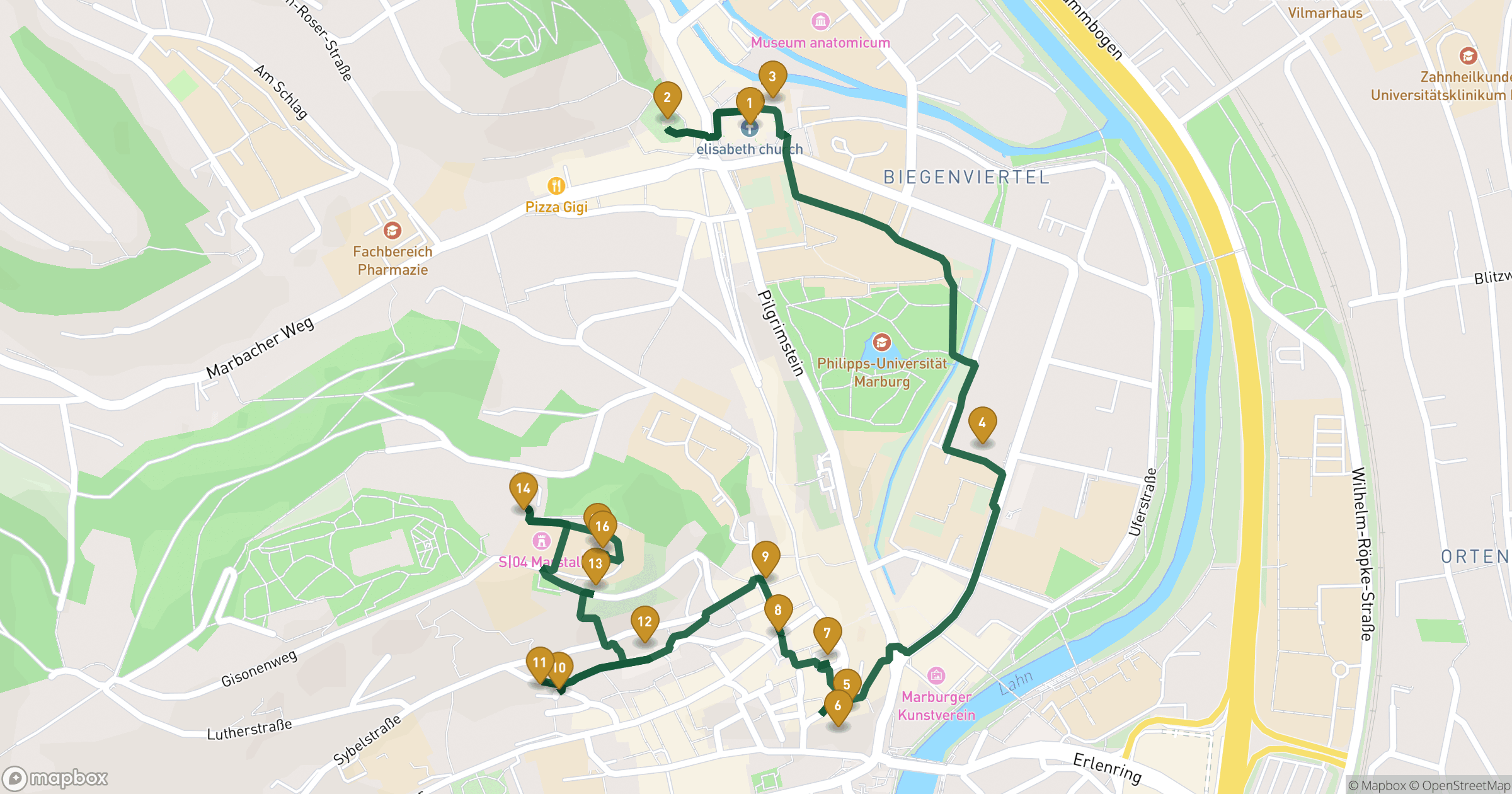
Map for Marburg walking tour with 16 stops
The static map shows the tour route with St. Elisabeth's Church, St. Michaelskapelle, F|12 Deutsches Haus, St. Peter und Paul, and 12 more stops.

Stops along the route

All stops on this self-guided tour at a glance.

  1. St. Elisabeth's Church in Marburg
    Hydro / CC BY-SA 4.0

    1St. Elisabeth's Church

    Elisabethkirche showcases the emergence of Gothic architecture around the memory of Elizabeth of Hungary, who cared for the sick here until her death in 1231. The Teutonic Order began building this great hall church in 1235 over her tomb, sparking three centuries of pilgrimage. In 1539, Landgrave Philipp the Magnanimous ended the tradition by removing her relics from the shrine.

    Built: 1235 · Architect: Johann Friedrich Lange · Style: Gothic architecture · Height: 80 m · Wikidata

  2. St. Michaelskapelle in Marburg
    Heinrich Stürzl / CC BY-SA 3.0

    2St. Michaelskapelle

    St. Michaelskapelle, known locally as Michelchen, is a 13th-century cemetery chapel tucked away from the main tourist paths. It served the burial ground of the hospital founded by Elizabeth, receiving travelers, patients, and residents whose journeys ended in Marburg. Its modest scale preserves a quieter sanctuary of remembrance, far from the grand monuments of rulers and saints.

    Style: Gothic architecture · Wikidata

  3. F|12 Deutsches Haus in Marburg
    © Heinrich Stürzl / Wikimedia Commons / CC BY-SA 4.0

    3F|12 Deutsches Haus

    Deutsches Haus represents the administrative nerve center and back office for the Teutonic Order's pilgrimage district in medieval Marburg. Members of the Order operated from this solid stone building to manage the property, supplies, and food needed by crowds of arriving pilgrims. Following the Reformation, the complex transitioned away from the Order and into university use.

  4. St. Peter und Paul in Marburg
    Helmut1954 / CC BY-SA 4.0

    4St. Peter und Paul

    St. Peter und Paul stands out in the university quarter as a modern mid-century departure from Marburg's medieval Gothic architecture. Constructed between 1957 and 1959, the church was built to provide communal space and light for a Catholic community that expanded rapidly after World War II. Its postwar design demonstrates that the town's architectural growth continued well beyond the 1500s.

    Architect: Otto Linder · Named after: Feast of Saints Peter and Paul · Wikidata

  5. Evangelische Universitätskirche in Marburg
    Foto von Hydro bei Wikipedia / CC BY-SA 4.0

    5Evangelische Universitätskirche

    The Evangelische Universitätskirche traces a diverse history that began in the 13th century as a monastery church for the Dominican Order. After Landgrave Philipp dissolved the monastery to found the university in 1527, the sacred hall was repurposed as a secular grain store for the city. It later returned to worship, standing today directly beside the 19th-century Alte Universität.

  6. Alte Universität in Marburg
    Hydro / CC BY 3.0

    6Alte Universität

    The Alte Universität is a neo-Gothic complex designed by architect Carl Schäfer and built between 1873 and 1891 after Prussia annexed Electoral Hesse. Decades earlier, in 1802 and 1803, student brothers Jacob and Wilhelm Grimm arrived here to study law under Friedrich Carl von Savigny. Savigny shared his private library with the brothers, instilling the historical methods that shaped their later work.

    Built: 1879 · Architect: Carl Schäfer · Style: Gothic Revival · Wikidata

  7. Kilianskapelle in Marburg
    Nikanos / CC BY-SA 2.5

    7Kilianskapelle

    The 12th-century Kilianskapelle is Marburg's oldest surviving church building, originally serving the medieval market community. Rounded Romanesque arches from the original windows remain visible through later masonry added when the chapel transitioned from worship into a workplace and residence. Rather than facing demolition, the modest structure was adapted over centuries by everyday local residents.

    Built: 1180 · Style: Romanesque architecture · Named after: Saint Kilian · Wikidata

  8. Markt in Marburg
    © Heinrich Stürzl / Wikimedia Commons / CC BY-SA 4.0

    8Markt

    The Markt forms the center of the Upper Town, anchored by the 1512–1527 Rathaus with its mechanical rooster on the clock tower. In 1248, Sophie of Brabant asserted her young son Heinrich's claim to the Hessian lands here, effectively founding the Landgraviate of Hesse. At the square's center stands the Georgsbrunnen, displaying a 1951 statue of Saint George by Rudolf Breidenbach.

  9. Brüder-Grimm-Stube in Marburg
    Heinrich Stürzl / CC BY-SA 4.0

    9Brüder-Grimm-Stube

    Markt 23 houses the Brüder-Grimm-Stube, honoring the brothers who arrived in 1802 and 1803 as law students rather than fairy-tale writers. Jacob and Wilhelm Grimm studied under legal scholar Friedrich Carl von Savigny and lived at local addresses including Barfüßerstraße 35 and Wendelgasse 4. Jacob memorably noted that Marburg had more stairs in its streets than inside its houses.

  10. Kugelgasse in Marburg
    © Heinrich Stürzl / Wikimedia Commons / CC BY-SA 4.0

    10Kugelgasse

    Kugelgasse climbs steeply up the hillside, framing views of tightly packed rooflines between leaning timber-framed houses. The lane is named after the hooded Gugel garments worn by the Brethren of the Common Life, or Kugelherren, who lived at the summit. This pathway physically linked the busy commercial market below with the quiet studies of the monks higher up the slope.

  11. Kirche Sankt Johannes Evangelist (Kugelkirche) in Marburg
    Hydro / CC BY-SA 4.0

    11Kirche Sankt Johannes Evangelist (Kugelkirche)

    Kirche Sankt Johannes Evangelist, known as the Kugelkirche, was built between 1492 and 1520 by the Brethren of the Common Life. Nicknamed the Kugelherren after their hooded habits, the Brethren emphasized literacy, book production, and personal devotion before the university existed. Its late Gothic interior features intricate net vaulting, surviving the dissolution of the community in 1527.

    Wikidata

  12. Lutherische Pfarrkirche St. Marien in Marburg
    Sergey Ashmarin / CC BY-SA 3.0

    12Lutherische Pfarrkirche St. Marien

    The Lutherische Pfarrkirche St. Marien is easily spotted on the skyline by its famously leaning spire. Inside, it preserves the elaborate memorials of Landgraves Ludwig IV and Ludwig V, whose disputed succession ignited local clashes during the Thirty Years' War. In late 1647, imperial troops plundered the surrounding town after occupying the homes of university professors.

    Style: Gothic architecture · Wikidata

  13. 13Aschenputtel

    An oversized slipper near the castle approach marks an installation along the Grimm-Dich-Pfad celebrating Cinderella, or Aschenputtel. In the version recorded by the Brothers Grimm, the prince traps the slipper in pitch on the palace steps, and stepsisters slice their feet to fit inside. Jacob and Wilhelm Grimm studied law here from 1802 before collecting their fairy tales elsewhere.

  14. S|05 Hexenturm in Marburg
    Foto von Hydro bei Wikipedia / CC BY-SA 4.0

    14S|05 Hexenturm

    Hexenturm is a sturdy round artillery tower built around 1478 with thick walls and narrow embrasures designed to defend the castle with cannons. As military technology shifted, the fortification became a prison and a site linked to the town's witch trials. Below the castle lived Catharina Staudinger of Wettergasse, who was condemned and executed on witchcraft accusations in 1656.

  15. Museum für Kulturgeschichte in Marburg
    © Heinrich Stürzl / Wikimedia Commons / CC BY-SA 4.0

    15Museum für Kulturgeschichte

    The Museum für Kulturgeschichte inside the castle holds medieval riding shields alongside the textile protective cover from St. Elizabeth's shrine. Another centerpiece of the collection is a large woven tapestry depicting the parable of the Prodigal Son. While its galleries in the Wilhelmsbau face fire-safety closures, the collections connect religious pilgrimage to the castle rulers.

  16. Marburg Castle in Marburg
    Adam Jones, Ph.D. / CC BY-SA 3.0

    16Marburg Castle

    The Landgrafenschloss crowns the hill as the historic seat of the Landgraves of Hesse, featuring the Gothic Fürstensaal. In 1529, Landgrave Philipp hosted the Marburg Colloquy here, bringing Martin Luther and Huldrych Zwingli together to debate the Eucharist. The castle's political roots trace back to 1248, when Elizabeth's daughter Sophie of Brabant secured the land for her son Heinrich.

    Built: 1200 · Wikidata

Download the app

This public page shows a preview. The full route, all content, and navigation are available in CityTour AI.

Cities nearby

Discover self-guided tours in nearby cities.

Frequently asked questions

The key answers before you start.

Is this a self-guided audio tour?

Yes. In the CityTour AI app (iOS and Android), this is a self-guided audio tour for Marburg — start anytime, at your own pace, with map, stops, and audio narration.

What will you see on this tour?

On this tour you'll see, among others, St. Elisabeth's Church, St. Michaelskapelle, F|12 Deutsches Haus, St. Peter und Paul, Evangelische Universitätskirche, Alte Universität and more sights.

Where does the tour start?

The route starts at St. Elisabeth's Church and ends at Marburg Castle. You can start anytime — the app guides you to the first stop.

How long does the tour take?

About 171 minutes for 16 stops — at your own pace, with breaks whenever you like.

Is it an outdoor tour — are entry tickets included?

Yes, it's an outdoor tour: the sights are viewed from the outside. Entry tickets are not included, and step-free access cannot be guaranteed.

Is the audio guide available in my language?

The tour and audio guide are available in English, Deutsch, Français, Español, Italiano and 9 more languages. You pick your language in the app.

Can I use the tour offline?

Yes. Tours can be used offline.

Can I ask the AI questions along the way?

Yes. At every stop you can ask the AI directly if you want to know more or didn't understand something.