CityTour AI

Bad Harzburg self-guided walking tour

Bad Harzburg: Between Imperial Power and Healing Springs

Experience the fascinating contrast between elegant 19th-century spa architecture and the wild nature of the Harz Mountains. This tour takes you from the bubbling healing springs in the valley up to the historic ruins of Harzburg, where emperors once shaped world politics. It is an atmospheric walk combining technical pioneering achievements with ancient legends and breathtaking views over the treetops.

Audio tourSelf-guidediOS & Android
103minutes
4.0 kmdistance
11stops
Audio guideFormat
Bad Harzburg: Between Imperial Power and Healing Springs
Lukas Beck / CC BY 4.0

Stops on this route

This tour works well for first-time visitors, weekend trips, and travelers who want to explore Bad Harzburg without a fixed tour time.

Route map for Bad Harzburg walking tour
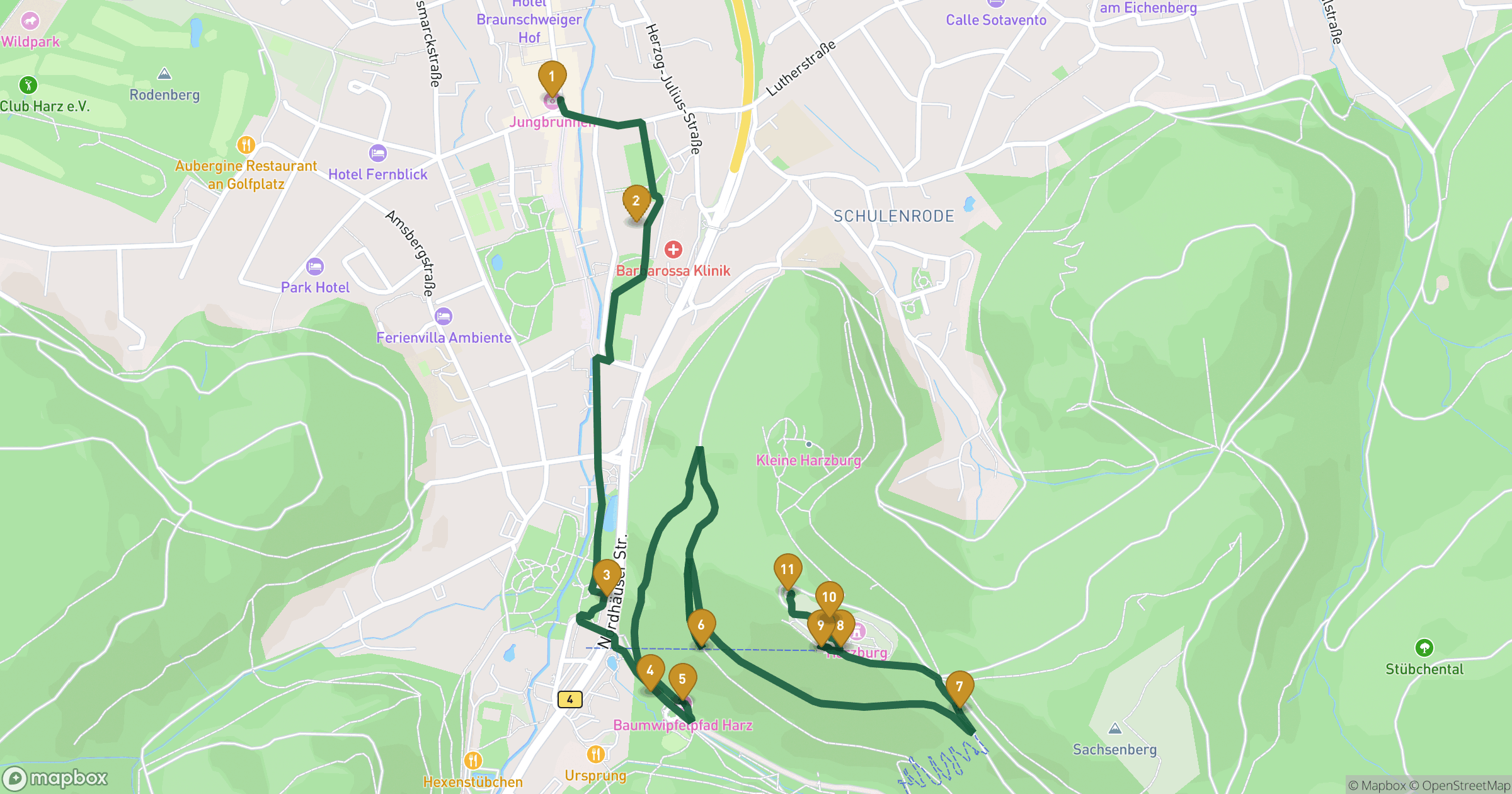
Map for Bad Harzburg walking tour with 11 stops
The static map shows the tour route with Jungbrunnen, Wandelhalle Trinkhalle, HarzWaldHaus (früher "Haus der Natur"), Märchenwald, and 7 more stops.

Stops along the route

All stops on this self-guided tour at a glance.

  1. Jungbrunnen in Bad Harzburg
    Robert Harvey on geo.hlipp.de / CC BY-SA 2.0

    1JungbrunnenAttraction

    The Fountain of Youth in the city center explores humanity's ancient longing for eternal renewal through playful bronze and stone figures. Sculptor Jochen Müller created the artwork in 2003, depicting frail figures descending into the water and emerging invigorated. Rather than classical beauty, the sculptures use caricature-like forms to parody local spa culture.

    Built: 2003 · Wikidata

  2. Wandelhalle Trinkhalle in Bad Harzburg
    Steffen Dietrich / CC BY-SA 4.0

    2Wandelhalle TrinkhalleMonument

    The Wandelhalle Trinkhalle stands as a heritage monument illustrating Bad Harzburg's rise into a prominent healing spa. Completed in its current architectural form during the 1930s, the hall was designed for slow indoor pacing to aid the ritual consumption of mineral spring water. Inside, visitors can taste distinct local waters such as the Krodo and Duke Julius springs.

    Wikidata

  3. HarzWaldHaus (früher "Haus der Natur") in Bad Harzburg
    Molgreen / CC BY-SA 4.0

    3HarzWaldHaus (früher "Haus der Natur")Museum

    Located at the edge of the spa park, the HarzWaldHaus serves as an interactive visitor center dedicated to the National Park's ecosystem. Exhibits focus on the return of native predators, documenting Europe's successful lynx reintroduction after its local extinction in the 19th century. Displays also showcase wildcats inhabiting the steep slopes of the Kalte Tal.

    Wikidata

  4. 4MärchenwaldMonument

    The Märchenwald theme park revives the fairy tales of the Brothers Grimm through traditional mechanical craftsmanship. Operating continuously since its opening in 1948, the attraction features handcrafted figures that move inside small woodland houses to recited stories. The displays include classic tales such as Snow White and Hansel and Gretel among natural forest trees.

  5. Baumwipfelpfad Harz in Bad Harzburg
    Llez / CC BY-SA 3.0

    5Baumwipfelpfad HarzAttraction

    The Harz Treetop Walk winds through the Kalte Tal, lifting pedestrians into the forest canopy up to 26 meters high. Spanning around 1,000 meters across wood and steel ramps, the path features 18 learning stations discussing local ecology, deadwood insects, and millions of years of rock formation. At one point, tectonic shifts reveal exposed geological rock layers.

    Built: 2014 · Wikidata

  6. Burgberg-Seilbahn in Bad Harzburg
    Kassandro / CC BY-SA 4.0

    6Burgberg-SeilbahnMonument

    The Burgberg Cable Car connects the valley to the Große Burgberg using large aerial cabins. Operating since its launch in 1929 during the Weimar Republic, it carries passengers up the cliffside in distinctive yellow gondolas within minutes. Once at the peak, views reach outward across the North German Plain.

    Built: 1929 · Wikidata

  7. BaumSchwebeBahn HARZ in Bad Harzburg
    Llez / CC BY-SA 3.0

    7BaumSchwebeBahn HARZ

    The BaumSchwebeBahn offers a canopy-level gliding descent down the Burgberg toward the end of the treetop path. Suspended from a circular pipe rail in harness seats, riders drift quietly between old beech and spruce trees. The curved system navigates height differences previously reserved for birds, contrasting modern engineering with the historic forest floor.

  8. Statue: Götze Krodo in Bad Harzburg
    Lukas Beck / CC BY 4.0

    8Statue: Götze KrodoMonument

    The Statue of the Idol Krodo depicts an enigmatic pagan figure standing on a fish with a wheel and bucket in hand. Local legend identifies him as an ancient Saxon protector whose altar was reputedly overthrown by Charlemagne, though historians still debate claims by 16th-century chronicler Erasmus Alberus. The symbols evoke solar paths and water fertility.

  9. Burgberg-Seilbahn Bergstation in Bad Harzburg
    Lukas Beck / CC BY 4.0

    9Burgberg-Seilbahn BergstationMonument

    The Burgberg Cable Car Mountain Station preserves early modern transport engineering at the top of the summit cliffs. Constructed in 1929 by the Leipzig-based Bleichert company, the terminal showcases the functional architecture of the late Weimar Republic. Its mechanical ambiance is defined by historic metalwork and the hum of steel drive cables.

  10. Großer Burgberg in Bad Harzburg
    Lukas Beck / CC BY 4.0

    10Großer BurgbergMonument

    The Große Burgberg preserves the stone ruins of the Harzburg, an imperial stronghold with a tumultuous past. Emperor Henry IV built the fortress between 1065 and 1068, only to flee through a secret drainage tunnel when rebelling Saxons besieged it in 1073. Saxon forces subsequently razed the site and desecrated the imperial family vault before Frederick Barbarossa rebuilt it.

    Wikidata

  11. Canossa-Säule in Bad Harzburg
    Llez / CC BY-SA 3.0

    11Canossa-SäuleMonument

    Standing 19 meters high atop the Burgberg, the Canossa Column is an obelisk erected as a political monument in 1877. It recalls Henry IV's penance before Pope Gregory VII in 1077, but was repurposed during Bismarck's Kulturkampf against the Vatican. Deeply engraved into the pedestal is Chancellor Otto von Bismarck's defiant slogan: 'To Canossa we will not go!'

    Wikidata

Download the app

This public page shows a preview. The full route, all content, and navigation are available in CityTour AI.

Cities nearby

Discover self-guided tours in nearby cities.

Frequently asked questions

The key answers before you start.

Is this a self-guided audio tour?

Yes. In the CityTour AI app (iOS and Android), this is a self-guided audio tour for Bad Harzburg — start anytime, at your own pace, with map, stops, and audio narration.

What will you see on this tour?

On this tour you'll see, among others, Jungbrunnen, Wandelhalle Trinkhalle, HarzWaldHaus (früher "Haus der Natur"), Märchenwald, Baumwipfelpfad Harz, Burgberg-Seilbahn and more sights.

Where does the tour start?

The route starts at Jungbrunnen and ends at Canossa-Säule. You can start anytime — the app guides you to the first stop.

How long does the tour take?

About 103 minutes for 11 stops — at your own pace, with breaks whenever you like.

How much does the tour cost?

This tour costs 15 credits. The exact price depends on the pack you buy and your country — roughly $5.

Is it an outdoor tour — are entry tickets included?

Yes, it's an outdoor tour: the sights are viewed from the outside. Entry tickets are not included, and step-free access cannot be guaranteed.

Is the audio guide available in my language?

The tour and audio guide are available in English, Deutsch, Français, Español, Italiano and 9 more languages. You pick your language in the app.

Can I use the tour offline?

Yes. Tours can be used offline.

Can I ask the AI questions along the way?

Yes. At every stop you can ask the AI directly if you want to know more or didn't understand something.