CityTour AI

Hamelin self-guided walking tour

Pied Piper, Grand Architecture, and the Weser

Join us for a relaxed stroll through the winding alleys of Hamelin's old town, where history comes alive at every turn. Experience the fascinating blend of the world-famous Pied Piper legend and the magnificent Weser Renaissance architecture. From defensive towers to ornate merchant houses, this tour showcases the best of the Pied Piper's city right on the river.

Audio tourSelf-guidediOS & Android
104minutes
2.6 kmdistance
14stops
Audio guideFormat
Pied Piper, Grand Architecture, and the Weser
Sergey Kuznetsov / CC BY 3.0

Stops on this route

This tour works well for first-time visitors, weekend trips, and travelers who want to explore Hamelin without a fixed tour time.

Route map for Hamelin walking tour
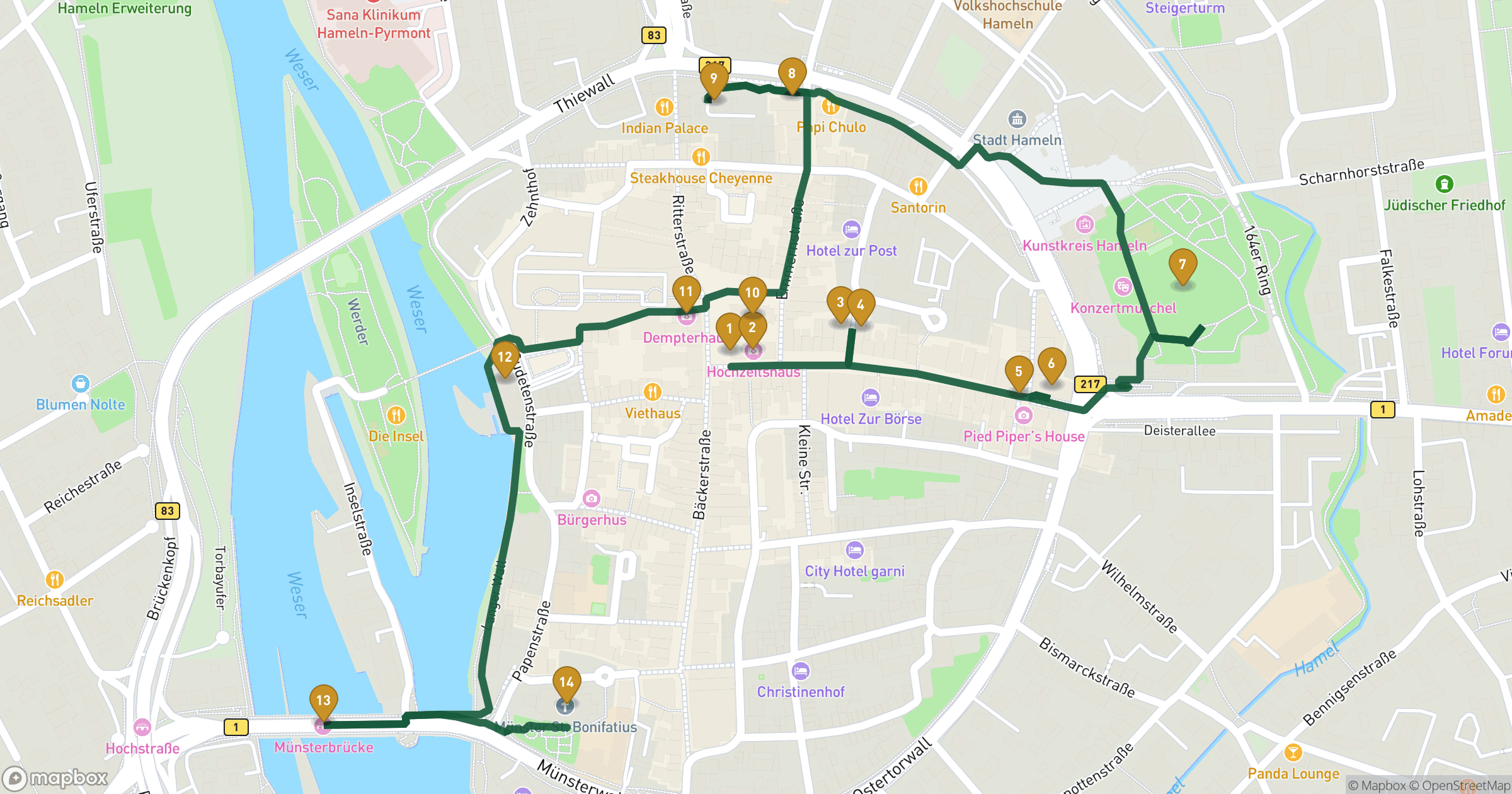
Map for Hamelin walking tour with 14 stops
The static map shows the tour route with Glockenspiel am Hochzeitshaus, Hochzeitshaus, Stiftsherrenhaus, Leisthaus, and 10 more stops.

Stops along the route

All stops on this self-guided tour at a glance.

  1. Glockenspiel am Hochzeitshaus in Hamelin
    Illustratedjc / CC BY-SA 4.0

    1Glockenspiel am HochzeitshausAttraction

    The Glockenspiel at the Wedding House sets the stage for Hamelin's world-famous folktale. Installed in 1964, its bronze doors open at set hours as 37 bells play while mechanical figures enact the Pied Piper leading away rats and children. The spectacle recalls the year 1284, serving as a cherished daily timekeeper for locals.

  2. Hochzeitshaus in Hamelin
    א (Aleph) / CC BY-SA 3.0

    2HochzeitshausAttraction

    Hamelin's Wedding House was designed not for marriage ceremonies, but as the central civic hall for celebrations. Built between 1610 and 1617 by architect Eberhard Wilkening, it stands as the city's final great stone edifice of the Weser Renaissance. Originally housing a municipal scale and a pharmacy on the ground floor, it now appropriately holds the local registry office.

    Built: 1610 · Wikidata

  3. Stiftsherrenhaus in Hamelin
    Martin Möller / CC BY-SA 2.0 de

    3Stiftsherrenhaus

    The Stiftsherrenhaus exemplifies the elaborate woodcarvings favored by merchants during the Weser Renaissance. Built in 1558 for merchant and mayor Friedrich Poppendiek, its timber facade is covered with depictions of biblical scenes, the seven planets, and virtues. A prominent carving of Lucretia embodies chastity, part of a painted exterior that functioned like an open history book.

    Style: Weser Renaissance · Wikidata

  4. Leisthaus in Hamelin
    Ymblanter / CC BY-SA 4.0

    4Leisthaus

    Next door, the Leisthaus showcases competitive merchant wealth rendered in lavish stone. Master builder Cord Tönnies created the mansion between 1585 and 1589 for Gerd Leist, complete with a ground-level bay window known as an Utlucht. Today the building houses the Hamelin Museum, where visitors find a mechanical Pied Piper theater.

    Wikidata

  5. Bungelosenstraße in Hamelin
    Bush6984 / CC BY-SA 4.0

    5BungelosenstraßeSquare

    Bungelosenstraße translates from Middle Low German as the drumless street, tied directly to the town's darkest legend. According to lore, the Pied Piper led 130 children down this lane on June 26, 1284, prompting a city law that still bans music and dancing here. The corner Rattenfängerhaus features a 1602 inscription recording the disappearance at the Koppen.

  6. Garnisonskirche in Hamelin
    Stefan Flöper / CC BY-SA 4.0

    6Garnisonskirche

    The Garrison Church in Osterstraße reflects the era when Hamelin was fortified as the Gibraltar of the North. Erected in 1713 during the reign of King Friedrich Wilhelm I, the Baroque building originally held religious services for garrison troops. After losing its military purpose in 1842, it served as a warehouse and now functions as a bank.

    Wikidata

  7. Bürgergarten in Hamelin
    TeWeBs / CC BY-SA 4.0

    7BürgergartenPark

    The Bürgergarten offers a green retreat on ground that once functioned as a military drill ground. Laid out in the 1960s, the park occupies land from Hamelin's former fortifications, once the strongest stronghold in the Electorate of Hanover. Remnants of the old town wall stand near modern sculptures, a concert pavilion, and a hidden Pied Piper relief.

    Wikidata

  8. Haspelmathturm in Hamelin
    Ymblanter / CC BY-SA 4.0

    8HaspelmathturmTower

    The Haspelmathturm is one of the few surviving towers of the medieval city fortifications. Built from solid quarry stone with narrow arrow slits, it was erected to deter attackers trying to storm Hamelin from the east. Linked to the local Haspelmath family, the tower later transitioned from front-line combat to storage inside modernized ramparts.

    Wikidata

  9. Pulverturm in Hamelin
    Ymblanter / CC BY-SA 4.0

    9Pulverturm

    The round Pulverturm was constructed around 1440 right on the city wall to store municipal gunpowder safely away from residential homes. Thick stone walls were built to withstand outside attacks and cushion potential internal blasts. After gunpowder supplies were moved outside the city, the tower was repurposed for glass production.

    Wikidata

  10. Marktkirche St. Nicolai (Hameln) in Hamelin
    StefanTsingtauer / CC BY-SA 4.0

    10Marktkirche St. Nicolai (Hameln)Church

    The Market Church of St. Nicolai honors the patron saint of merchants and sailors who traded along the Weser River. Artillery fire nearly obliterated the church on April 5, 1945, leaving only the outer walls and part of the tower standing. The 1950s rebuilding introduced a modern interior, featuring a redesigned chancel window that fills the hall with light.

    Style: Gothic architecture · Named after: Saint Nicholas · Wikidata

  11. Dempterhaus in Hamelin
    Beckstet; Beckstet at German Wikipedia; Own work (Original text: Eigenes Photo) / CC BY-SA 3.0

    11DempterhausAttraction

    The Dempterhaus on the marketplace demonstrates the architectural ambitions of early seventeenth-century Hamelin. Constructed between 1607 and 1608 for Mayor Tobias von Dempter, it boasts an elaborate Utlucht bay window overlooking the square. Its facade is covered with intricate carvings, coats of arms, and period inscriptions that celebrated the merchant elite.

  12. Pfortmühle in Hamelin
    Losch / CC BY-SA 3.0

    12Pfortmühle

    The Pfortmühle resembles a fortress along the river but actually operated as a busy industrial grain mill. Built in the Historicist style between 1893 and 1895, it was the final major watermill powered directly by the Weser in Hamelin. Today bookshelves replace flour sacks inside, as the Wilhelminian brick building houses the city library beside the roaring weir.

  13. Münsterbrücke in Hamelin
    GeorgDerReisende@Vicuna / CC BY-SA 4.0

    13MünsterbrückeBridge

    The Münsterbrücke spans the Weser River, crossing a waterway that brought both destructive floods and lucrative staple rights to Hamelin. Looking upstream reveals water churning past the Pfortmühle as well as a postcard vista of St. Boniface Minster. The crossing links the historic old town with the Klüt district where wooden predecessors once stood.

    Wikidata

  14. St. Bonifatius in Hamelin
    Sergey Kuznetsov / CC BY 3.0

    14St. BonifatiusChurch

    St. Boniface Minster marks the founding site of Hamelin, tracing its origins to a ninth-century Benedictine monastery. Nineteenth-century architect Conrad Wilhelm Hase rigorously removed Baroque alterations to restore its medieval core of Romanesque round arches and Gothic details. Below the three-aisled hall church lies its crypt, preserved as the oldest part of the building.

    Architect: Conrad Wilhelm Hase · Named after: Saint Boniface · Wikidata

Download the app

This public page shows a preview. The full route, all content, and navigation are available in CityTour AI.

Cities nearby

Discover self-guided tours in nearby cities.

Frequently asked questions

The key answers before you start.

Is this a self-guided audio tour?

Yes. In the CityTour AI app (iOS and Android), this is a self-guided audio tour for Hamelin — start anytime, at your own pace, with map, stops, and audio narration.

What will you see on this tour?

On this tour you'll see, among others, Glockenspiel am Hochzeitshaus, Hochzeitshaus, Stiftsherrenhaus, Leisthaus, Bungelosenstraße, Garnisonskirche and more sights.

Where does the tour start?

The route starts at Glockenspiel am Hochzeitshaus and ends at St. Bonifatius. You can start anytime — the app guides you to the first stop.

How long does the tour take?

About 104 minutes for 14 stops — at your own pace, with breaks whenever you like.

How much does the tour cost?

This tour costs 15 credits. The exact price depends on the pack you buy and your country — roughly $5.

Is it an outdoor tour — are entry tickets included?

Yes, it's an outdoor tour: the sights are viewed from the outside. Entry tickets are not included, and step-free access cannot be guaranteed.

Is the audio guide available in my language?

The tour and audio guide are available in English, Deutsch, Français, Español, Italiano and 9 more languages. You pick your language in the app.

Can I use the tour offline?

Yes. Tours can be used offline.

Can I ask the AI questions along the way?

Yes. At every stop you can ask the AI directly if you want to know more or didn't understand something.