CityTour AI

Hanover self-guided walking tour

The Heart of Hannover: From Brick Gothic to Laves Classicism

Experience Hannover on a relaxed walking tour showcasing its transformation from a royal residence to a modern state capital. We stroll from the elegant Neoclassical buildings of court architect Laves to the heart of the Old Town, which rose again in an unusual way after the war. Discover architectural masterpieces, moving memorials, and hidden courtyards that even locals often overlook.

Audio tourSelf-guidediOS & Android
105minutes
3.0 kmdistance
13stops
Audio guideFormat
The Heart of Hannover: From Brick Gothic to Laves Classicism
Bärbel Miemietz / CC BY-SA 4.0

Stops on this route

This tour works well for first-time visitors, weekend trips, and travelers who want to explore Hanover without a fixed tour time.

Route map for Hanover walking tour
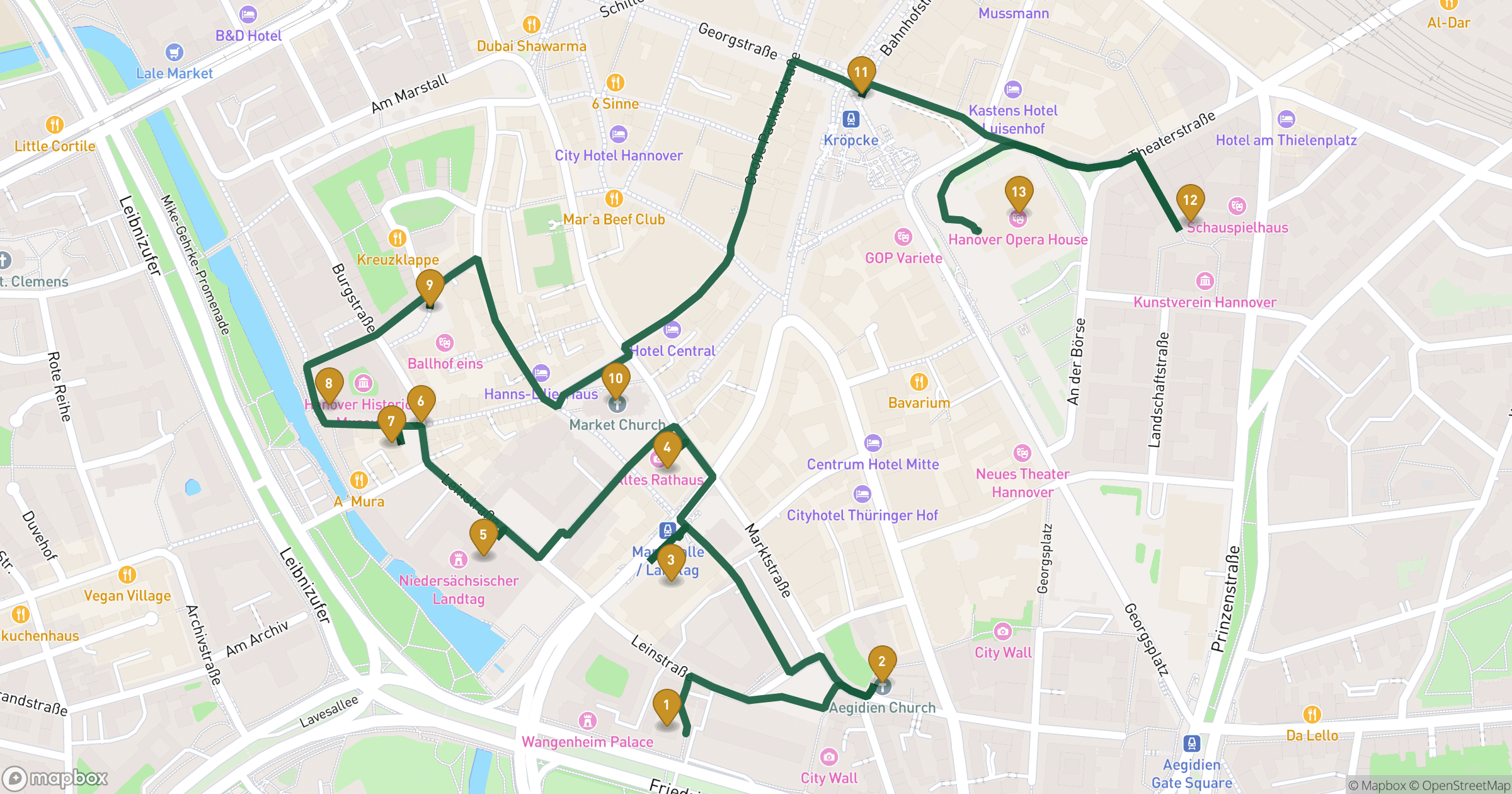
Map for Hanover walking tour with 13 stops
The static map shows the tour route with Laveshaus, Aegidienkirche, Markthalle, Altes Rathaus, and 9 more stops.

Stops along the route

All stops on this self-guided tour at a glance.

  1. Laveshaus in Hanover
    No machine-readable author provided. Axel Hindemith assumed (based on copyright claims). / Public domain

    1Laveshaus

    Laveshaus stands as the private residence of court architect Georg Ludwig Friedrich Laves, who fundamentally reshaped nineteenth-century Hannover. Erected between 1822 and 1824 on land brought into the marriage by his wife, Laves lived only on the third floor while renting out the grand bel étage to prominent figures like Sir Hugh Halkett to fund his lifestyle. Surviving wartime air raids largely intact, the classical building now serves as the headquarters of the Architektenkammer Niedersachsen.

    Wikidata

  2. Aegidienkirche in Hanover
    Christian A. Schröder (ChristianSchd) / CC BY-SA 4.0

    2AegidienkircheChurch

    The ruined Aegidienkirche remains preserved without a roof as a memorial to the victims of war and violence after its destruction in October 1943. An exterior relief known as the Siebenmännerstein depicts seven citizens who, according to a 1490 legend, sacrificed themselves at the Döhrener Turm to warn Hannover of an impending assault. In the tower entrance hangs a peace bell gifted by Hiroshima, which tolls annually on 6 August.

    Built: 1347 · Architect: Georg Ludwig Friedrich Laves, Rudolf Wiegmann · Style: Gothic architecture · Named after: Saint Giles · Wikidata

  3. Markthalle in Hanover
    AxelHH at de.wikipedia | Foto aufgenommen von Benutzer Benutzer:AxelHH / Public domain

    3Markthalle

    Hannover's Markthalle, known locally as the city's belly, replaced a lavish iron-and-glass market lost in the war. Outside the entrance stands a bronze monument to Karoline Duhnsen, who commuted from Lindhorst for over fifty years to sell meat and sausage at a butcher's stall. Designed by Erwin Töllner in 1954, the post-war hall now houses over seventy diverse market stalls across four thousand square meters.

    Built: 1888 · Wikidata

  4. Altes Rathaus in Hanover
    Hombre , cutout Ulamm ( talk ) | User: Hombre at wikivoyage shared | File:Altes Rathaus (01).JPG / CC BY-SA 3.0

    4Altes Rathaus

    The Altes Rathaus preserves the city's secular Brick Gothic heritage, saved from demolition in the nineteenth century by architect Conrad Wilhelm Hase. Hase debated masonry techniques for hours to ensure authentic restorations, surrounding unusual exterior terracotta carvings like the Luderziehen, a medieval tug-of-war fought by pulling ears or hair. The Italian Renaissance wing along Köbelingerstraße contrasts with the older fifteenth-century sections.

    Built: 1230 · Architect: August Heinrich Andreae, Conrad Wilhelm Hase · Wikidata

  5. Niedersächsischer Landtag in Hanover
    Tim Rademacher / CC BY-SA 3.0

    5Niedersächsischer LandtagCastle

    The Leineschloss houses the Lower Saxony State Parliament on grounds originally occupied by a thirteenth-century Franciscan monastery. Court architect Laves added the prominent classical portico modeled after London's Carlton House, reflecting Hannover's close historic links to the British monarchy. Polymath Gottfried Wilhelm Leibniz once lived and worked here as court councillor and librarian, often retreating to his chambers for days to calculate diplomatic strategies.

    Built: 1947 · Wikidata

  6. Kramerstraße in Hanover
    Ymblanter / CC BY-SA 4.0

    6KramerstraßeSquare

    Kramerstraße presents an ensemble of timber-framed facades, many of which were moved here from other neighborhoods after the Second World War. Built around 1630, house number 16 survives as the oldest building on the street and displays elaborate wooden brackets called Knaggen supporting its upper levels. Once the lane of small grocers, its joinery relies entirely on complex interlocking timber connections without any nails.

    Built: 1358 · Named after: trader · Wikidata

  7. Leibnizhaus in Hanover
    Christo / CC0

    7LeibnizhausBuilding

    The Leibnizhaus on the Holzmarkt showcases a reconstructed Renaissance facade covered in sculpted stone reliefs detailing biblical scenes and classical virtues. Universal scholar Gottfried Wilhelm Leibniz resided in the original 1499 house from 1698 until his death in 1716. While living here, he designed a pioneering mechanical calculating machine capable of all four arithmetic functions and worked at an installed desk inside his carriage.

    Named after: Gottfried Wilhelm Leibniz · Wikidata

  8. Beginenturm in Hanover
    Bärbel Miemietz / CC BY-SA 4.0

    8BeginenturmTower

    The Beginenturm is the best-preserved bastion of Hannover's medieval fortifications, dating back to around 1357. Its name derives from the Beguines, an adjacent community of devout women who lived religious lives without taking formal monastic vows. Rising twenty-three meters high with walls up to three meters thick, the former peat warehouse and jail is now incorporated directly into the Historisches Museum.

    Built: 1357 · Wikidata

  9. Ballhofplatz in Hanover
    SchauspielH / CC BY-SA 3.0

    9BallhofplatzSquare

    Ballhofplatz centers around a seventeenth-century hall built by Duke Christian Ludwig for a racquet game popular among nobility rather than ballroom dancing. Functioning effectively as the city's earliest sports hall, the building hosted Hannover's very first opera performance in 1672. Cobblestones and timber-framed structures encircle the venue, which now operates as a stage for the state theatre.

    Built: 1649 · Named after: Ballhof · Wikidata

  10. Marktkirche in Hanover
    H. Helmlechner / CC BY-SA 3.0

    10MarktkircheChurch

    The Marktkirche St. Georgii et Jacobi is Hannover's oldest parish church, crowned by a truncated tower legendarily cut short after funds ran dry or plague struck the builders. Its western tower wall displays a protective medieval pentagram, carved to ward off evil and honor the wounds of Christ. Inside lies buried Johann Michael von Obentraut, a cavalry leader killed in 1625 who served as the basis for the popular figure Deutscher Michel.

    Architect: Ludwig Droste · Style: Brick Gothic · Named after: St. James the Elder · Wikidata

  11. Kröpcke in Hanover
    ChristianSchd / CC BY-SA 3.0

    11KröpckeSquare

    Kröpcke serves as the primary gathering square in modern central Hannover, centered around a green cast-iron clock replicated from an 1885 design. The plaza takes its name from Wilhelm Kröpcke, a well-liked former head waiter who leased the square's central café in 1895. Broad shopping thoroughfares radiate outward from this crossroads, where a contemporary glass pavilion has replaced the former Viennese-style coffeehouse.

    Named after: Café Kröpcke · Wikidata

  12. Cumberland Gallery in Hanover
    Foto: Bernd Schwabe / CC BY-SA 4.0

    12Cumberland GalleryTheatre

    The Cumberlandsche Galerie sits concealed within a courtyard, built between 1883 and 1886 by Otto Goetze for Crown Prince Ernst August, Duke of Cumberland. Designed to house the prince's private art collection in competition with Berlin's museum landscape, only its cast-iron staircase survived later changes. The multi-tiered structure combines Romanesque arches, Gothic light wells, and baroque flourishes with industrial structural ironwork beneath a glass ceiling.

    Wikidata

  13. Opernhaus in Hanover
    Bärbel Miemietz / CC BY-SA 4.0

    13OpernhausTheatre

    Hannover's classical Opernhaus was conceived by Georg Ludwig Friedrich Laves between 1845 and 1852 to anchor his newly laid-out Georgstadt district. Laves convinced King Ernst August I to fund the royal court theatre by framing the grand sandstone project as a matter of prestige. The exterior porch features stone likenesses of cultural figures like Goethe, Mozart, and Beethoven, standing atop walls reconstructed after severe bomb damage in July 1943.

    Built: 1851 · Architect: Georg Ludwig Friedrich Laves · Style: Neoclassical architecture · Wikidata

Download the app

This public page shows a preview. The full route, all content, and navigation are available in CityTour AI.

Cities nearby

Discover self-guided tours in nearby cities.

Frequently asked questions

The key answers before you start.

Is this a self-guided audio tour?

Yes. In the CityTour AI app (iOS and Android), this is a self-guided audio tour for Hanover — start anytime, at your own pace, with map, stops, and audio narration.

What will you see on this tour?

On this tour you'll see, among others, Laveshaus, Aegidienkirche, Markthalle, Altes Rathaus, Niedersächsischer Landtag, Kramerstraße and more sights.

Where does the tour start?

The route starts at Laveshaus and ends at Opernhaus. You can start anytime — the app guides you to the first stop.

How long does the tour take?

About 105 minutes for 13 stops — at your own pace, with breaks whenever you like.

How much does the tour cost?

This tour costs 15 credits. The exact price depends on the pack you buy and your country — roughly $5.

Is it an outdoor tour — are entry tickets included?

Yes, it's an outdoor tour: the sights are viewed from the outside. Entry tickets are not included, and step-free access cannot be guaranteed.

Is the audio guide available in my language?

The tour and audio guide are available in English, Deutsch, Français, Español, Italiano and 9 more languages. You pick your language in the app.

Can I use the tour offline?

Yes. Tours can be used offline.

Can I ask the AI questions along the way?

Yes. At every stop you can ask the AI directly if you want to know more or didn't understand something.