CityTour AI

Peine self-guided walking tour

Brewing, Steel, and Medieval Legends

Discover the hidden layers of Peine on a relaxed stroll that bridges the gap between medieval legends and industrial innovation. You’ll wander through historic half-timbered streets, explore the site of a vanished fortress, and see how the town’s famous brewing and steel traditions still shape its character today. It’s a perfect mix of local lore, architectural gems, and the green escapes that make this Lower Saxon town so unique.

Audio tourSelf-guidediOS & Android
102minutes
3.5 kmdistance
12stops
Audio guideFormat
Brewing, Steel, and Medieval Legends
TeWeBs / CC BY-SA 4.0

Stops on this route

This tour works well for first-time visitors, weekend trips, and travelers who want to explore Peine without a fixed tour time.

Route map for Peine walking tour
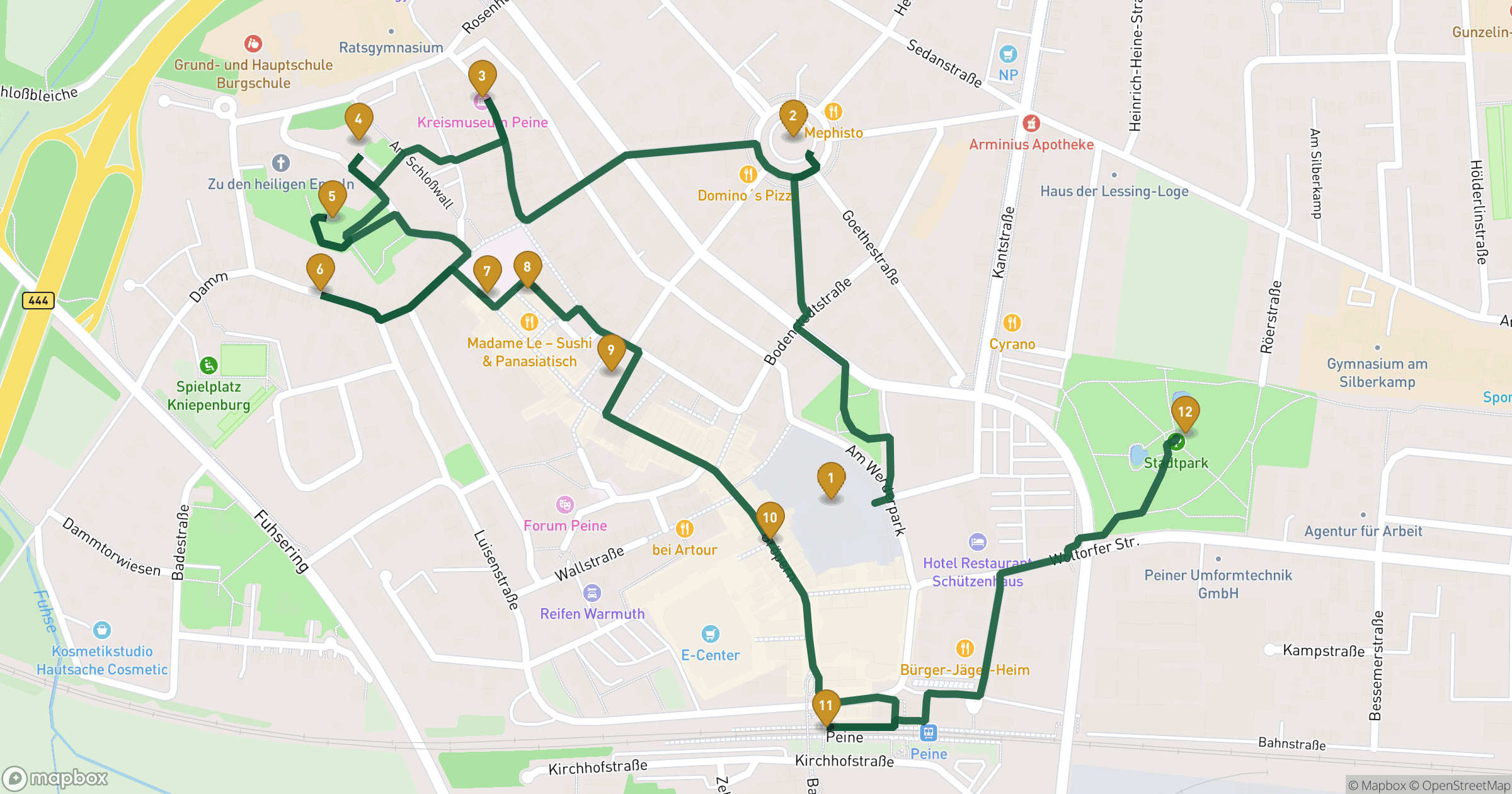
Map for Peine walking tour with 12 stops
The static map shows the tour route with Braumanufaktur Härke, Hagenmarkt, Kreismuseum Peine, Amtsgericht, and 8 more stops.

Stops along the route

All stops on this self-guided tour at a glance.

  1. Braumanufaktur Härke in Peine
    TeWeBs / CC BY-SA 4.0

    1Braumanufaktur HärkeBuilding

    Braumanufaktur Härke stands as a red-brick monument to local brewing traditions dating back to 1356. Architect Anton van Norden designed the listed brick-expressionist complex for Heinrich Härke in 1935. Following Heinrich's death in 1945, his widow Änny brewed a special Porter for British occupation officers that became the Härke Doppelbock.

    Built: 1890 · Wikidata

  2. Hagenmarkt in Peine
    bruce-y / CC BY-SA 3.0

    2Hagenmarkt

    Hagenmarkt owes its character and name to an old field term for a swampy area beyond the original city walls. Laid out in the 19th century, the square served as a crucial market hub for the growing population of industrial workers. Today it showcases rebuilding styles after historic fires and hosts the community's annual Eulenmarkt festival.

  3. 3Kreismuseum Peine

    Kreismuseum Peine occupies the historic Glück-auf-Haus, once the private residence of town councilor Heinrich Köning. The museum traces Peine's shift from an agricultural town into a steel hub through exhibits like a furnished 1922 Konsum shop. It also details the legend of panicked villagers burning down a barn after mistaking a glowing-eyed owl for a monster.

    Wikidata

  4. Amtsgericht in Peine
    Axel Hindemith / CC BY 4.0

    4AmtsgerichtBuilding

    The Amtsgericht district court sits directly on the former grounds of medieval Peine Castle. This site served as a contested prize subjected to heavy sieges and political strife during the Hildesheim Diocesan Feud in the early 1500s. Early 20th-century judicial buildings now occupy this spot, linking the historic market to the neighboring park.

    Built: 1852 · Wikidata

  5. Burgpark in Peine
    Axel Hindemith | Foto: Axel Hindemith / CC BY 4.0

    5Burgpark

    Burgpark marks the birthplace of Peine on the site of a medieval fortress. Gunzelin von Wolfenbüttel founded the adjacent settlement in 1223, and his family seal of a wolf leaping over two grain sheaves still forms the municipal coat of arms. Redesigned in 2000, the park displays excavated castle ruins alongside old town walls and a moat.

  6. Damm in Peine
    Eekhoorntje / CC BY-SA 4.0

    6DammBuilding

    Damm is the oldest street in Peine, holding a distinct past as an independent municipality. Until merging with Peine in 1852, it housed castle craftsmen and laborers who lacked full citizenship rights and had their own night watchman. The narrow street preserve half-timbered houses with carved wooden beams and was the historical center of local Jewish life.

  7. Historischer Marktplatz in Peine
    bruce-y / CC BY-SA 3.0

    7Historischer MarktplatzBuilding

    Historischer Marktplatz forms the city's central square, surrounded by half-timbered houses rebuilt after a devastating fire in 1557. Local lore recounts that townspeople burned down a barn when an owl's glowing eyes frightened them, earning Peine the mockery of its neighbors. Rather than remaining ashamed, the community adopted the owl as its mascot, placing motifs across the cobblestones and facades.

  8. Altes Rathaus in Peine
    Losch / CC BY-SA 3.0

    8Altes RathausBuilding

    Altes Rathaus stands on the market square as the enduring administrative center rebuilt after the great fire of 1557. A carillon gifted to the city in 1985 features a mechanical herald nicknamed Tröten-Horst who emerges from a gable door with a trumpet to announce the music. The ground floor historically served as a covered market for local bakers and blacksmiths.

  9. Sankt-Jakobi-Kirche in Peine
    Losch / CC BY-SA 3.0

    9Sankt-Jakobi-KircheChurch

    Sankt-Jakobi-Kirche is a Neo-Gothic Lutheran church erected between 1896 and 1899 to plans by architect Eberhard Hillebrand. Artists Alexander and Otto Linnemann adorned the interior with vibrant murals, including an owl carved directly into the pulpit. In 1522, during the Hildesheim Diocesan Feud, the previous church fortified the town when an owl reportedly warned of a night siege.

    Architect: Eberhard Hillebrand · Style: Gothic Revival · Named after: St. James the Elder · Wikidata

  10. Gröpern in Peine
    Bebato2021 / CC BY-SA 4.0

    10GröpernSquare

    Gröpern is a bustling pedestrian street whose name stems from Grapen, traditional three-legged bronze or ceramic cooking pots. Medieval potters operated here because their fire-hazardous kilns were grouped together near the city gates. The street once housed the Gröperntor city gate and now displays mixed facades of timber frames and ornate 19th-century brickwork.

  11. Peine station in Peine
    Sebman81 / CC BY-SA 3.0

    11Peine stationBuilding

    Peine station marks the turning point that sparked the town's swift rise as a steel-making hub. Service began on May 19, 1844, along the line connecting Hanover and Brunswick. The railway transported coal and iron ore straight to local steelworks, leaving massive industrial structures still visible on the horizon today.

    Wikidata

  12. 12Stadtpark

    Stadtpark offers 40,000 square meters of greenery completed in 1884 under Mayor Max Röer to give factory workers fresh air. Every May, the grounds host Europe's largest Scottish festival outside Scotland, the Highland Gathering, featuring bagpipes and caber tossing. Near the entrance stands a bronze statue of the Peine Owl on a boulder, created by Hans Nowak in 1992.

Download the app

This public page shows a preview. The full route, all content, and navigation are available in CityTour AI.

Cities nearby

Discover self-guided tours in nearby cities.

Frequently asked questions

The key answers before you start.

Is this a self-guided audio tour?

Yes. In the CityTour AI app (iOS and Android), this is a self-guided audio tour for Peine — start anytime, at your own pace, with map, stops, and audio narration.

What will you see on this tour?

On this tour you'll see, among others, Braumanufaktur Härke, Hagenmarkt, Kreismuseum Peine, Amtsgericht, Burgpark, Damm and more sights.

Where does the tour start?

The route starts at Braumanufaktur Härke and ends at Stadtpark. You can start anytime — the app guides you to the first stop.

How long does the tour take?

About 102 minutes for 12 stops — at your own pace, with breaks whenever you like.

How much does the tour cost?

This tour costs 15 credits. The exact price depends on the pack you buy and your country — roughly $5.

Is it an outdoor tour — are entry tickets included?

Yes, it's an outdoor tour: the sights are viewed from the outside. Entry tickets are not included, and step-free access cannot be guaranteed.

Is the audio guide available in my language?

The tour and audio guide are available in English, Deutsch, Français, Español, Italiano and 9 more languages. You pick your language in the app.

Can I use the tour offline?

Yes. Tours can be used offline.

Can I ask the AI questions along the way?

Yes. At every stop you can ask the AI directly if you want to know more or didn't understand something.