CityTour AI

Stade self-guided walking tour

Stade: Hanseatic Port, Fortress Walls, and Dark Alleys

Join us for a relaxed stroll through historic Stade, where North German charm meets a turbulent fortress history. Experience the maritime flair of the Old Hanseatic Port, walk along massive Swedish ramparts, and discover hidden details on leaning half-timbered houses. This tour combines classic sights with exciting anecdotes about life in a former Hanseatic metropolis.

Audio tourSelf-guidediOS & Android
101minutes
3.3 kmdistance
11stops
Audio guideFormat
Stade: Hanseatic Port, Fortress Walls, and Dark Alleys
ItDozent / CC BY-SA 3.0

Stops on this route

This tour works well for first-time visitors, weekend trips, and travelers who want to explore Stade without a fixed tour time.

Route map for Stade walking tour
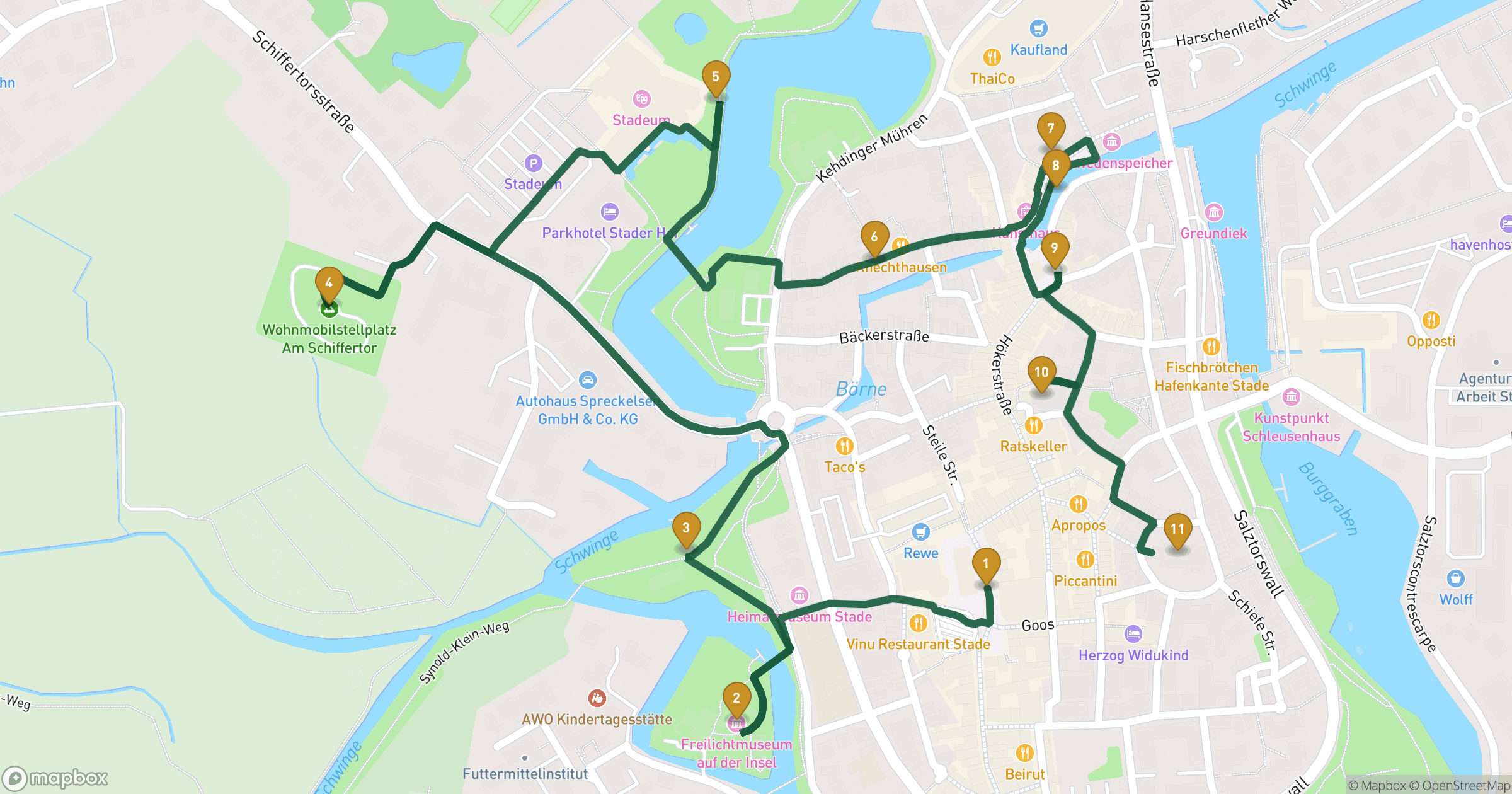
Map for Stade walking tour with 11 stops
The static map shows the tour route with Pferdemarkt, Freilichtmuseum auf der Insel, Königsmarck-Bastion, Wohnmobilstellplatz Am Schiffertor, and 7 more stops.

Stops along the route

All stops on this self-guided tour at a glance.

  1. Pferdemarkt in Stade
    hh oldman / CC BY 3.0

    1PferdemarktSquare

    Der Pferdemarkt served not only as a livestock trading hub but also as a grim stage for public announcements, floggings, and executions. Facing the cobbled square stands the Zeughaus, erected between 1697 and 1699 under Swedish rule on the foundation of Saint George's Monastery. The Swedish military used the building as an arsenal, creating a functional, austere contrast to nearby timber-framed houses.

    Wikidata

  2. Freilichtmuseum auf der Insel in Stade
    ItDozent / CC BY-SA 3.0

    2Freilichtmuseum auf der Insel

    Set on the former Bleicher-Ravelin fortification, this open-air museum highlights regional rural heritage. It was founded in 1914 largely through the efforts of Mayor Ado Jürgens to preserve local farming culture. Its centerpiece is the Altländer Haus from 1733, a traditional timber-framed hall house relocated here with status-symbol brickwork, standing alongside a post mill and historical forge.

    Wikidata

  3. Königsmarck-Bastion in Stade
    Ulf Heinsohn / CC BY 4.0

    3Königsmarck-BastionMonument

    This massive earth-and-stone bastion recalls Field Marshal Hans Christoph von Königsmarck, who turned Stade into a major seventeenth-century stronghold. His grandson Philipp Christoph vanished without a trace in Hanover in 1694 amid an affair with Princess Sophie Dorothea. From the rampart, water-filled moats extend around the town, a defense system once formidable enough to earn Stade the moniker 'Gibraltar of the North.'

  4. 4Wohnmobilstellplatz Am SchiffertorMonument

    Now occupied by camper vans, this site once marked the Schiffertor, the fortified river gate controlling access from the Schwinge. Sailors, merchants, and fishermen were halted here to declare goods and pay mandatory tolls before entering the town. The defensive gatehouse was demolished in the nineteenth century to make way for traffic, leaving only the street name to indicate its presence.

  5. 5WallanlagenPark

    The ring of Wallanlagen preserves the defensive ramparts perfected under Swedish direction in the seventeenth century. During the siege of 1675 to 1676, the complex survived attacks by combined Danish, Brandenburg, and Lüneburg forces thanks to bastions designed for total cannon coverage. When leaves thin in autumn and spring, the original star-shaped geometry of the fortress becomes clearly visible.

  6. Bungenstraße in Stade
    ClausNe / CC BY-SA 4.0

    6BungenstraßeMonument

    Bungenstraße offers an authentic glimpse into the everyday life of the artisans and laborers who kept Stade running. The street name likely traces back to drum builders or makers of woven fish traps. Along the narrow, tilted half-timbered houses, original timber beam inscriptions preserve carved blessings for the households and their residents.

  7. Bürgermeister-Hintze-Haus in Stade
    MrsMyer / CC BY-SA 3.0

    7Bürgermeister-Hintze-HausBuilding

    Bürgermeister-Hintze-Haus showcases an ornate Weser Renaissance facade completed around 1621 for Mayor Heino Hintze. A prominent sandstone 'Neidkopf' grimace was carved into the exterior to ward off evil spirits and envious neighbours. Hintze pushed craftsmen to exhaustion to outshine his peers before dying in 1646, and the structure miraculously survived the town fire of 1659.

    Wikidata

  8. Hansehafen in Stade
    Fyrtaarn / CC BY-SA 4.0

    8HansehafenWater

    The Alter Hansehafen preserves Stade's maritime trading core connected via the Schwinge directly to the Elbe. Its dominant brick structure, the Schwedenspeicher, was constructed around 1705 as a fortified provincial grain store for the Swedish garrison. The basin retained its historical form because it was simply too shallow and narrow to accommodate nineteenth-century steamships.

    Wikidata

  9. Fischmarkt in Stade
    hh oldman / CC BY 3.0

    9FischmarktSquare

    Stade's Fischmarkt revolves around the Alter Kran, a wooden treadmill crane replica built in 1977 after the 1661 original was dismantled in 1898. Men known as Krantreter powered the mechanism by walking inside large internal wheels to hoist cargo directly from moored ships. Next door stands the timber-framed Waage, remodeled in 1753 to weigh imported goods for taxation.

    Wikidata

  10. St. Cosmae et Damiani in Stade
    Roland Struwe ( Sneecs ) / CC BY 3.0

    10St. Cosmae et DamianiChurch

    The distinctive onion dome of St. Cosmae et Damiani once served city watchmen as an observation post against approaching fires and enemies. Inside, Vincent Lübeck served for nearly thirty years as organist, attracting travelers from afar to hear the famous Huß-Schnitger organ. Wealthy families and Swedish governors attended services sequestered in enclosed gallery boxes known as Priechen.

    Built: 1659 · Style: Brick Gothic · Named after: Saints Cosmas and Damian · Wikidata

  11. Sankt Wilhadi in Stade
    Tapico / CC BY-SA 3.0

    11Sankt WilhadiChurch

    The fourteenth-century Gothic hall church of Sankt Wilhadi features a prominent tower that leans over two meters to the west due to soft marsh ground. Rebuilt after losing its medieval interior during the town fire of 1659, the sanctuary houses an eighteenth-century organ by Erasmus Bielfeldt. Bielfeldt reportedly slept inside the church for weeks to tune every pipe precisely to the acoustics.

    Wikidata

Download the app

This public page shows a preview. The full route, all content, and navigation are available in CityTour AI.

Cities nearby

Discover self-guided tours in nearby cities.

Frequently asked questions

The key answers before you start.

Is this a self-guided audio tour?

Yes. In the CityTour AI app (iOS and Android), this is a self-guided audio tour for Stade — start anytime, at your own pace, with map, stops, and audio narration.

What will you see on this tour?

On this tour you'll see, among others, Pferdemarkt, Freilichtmuseum auf der Insel, Königsmarck-Bastion, Wohnmobilstellplatz Am Schiffertor, Wallanlagen, Bungenstraße and more sights.

Where does the tour start?

The route starts at Pferdemarkt and ends at Sankt Wilhadi. You can start anytime — the app guides you to the first stop.

How long does the tour take?

About 101 minutes for 11 stops — at your own pace, with breaks whenever you like.

How much does the tour cost?

This tour costs 15 credits. The exact price depends on the pack you buy and your country — roughly $5.

Is it an outdoor tour — are entry tickets included?

Yes, it's an outdoor tour: the sights are viewed from the outside. Entry tickets are not included, and step-free access cannot be guaranteed.

Is the audio guide available in my language?

The tour and audio guide are available in English, Deutsch, Français, Español, Italiano and 9 more languages. You pick your language in the app.

Can I use the tour offline?

Yes. Tours can be used offline.

Can I ask the AI questions along the way?

Yes. At every stop you can ask the AI directly if you want to know more or didn't understand something.