CityTour AI

Wolfenbüttel self-guided walking tour

Dukes, Poets, and the Secret of the Painted Stones

Discover Wolfenbüttel on a humorous tour through the former residence of the Guelphs, where ducal splendor meets charming half-timbered idyll. From the world-famous library to the picturesque canals of "Little Venice," experience a perfect blend of intellectual history and architectural curiosities. This walk takes you to the sites of great poets and the hidden details of a city that has preserved its historical character with a dash of North German serenity.

Audio tourSelf-guidediOS & Android
98minutes
2.7 kmdistance
12stops
Audio guideFormat
Dukes, Poets, and the Secret of the Painted Stones
Losch / CC BY-SA 3.0

Stops on this route

This tour works well for first-time visitors, weekend trips, and travelers who want to explore Wolfenbüttel without a fixed tour time.

Route map for Wolfenbüttel walking tour
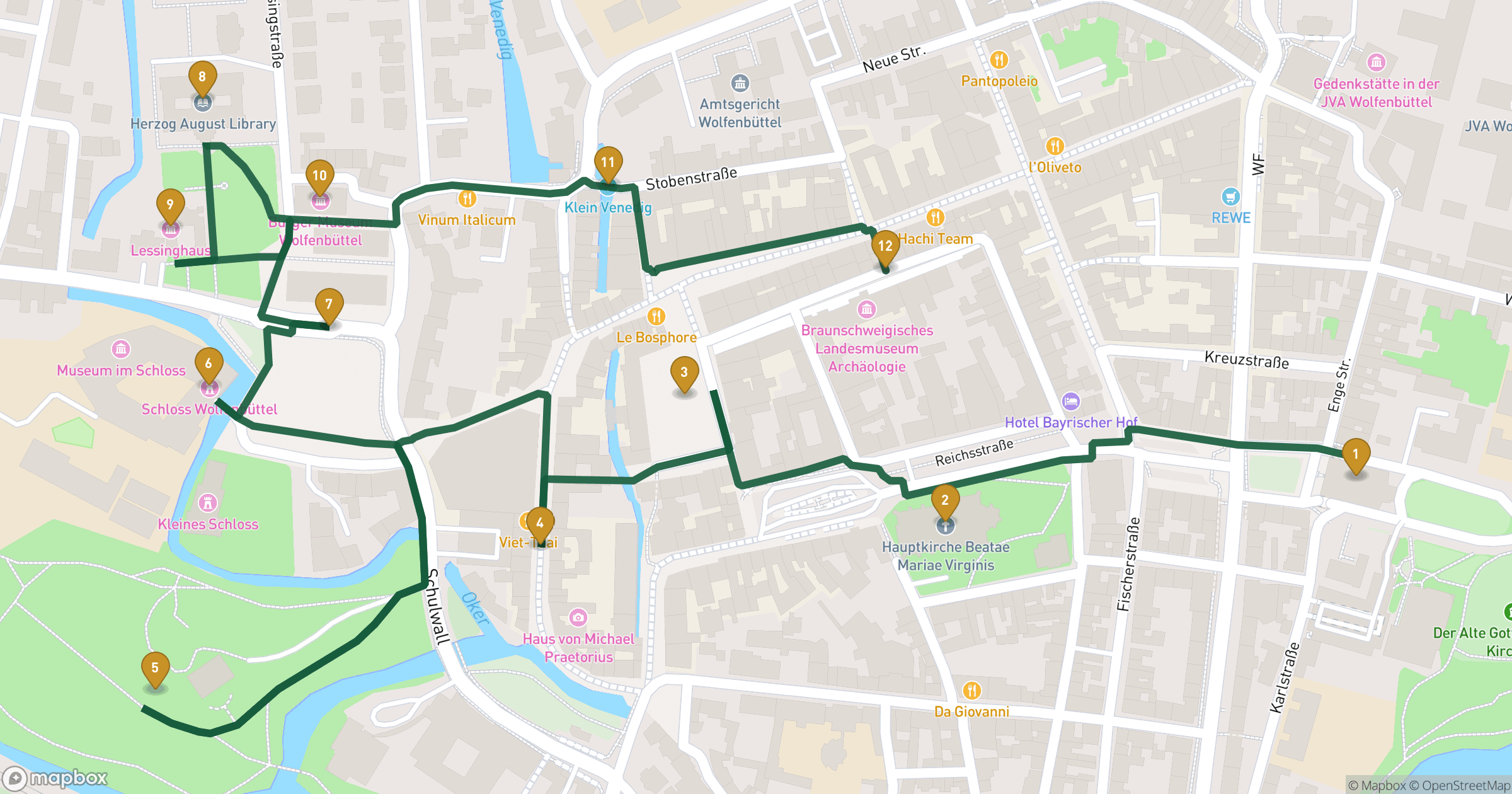
Map for Wolfenbüttel walking tour with 12 stops
The static map shows the tour route with Trinity Church, Marienkirche, Stadtmarkt, Großer Zimmerhof, and 8 more stops.

Stops along the route

All stops on this self-guided tour at a glance.

  1. Trinity Church in Wolfenbüttel
    Losch / CC BY-SA 3.0

    1Trinity Church

    St. Trinitatis Church showcases an ingenious design that repurposed the stone foundations of an old city gate into a house of worship. When the Kaisertor lost its military role, master builder Hermann Korb erected a timber-framed baroque structure disguised as solid stone. Consecrated in 1719, its bright interior cleverly conceals the original passageway layout.

    Architect: Hermann Korb · Style: baroque architecture · Named after: Holy Trinity · Wikidata

  2. Marienkirche in Wolfenbüttel
    Chris06 / CC BY-SA 4.0

    2MarienkircheChurch

    The Marienkirche stands as the world's first major protestant cathedral, commissioned in 1608 by Duke Heinrich Julius to demonstrate the grandeur of the new faith. Architect Paul Francke combined outdated late Gothic pointed-arch windows with a lavish Renaissance portal. Beneath the chancel, a ducal crypt contains the ornate sarcophagi of nearly thirty members of the Welf family.

    Architect: Paul Francke · Named after: Mary, Our Lady · Wikidata

  3. Stadtmarkt in Wolfenbüttel
    Losch / CC BY-SA 3.0

    3StadtmarktMarket

    The Stadtmarkt centers on the modular town hall, assembled from several joined timber-framed structures, and an equestrian monument of Duke Augustus the Younger. Despite being immortalized on horseback, Augustus preferred reading in his library over riding. Adjacent to the square lies the Krambuden, a narrow alley of tiny stalls where vendors once hawked all manner of wares.

  4. Großer Zimmerhof in Wolfenbüttel
    Dguendel / CC BY 4.0

    4Großer ZimmerhofSquare

    Großer Zimmerhof reveals the craft quarter where carpenters turned decorative carvings into a display of neighborhood prestige. Beams feature ornate fan rosettes, ship channels, and inscriptions alongside small, grotesque carved heads known as Knasten. Intended to ward off spirits or startle onlookers, these wooden faces typify the intricate woodwork preserved along the street.

  5. Seeliger Park in Wolfenbüttel
    Kerstin Namuth / CC BY-SA 4.0

    5Seeliger Park

    Seeliger Park occupies the former fortification moat and was originally the private garden of the local Seeliger banking family. A historic villa within the park grounds once served as the bankers' residence and now houses the municipal music school. Today, mature trees replace military sentries along paths that frame quiet waterside views of the rear palace.

  6. Schloss Wolfenbüttel in Wolfenbüttel
    User:Brunswyk / CC BY-SA 3.0

    6Schloss WolfenbüttelCastle

    Schloss Wolfenbüttel represents the power base of the Welf dukes, beginning as a 1283 moated castle before evolving into a grand baroque palace. Master builders Johann Balthasar Lauterbach and Hermann Korb used plastered timber framing to mimic expensive sandstone across its vast facade. Today, the complex accommodates both the castle museum and an active secondary school.

    Built: 1283 · Architect: Hermann Korb, Johann Balthasar Lauterbach · Wikidata

  7. Schlossplatz in Wolfenbüttel
    Dguendel / CC BY 4.0

    7SchlossplatzSquare

    The Schlossplatz features the imposing Zeughaus, erected between 1613 and 1619 by Paul Francke as Germany's largest armory of its time. Built to store tons of gunpowder and heavy siege cannons, the armory features a grand portal adorned with sculptures of war and peace. Today, learning and municipal administration occupy the grounds where armored ducal guards once patrolled.

  8. Herzog August Library in Wolfenbüttel
    Losch / CC BY-SA 3.0

    8Herzog August Library

    The Herzog August Bibliothek preserves a collection that reached 135,000 titles across 35,000 volumes by the death of Duke Augustus the Younger in 1666. Built in the late nineteenth century after an earlier circular building proved unstable, the facility houses the Gospels of Henry the Lion, acquired in 1983 for 32.5 million German marks. Augustus personally cataloged every volume.

    Built: 1572 · Architect: Hermann Korb · Named after: Augustus the Younger, Duke of Brunswick-Lüneburg · Wikidata

  9. Lessinghaus in Wolfenbüttel
    Holbein66 / CC BY-SA 4.0

    9LessinghausMuseum

    The Lessinghaus is a late baroque residence from 1733 where Gotthold Ephraim Lessing served as ducal librarian from 1777 until his death in 1781. Tragedy marked his stay, as his wife Eva König and their newborn son passed away shortly after moving in. Within these rooms, despite cold winter drafts that froze his ink, Lessing composed his play Nathan the Wise.

    Built: 1733 · Style: Late Baroque · Named after: Gotthold Ephraim Lessing · Wikidata

  10. Bürger Museum Wolfenbüttel in Wolfenbüttel
    Tilman2007 / CC BY-SA 4.0

    10Bürger Museum Wolfenbüttel

    The Bürger Museum Wolfenbüttel explores daily civic life inside a former riding hall built around 1850 that later served as a sports gymnasium. Rather than focusing on ruling dukes or poets, the exhibits examine ordinary townspeople, craft guilds, and local clubs. Displays highlight historic leisure traditions such as marksmen festivals and choral societies.

  11. Klein Venedig in Wolfenbüttel
    Bärbel Miemietz / CC BY-SA 4.0

    11Klein VenedigViewpoint

    Klein Venedig lines the Oker river with tightly packed timber-framed facades, recalling the city's historic Dutch-inspired canal defenses. Dug to transport goods and shield fortifications, the waterways were once busy with working barges laden with beer and grain. The colorful facades still cast striking reflections onto the surviving river inlet.

  12. Kanzleistraße in Wolfenbüttel
    Tilman2007 / CC BY-SA 4.0

    12Kanzleistraße

    Kanzleistraße formed the premier residential address for the dukedom's top civil servants, chancellors, and government councilors. Its defining structure, the massive Kanzlei government building, concentrated administrative authority and document processing. The preserved streetscape displays increasingly ornate timberwork that advertised each resident's official rank.

Download the app

This public page shows a preview. The full route, all content, and navigation are available in CityTour AI.

Cities nearby

Discover self-guided tours in nearby cities.

Frequently asked questions

The key answers before you start.

Is this a self-guided audio tour?

Yes. In the CityTour AI app (iOS and Android), this is a self-guided audio tour for Wolfenbüttel — start anytime, at your own pace, with map, stops, and audio narration.

What will you see on this tour?

On this tour you'll see, among others, Trinity Church, Marienkirche, Stadtmarkt, Großer Zimmerhof, Seeliger Park, Schloss Wolfenbüttel and more sights.

Where does the tour start?

The route starts at Trinity Church and ends at Kanzleistraße. You can start anytime — the app guides you to the first stop.

How long does the tour take?

About 98 minutes for 12 stops — at your own pace, with breaks whenever you like.

How much does the tour cost?

This tour costs 15 credits. The exact price depends on the pack you buy and your country — roughly $5.

Is it an outdoor tour — are entry tickets included?

Yes, it's an outdoor tour: the sights are viewed from the outside. Entry tickets are not included, and step-free access cannot be guaranteed.

Is the audio guide available in my language?

The tour and audio guide are available in English, Deutsch, Français, Español, Italiano and 9 more languages. You pick your language in the app.

Can I use the tour offline?

Yes. Tours can be used offline.

Can I ask the AI questions along the way?

Yes. At every stop you can ask the AI directly if you want to know more or didn't understand something.