CityTour AI

Wolfsburg self-guided walking tour

Wolfsburg: Modern Icons and Hidden History

Discover Wolfsburg beyond the factory gates on a relaxed walk through architectural history and green oases. From futuristic concrete wonders to hidden medieval treasures, experience the surprising diversity of a city that is much more than just an industrial site. This tour combines world-famous design icons with romantic retreats in the heart of the city.

Audio tourSelf-guidediOS & Android
104minutes
5.1 kmdistance
8stops
Audio guideFormat
Wolfsburg: Modern Icons and Hidden History
Vanellus / CC BY-SA 4.0

Stops on this route

This tour works well for first-time visitors, weekend trips, and travelers who want to explore Wolfsburg without a fixed tour time.

Route map for Wolfsburg walking tour
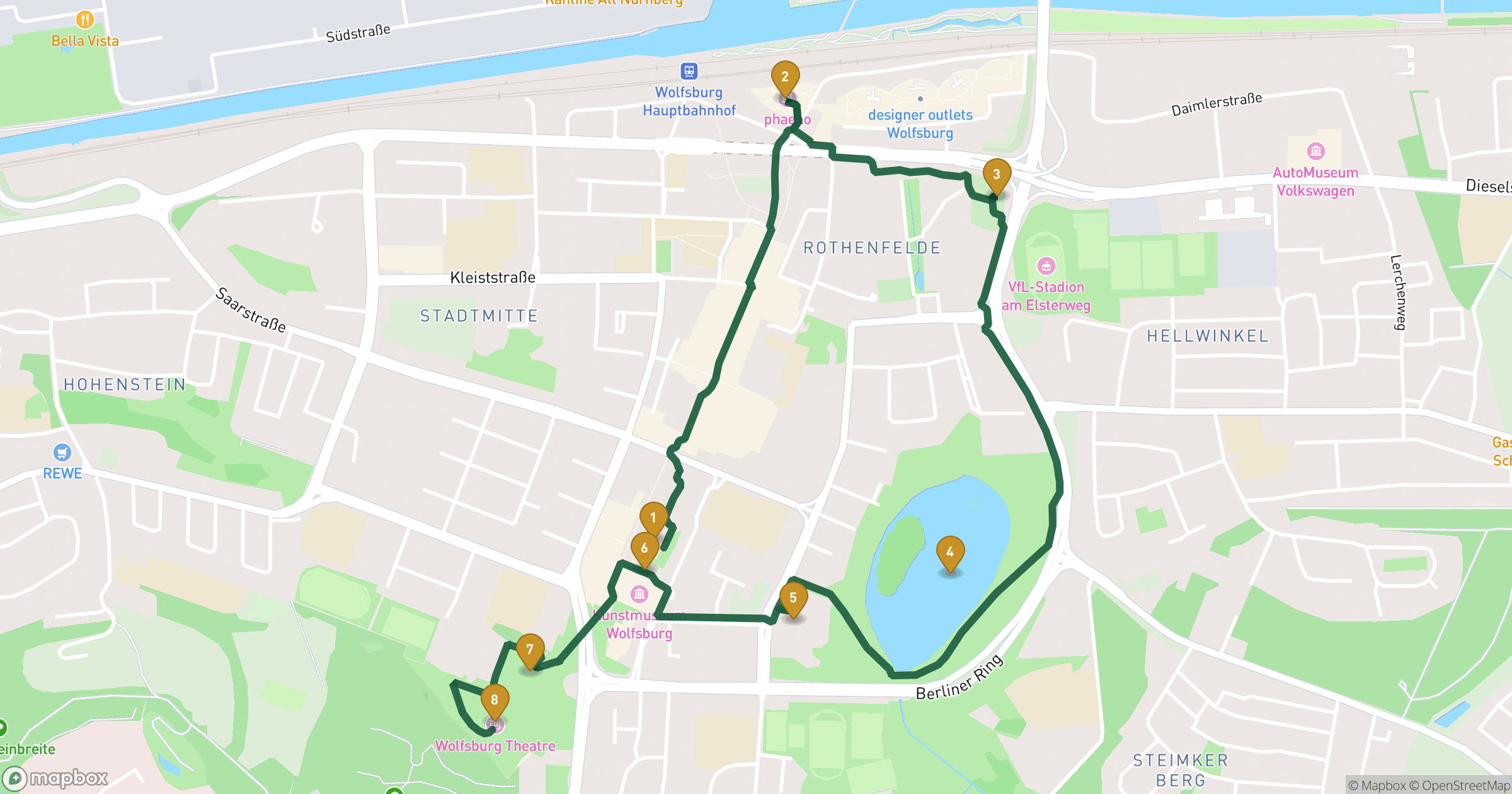
Map for Wolfsburg walking tour with 8 stops
The static map shows the tour route with Alvar-Aalto-Kulturhaus, Phaeno Science Center, St. Annen Kirche, Großer Schillerteich, and 4 more stops.

Stops along the route

All stops on this self-guided tour at a glance.

  1. Alvar-Aalto-Kulturhaus in Wolfsburg
    Kirchenfan / CC0

    1Alvar-Aalto-KulturhausBuilding

    The Alvar-Aalto-Kulturhaus highlights the Finnish architect's distinctive approach to materials and natural light in late 1950s post-war modernism. White Carrara marble clads the facade, designed to interact with changing daylight. Under one roof, the complex houses the city library, an adult education center, and signature details like blue ceramic tiles and custom handrails.

    Built: 1962 · Architect: Alvar Aalto · Named after: Alvar Aalto · Wikidata

  2. Phaeno Science Center in Wolfsburg
    Richard Bartz / CC BY-SA 3.0

    2Phaeno Science CenterMuseum

    Phæno stands out as a deconstructivist exposed-concrete sculpture designed by Iraqi-British architect Zaha Hadid. Opened in 2005, the building rests on ten cone-shaped pillars that elevate the structure while accommodating features like the entrance and a science theater. Inside, an open experimental landscape without fixed routes features more than 350 interactive stations.

    Built: 2005 · Architect: Zaha Hadid · Style: deconstructivism · Wikidata

  3. St. Annen Kirche in Wolfsburg
    Kirchenfan / CC0

    3St. Annen KircheChurch

    St. Annen Church provides a direct link to the area's distant past with thick walls built of fieldstone and sandstone. Dating back to the 13th century, it was constructed centuries before car manufacturing and modern city planning shaped the region. As one of the city's oldest surviving buildings, it retains a simple, modest interior.

    Architect: Frank D. Hemmer · Named after: Saint Anne · Wikidata

  4. Großer Schillerteich in Wolfsburg
    Kirchenfan / CC0

    4Großer SchillerteichWater

    The Großer Schillerteich serves as a scenic green retreat that doubles as vital urban infrastructure. Measuring about 400 meters in length and featuring a tree-covered artificial island, it forms the city's largest rainwater retention basin alongside the Kleiner Schillerteich. The historic Schillermühle stood on its northern shore from 1600 until its demolition in 1971.

    Wikidata

  5. Christuskirche in Wolfsburg
    Kirchenfan / CC0

    5ChristuskircheChurch

    Christuskirche marks a key moment of post-war recovery as the city's first solid Protestant church, designed by architect Gerhard Langmaack. Building plans from 1939 had been personally blocked by Adolf Hitler, forcing the congregation to use a former Volkswagen barracks after the war. Consecrated in 1951, the complex in the Schillerteich district features a freestanding bell tower.

    Architect: Gerhard Langmaack · Style: modern architecture · Named after: Jesus Christ · Wikidata

  6. Hollerplatz in Wolfsburg
    Kintaiyo / CC BY-SA 3.0

    6HollerplatzSquare

    Hollerplatz functions as a central cultural plaza defined by sweeping sightlines that connect distinct eras of modern architecture. The square is framed by the Alvar-Aalto-Kulturhaus and the Kunstmuseum Wolfsburg, which opened in 1994 for contemporary exhibitions. Regularly hosting markets and public events, the open space reflects the generous scale of the city's urban design.

  7. Planetarium Wolfsburg in Wolfsburg
    Axel Hindemith / Public domain

    7Planetarium WolfsburgAttraction

    Planetarium Wolfsburg presents a clean geometric half-sphere embedded within surrounding parkland. It opened in 1983, following Volkswagen AG's gift of its initial projector in 1978 for the city's 40th anniversary. Inside the dome, a specialized Zeiss projector casts realistic celestial projections across the ceiling.

    Built: 1983 · Wikidata

  8. Scharoun-Theater Wolfsburg in Wolfsburg
    Vanellus / CC BY-SA 4.0

    8Scharoun-Theater WolfsburgTheatre

    Scharoun-Theater crowns the Klieversberg hill as an asymmetrical landmark of organic architecture by Hans Scharoun, the architect of the Berlin Philharmonie. Opened in 1973, the theater flows into the slope with staggered levels and projecting sections that avoid rigid right angles. From its vantage point, views extend across Wolfsburg's rooftops directly to the Volkswagen plant.

    Architect: Hans Scharoun · Named after: Hans Scharoun · Wikidata

Download the app

This public page shows a preview. The full route, all content, and navigation are available in CityTour AI.

Cities nearby

Discover self-guided tours in nearby cities.

Frequently asked questions

The key answers before you start.

Is this a self-guided audio tour?

Yes. In the CityTour AI app (iOS and Android), this is a self-guided audio tour for Wolfsburg — start anytime, at your own pace, with map, stops, and audio narration.

What will you see on this tour?

On this tour you'll see, among others, Alvar-Aalto-Kulturhaus, Phaeno Science Center, St. Annen Kirche, Großer Schillerteich, Christuskirche, Hollerplatz and more sights.

Where does the tour start?

The route starts at Alvar-Aalto-Kulturhaus and ends at Scharoun-Theater Wolfsburg. You can start anytime — the app guides you to the first stop.

How long does the tour take?

About 104 minutes for 8 stops — at your own pace, with breaks whenever you like.

How much does the tour cost?

This tour costs 15 credits. The exact price depends on the pack you buy and your country — roughly $5.

Is it an outdoor tour — are entry tickets included?

Yes, it's an outdoor tour: the sights are viewed from the outside. Entry tickets are not included, and step-free access cannot be guaranteed.

Is the audio guide available in my language?

The tour and audio guide are available in English, Deutsch, Français, Español, Italiano and 9 more languages. You pick your language in the app.

Can I use the tour offline?

Yes. Tours can be used offline.

Can I ask the AI questions along the way?

Yes. At every stop you can ask the AI directly if you want to know more or didn't understand something.