CityTour AI

Rostock self-guided walking tour

Hanseatic Splendor and Sea Breeze: The Heart of Rostock

Experience the Hanseatic pride and maritime soul of Rostock on a relaxed walk through the historic old town. From monumental brick churches to the wide city harbor, discover the traces of powerful merchants and centuries-old academic tradition. An authentic insight into life between tradition and the Baltic breeze.

Audio tourSelf-guidediOS & Android
104minutes
3.4 kmdistance
12stops
Audio guideFormat
Hanseatic Splendor and Sea Breeze: The Heart of Rostock
Derbrauni / CC BY-SA 4.0

Stops on this route

This tour works well for first-time visitors, weekend trips, and travelers who want to explore Rostock without a fixed tour time.

Route map for Rostock walking tour
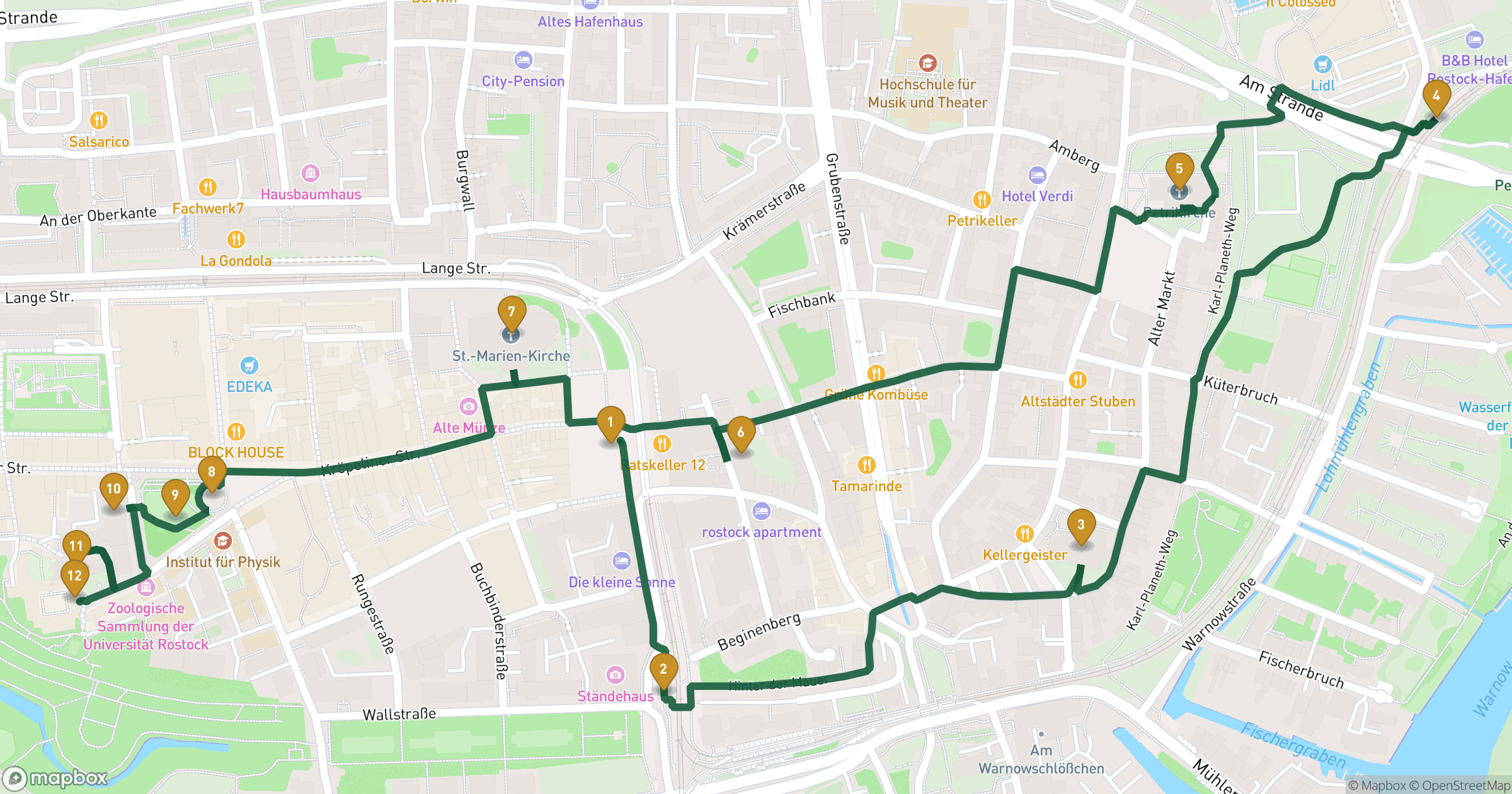
Map for Rostock walking tour with 12 stops
The static map shows the tour route with Neuer Markt, Steintor, St. Nicholas church (Rostock), Stadthafen Rostock, and 8 more stops.

Stops along the route

All stops on this self-guided tour at a glance.

  1. Neuer Markt in Rostock
    Derbrauni / CC BY-SA 4.0

    1Neuer MarktSquare

    Neuer Markt was the commercial core of medieval Rostock, where seven historic streets converged. Once the site of public witch burnings and a pillory called the Kaak, it is dominated by the town hall featuring seven distinctive roof towers. Next to it stand two gabled houses that miraculously escaped the 1942 bombing raids.

    Wikidata

  2. Steintor in Rostock
    chrisaliv / CC BY-SA 4.0

    2SteintorCastle

    Steintor served as the grand ceremonial entrance for visiting princes and dignitaries entering Rostock. Duke Johann Albrecht I demolished the original medieval gate in 1566 and used its stones to build a fortress after citizens refused him an oath of allegiance. Built between 1574 and 1577, the current gate displays sculptor Hans Borgloh's Latin inscription calling for harmony.

    Wikidata

  3. St. Nicholas church (Rostock) in Rostock
    A.Savin / FAL

    3St. Nicholas church (Rostock)

    Nikolaikirche is an early hall church distinguished by a rare vaulted archway running directly beneath its altar. This passage allowed horse carts to navigate the steep hillside under an image of Saint Nicholas. In 1976, modern residential apartments and offices were built directly inside the church's medieval attic space.

    Style: Brick Gothic · Named after: Saint Nicholas · Wikidata

  4. Stadthafen Rostock in Rostock
    Darkone (talk · contribs) / CC BY-SA 2.5

    4Stadthafen Rostock

    Rostocker Stadthafen once formed the economic backbone of the city, lined with twelve gates opening toward the water. In 1851, the Neptun shipyard here constructed the Erbgroßherzog Friedrich Franz, the first iron screw-driven steamship in Germany. By around 1870, the port served as home to the largest merchant fleet in the entire Baltic Sea region.

    Wikidata

  5. St. Peter's Church in Rostock
    Public domain

    5St. Peter's Church

    Petrikirche boasts the city's tallest church tower at 117 meters, which guided sailors along the Warnow for centuries. Chaplain Joachim Slüter introduced the Reformation here in 1523 by celebrating the city's first church service held in German. During the 1942 air raids the interior burned down, but residents saved the bronze baptismal font by burying it in 1945.

    Built: 1351 · Style: Brick Gothic · Height: 117 m · Named after: Saint Peter · Wikidata

  6. Kerkhoffhaus in Rostock
    Bahnfrend / CC BY-SA 4.0

    6Kerkhoffhaus

    The Kerkhoffhaus is a gabled patrician residence built around 1470 by councilman Bartold Kerkhoff, decorated with detailed terracotta reliefs. During the Rostock Cathedral Feud of 1487, rebellious citizens painted a gallows on Kerkhoff's front door, forcing him to flee the city. Restored in the early twentieth century, the building now houses the municipal archives and registry office.

    Built: 1470 · Wikidata

  7. St. Mary's Church in Rostock
    PtrQs | Photo by PtrQs / CC BY-SA 4.0

    7St. Mary's Church

    Marienkirche features an unusually compact silhouette because its planned double towers were never completed. Behind the main altar sits a medieval astronomical clock that survived along with an ornate pulpit and bronze font despite the Reformation. Unlike in neighboring Hanseatic cities, this main parish church stands detached from the town hall rather than beside it.

    Built: 1265 · Architect: Jean-Laurent Le Geay · Style: Brick Gothic · Named after: Mary · Wikidata

  8. Brunnen der Lebensfreude in Rostock
    Derbrauni / CC BY-SA 4.0

    8Brunnen der LebensfreudeAttraction

    Brunnen der Lebensfreude is a 1980 bronze fountain on Universitätsplatz created by sculptors Reinhard Dietrich and Jo Jastram. It features sixteen completely naked bronze figures depicting animals, sports, and a family pyramid, which caused widespread local controversy in the GDR era. Because of its nudity, locals gave the popular gathering spot the nickname Porno-Brunnen.

    Built: 1980 · Wikidata

  9. Universitätsplatz in Rostock
    Oriol Sastre / CC BY-SA 4.0

    9UniversitätsplatzPark

    Universitätsplatz originated as the Hopfenmarkt, acquiring its distinctive triangular layout from two medieval trade routes that split here toward the harbor. The former Neustadt town hall once stood on this ground and served as a university lecture hall before being torn down in the nineteenth century. Renamed Blücherplatz in 1819 after a local field marshal, it is now fully pedestrianized.

    Named after: University of Rostock main building · Wikidata

  10. University of Rostock main building in Rostock
    A.Savin / FAL

    10University of Rostock main building

    The neo-Renaissance main building of the University of Rostock occupies ground where students have gathered since 1419. Constructed between 1867 and 1870, it replaced the crumbling medieval Weiße Kollegium. Today it houses the rectorate, university archive, and theological faculty, decorated with facade statues and coats of arms honoring the ducal founders.

    Style: Renaissance Revival architecture · Wikidata

  11. Abbey of the Holy Cross in Rostock
    A.Savin / FAL

    11Abbey of the Holy CrossChurch

    Kloster zum Heiligen Kreuz is Rostock's only fully preserved medieval monastery, founded between 1269 and 1272. According to legend, Danish Queen Margaret established the convent after surviving a shipwreck near the city, gifting it a relic of the True Cross brought from Rome. Converted into a Protestant residence in 1584, the complex housed aristocratic ladies until the final resident died in 1981.

    Built: 1201 · Named after: True Cross · Wikidata

  12. Kulturhistorisches Museum Rostock in Rostock
    Hajotthu / CC BY-SA 3.0

    12Kulturhistorisches Museum Rostock

    Kulturhistorisches Museum Rostock showcases municipal history inside the historic rooms of the Kloster zum Heiligen Kreuz. Founded in 1859, the museum endured major losses in 1937 when Nazi authorities seized fifteen artworks deemed degenerate, destroying eight by artists such as Otto Dix and Emil Nolde. Today its permanent galleries pair Hanseatic heritage with the monastery's architecture.

    Built: 1859 · Wikidata

Download the app

This public page shows a preview. The full route, all content, and navigation are available in CityTour AI.

Cities nearby

Discover self-guided tours in nearby cities.

Frequently asked questions

The key answers before you start.

Is this a self-guided audio tour?

Yes. In the CityTour AI app (iOS and Android), this is a self-guided audio tour for Rostock — start anytime, at your own pace, with map, stops, and audio narration.

What will you see on this tour?

On this tour you'll see, among others, Neuer Markt, Steintor, St. Nicholas church (Rostock), Stadthafen Rostock, St. Peter's Church, Kerkhoffhaus and more sights.

Where does the tour start?

The route starts at Neuer Markt and ends at Kulturhistorisches Museum Rostock. You can start anytime — the app guides you to the first stop.

How long does the tour take?

About 104 minutes for 12 stops — at your own pace, with breaks whenever you like.

How much does the tour cost?

This tour costs 15 credits. The exact price depends on the pack you buy and your country — roughly $5.

Is it an outdoor tour — are entry tickets included?

Yes, it's an outdoor tour: the sights are viewed from the outside. Entry tickets are not included, and step-free access cannot be guaranteed.

Is the audio guide available in my language?

The tour and audio guide are available in English, Deutsch, Français, Español, Italiano and 9 more languages. You pick your language in the app.

Can I use the tour offline?

Yes. Tours can be used offline.

Can I ask the AI questions along the way?

Yes. At every stop you can ask the AI directly if you want to know more or didn't understand something.