CityTour AI

Schwerin self-guided walking tour

Splendor, Pomp, and Petermännchen: Schwerin's Ducal Makeover

Discover how Schwerin transformed from a medieval enclave into a magnificent residence city that architecturally punches above its weight. This humorous tour takes you past golden castle towers, masterful facade deceptions, and the traces of the man who single-handedly reinvented the city. Experience the charm of Germany's smallest state capital between aristocratic heritage and North German serenity.

Audio tourSelf-guidediOS & Android
104minutes
3.2 kmdistance
13stops
Audio guideFormat
Splendor, Pomp, and Petermännchen: Schwerin's Ducal Makeover
Tmv23 / CC BY-SA 3.0

Stops on this route

This tour works well for first-time visitors, weekend trips, and travelers who want to explore Schwerin without a fixed tour time.

Route map for Schwerin walking tour
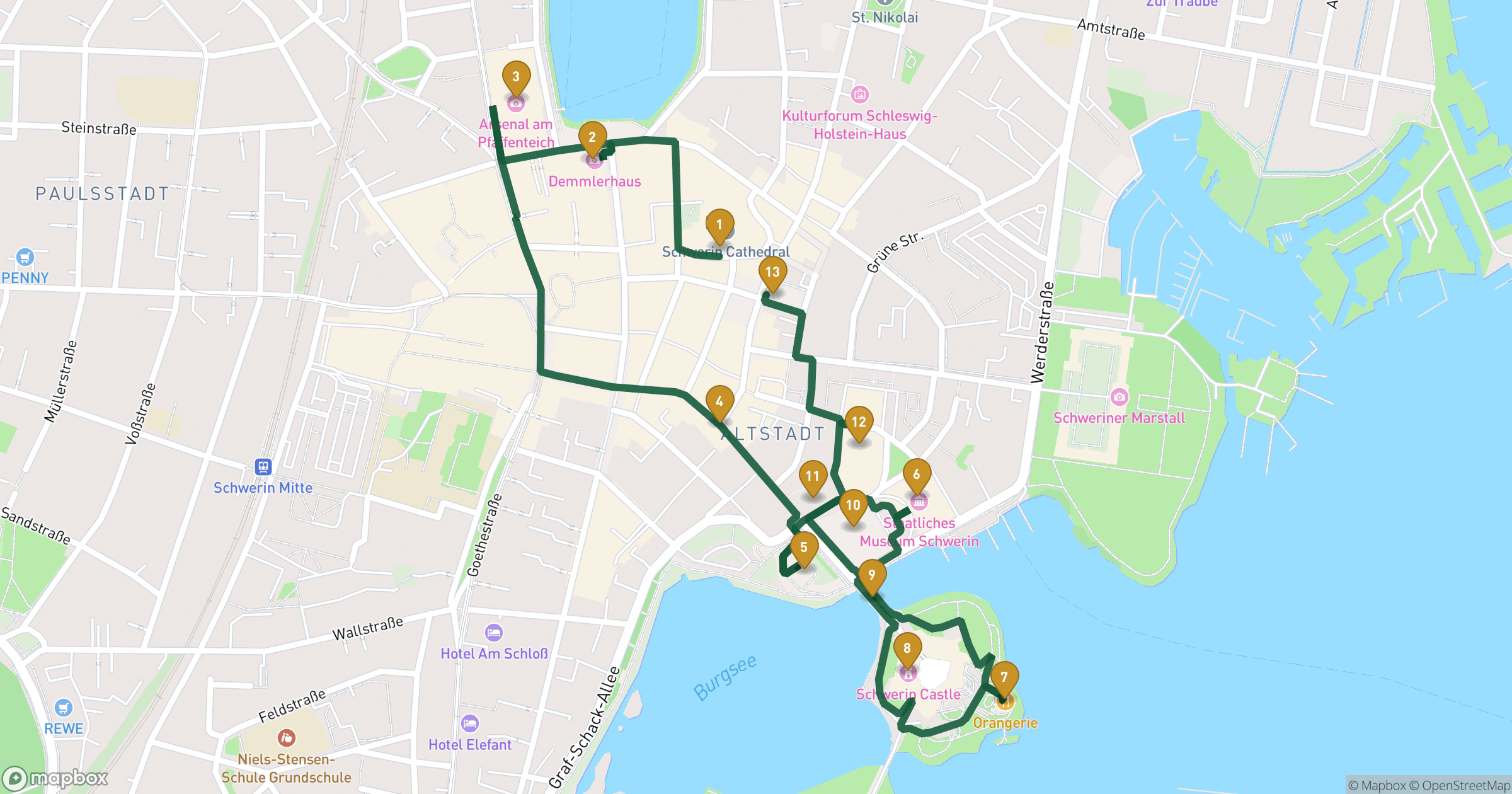
Map for Schwerin walking tour with 13 stops
The static map shows the tour route with Schwerin Cathedral, Demmlerhaus, Arsenal am Pfaffenteich, Puschkinstraße, and 9 more stops.

Stops along the route

All stops on this self-guided tour at a glance.

  1. Schwerin Cathedral in Schwerin
    chrisaliv / CC BY-SA 4.0

    1Schwerin CathedralChurch

    Schwerin Cathedral owes its massive Brick Gothic presence to an early medieval marketing triumph. In 1222, Count Henry I brought home a Holy Blood relic that drew crowds of wealthy pilgrims, funding the construction that began in 1260. Centuries later, architect Georg Daniel completed the spire exactly 50 centimeters taller than St. Peter's in rival Rostock.

    Built: 1260 · Architect: Adolf Friedrich Lorenz, Heinrich Julius Tode … · Style: Brick Gothic · Height: 117.5 m · Wikidata

  2. Demmlerhaus in Schwerin
    Niteshift (talk); Self-photographed / CC BY-SA 3.0

    2DemmlerhausAttraction

    Standing by the Pfaffenteich, Demmler House is the fortress-like residence and office built in 1843 by court architect Georg Adolf Demmler. Designed in Tudor Renaissance style with octagonal turrets, it reflects the bold spirit of a man dismissed in 1851 by Grand Duke Friedrich Franz II over his support for the 1848 revolution. Demmler later became a Social Democratic member of the Reichstag and established a foundation for sick workers.

    Built: 1843 · Architect: Georg Adolph Demmler · Style: Tudor Revival architecture · Wikidata

  3. Arsenal am Pfaffenteich in Schwerin
    Carsten Steger / CC BY-SA 4.0

    3Arsenal am PfaffenteichAttraction

    The Arsenal on the western shore of the Pfaffenteich is a fortress-like military depot designed by Georg Adolf Demmler. Erected between 1840 and 1844, this Tudor-style complex was commissioned to store weapons and ammunition for the ducal army behind crenellated stone walls. Later repurposed as a police station and post-war refugee housing, it currently serves as the Ministry of the Interior of Mecklenburg-Vorpommern.

    Built: 1840 · Wikidata

  4. Puschkinstraße in Schwerin
    Dguendel / CC BY 4.0

    4PuschkinstraßeSquare

    Puschkinstraße traces the architectural evolution of Schwerin's old town as rustic timber frames give way to solid stone structures. Originally known as Königstraße, the cobblestone road was later renamed after Russian poet Alexander Pushkin. Today, independent shops and cafés occupy the ground floors along this historic route.

    Named after: Alexander Pushkin · Wikidata

  5. Siegessäule in Schwerin
    Jan-Herm Janßen / CC BY-SA 4.0

    5SiegessäuleMonument

    The Victory Column stands in the center of the Alter Garten, designed by architect Hermann Willebrand to commemorate the Franco-Prussian War of 1870–71. Rather than Victoria, the pillar is crowned by Megalopolis, the female personification of Mecklenburg holding a shield adorned with the regional bull's head. The monument forms the central vertical anchor between the surrounding museum and theater.

    Built: 1874 · Architect: Hermann Willebrand · Height: 23 m · Wikidata

  6. Staatliches Museum Schwerin in Schwerin
    Tmv23 / CC BY-SA 3.0

    6Staatliches Museum Schwerin

    The Staatliches Museum Schwerin showcases high culture in a Greek Renaissance palace designed by architect Hermann Willebrand and opened in 1882. Behind its Ionic columns and broad outdoor staircase lies an extensive collection of 17th-century Dutch and Flemish masters commissioned under Grand Duke Friedrich Franz II. The galleries hold the world's largest collection of animal paintings by Jean-Baptiste Oudry alongside works by Marcel Duchamp.

    Built: 1882 · Wikidata

  7. Orangerie Schwerin in Schwerin
    Dguendel / CC BY 4.0

    7Orangerie Schwerin

    The Schwerin Orangery is an 1853 iron-and-glass retreat that protected exotic plants from northern German weather. During the East German era, this ducal winter garden was repurposed as a warehouse, a kindergarten teachers' gymnasium, and a polytechnic museum. Outside, the sheltered palm garden features roof statues of Victoria, a Jupiter sundial, and a sculpture of Heracles wrestling the Cretan bull.

    Built: 1853 · Style: historicist architecture · Wikidata

  8. Schweriner Schloss in Schwerin
    User:Kolossos / CC BY-SA 3.0

    8Schweriner SchlossCastle

    Schwerin Castle combines political power and romantic historicism, operating today as the seat of the state parliament of Mecklenburg-Vorpommern. Across its 635 rooms, folklore credits the goblin Petermännchen with waking sleeping guards, punishing thieves, and warning a princess during the devastating 1913 fire. The 19th-century complex is recognized as a UNESCO World Heritage site.

    Architect: Gottfried Semper, Friedrich August Stüler … · Style: historicist architecture · Heritage status: World Heritage Site · Wikidata

  9. Schlossbrücke in Schwerin
    Niteshift / CC BY 2.5

    9SchlossbrückeBridge

    Built between 1844 and 1845, the Castle Bridge was completed by court architect Georg Adolph Demmler while the palace itself was still under construction. Spanning the connection between Lake Schwerin and the Burgsee, its city side features Christian Genschow's 1876 zinc-cast Horse Tamers sculptures. Vertical wooden piles driven 23 meters into the mud could not withstand the lateral vault pressure, requiring extensive structural restoration in the 1980s.

    Wikidata

  10. Alter Garten in Schwerin
    No machine-readable author provided. Da~commonswiki assumed (based on copyright claims).; No machine-readable source provided. Own work assumed (based on copyright claims). / CC BY 2.5

    10Alter GartenSquare

    The Alter Garten is Schwerin's monumental square, transformed from a 16th-century ducal pleasure garden into a paved ceremonial space. Framed by the castle, theater, museum, Old Palace, and State Chancellery, its history dates back to a 9th-century dam leading to the Slavic fortress of Zuarin. At its center stands the 23-meter Victory Column from 1874, circled by linden trees and topped by an armored Megalopolis.

    Wikidata

  11. Altes Palais Schwerin in Schwerin
    Matthias Bethke / CC BY-SA 4.0

    11Altes Palais SchwerinCastle

    The Old Palace is an unassuming timber-framed residence built at the end of the 18th century as a ducal guest house. It became famous as the widow's seat of Grand Duchess Alexandrine, who resided here from 1842 until her death in 1892. In 1837, Georg Adolf Demmler added an archway connecting it to Schloßstraße 3, and the building now houses administrative offices for the state parliament.

    Wikidata

  12. Mecklenburgisches Staatstheater Schwerin in Schwerin
    Niteshift (talk); Self-photographed / CC BY-SA 3.0

    12Mecklenburgisches Staatstheater SchwerinTheatre

    The Mecklenburg State Theatre is a Neo-Renaissance venue built between 1883 and 1886 after a catastrophic fire destroyed its predecessor in 1882. Designed by Georg Daniel with a portico and ornate concert foyer, its acoustics carry even the faintest rustle from the back row to the stage. Unharmed during World War II, it reopened immediately in 1945 under Soviet orders with light operettas.

    Wikidata

  13. Rathaus Schwerin in Schwerin
    Tmv23 / CC BY-SA 3.0

    13Rathaus Schwerin

    Schwerin City Hall on the marketplace conceals centuries of rebuilding behind an English Tudor-style facade. Architect Georg Adolf Demmler added the crenellated exterior and pointed turrets in 1835 over a 14th-century core that had survived major fires in 1531, 1558, and 1651. High above the main entrance sits a golden equestrian statue of Henry the Lion, who founded the city in 1160.

    Style: historicist architecture · Wikidata

Download the app

This public page shows a preview. The full route, all content, and navigation are available in CityTour AI.

Cities nearby

Discover self-guided tours in nearby cities.

Frequently asked questions

The key answers before you start.

Is this a self-guided audio tour?

Yes. In the CityTour AI app (iOS and Android), this is a self-guided audio tour for Schwerin — start anytime, at your own pace, with map, stops, and audio narration.

What will you see on this tour?

On this tour you'll see, among others, Schwerin Cathedral, Demmlerhaus, Arsenal am Pfaffenteich, Puschkinstraße, Siegessäule, Staatliches Museum Schwerin and more sights.

Where does the tour start?

The route starts at Schwerin Cathedral and ends at Rathaus Schwerin. You can start anytime — the app guides you to the first stop.

How long does the tour take?

About 104 minutes for 13 stops — at your own pace, with breaks whenever you like.

How much does the tour cost?

This tour costs 15 credits. The exact price depends on the pack you buy and your country — roughly $5.

Is it an outdoor tour — are entry tickets included?

Yes, it's an outdoor tour: the sights are viewed from the outside. Entry tickets are not included, and step-free access cannot be guaranteed.

Is the audio guide available in my language?

The tour and audio guide are available in English, Deutsch, Français, Español, Italiano and 9 more languages. You pick your language in the app.

Can I use the tour offline?

Yes. Tours can be used offline.

Can I ask the AI questions along the way?

Yes. At every stop you can ask the AI directly if you want to know more or didn't understand something.