CityTour AI

Wismar self-guided walking tour

Brick, Breezes, and Baroque: Wismar's Hanseatic Heritage

Experience the maritime heart of the UNESCO World Heritage city of Wismar on a relaxed walk from the massive brick giants of the old town to the salty breeze at the Old Harbor. Discover traces of powerful Hanseatic merchants, Swedish governors, and the birthplace of a world-famous department store empire. This tour leads you through winding alleys and along historic canals to where Wismar is at its most authentic.

Audio tourSelf-guidediOS & Android
98minutes
2.8 kmdistance
12stops
Audio guideFormat
Brick, Breezes, and Baroque: Wismar's Hanseatic Heritage
JoachimKohler-HB / CC BY-SA 4.0

Stops on this route

This tour works well for first-time visitors, weekend trips, and travelers who want to explore Wismar without a fixed tour time.

Route map for Wismar walking tour
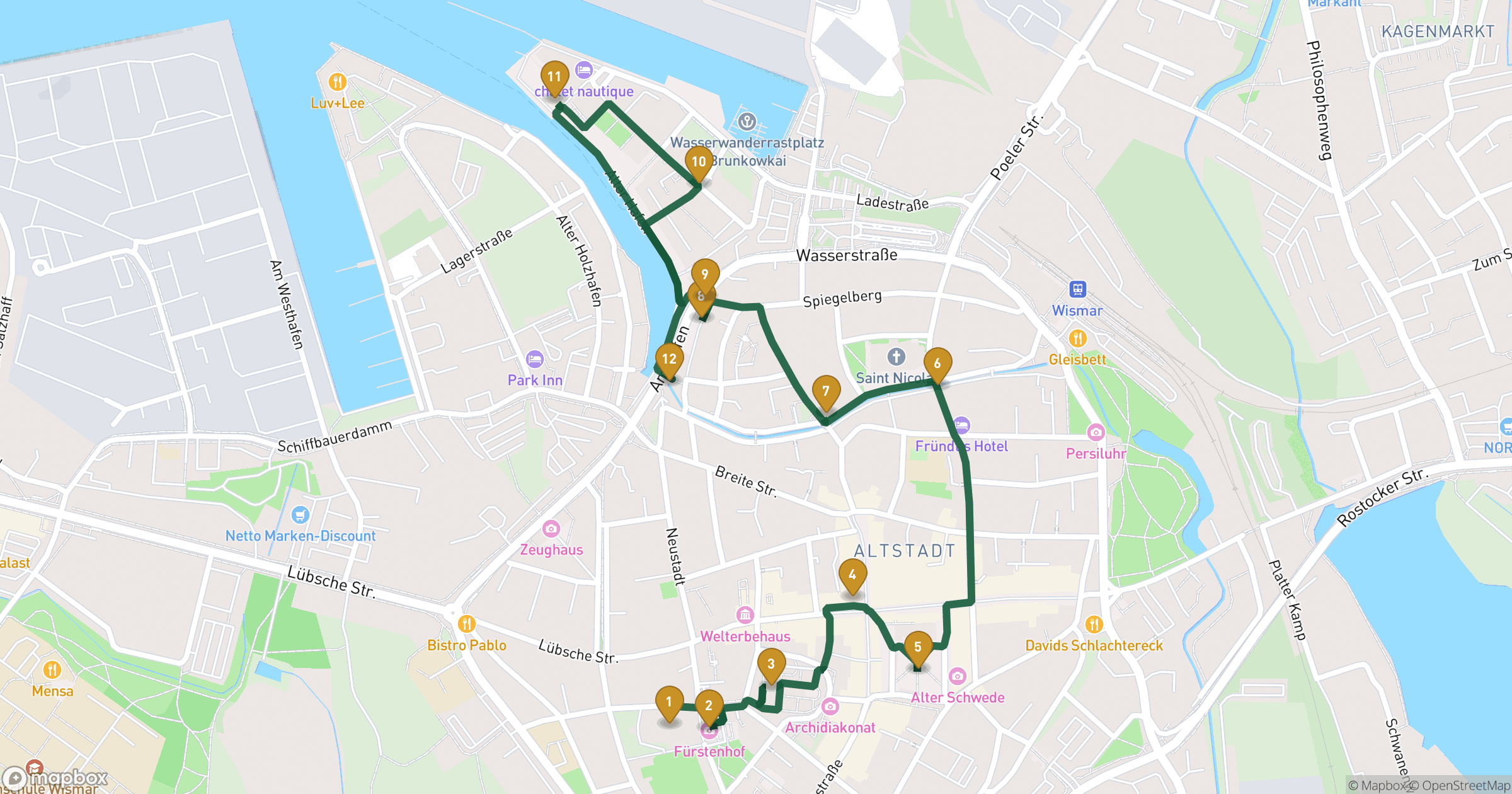
Map for Wismar walking tour with 12 stops
The static map shows the tour route with Georgenkirche (Wismar), duke manor, St.-Marien-Kirchturm, Karstadt-Stammhaus, and 8 more stops.

Stops along the route

All stops on this self-guided tour at a glance.

  1. Georgenkirche (Wismar) in Wismar
    Tilman2007 / CC BY-SA 3.0

    1Georgenkirche (Wismar)Church

    Georgenkirche stands as a colossal brick giant whose post-war fate turned on a dramatic disaster. In January 1990, a severe storm collapsed the north transept gable, smashing through two houses and finally triggering a major rescue effort. Inside, visitors now find a modern cultural center, while outside the unfinished tower reaches only about 36 meters.

    Style: Brick Gothic · Named after: Saint George · Wikidata

  2. duke manor in Wismar
    Tilman2007 / CC BY-SA 3.0

    2duke manorAttraction

    Fürstenhof showcases the northern Renaissance style inspired directly by Ferrara's Palazzo Roverella. Duke Johann Albrecht I commissioned the New Court between 1553 and 1555, adorned with terracotta reliefs from Statius von Düren depicting Hercules, Troy, and Samson. After 1648, Sweden installed its highest court for its German territories here, and the building now houses the local district court.

    Style: Johann Albrecht style · Wikidata

  3. 3St.-Marien-KirchturmChurch

    St. Marien zu den Weiden survives only as an empty space, remembered for a brutal political aftermath. In 1427, executed mayor Johann Bantzkow was buried in his family crypt beneath this former brick chapel following a lost naval battle and artisan revolts. Damaged by air raids in April 1945 and later cleared, the site once served briefly as an ancestral hall in 1934.

    Style: Brick Gothic · Named after: Mary · Wikidata

  4. Karstadt-Stammhaus in Wismar
    Matthias Süßen / CC BY-SA 4.0

    4Karstadt-StammhausBuilding

    Rudolph-Karstadt-Platz 1 marks the birthplace of a nationwide department store empire. Rudolph Karstadt opened his first shop here in 1881, pioneering fixed prices and cash payments before architect Johannes Busch designed the current 1907 building. Its originally green glazed roof tiles were swapped for plain red ones in 1941 to avoid drawing the attention of bombers.

    Wikidata

  5. Market square in Wismar in Wismar
    Tilman2007 / CC BY-SA 3.0

    5Market square in Wismar

    Markt is Wismar's vast central square, shadowed by a grim episode of municipal rebellion. A ground plaque commemorates Mayor Bantzkow and councillor Hinrik van Haren, both executed here in late 1427 during weaver Claus Jesup's uprising. Beside the 1380 Alter Schwede townhouse sits the Wasserkunst pavilion, which provided the city's drinking water until 1897.

    Wikidata

  6. Schweinsbrücke in Wismar
    E-W / CC BY-SA 3.0

    6Schweinsbrücke

    Schweinsbrücke spans Germany's historic Grube canal, marked by livestock traditions and brewer heritage. Four bronze pigs sculpted by Christian Wetzel in 1989 recall when farm animals were driven across toward the market. Directly adjacent rises the Schabbellhaus, built around 1570 by Philipp Brandin for brewer and mayor Hinrich Schabbell.

    Wikidata

  7. Frische Grube in Wismar
    Whgler / CC BY 4.0

    7Frische Grube

    Frische Grube traces an artificial 13th-century waterway engineered to power mills and supply urban breweries. The channel was dug to divert freshwater from the Mühlenteich pond directly into town before carrying waste into the harbor. Walking along its edge reveals quiet bridges and the unadorned rear facades of old residential quarters.

  8. Am Lohberg in Wismar
    JoachimKohler-HB / CC BY-SA 4.0

    8Am LohbergSquare

    Am Lohberg descends directly toward the harbor along a street named for historic tanners. First recorded in 1437 as supra Loberge, the route housed leather craftsmen who cured hides using oak bark. Around 1680, this steep descent was known as Hellepforte, and today active beer brewing continues along its rows of gabled houses.

    Wikidata

  9. Wassertor in Wismar
    Niteshift (talk) / CC BY 3.0

    9WassertorCastle

    Wassertor is the sole survivor of the city's five historic defensive gates, built around 1450 in Brick Gothic style. Its urban facade features a stepped gable with six blank arches, whereas the harbor front was altered around 1600 into a simple triangular gable. Over the archway, the Mecklenburg bull's head and the municipal coat of arms remain visible on both sides.

    Built: 1450 · Style: Brick Gothic · Wikidata

  10. Alter Hafen in Wismar
    Bärwinkel,Klaus / CC BY-SA 4.0

    10Alter Hafen

    Alter Hafen anchors Wismar's seafaring heritage, lined by weathered brick warehouses that once handled furs, cloth, and local beer. Traditional cutters still dock throughout the basin to sell fresh fish right off the deck. Across the water, the quay offers panoramic views of the bay and the towering spires of the Old Town.

  11. Baumhaus in Wismar
    Whgler / CC BY 4.0

    11BaumhausBuilding

    Baumhaus stands apart as a baroque harbor post named for the floating barriers once deployed across the basin. Harbor wardens called Bohmschlüter barred nocturnal entry using chains and floating logs operated from this administrative building. Two colorful bust replicas known as Schwedenköpfe flank the portal, having originally guided vessels from wooden harbor pilings.

    Style: baroque architecture · Wikidata

  12. Gewölbe in Wismar
    JoachimKohler-HB / CC BY-SA 4.0

    12GewölbeBuilding

    Gewölbe straddles the water on two barrel-vaulted bridge arches along the Runde Grube canal. In the 17th and 18th centuries, municipal wine inspectors called Weinherren worked inside to test every incoming harbor wine vintage before sale. Restored in 2003, the timber-framed structure later housed an eel smoking business throughout the 19th century.

    Wikidata

Download the app

This public page shows a preview. The full route, all content, and navigation are available in CityTour AI.

Cities nearby

Discover self-guided tours in nearby cities.

Frequently asked questions

The key answers before you start.

Is this a self-guided audio tour?

Yes. In the CityTour AI app (iOS and Android), this is a self-guided audio tour for Wismar — start anytime, at your own pace, with map, stops, and audio narration.

What will you see on this tour?

On this tour you'll see, among others, Georgenkirche (Wismar), duke manor, St.-Marien-Kirchturm, Karstadt-Stammhaus, Market square in Wismar, Schweinsbrücke and more sights.

Where does the tour start?

The route starts at Georgenkirche (Wismar) and ends at Gewölbe. You can start anytime — the app guides you to the first stop.

How long does the tour take?

About 98 minutes for 12 stops — at your own pace, with breaks whenever you like.

How much does the tour cost?

This tour costs 15 credits. The exact price depends on the pack you buy and your country — roughly $5.

Is it an outdoor tour — are entry tickets included?

Yes, it's an outdoor tour: the sights are viewed from the outside. Entry tickets are not included, and step-free access cannot be guaranteed.

Is the audio guide available in my language?

The tour and audio guide are available in English, Deutsch, Français, Español, Italiano and 9 more languages. You pick your language in the app.

Can I use the tour offline?

Yes. Tours can be used offline.

Can I ask the AI questions along the way?

Yes. At every stop you can ask the AI directly if you want to know more or didn't understand something.