CityTour AI

Aachen self-guided walking tour

Imperial City of Aachen: Between Thermal Springs and Coronation Splendor

Join us for a relaxed stroll through Aachen's old town and discover the fascinating blend of imperial grandeur and ancient bathing traditions. Experience the legacy of Charlemagne firsthand, feel the warmth of the thermal springs, and wander through charming alleys full of history. This tour takes you to the architectural highlights and hidden corners of Germany's westernmost city.

Audio tourSelf-guidediOS & Android
103minutes
2.6 kmdistance
12stops
Audio guideFormat
Imperial City of Aachen: Between Thermal Springs and Coronation Splendor
CEphoto, Uwe Aranas / CC BY-SA 3.0

Stops on this route

This tour works well for first-time visitors, weekend trips, and travelers who want to explore Aachen without a fixed tour time.

Route map for Aachen walking tour
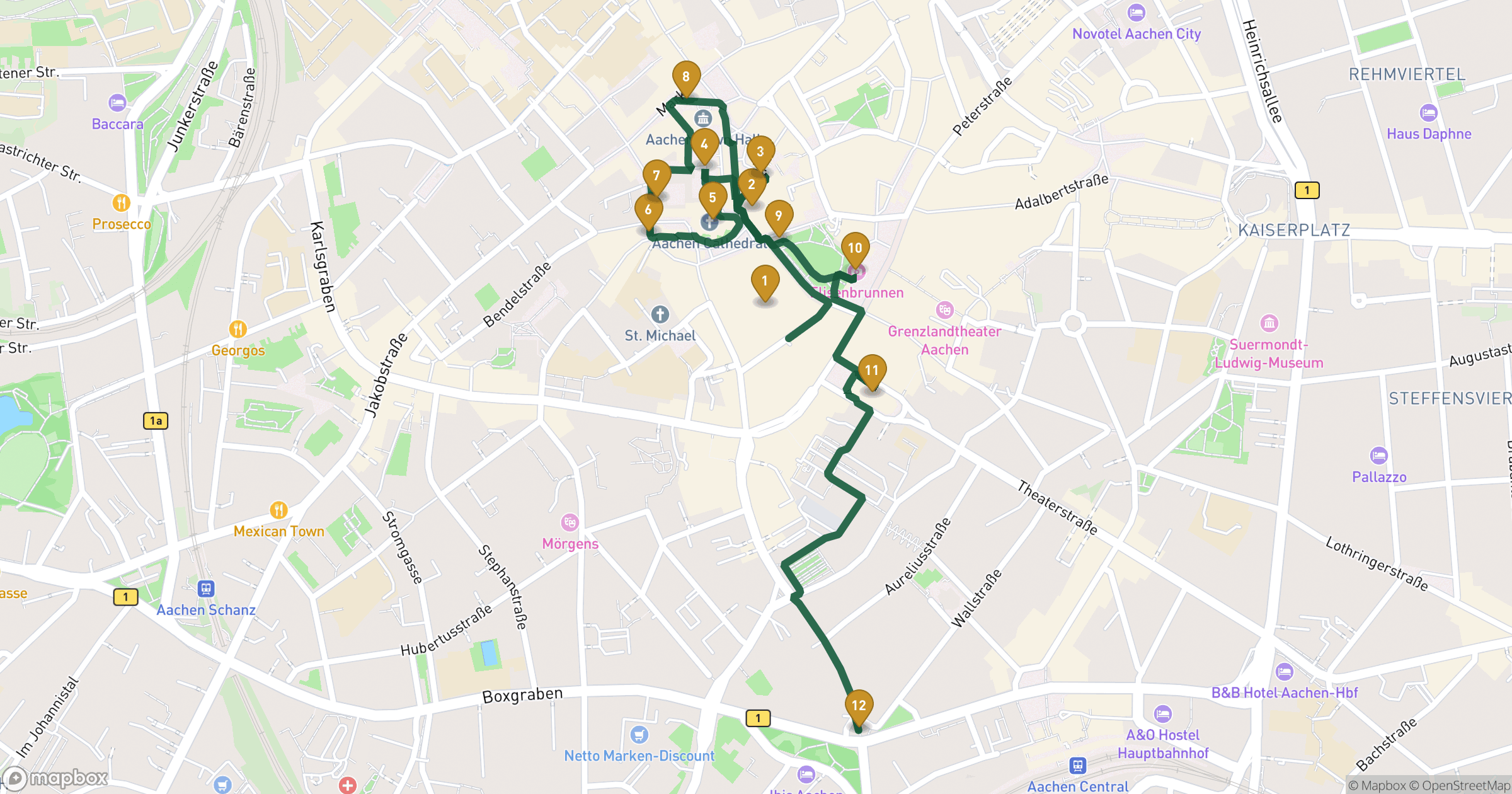
Map for Aachen walking tour with 12 stops
The static map shows the tour route with Elisabethhalle, St. Foillan, Hof, Katschhof, and 8 more stops.

Stops along the route

All stops on this self-guided tour at a glance.

  1. Elisabethhalle in Aachen
    Euku / CC BY-SA 3.0

    1Elisabethhalle

    Elisabethhalle stands as an intact municipal bathhouse capturing the elegance of Jugendstil design. Architect Joseph Laurent designed it in 1911 with separate halls, giving the men's section notably grander decor. Inside, a marble Neptune fountain overlooks the main pool, which is filled with ordinary tap water rather than the city's thermal springs.

    Built: 1911 · Architect: Joseph Laurent · Style: Art Nouveau architecture · Wikidata

  2. St. Foillan in Aachen
    Karlunun / CC BY-SA 4.0

    2St. FoillanChurch

    St. Foillan introduces an unusual dedication as the German-speaking world's only church named after this seventh-century Irish monk. Built originally by local citizens around 1180, its tower sits on the south side rather than the west to avoid crowding the nearby cathedral. Following wartime destruction, architect Leo Hugot added a folded concrete ceiling inspired by a church in Toulouse.

    Built: 1482 · Named after: Foillan · Wikidata

  3. Hof in Aachen
    Armin Kleiner / CC BY-SA 4.0

    3HofSquare

    Hof square showcases reconstructed Roman portico columns that evoke the city's origins as an ancient legionary spa. Sculptor Bonifatius Stirnberg added the Puppenbrunnen in 1975, featuring articulated bronze figures with movable joints. These bendable characters carry symbolic local meanings, such as a rooster for French occupation and dolls representing the textile industry.

    Wikidata

  4. Katschhof in Aachen
    Carolus Ludovicus / CC BY-SA 2.0 de

    4KatschhofSquare

    Katschhof occupies the inner courtyard of Charlemagne's imperial palace between the cathedral and the town hall. Its name recalls the medieval pillory that once stood on the grounds for public justice. Pavement markings across the open area trace the outlines of ancient palace buildings buried underground.

    Wikidata

  5. Aachen Cathedral in Aachen
    CEphoto, Uwe Aranas / CC BY-SA 3.0

    5Aachen Cathedral

    Aachen Cathedral centers on Charlemagne's Palatine Chapel, an octagonal core completed around 800 by architect Odo of Metz. Between 936 and 1531, thirty German kings were crowned upon its plain marble throne. At the main bronze entrance, visitors can reach inside the right lion-head handle to feel a metal pin known locally as the devil's thumb.

    Built: 801 · Architect: Odo of Metz · Style: Pre-Romanesque architecture … · Heritage status: World Heritage Site · Wikidata

  6. Fischmarkt in Aachen
    CherryX / CC BY-SA 3.0

    6FischmarktSquare

    Fischmarkt centers on civic history beside the cathedral, anchored by the Grashaus that served as the city's first town hall around 1260. In the middle of the square stands the Fischpüddelchen fountain, depicting a naked boy grasping two fish. Melted down during the war, the beloved bronze statue was recast from old models in 1954.

    Wikidata

  7. Aachen Cathedral Treasury in Aachen
    Berthold Werner / CC BY-SA 3.0

    7Aachen Cathedral TreasuryMuseum

    Aachen Cathedral Treasury safeguards centuries of precious imperial and religious relics that survived the devastating city fire of 1656. In the nineteenth century, the sexton personally guided visitors to the gothic relic cabinet for a small fee, swinging open its heavy painted doors. Highlights on display include the jeweled Cross of Lothair and the gilded bust of Charlemagne.

    Heritage status: World Heritage Site · Wikidata

  8. Markt in Aachen
    Berthold Werner / CC BY-SA 3.0

    8MarktSquare

    Markt forms the civic heart of the old town, dominated by the fourteenth-century town hall built atop the foundations of Charlemagne's palace hall. Directly out front stands the Karlsbrunnen, the city's oldest fountain, crowned by a statue of Charlemagne. The Gothic facade of the town hall is lined with stone statues of German kings.

    Wikidata

  9. Kreislauf des Geldes monument (money cycle) in Aachen
    Grunpfnul / CC BY-SA 4.0

    9Kreislauf des Geldes monument (money cycle)

    Kreislauf des Geldes presents a satirical look at human vices through a circular fountain installed in 1976. Sculptor Karl-Henning Seemann cast bronze figures such as a miser clutching coins and a greedy man who never has enough. Water circulates continuously around the movable figures to mirror the flow of money in commerce.

    Built: 1976 · Wikidata

  10. Elisenbrunnen in Aachen
    Karl Friedrich Schinkel / CC BY-SA 2.5

    10ElisenbrunnenAttraction

    Elisenbrunnen exemplifies classical Prussian bath architecture with its colonnaded pavilion designed by Johann Peter Cremer and Karl Friedrich Schinkel. Sulfuric thermal water bubbles up from the ground here at over 50 degrees Celsius, creating a pungent odor. Marble tablets inside commemorate famous visitors who came to drink the water, including Casanova and Peter the Great.

    Architect: Karl Friedrich Schinkel, Johann Peter Cremer · Style: Neoclassical architecture · Wikidata

  11. Theater Aachen in Aachen
    Berthold Werner / CC BY-SA 3.0

    11Theater AachenTheatre

    Theater Aachen displays monumental classical architecture with a temple-style portico built during the 1820s. A young Herbert von Karajan launched his international conducting career here in the 1930s as Germany's youngest general music director. Above the imposing entrance columns, the triangular pediment features delicate relief carvings.

    Wikidata

  12. Marschiertor in Aachen
    א (Aleph) / CC BY-SA 2.5

    12MarschiertorAttraction

    Marschiertor stands as the fourteenth-century southern main gate of the outer city wall, drawing its name from an old designation for nearby Burtscheid. Over the centuries it functioned as an armory, a prison, and eventually a twentieth-century youth hostel. Today, the massive twin-towered structure serves as the headquarters of the Stadtwache Oecher Penn carnival society.

    Wikidata

Download the app

This public page shows a preview. The full route, all content, and navigation are available in CityTour AI.

Cities nearby

Discover self-guided tours in nearby cities.

Frequently asked questions

The key answers before you start.

Is this a self-guided audio tour?

Yes. In the CityTour AI app (iOS and Android), this is a self-guided audio tour for Aachen — start anytime, at your own pace, with map, stops, and audio narration.

What will you see on this tour?

On this tour you'll see, among others, Elisabethhalle, St. Foillan, Hof, Katschhof, Aachen Cathedral, Fischmarkt and more sights.

Where does the tour start?

The route starts at Elisabethhalle and ends at Marschiertor. You can start anytime — the app guides you to the first stop.

How long does the tour take?

About 103 minutes for 12 stops — at your own pace, with breaks whenever you like.

How much does the tour cost?

This tour costs 15 credits. The exact price depends on the pack you buy and your country — roughly $5.

Is it an outdoor tour — are entry tickets included?

Yes, it's an outdoor tour: the sights are viewed from the outside. Entry tickets are not included, and step-free access cannot be guaranteed.

Is the audio guide available in my language?

The tour and audio guide are available in English, Deutsch, Français, Español, Italiano and 9 more languages. You pick your language in the app.

Can I use the tour offline?

Yes. Tours can be used offline.

Can I ask the AI questions along the way?

Yes. At every stop you can ask the AI directly if you want to know more or didn't understand something.