CityTour AI

Bad Oeynhausen self-guided walking tour

Bad Oeynhausen: Between Spa Gardens and Fairytales

Experience the splendor of the Prussian state spa on a relaxed walk through the magnificent Kurpark and the historic city center. Discover architectural gems from Neo-Baroque to Art Nouveau and learn about the history of the healing brine. A perfect mix of history, nature, and culture awaits you.

Audio tourSelf-guidediOS & Android
104minutes
4.1 kmdistance
11stops
Audio guideFormat
Bad Oeynhausen: Between Spa Gardens and Fairytales
Gwexter / CC BY-SA 3.0

Stops on this route

This tour works well for first-time visitors, weekend trips, and travelers who want to explore Bad Oeynhausen without a fixed tour time.

Route map for Bad Oeynhausen walking tour
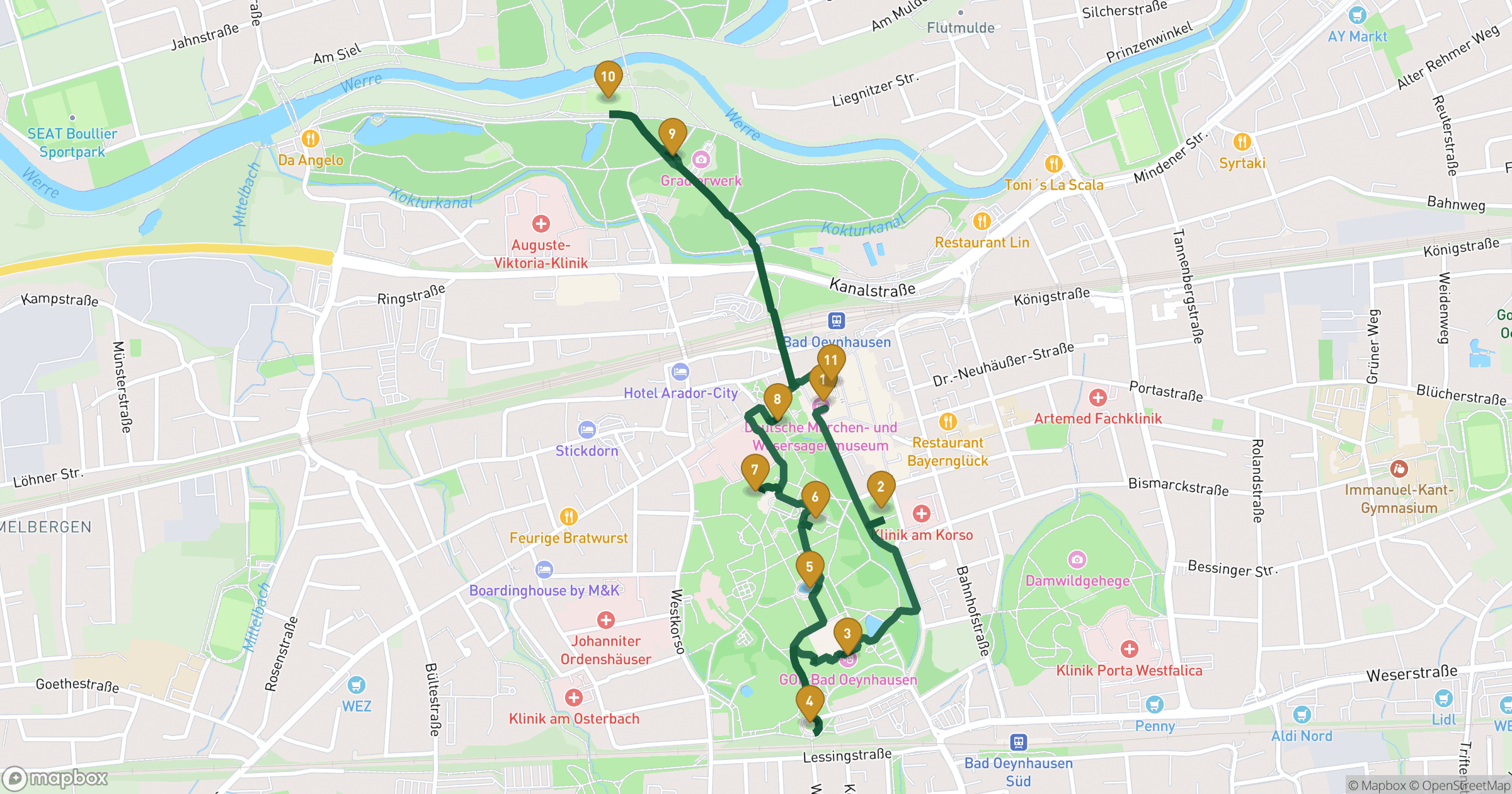
Map for Bad Oeynhausen walking tour with 11 stops
The static map shows the tour route with Deutsches Märchen- und Wesersagenmuseum, Auferstehungskirche, Kurhaus Bad Oeynhausen, Jordansprudel, and 7 more stops.

Stops along the route

All stops on this self-guided tour at a glance.

  1. Deutsches Märchen- und Wesersagenmuseum in Bad Oeynhausen
    Gwexter / CC BY-SA 3.0

    1Deutsches Märchen- und Wesersagenmuseum

    The German Fairy Tale and Weser Myth Museum is housed inside the Art Nouveau Villa Paul Baehr. It opened in 1973 after folklorist and writer Karl Paetow donated his extensive private collection to the town, directing it as a volunteer until 1981. Paetow contributed countless graphics depicting legendary figures such as the Pied Piper of Hamelin and Rübezahl.

    Built: 1973 · Wikidata

  2. Auferstehungskirche in Bad Oeynhausen
    Z thomas / CC BY-SA 4.0

    2AuferstehungskircheChurch

    The Resurrection Church stands with its striking tower, showing a post-war rebuilding rather than its 1879 neo-Gothic original. Under Pastor Karl Koch, who served from 1915 to 1949, the parish hosted the Confessing Church's final Reich-level synod in 1936. A severe fire ruined the building in 1947, leading architect Diez Brandi to design the new structure consecrated in 1956.

    Architect: Diez Brandi · Named after: Resurrection of Jesus · Wikidata

  3. Kurhaus Bad Oeynhausen in Bad Oeynhausen
    Elelicht / CC BY-SA 3.0

    3Kurhaus Bad OeynhausenTheatre

    The Kurhaus is a neo-Baroque palace from 1908 that originally served as the social heart for Prussian nobility and wealthy visitors. Its monumental facade featuring classic columns was meant to signal world-class status during the imperial era. Today, the ballroom atmosphere has shifted, as the building houses the GOP Varieté-Theater with acrobats and magicians.

    Style: baroque revival · Wikidata

  4. Jordansprudel in Bad Oeynhausen
    Gunnar Ries Amphibol / CC BY-SA 3.0

    4Jordansprudel

    The Jordan Spring is a technical marvel drilled between 1924 and 1926 to a depth of 725 meters, creating the world's largest carbonated thermal brine spring. Named after bath director Albert Jordan, its 36-degree water originally erupted up to 50 meters into the air. Since 2000, stored water from the Werre runs in a closed loop, powering a 20-meter jet from Easter to October.

    Wikidata

  5. Kurpark Bad Oeynhausen in Bad Oeynhausen
    -- Ingo2802 11:15, 17. Apr 2006 (CEST) / CC BY-SA 3.0

    5Kurpark Bad Oeynhausen

    The Spa Park was planned between 1851 and 1853 by Prussian landscape architect Peter Joseph Lenné in a characteristic horseshoe shape. After 1945, the British army fenced the grounds with barbed wire, turning the Kaiserpalais into a canteen and bathhouses into offices. Bathhouse I, built by Carl Ferdinand Busse in 1854, remains preserved as the park's oldest building.

    Wikidata

  6. Theater im Park in Bad Oeynhausen
    Ub12vow / CC BY 3.0

    6Theater im ParkTheatre

    The Theater in the Park was opened in 1915 to integrate high culture directly into the daily spa routine. Designed with classical proportions, the building offers an intimate alternative to the sprawling Kurhaus nearby. Its restrained and elegant architecture was deliberately chosen over the dominant monumentalism of that era.

    Wikidata

  7. 7WandelhalleBuilding

    The Wandelhalle is a neoclassical promenade hall built in 1926 by architect Diez Brandi to replace an earlier wooden structure. Here, spa guests strolled sheltered from the elements while receiving precise doses of medicinal brine from fountain girls behind counters. Brandi intentionally kept open connections to the surrounding park, and the hall is now used for concerts.

  8. Badehaus in Gmunden in Bad Oeynhausen
    Otto Friedrich / Public domain

    8Badehaus in Gmunden

    The Bathhouse in Gmunden features a distinct Prussian brick construction dating in its present form to around 1906. Rising to over 18 meters in height, the exterior displays elaborate brick ornamentation that lends the utility building a sacred feel. On the inside, guests once took therapeutic brine baths in luxurious private tub chambers.

    Built: 1906 · Height: 18.8 m · Wikidata

  9. 9Bülow-BrunnenMonument

    The Bülow Fountain commemorates the Prussian senior president Hans von Bülow and his decade-long persistence in drilling for underground salt deposits. In 1845, crews finally struck warm thermal brine at a depth of roughly 600 meters, marking the birth of the spa town. Bülow immediately commissioned grand plans for the resort before the water's medical traits were analyzed.

  10. 10Turnierplatz im Sielpark

    The tournament grounds in Sielpark offer a wide, open meadow that links the urban center to the natural banks of the Werre. The expansive lawns are regularly used for equestrian events and community gatherings away from the dense town center. The gently flowing Werre serves as a reminder of the natural river waters that shaped the local landscape.

  11. Lenné-Karree in Bad Oeynhausen
    Roy Zuo / CC BY-SA 4.0

    11Lenné-Karree

    Lenné-Karree is a modern urban square paying tribute to Peter Joseph Lenné, the Prussian garden master behind the nearby spa park. Lenné never visited the town in person, creating his entire park layout from precise topographical maps. Today, functional and open architecture frames shops and cafés just steps away from the historic spa grounds.

Download the app

This public page shows a preview. The full route, all content, and navigation are available in CityTour AI.

Cities nearby

Discover self-guided tours in nearby cities.

Frequently asked questions

The key answers before you start.

Is this a self-guided audio tour?

Yes. In the CityTour AI app (iOS and Android), this is a self-guided audio tour for Bad Oeynhausen — start anytime, at your own pace, with map, stops, and audio narration.

What will you see on this tour?

On this tour you'll see, among others, Deutsches Märchen- und Wesersagenmuseum, Auferstehungskirche, Kurhaus Bad Oeynhausen, Jordansprudel, Kurpark Bad Oeynhausen, Theater im Park and more sights.

Where does the tour start?

The route starts at Deutsches Märchen- und Wesersagenmuseum and ends at Lenné-Karree. You can start anytime — the app guides you to the first stop.

How long does the tour take?

About 104 minutes for 11 stops — at your own pace, with breaks whenever you like.

How much does the tour cost?

This tour costs 15 credits. The exact price depends on the pack you buy and your country — roughly $5.

Is it an outdoor tour — are entry tickets included?

Yes, it's an outdoor tour: the sights are viewed from the outside. Entry tickets are not included, and step-free access cannot be guaranteed.

Is the audio guide available in my language?

The tour and audio guide are available in English, Deutsch, Français, Español, Italiano and 9 more languages. You pick your language in the app.

Can I use the tour offline?

Yes. Tours can be used offline.

Can I ask the AI questions along the way?

Yes. At every stop you can ask the AI directly if you want to know more or didn't understand something.