CityTour AI

Gelsenkirchen self-guided walking tour

Knights, Crimes, and Industrial Fires

Discover the surprising layers of Gelsenkirchen, from its medieval knightly roots and industrial 'City of a Thousand Fires' legacy to its modern identity as a hub of solar innovation. This walk weaves through hidden water castles, avant-garde theaters, and the sites of forgotten historical dramas. You will experience the city's dramatic transformation through its architecture, art-filled forests, and the echoes of the people who shaped the Ruhr area.

Audio tourSelf-guidediOS & Android
105minutes
5.2 kmdistance
8stops
Audio guideFormat
Knights, Crimes, and Industrial Fires
Thomas Dahlstrøm Nielsen / CC BY-SA 4.0

Stops on this route

This tour works well for first-time visitors, weekend trips, and travelers who want to explore Gelsenkirchen without a fixed tour time.

Route map for Gelsenkirchen walking tour
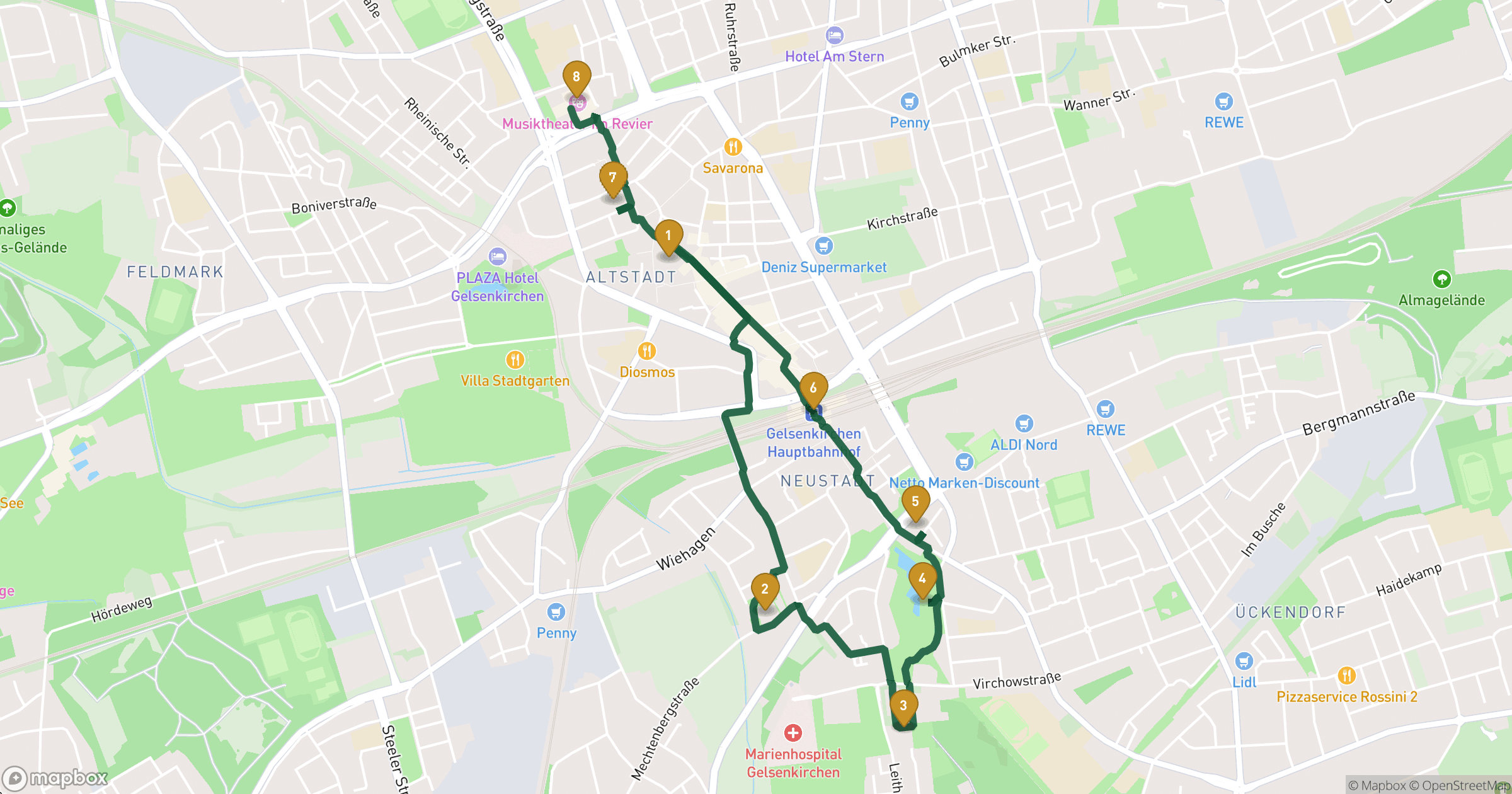
Map for Gelsenkirchen walking tour with 8 stops
The static map shows the tour route with Propsteikirche Sankt Augustinus, Haus Leithe, Rheinelbe mine, Wissenschaftspark Gelsenkirchen, and 4 more stops.

Stops along the route

All stops on this self-guided tour at a glance.

  1. Propsteikirche Sankt Augustinus in Gelsenkirchen
    Thomas Dahlstrøm Nielsen / CC BY-SA 4.0

    1Propsteikirche Sankt AugustinusChurch

    Propsteikirche Sankt Augustinus stands in the heart of the city as a massive neo-Gothic brick anchor from the coal boom era. Designed by August Rincklake and finished in 1884, its nearly 100-meter spire once served as a primary landmark for the City of a Thousand Fires. Inside its vaulted nave, original stained-glass windows remain intact after surviving heavy wartime bombings.

    Architect: August Lange · Style: Gothic Revival · Named after: Augustine of Hippo · Wikidata

  2. Haus Leithe in Gelsenkirchen
    Jo22ge / CC BY-SA 3.0

    2Haus LeitheMonument

    Haus Leithe in the Neustadt district preserves the legacy of a knightly dynasty whose lineage traces back to the 14th century. Built around 1565 with a stepped gable, the main manor rests on a brick cross-vaulted cellar that has endured for nearly five centuries. Following a severe 2019 roof fire, a local architect and an art historian bought the site in 2025 to create a cultural venue.

    Wikidata

  3. 3Rheinelbe mine

    Rheinelbe mine highlights how nature and public art reclaimed an industrial landscape scarred by early mine flooding. Following the 1906 Courrières disaster in France, a rescue crew from this colliery traveled across the border to assist trapped French miners. Hermann Prigann transformed the grounds into a sculpture forest crowned by the Stairway to Heaven atop the slag heap.

    Wikidata

  4. Wissenschaftspark Gelsenkirchen in Gelsenkirchen
    Frank Vincentz / CC BY-SA 3.0

    4Wissenschaftspark GelsenkirchenBuilding

    Wissenschaftspark Gelsenkirchen replaced the former Munscheid steelworks with a striking 300-meter glass gallery dedicated to solar innovation. American artist Dan Flavin created a bold permanent light installation here, using colored neon tubes along the glass concourse. Next to the park's lake, the building also houses the Pixelprojekt Ruhrgebiet photographic collection.

    Wikidata

  5. Amtsgericht in Gelsenkirchen
    Jordi / CC BY-SA 4.0

    5Amtsgericht

    The Amtsgericht operates inside the contemporary Justizzentrum opened in April 2016 at Bochumer Straße and Junkerweg. It replaced the previous courthouse, which was abruptly shuttered in February 2013 due to an acute risk of structural collapse. Behind its quiet facade, the 20,000-square-meter complex contains 23 courtrooms and serves as a workplace for around 320 staff members.

  6. Gelsenkirchen Central Station in Gelsenkirchen
    No machine-readable author provided. Marc Schuelper assumed (based on copyright claims).; No machine-readable source provided. Own work assumed (based on copyright claims). / CC BY-SA 3.0

    6Gelsenkirchen Central Station

    Gelsenkirchen Central Station marks the site of an international wartime shooting on the eve of the Great War. On August 3, 1914, British civilian Henry Hadley was fatally shot on the platform by a German officer during a train stop. The station grounds became a battleground again during the 1920 Ruhr Uprising as workers clashed with paramilitaries over vital railway links.

    Wikidata

  7. Hans-Sachs-Haus in Gelsenkirchen
    Dr. W. Strickling / CC BY-SA 4.0

    7Hans-Sachs-HausBuilding

    Hans-Sachs-Haus exemplifies 1920s Brick Expressionism, built as a multi-purpose municipal center by Alfred Fischer. Fischer devised an innovative navigation method for the interior, assigning distinct colors to each floor to guide visitors. While a major overhaul in the early 2000s gutted the interior to insert a modern glass atrium, the original curved brick facade was kept intact.

    Named after: Hans Sachs · Wikidata

  8. Musiktheater im Revier in Gelsenkirchen
    MiR Gelsenkirchen / CC BY-SA 3.0

    8Musiktheater im RevierTheatre

    Musiktheater im Revier was conceived in 1959 by Werner Ruhnau as a transparent, democratic theater welcoming the industrial city. The foyer is world-renowned for monumental deep-blue sponge reliefs installed directly onto the walls by French artist Yves Klein. Alongside Klein's work, integrated pieces by Robert Adams and Jean Tinguely turned the venue into a landmark of 1950s modernism.

    Built: 1959 · Architect: Werner Ruhnau · Wikidata

Download the app

This public page shows a preview. The full route, all content, and navigation are available in CityTour AI.

Cities nearby

Discover self-guided tours in nearby cities.

Frequently asked questions

The key answers before you start.

Is this a self-guided audio tour?

Yes. In the CityTour AI app (iOS and Android), this is a self-guided audio tour for Gelsenkirchen — start anytime, at your own pace, with map, stops, and audio narration.

What will you see on this tour?

On this tour you'll see, among others, Propsteikirche Sankt Augustinus, Haus Leithe, Rheinelbe mine, Wissenschaftspark Gelsenkirchen, Amtsgericht, Gelsenkirchen Central Station and more sights.

Where does the tour start?

The route starts at Propsteikirche Sankt Augustinus and ends at Musiktheater im Revier. You can start anytime — the app guides you to the first stop.

How long does the tour take?

About 105 minutes for 8 stops — at your own pace, with breaks whenever you like.

How much does the tour cost?

This tour costs 15 credits. The exact price depends on the pack you buy and your country — roughly $5.

Is it an outdoor tour — are entry tickets included?

Yes, it's an outdoor tour: the sights are viewed from the outside. Entry tickets are not included, and step-free access cannot be guaranteed.

Is the audio guide available in my language?

The tour and audio guide are available in English, Deutsch, Français, Español, Italiano and 9 more languages. You pick your language in the app.

Can I use the tour offline?

Yes. Tours can be used offline.

Can I ask the AI questions along the way?

Yes. At every stop you can ask the AI directly if you want to know more or didn't understand something.