CityTour AI

Münster self-guided walking tour

The Heart of Münster: From Baroque Splendor to the Peace of Westphalia

Join us for a relaxed stroll through Westphalia’s "parlor," where history comes alive at every turn. From monumental churches and the famous Peace Hall to hidden Baroque gems, experience a unique blend of tradition and vibrant student life. We follow the traces of powerful bishops, skilled merchants, and the spirit of the Peace of Westphalia through the charming alleys of the Old Town.

Audio tourSelf-guidediOS & Android
104minutes
3.2 kmdistance
13stops
Audio guideFormat
The Heart of Münster: From Baroque Splendor to the Peace of Westphalia
J.-H. Janßen / CC BY-SA 4.0

Stops on this route

This tour works well for first-time visitors, weekend trips, and travelers who want to explore Münster without a fixed tour time.

Route map for Münster walking tour
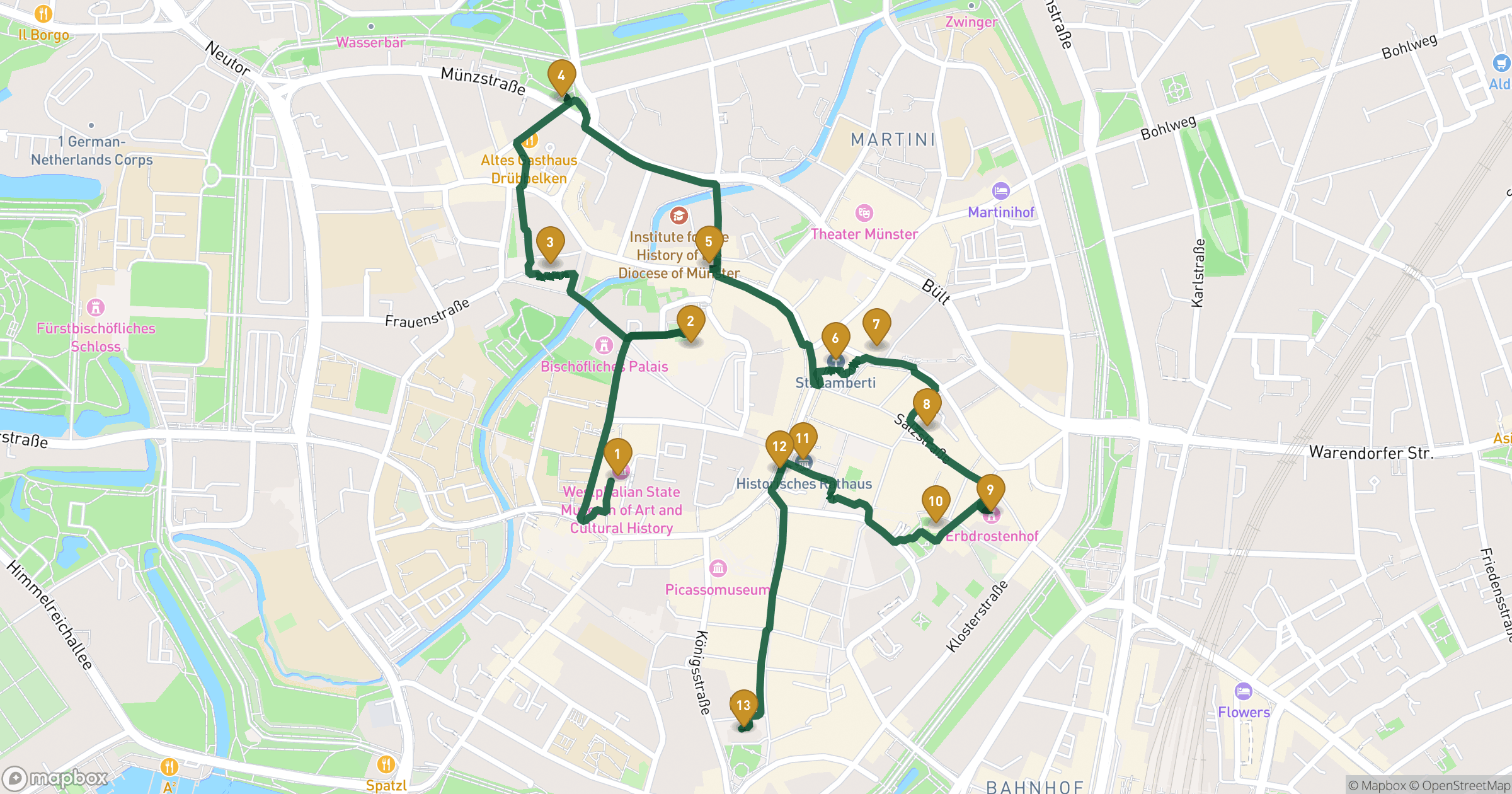
Map for Münster walking tour with 13 stops
The static map shows the tour route with Westphalian State Museum of Art and Cultural History, St.-Paulus-Dom, Überwasserkirche, Buddenturm, and 9 more stops.

Stops along the route

All stops on this self-guided tour at a glance.

  1. Westphalian State Museum of Art and Cultural History in Münster
    J.-H. Janßen / CC BY-SA 4.0

    1Westphalian State Museum of Art and Cultural History

    The LWL Museum for Art and Culture displays an architectural contrast between Hermann Schaedtler's 1908 neo-Renaissance building and Volker Staab's modern 2014 extension. Above the portal sits an allegorical figure of art sculpted by Wilhelm Bolte. In 1937, works by expressionists such as August Macke and Ernst Ludwig Kirchner were seized during the Degenerate Art campaign.

    Built: 1905 · Architect: Hermann Schaedtler, Volker Staab · Wikidata

  2. St.-Paulus-Dom in Münster
    Dietmar Rabich / CC BY-SA 4.0

    2St.-Paulus-DomChurch

    St. Paul's Cathedral stands on the Horsteberg, showcasing a blend of Romanesque and Gothic architecture between its massive west towers. Inside, an astronomical clock from the sixteenth century displays not only the time but also moon phases and planetary positions. In the Ludgerus Chapel lies Clemens August Graf von Galen, who delivered sermons opposing Nazi euthanasia programs.

    Built: 1225 · Architect: Emil Steffann · Style: Gothic architecture · Height: 58 m · Wikidata

  3. Überwasserkirche in Münster
    Überwasserkirche_-_Münster_-_003_-_Panorama_part.jpg: Roland Geider (Ogre) Überwasserkirche_-_Münster_-_004_-_Panorama_part.jpg: Roland Geider (Ogre) Überwasserkirche_-_Münster_-_005_-_Panorama_part.jpg: Roland Geider (Ogre) Überwasserkirche_-_Münster_-_006_-_Panorama_part.jpg: Roland Geider (Ogre) Überwasserkirche_-_Münster_-_007_-_Panorama_part.jpg: Roland Geider (Ogre) Überwasserkirche_-_Münster_-_008_-_Panorama_part.jpg: Roland Geider (Ogre) Überwasserkirche_-_Münster_-_009_-_Panorama_part.jpg: Roland Geider (Ogre) derivative work: kaʁstn Disk/Cat; Überwasserkirche_-_Münster_-_003_-_Panorama_part.jpg Überwasserkirche_-_Münster_-_004_-_Panorama_part.jpg Überwasserkirche_-_Münster_-_005_-_Panorama_part.jpg Überwasserkirche_-_Münster_-_006_-_Panorama_part.jpg Überwasserkirche_-_Münster_-_007_-_Panorama_part.jpg Überwasserkirche_-_Münster_-_008_-_Panorama_part.jpg Überwasserkirche_-_Münster_-_009_-_Panorama_part.jpg / Public domain

    3ÜberwasserkircheChurch

    Across the river Aa, the Gothic Liebfrauen-Überwasser church originated in 1040 as an exclusive convent founded by Bishop Hermann I for noblewomen. The church tower permanently lost its spire in 1534 when Anabaptists dismantled it to position defensive cannons on the platform. Inside lies the final resting place of Baroque architect Johann Conrad Schlaun, whose exact grave location remains unknown.

    Built: 1343 · Architect: Gerhard Gröninger, Johann Conrad Schlaun · Style: Gothic architecture · Height: 64.5 m · Wikidata

  4. Buddenturm in Münster
    Rüdiger Wölk / CC BY-SA 2.0 de

    4BuddenturmTower

    Erected around 1150 from quarry stone, the Romanesque Buddenturm is the oldest surviving segment of the medieval city fortifications. Having served through the centuries as a powder magazine and a prison, the structure was drastically altered in 1878 to supply drinking water. This conversion raised the tower to 40 meters, added a large water reservoir, and fitted a new battlement.

    Built: 1150 · Style: Romanesque architecture · Wikidata

  5. Kiepenkerldenkmal in Münster
    NordhornerII / CC BY-SA 3.0

    5Kiepenkerldenkmal

    The Kiepenkerl monument commemorates the traveling merchants of Westphalia who transported goods across villages in their traditional linen smocks and carrying baskets. After an American tank crushed August Schmiemann's original 1896 statue in 1945, sculptors Albert Mazzotti and Heinrich Ostlinnig cast an authentic bronze copy. Federal President Theodor Heuss ceremoniously inaugurated this replacement in 1953.

    Built: 1896 · Wikidata

  6. St. Lamberti in Münster
    Dietmar Rabich / CC BY-SA 4.0

    6St. LambertiChurch

    Financed by local merchants rather than the church, the late-Gothic St. Lamberti market church features three prominent iron cages hanging from its tower. In 1536, the remains of executed Anabaptist leaders Jan van Leiden, Bernd Krechting, and Bernd Knipperdolling were displayed inside these enclosures. Since 2014, tower keeper Martje Thalmann climbs 298 steps nightly to sound her copper horn in three directions.

    Built: 1600 · Architect: Hans Ostermann, Hilger Hertel the Elder … · Style: Gothic architecture · Height: 90.5 m · Wikidata

  7. Krameramtshaus in Münster
    Dietmar Rabich / CC BY-SA 4.0

    7Krameramtshaus

    Built in 1589 with stepped gables, the Krameramtshaus displays the wealth and prestige of the historic merchant guild. Dutch envoys lodged inside this Renaissance brick building in 1648 while negotiating the Peace of Westphalia to conclude the Eighty Years' War. It stands out in the quarter as one of the few historical buildings that emerged nearly unscathed from the Second World War.

    Wikidata

  8. Dominikanerkirche in Münster
    Dietmar Rabich / CC BY-SA 4.0

    8DominikanerkircheChurch

    Built in the early eighteenth century, the deconsecrated Baroque Dominican Church now functions as a dedicated venue for art and science. A massive metal sphere suspended from the dome alongside two gray glass mirrors forms a site-specific Foucault pendulum created by Gerhard Richter. The steady shift in the pendulum's oscillation plane demonstrates the physical rotation of the Earth.

    Architect: Karlheinz Sundermann, Lambert Friedrich Corfey · Style: Baroque · Wikidata

  9. Erbdrostenhof in Münster
    Original: Dietmar Rabich ( Derivative work: Rabanus Flavus ) | File:Münster, Erbdrostenhof -- 2017 -- 6918.jpg / CC BY-SA 4.0

    9ErbdrostenhofCastle

    The Erbdrostenhof palace stands out as Johann Conrad Schlaun's three-winged Baroque masterpiece designed for Baron Droste zu Vischering around 1757. Schlaun curved the facade concavely to visually enlarge the cramped forecourt along Salzstraße. Although heavily damaged during the Second World War, the residence was meticulously reconstructed and still hosts concerts in its banquet hall.

    Built: 1757 · Architect: Johann Conrad Schlaun · Style: baroque architecture · Wikidata

  10. Clemenskirche in Münster
    Hajotthu / CC BY 3.0

    10ClemenskircheChurch

    Commissioned by Prince-Bishop Clemens August I of Bavaria, St. Clement's Church is a Baroque monastery sanctuary based on Rome's Sant'Agnese in Agone. A chronogram above the main entrance explicitly declares that the prince-bishop financed the construction from his own funds. Reconstruction in the 1950s left out the destroyed hospital wings, while yellow-brown scagliola covers the interior pillars.

    Architect: Johann Conrad Schlaun · Style: baroque architecture · Named after: Clement · Wikidata

  11. Historical Town Hall of Münster in Münster
    Dietmar Rabich / CC BY-SA 4.0

    11Historical Town Hall of MünsterAttraction

    Münster's Historical City Hall is defined by its soaring 31-meter Gothic gable from the fourteenth century, adorned with statues of saints and kings. Inside lies the Hall of Peace, where envoys assembled in 1648 to swear the Peace of Westphalia and end the Thirty Years' War. Despite near-total wartime destruction, citizens faithfully rebuilt the landmark to its original specifications.

    Built: 1200 · Height: 31 m · Wikidata

  12. Prinzipalmarkt in Münster
    Günter Seggebäing, Coesfeld / CC BY-SA 3.0

    12Prinzipalmarkt

    Originating as a twelfth-century marketplace, the Prinzipalmarkt forms the historic commercial core through its continuous rows of arcaded gabled houses. Following near-total destruction in the Second World War, citizens reconstructed each individual facade with distinct shapes, stair patterns, and curves. The ground-floor arches offer sheltered walkways for shoppers and direct views toward the cages of St. Lamberti.

    Wikidata

  13. St. Ludgeri (Münster) in Münster
    Elektroschreiber / CC BY-SA 3.0

    13St. Ludgeri (Münster)Church

    Founded around 1173 by Bishop Ludwig I of Wippra to anchor a new southern district, St. Ludgeri blends distinct building eras. In 1178, the nobleman Franco of Wettringen donated his entire parental inheritance to fund the construction after both his brothers died childless. While the massive Romanesque-style west towers date to 1874, the church's centerpiece is its delicate octagonal Gothic crossing tower.

    Style: Gothic architecture · Named after: Ludger · Wikidata

Download the app

This public page shows a preview. The full route, all content, and navigation are available in CityTour AI.

Cities nearby

Discover self-guided tours in nearby cities.

Frequently asked questions

The key answers before you start.

Is this a self-guided audio tour?

Yes. In the CityTour AI app (iOS and Android), this is a self-guided audio tour for Münster — start anytime, at your own pace, with map, stops, and audio narration.

What will you see on this tour?

On this tour you'll see, among others, Westphalian State Museum of Art and Cultural History, St.-Paulus-Dom, Überwasserkirche, Buddenturm, Kiepenkerldenkmal, St. Lamberti and more sights.

Where does the tour start?

The route starts at Westphalian State Museum of Art and Cultural History and ends at St. Ludgeri (Münster). You can start anytime — the app guides you to the first stop.

How long does the tour take?

About 104 minutes for 13 stops — at your own pace, with breaks whenever you like.

How much does the tour cost?

This tour costs 15 credits. The exact price depends on the pack you buy and your country — roughly $5.

Is it an outdoor tour — are entry tickets included?

Yes, it's an outdoor tour: the sights are viewed from the outside. Entry tickets are not included, and step-free access cannot be guaranteed.

Is the audio guide available in my language?

The tour and audio guide are available in English, Deutsch, Français, Español, Italiano and 9 more languages. You pick your language in the app.

Can I use the tour offline?

Yes. Tours can be used offline.

Can I ask the AI questions along the way?

Yes. At every stop you can ask the AI directly if you want to know more or didn't understand something.