CityTour AI

Wuppertal self-guided walking tour

Wuppertal's Contrasts: From Suspension Railway Steel to Baroque Splendor

Experience Wuppertal on a diverse route that bridges the gap between industrial pioneering and modern culture. Stroll along the Wupper, discover architectural gems like the Art Nouveau Werther Brücke, and enjoy the view over the valley from the Botanical Garden. This relaxed city walk shows you how technology, art, and nature uniquely merge in the city of the suspension railway.

Audio tourSelf-guidediOS & Android
192minutes
10.0 kmdistance
14stops
Audio guideFormat
Wuppertal's Contrasts: From Suspension Railway Steel to Baroque Splendor
Fotograf: Daniel Jünger / CC BY-SA 3.0

Stops on this route

This tour works well for first-time visitors, weekend trips, and travelers who want to explore Wuppertal without a fixed tour time.

Route map for Wuppertal walking tour
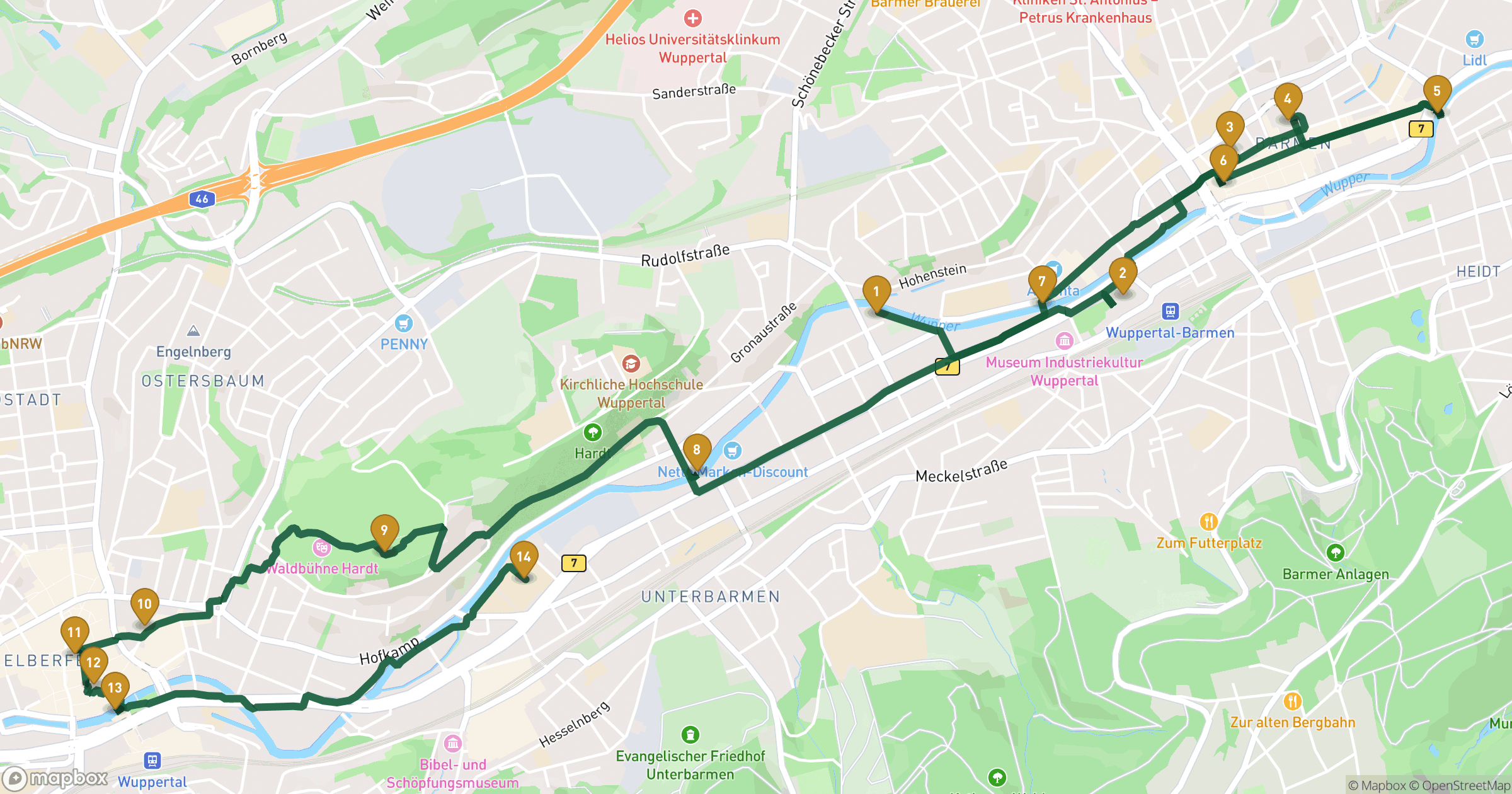
Map for Wuppertal walking tour with 14 stops
The static map shows the tour route with Junior-Uni Wuppertal, Opernhaus, Gemarker Kirche, Rathaus Wuppertal-Barmen, and 10 more stops.

Stops along the route

All stops on this self-guided tour at a glance.

  1. Junior-Uni Wuppertal in Wuppertal
    -wuppertaler / CC BY-SA 4.0

    1Junior-Uni Wuppertal

    This colorful building directly on the Wupper riverbank houses the Junior-Uni, an unconventional youth learning center designed like giant stacked toy bricks. Former press office head Ernst-Andreas Ziegler founded the tuition-free initiative in 2008, funding it almost entirely through private donations. Since its new campus opened in 2013, the concept has spread to Daun.

    Built: 2008 · Wikidata

  2. Opernhaus in Wuppertal
    Atamari / CC BY-SA 3.0

    2OpernhausTheatre

    The Wuppertal Opera House pairs its reconstructed historic exterior with post-war modernist interiors. Originally built in 1905 by architect Carl Moritz, the theater achieved global fame after Pina Bausch took charge of its dance division in 1973. Her daring choreography initially startled local audiences by having dancers speak and perform on stages carpeted with carnations.

    Built: 1907 · Architect: Carl Moritz · Style: Art Nouveau architecture · Wikidata

  3. Gemarker Kirche in Wuppertal
    -wuppertaler / CC BY-SA 4.0

    3Gemarker KircheChurch

    Rebuilt in the 1950s after wartime destruction, Gemarker Church holds global significance as a center of religious resistance to the Nazi regime. In May 1934, representatives of the Confessing Church met here for the Barmen Synod to issue the Barmen Theological Declaration. Swiss theologian Karl Barth drafted the text almost single-handedly in an overnight session while colleagues slept.

    Architect: Helmut Erdle · Style: eclectic architecture · Wikidata

  4. Rathaus Wuppertal-Barmen in Wuppertal
    ZeroTwoZero from London, United Kingdom / CC BY-SA 2.0

    4Rathaus Wuppertal-Barmen

    Barmen City Hall presents a fortress-like stone facade designed to express municipal pride over Johannes-Rau-Platz. Architect Karl Roth designed the monumental complex between 1913 and 1923, which was reconstructed in its striking form following World War II damage. The square honors former German Federal President Johannes Rau, who began his political career inside this building.

    Wikidata

  5. Werther Brücke in Wuppertal
    Qwertzu111111 / CC BY-SA 4.0

    5Werther Brücke

    Werther Brücke is a suspended railway station showcasing delicate Art Nouveau ironwork over the Wupper river. Originally opened in 1903, the station lost much of its ornament before being faithfully reconstructed according to historic plans in the late 1990s. Its curved green steel girders give the structure a floating quality, functioning as a work of art on a modern transit line.

    Wikidata

  6. Alter Markt in Wuppertal
    Der-wuppertaler / CC BY-SA 3.0

    6Alter MarktSquare

    Alter Markt forms the historic geographic heart of Barmen, framed by post-war transit planning and 1960s architecture. A former Kaufhof department store from this redevelopment era defines the western edge, while the suspended railway station literally roofs over the square. Local trams once crossed the cobblestones here until they vanished completely from the city in 1987.

    Wikidata

  7. Adlerbrücke in Wuppertal
    Frank Vincentz / CC BY-SA 3.0

    7AdlerbrückeBridge

    Spanning over 26 meters, Adlerbrücke is one of the oldest surviving lattice girder bridges in the Rhineland. Built in 1868 for 12,000 talers, the wrought-iron structure connects Unterdörnen with Friedrich-Engels-Allee. Its name references cast-iron eagles that stood on the four corner pillars until they were removed early in World War II, presumably melted down for munitions.

    Built: 1868 · Wikidata

  8. Schwebebahn station Völklinger Straße in Wuppertal
    Im Fokus / CC BY-SA 4.0

    8Schwebebahn station Völklinger Straße

    The Völklinger Straße suspension railway station blends historic styling with modern reconstruction along the Wupper. Rebuilt between 2011 and 2012, it follows the original Art Nouveau Barmen design that covers only the platforms rather than using a gabled roof. Together with Landgericht station, this heavily glazed stop remains the last surviving example of this open layout.

    Wikidata

  9. Botanischer Garten Wuppertal in Wuppertal
    Atamari / CC BY-SA 3.0

    9Botanischer Garten WuppertalPark

    Wuppertal Botanical Garden occupies the grounds of the Ellersche Villa on the Hardt hill, roughly 90 meters above the Wupper. Founded in 1890 as a school garden, it relocated to this site in 1910 beside the historic Elisenturm observation tower and an orangery. Glasshouses built for Regionale 2006 now display tropical crops like cocoa and coffee alongside rare cacti.

    Wikidata

  10. Rex-Theater in Wuppertal
    Frank Vincentz / CC BY-SA 3.0

    10Rex-TheaterTheatre

    The Rex-Theater in Elberfeld dates to 1887, when it opened as the Hôtel-Restaurant Im Salamander with a painted glass ceiling that opened outdoors. Over the decades it served as a variety theater and dance hall before conversion in 1937 into a cinema opened with the film Der Mann, der Sherlock Holmes war. Its current facade reflects late 1930s Art Deco architecture.

    Built: 1887 · Wikidata

  11. Von der Heydt Museum in Wuppertal
    Fotograf: Daniel Jünger / CC BY-SA 3.0

    11Von der Heydt Museum

    The Von der Heydt-Museum occupies Elberfeld's former neoclassical town hall, constructed between 1827 and 1842. Named after the local von der Heydt banking family, banker August von der Heydt co-founded the municipal museum association in 1892 to build the civic collection. Many artworks were confiscated as degenerate art under Nazi rule before post-war acquisitions rebuilt it.

    Built: 1902 · Named after: Von der Heydt · Wikidata

  12. Alte reformierte Kirche Elberfeld in Wuppertal
    Ökologix; File:Alte_Reformierte_Kirche_Elberfeld.JPG / CC BY-SA 3.0 de

    12Alte reformierte Kirche ElberfeldChurch

    The Old Reformed Church stands on foundations dating back to 955, marking the historical starting point of Elberfeld. Archaeologists in the 1950s discovered tree-coffin graves here, confirming burials on this ground over a millennium ago. Originally dedicated to Saint Lawrence of Rome, the church's surviving choir dates in its basic structure to rebuilding after a major 1230 fire.

    Named after: Lawrence of Rome · Wikidata

  13. Schwebebahn station Wuppertal Hbf in Wuppertal
    Frank Vincentz / CC BY-SA 3.0

    13Schwebebahn station Wuppertal Hbf

    The Hauptbahnhof suspension railway station forms part of a 1920s ensemble connected directly to the Köbo-Haus over the Wupper. Architect Clemens Julius Mangner and Siemens-Bauunion replaced the 1901 original by Bruno Möhring, whose scaled-down Art Nouveau terminal was mocked as the Elberfeld Bathtub. That nickname came from curved metal sheet walls resembling a wash tub.

    Named after: Wuppertal Central Station · Wikidata

  14. Bergische Universität Wuppertal - Campus Haspel in Wuppertal
    Frank Vincentz / CC BY-SA 3.0

    14Bergische Universität Wuppertal - Campus Haspel

    Campus Haspel of the University of Wuppertal lines the river with historic buildings that originally housed the Royal School of Building Trades. The neoclassical stucco facades now serve the university's faculty of architecture and civil engineering. The name recalls a haspel, a textile reeling device central to the yarn-spinning industry that brought early wealth to Wuppertal.

Download the app

This public page shows a preview. The full route, all content, and navigation are available in CityTour AI.

Cities nearby

Discover self-guided tours in nearby cities.

Frequently asked questions

The key answers before you start.

Is this a self-guided audio tour?

Yes. In the CityTour AI app (iOS and Android), this is a self-guided audio tour for Wuppertal — start anytime, at your own pace, with map, stops, and audio narration.

What will you see on this tour?

On this tour you'll see, among others, Junior-Uni Wuppertal, Opernhaus, Gemarker Kirche, Rathaus Wuppertal-Barmen, Werther Brücke, Alter Markt and more sights.

Where does the tour start?

The route starts at Junior-Uni Wuppertal and ends at Bergische Universität Wuppertal - Campus Haspel. You can start anytime — the app guides you to the first stop.

How long does the tour take?

About 192 minutes for 14 stops — at your own pace, with breaks whenever you like.

How much does the tour cost?

This tour costs 30 credits. The exact price depends on the pack you buy and your country — roughly $10.

Is it an outdoor tour — are entry tickets included?

Yes, it's an outdoor tour: the sights are viewed from the outside. Entry tickets are not included, and step-free access cannot be guaranteed.

Is the audio guide available in my language?

The tour and audio guide are available in English, Deutsch, Français, Español, Italiano and 9 more languages. You pick your language in the app.

Can I use the tour offline?

Yes. Tours can be used offline.

Can I ask the AI questions along the way?

Yes. At every stop you can ask the AI directly if you want to know more or didn't understand something.